Blog

  • Sunday Puzzle: That’s HOT!

    Sunday Puzzle: That’s HOT!

    On-air challenge

    Today’s theme is “hot.” Every answer is a familiar two-word phrase in which the first word starts HO- and the second word starts with T-.

    Ex. Rowdy bar with country music, in slang –> HONKY TONK
    1. Guided walkthrough of a property
    2. Any member of the N.H.L.
    3. Lone Star State metropolis that’s the fourth-largest city in the U.S.
    4. Like an animal with its four legs bound (hyph.)
    5. Instruction manual (hyph.)
    6. A little pompous and arrogant, informally (hyph.)
    7. Punny greeting from a magician
    8. Someone who steals animals from a stable
    9. Congestion that drivers encounter around July 4th, say
    10. Acquisition of a company against its will.
    11. Exclamation for “wow!” on TV’s “Batman”

    Last week’s challenge

    Last week’s challenge comes from Evan Kalish, of Bayside, N.Y. Take the name of a nocturnal creature, in two words. The first word is a spooky sound. Move the last letter of the first word to the start of the second word and you’ll get another spooky, nocturnal sound. What is the creature and what are the sounds?

    Answer: Screech owl –> howl

    Winner

    Dan Sadoff of St. Paul, Minnesota

    This week’s challenge

    This week’s challenge comes from Rawson Sheinberg. of Plymouth, Mich. Think of a U.S. city with a two-word name. Add a letter to the first word, without rearranging letters, to name a country. Then, without adding a letter, rearrange the letters of the second word to name another country. What places are these?

    If you know the answer to the challenge, submit it here by Thursday, July 2 at 3 p.m. ET. Listeners whose answers are selected win a chance to play the on-air puzzle. Important: include a phone number where we can reach you.

    Transcript:

    AYESHA RASCOE, HOST:

    Time to play the Puzzle.

    (SOUNDBITE OF STEFAN SCAGGIARI & NED WHARTON’S “PUZZLEMASH THEME”)

    RASCOE: Joining us is Will Shortz. He’s puzzle editor of The New York Times and puzzlemaster of WEEKEND EDITION. How’s it going, Will?

    WILL SHORTZ: I’m doing great. How are you, Ayesha?

    RASCOE: I am good. Will, please remind us of last week’s challenge.

    SHORTZ: Yes, it came from Evan Kalish of Bayside, New York. I said take the name of a nocturnal creature in two words. The first word is a spooky sound. Move the last letter of the first word to the start of the second word, and you’ll get another nocturnal, spooky sound. What’s the creature, and what are the sounds? Well, the creature is a screech owl. Of course, it makes a screech at night. Move the H of screech to the start of owl, and you get howl.

    RASCOE: OK. Well, a lot of y’all got this. There were more than 1,700 correct entries this week, and our lucky winner is Dan Sadoff of St. Paul, Minnesota. Congratulations, Dan.

    DAN SADOFF: Oh, well, thank you.

    RASCOE: How did you figure out this week’s answer? Now that I’ve heard the answer, it sounds obvious.

    SADOFF: It actually did not take long, and it may have been helped by the fact that we have a lot of nocturnal creatures in our neighborhood. Owl and howl came to me pretty quickly.

    RASCOE: OK. How long have you been playing the Puzzle?

    SADOFF: I date back to the postcard era.

    RASCOE: But this is your first time winning?

    SADOFF: Oh, yes.

    RASCOE: (Laughter) OK. What do you do for fun?

    SADOFF: Well, recording audiobooks.

    RASCOE: Oh.

    SADOFF: And certainly, in Minnesota, enjoying the outdoors this time of year.

    RASCOE: Oh. Well, that is wonderful. Well, I have to ask you, are you ready to play the Puzzle? But it sounds like you’re ready.

    SADOFF: Oh, I hope I am.

    RASCOE: (Laughter) Take it away, Will.

    SHORTZ: All right, Dan, and Ayesha. Today’s puzzle is hot. Every answer is a familiar two-word phrase in which the first word starts H-O and the second word starts with T. For example, if I said a rowdy bar with country music in slang, you would say honky-tonk. Here’s No. 1 – a guided walkthrough of a property.

    SADOFF: House tour.

    SHORTZ: That’s it. Any member of the NHL.

    SADOFF: Hockey…

    SHORTZ: Yeah. Not the player itself, but who would be a member of the NHL.

    SADOFF: Oh, hockey team.

    SHORTZ: Hockey team is it. How about Lone Star State, metropolis, that’s the fourth largest city in the U.S.?

    SADOFF: Houston, Texas.

    SHORTZ: That’s it. Like an animal with its four legs bound.

    SADOFF: Hog-tied.

    SHORTZ: That’s it. An instruction manual.

    SADOFF: How-to.

    SHORTZ: That’s it. A little pompous and arrogant.

    SADOFF: Hoity-toity.

    SHORTZ: That’s it. Here’s a tough one. A punny greeting from a magician.

    SADOFF: Oh. How’s tricks?

    SHORTZ: Good job. I’m impressed. Someone who steals animals from a stable.

    SADOFF: Oh, dear. Horse thief.

    SHORTZ: That’s it. Congestion that drivers encounter around July Fourth.

    SADOFF: Holiday traffic.

    SHORTZ: That’s it. Acquisition of a company against its will.

    SADOFF: Hostile takeover.

    SHORTZ: Right. And here’s your last one. An exclamation for wow on TV’s “Batman.”

    SADOFF: Holy almost anything. Holy Toledo?

    SHORTZ: Holy Toledo is it. Good job – 100%.

    RASCOE: Yeah. I told you. I knew you were going to take it away with this one (laughter). But you did a wonderful job. How do you feel?

    SADOFF: Oh, I feel puzzlerific.

    RASCOE: (Laughter) Puzzlerific. I love – that’s a first. I like that.

    SHORTZ: That’s a new one.

    RASCOE: (Laughter) For playing our Puzzle today, you’ll get a WEEKEND EDITION lapel pin, as well as puzzle books and games. You can read all about it at npr.org/puzzle. And, Dan, what member station do you listen to?

    SADOFF: KNOW-FM, which is part of Minnesota Public Radio, and it is the news and information station.

    RASCOE: That’s Dan Sadoff of St. Paul, Minnesota. Thank you so much for playing the Puzzle.

    SADOFF: Thank you, Ayesha, and great to hear from you, Will.

    SHORTZ: Thanks a lot.

    RASCOE: All right, Will, what’s next week’s challenge?

    SHORTZ: Yes, it comes from a Rawson Sheinberg of Plymouth, Michigan. Think of a U.S. city with a two-word name. Add a letter to the first word without rearranging letters to name a country. Then, without adding a letter, rearrange the letters of the second word to name another country. What places are these? So, again, a U.S. city with a two-word name, add a letter to the first word to get the name of a country, and then, without adding a letter, rearrange the letters of the second word to name another country. What places are these?

    RASCOE: Dan, do you already know the answer to next week’s challenge?

    SADOFF: (Laughter) I’m going to have to think a little longer about it, but it won’t stop me from entering.

    RASCOE: Well, then you and everyone else, when you have the answer, go to our website npr.org/puzzle to submit your response. Just fill out the form on the Puzzle page. Remember, just one entry, please. Our deadline for entries this week is Thursday, July 2, at 3 p.m. Eastern. Don’t forget to include a phone number where we can reach you. If you’re the winner, we’ll give you a call. And if you pick up the phone, you’ll get to play on the air with the puzzle editor of The New York Times and puzzlemaster of WEEKEND EDITION, Will Shortz. Thank you, Will.

    SHORTZ: Thanks a lot, Ayesha.

    (SOUNDBITE OF STEFAN SCAGGIARI & NED WHARTON’S “PUZZLEMASH THEME”)

  • Win the family cookout with perfectly cooked hot dogs

    Win the family cookout with perfectly cooked hot dogs

    Preparing a hot dog is simple enough. But what is the best way to cook this summertime staple? Chef Kenji López-Alt, the James Beard Award winner and cookbook author, has some advice.

    It all starts in the supermarket.

    “Look for a hot dog that has a natural casing,” he said. Natural casings are made of lamb skins and give hot dogs a bit of a curve, while the hot dogs without casing pack flat into the package.

    “That’s what’s going to give you the snap no matter how you cook it,” López-Alt said.

    As far as how to cook a hot dog, there are about as many opinions as there are home cooks. Boil them in water? Roast them over a fire with a stick? We investigated a few methods for cooking hot dogs just right.

    A quick fix for when you need a hot dog NOW 

    The best flavor emerges with time, according to Kenji López-Alt. “Low and slow is always a good idea with any kind of sausages,” he said.

    Ayesha Rascoe, however, confessed to cooking “hot and fast. And burnt.”

    As fast as a microwave might be, it did not exactly win in our testing. We wrapped the hot dog in a paper towel and cooked it for 45 seconds. But it was a mess. The skin split, the ends were shriveled, and the texture was limp.

    While not his preferred method, López-Alt conceded that microwaves have their place in any kitchen with kids.

    “I’ve cooked plenty of hot dogs in the microwave,” he said. “I’ve had to get food on the table as quickly as possible.”

    Our tests found that an air fryer, on the other hand, cooked a hot dog nearly as quickly, and produced a snappier skin and much better flavor.

    “An air fryer has a very strong convection fan that’s pulling away excess moisture,” López-Alt explained.

    Our air fryer hot dog looked crispy and the color seemed right. But structurally, it came out a little misshapen.

    Online chefs suggested cutting the skin to give the hot dog more surface area. It worked for our Ballpark beef franks, but López-Alt forbade that kind of hack for hot dogs with natural casings.

    Slow and steady, and a little off-color? 

    The slowest method we tested for a hot dog was not so different from what they’re doing at gas stations: a little heat for hours on end.

    López-Alt shared a recipe from a Kentucky friend who puts cocktail weenies in a slow cooker with a cup of ketchup, a cup of brown sugar, and a cup of bourbon before a party. The flavor is rich. But the color of slow cooker hot dogs can be a little off-putting.

    We put hot dogs in a slow cooker without any water for two hours on low heat.

    “It looks kind of dead,” Rascoe said, as though everything good had been cooked right out of it.

    After a bite, however, Rascoe changed her mind. “Looks can be deceiving,” she said.

    With its wan color and swollen skin, “I would have been like, it’s NASTY!” she said. But, the slow cooker brought out the hot dog’s deep, meaty flavor.

    It’s an easy way to have cooked hot dogs on hand for as long as the party lasts. A few dozen could sit in the slow cooker for hours.

    Sometimes a classic is classic for a reason

    A hot grill was also a winner in our testing. We put a little Weber grill on a balcony at NPR headquarters and roasted the dogs away from the coals for a minute and a half to warm them up. Then, we put them right over the coals until they were sweating and crisp. The skin had beautiful grill marks and a perfect color.

    “It’s not as salty off the grill,” Rascoe concluded, although as a daughter of North Carolina, she yearned for mustard, coleslaw, onions and chili to eat with it.

    López-Alt, a New Yorker, prefers sauerkraut and spicy mustard.

    As a chef, López-Alt is attuned to the regional preferences in hot dog toppings. Since he’s been in Seattle, he’s seen hot dogs topped with warm cream cheese, jalapenos, and grilled onions. Sounds suspicious, but, “if you get it right, with the right person, they’re an interesting variation,” he said.

    Whether it’s relish, ketchup, or cream cheese, and whether it’s the air fryer, the grill, or the slow cooker, we hope your holiday is delicious.

    Transcript:

    AYESHA RASCOE, HOST:

    It’s a big holiday this week with plenty of reasons to fire up the grill. And I, for one, intend to eat the most delicious hot dogs. Here to help me with this goal is Kenji Lopez-Alt, the cookbook author and chef extraordinaire. Hi, Kenji.

    KENJI LOPEZ-ALT: How you doing?

    RASCOE: I’m doing all right. I got all these hot dogs here with me, so I’m doing well (laughter). But I got to ask you, there are so many ways to cook a hot dog – you can boil them in water, you can, you know, use a stick and roast them over a fire. Kenji, what is your favorite way to make a hot dog?

    LOPEZ-ALT: For me, the first thing – the most important part is getting the right hot dog, you know? So I always look for a hot dog that has a natural casing, you know? ‘Cause that’s what’s going to give you the snap, no matter how you cook it.

    RASCOE: OK. What’s the natural casing? Now, what’s that?

    LOPEZ-ALT: So if you’re looking at a package of hot dogs in the supermarket, and they are perfectly straight, they were made inside, like, a plastic tube, and then the plastic was peeled off. And so they don’t have a skin on them, which means that, essentially, you know, they’re just the same consistency all the way, edge to center. Whereas, if your hot dog has, like, a little bit of a curve in it, it’s been put into a lamb casing, you know? So hot dogs that are made out of lamb casings, and that’s what’s going to give you sort of the snap when you bite into it, however you cook it.

    RASCOE: OK.

    LOPEZ-ALT: But, you know, whatever you’re going to do, I think, sort of low and slow is always a good idea with any kind of sausages, whether it’s a hot dog or not.

    RASCOE: That’s totally the opposite of the way I make my hot dogs – hot and fast and burnt.

    (LAUGHTER)

    LOPEZ-ALT: That’s a personal choice, you know?

    RASCOE: I’m sure your favorite way to cook a hot dog is not the microwave.

    LOPEZ-ALT: I’ve cooked plenty of hot dogs in the – you know, I got two kids. I’ve had to, like, get food on the table as quick as possible. I’ve cooked plenty of hot dogs in the microwave (laughter).

    RASCOE: OK. OK. So we have a hot dog cooked in the microwave first. It was wrapped in a paper towel and microwaved for one minute.

    LOPEZ-ALT: OK.

    RASCOE: Let me taste it. I’m tasting it without the mustard. (Mouth full) I would give this a 4 out of 10. Four out of 10.

    LOPEZ-ALT: OK. That’s pretty harsh, but all right.

    RASCOE: And so let’s see. So for the next hot dog, they did the slow cooker. Now, this one I’m worried about because (laughter)…

    LOPEZ-ALT: Yeah. I wouldn’t put a hot dog in a slow cooker. That’s…

    RASCOE: (Laughter) Yeah. Just – ’cause you – so you just throw the whole bag in there, no water. Let them sit as long as you want. It’s been in the slow cooker for two hours. Now, this one – it looks different from the other hot dogs. It looks kind of almost dead.

    LOPEZ-ALT: Like, everything good has been cooked out of it.

    RASCOE: Let me see. (Mouth full) That’s not bad. It’s a hot dog.

    LOPEZ-ALT: Not bad.

    RASCOE: (Mouth full) I’m surprised. I think it maybe tastes a little better than the microwave one.

    LOPEZ-ALT: OK.

    RASCOE: Now, I got to ask you, Kenji, if you’re making a perfect plate, what do you serve with your hot dog?

    LOPEZ-ALT: If I’m doing them on the grill, what I actually like to do is I’ll get, like, a little disposable aluminum pan, you know? And in that pan, I’ll put my toppings. So I like sauerkraut and mustard. So I’ll put the sauerkraut in the pan and then kind of nestle the hot dogs in there, and then put that whole thing over kind of, like, the cooler side of the grill and then let them kind of really slowly heat through. So it’s essentially, like, simmer it in your toppings, and then sear it on the grill to get some grill marks on there to get a little more flavor on them.

    RASCOE: OK. So for my hot dogs, I’m from North Carolina.

    LOPEZ-ALT: Yeah.

    RASCOE: So in North Carolina, we eat our hot dogs with mustard, chili and coleslaw and maybe onions.

    LOPEZ-ALT: You know what they do here in Seattle?

    RASCOE: What?

    LOPEZ-ALT: Cream cheese.

    RASCOE: Oh, no.

    LOPEZ-ALT: Cream cheese with grilled onions and, like, jalapenos and mustard. They got, like, an open flame, and they use these kind of bigger buns that they get really nice and charred. And then the cream cheese is kind of soft already. So it kind of just, like, melts into the bun, you know?

    RASCOE: Really? OK. No disrespect…

    LOPEZ-ALT: And…

    RASCOE: …To the people that love this, but that does not sound (laughter)…

    LOPEZ-ALT: Yeah. They’re an interesting regional hot dog variation.

    RASCOE: Now – OK. So the slow cooker was not that bad. I would give it a 6 out of 10. It was actually…

    LOPEZ-ALT: OK.

    RASCOE: It was surprisingly good. OK. Now, people are really into air fryers, and I am an air fryer person too. The air fryer makes crispy skin with a juicy dog. Let’s see how the air-fried dog comes out. These dogs were cooked at 400 for five minutes. Got a little char on it. OK. So let me see. (Mouth full) This a good hot dog (laughter). You got the flavor. You got the flavor in this, and it’s a little crunchy. This is good. This is a good hot dog.

    LOPEZ-ALT: Yeah. Well, that makes sense ’cause, like, an air fryer, you know, it’s like a – got a very strong convection fan. It’s really good at – so as your hot dog kind of cooks, it’s pulling away some excess moisture, so you end up with, like, a kind of more concentrated – it’s probably saltier and a little more flavorful.

    RASCOE: Eight out of 10 stars. Eight of 10. OK. So now we have the fourth and final one, which is on a hot grill. We put a little Weber grill on one of the balconies here at NPR headquarters and roasted the dogs away from the coals for a minute and a half to warm them up, and then put them right over the coals for another couple of minutes, until they were sweating and crisp. OK. So let me get this. But I want to get a little – I want to make sure I get some of the char. OK. (Mouth full) OK.

    LOPEZ-ALT: Oh, boy. That sounds good.

    RASCOE: It’s good, but not as good as the air fryer.

    LOPEZ-ALT: OK. OK. That’s a shock.

    RASCOE: I’ll give it a seven, a seven. The air fryer is the winner on this one. Although I think this is good because it’s not as salty off the grill. This would be good with the chili and the coleslaw on it.

    LOPEZ-ALT: Well, I’ll come by this summer then.

    RASCOE: You got to come by this summer. I’ll hook you up. It’ll be good (laughter).

    LOPEZ-ALT: Sounds great.

    RASCOE: That’s Kenji Lopez-Alt, chef and cookbook author. He joined me from Seattle. Thanks, Kenji, and happy grilling this weekend.

    LOPEZ-ALT: Same to you.

  • Will the new student loan limits actually drive down tuition? Economists weigh in

    For the past two decades, graduate students have been able to take out an unlimited amount of federal student loans to cover the full cost of their education.

    If they needed $60,000 a year, they could borrow $60,000 a year, year after year.

    The Trump administration has a plan to change that by capping graduate school loans for many students at $20,500 a year, and $100,000 overall — effective July 1. (A federal court temporarily blocked a small piece of that plan, but the U.S. Education Department confirmed to NPR that loan limits will indeed begin July 1.)

    In a year packed with changes to higher education policy, this new loan limit is one of the biggest, and one of the most controversial.

    U.S. Secretary of Education Linda McMahon says the endgame is to force colleges to slash their tuition prices.

    “College costs are just exorbitant. Students are burdened with debt…” McMahon told the House education committee in May. “We really have to do something to bring down the cost of college.”

    With that goal in mind, Republicans used last year’s One Big Beautiful Bill Act to scuttle the program known as Grad PLUS and limit graduate loans. The thinking goes: Borrowers will choose cheaper programs, and expensive schools will have to cut prices to compete.

    But many economists aren’t so sure it will do what Republicans say it will.

    A decades-old idea

    The idea that there’s a connection between federal student loans and what colleges charge dates back almost four decades, to Feb. 18, 1987.

    That’s the day then-Education Secretary William Bennett, under President Ronald Reagan, penned a scathing opinion piece for The New York Times, titled “Our Greedy Colleges.”

    In it, Bennett excoriated schools for tuition increases that outpaced inflation, and he argued that increases in federal student aid “have enabled colleges and universities blithely to raise their tuitions, confident that Federal loan subsidies would help cushion the increase.”

    His idea took hold, and economists have dubbed it “The Bennett Hypothesis.”

    “The Bennett Hypothesis essentially says that, if you provide greater federal aid to schools, they will respond by increasing the price,” says Phillip Levine, a professor of economics at Wellesley College.

    Almost 40 years later, Republicans are dusting off the Bennett Hypothesis to justify severe limits to student borrowing.

    Graduate school is fueling the explosive growth of student debt 

    To be clear, current limits on undergraduate loans aren’t budging – and haven’t budged in years. One reason: According to Levine, the net price for undergraduate programs – what families actually pay – has been pretty stagnant lately.

    “We’ve seen at the undergraduate level for at least the last five years or so that college costs have actually been fairly flat,” says Preston Cooper, who studies higher education policy at the conservative-leaning American Enterprise Institute (AEI).

    But the cost of graduate school has increased considerably.

    “We’re at a point where almost half of the borrowing right now is among graduate students, despite them being a much smaller share of the overall population,” says Robert Kelchen, a professor of higher education at the University of Tennessee, Knoxville.

    Which brings us to Grad PLUS, which the Trump administration plans to shut down on July 1.

    For two decades, Grad PLUS has worked as an add-on to the traditional loan program, allowing graduate students to effectively borrow as much as they needed – no limits or guardrails.

    Cooper says it’s not a stretch to think Grad PLUS helped fuel a rise in graduate school costs.

    “Up to this time, it has been a very easy answer [for schools] to basically increase revenues a little bit every year by just raising the cost of graduate school tuition because they know that the federal government is going to have to give their students a loan for those extra costs.” 

    What the research shows

    “Having essentially uncapped loans, I think, is not a great policy,” says Jeff Denning, an economist and professor at the University of Texas at Austin.

    Denning was part of a team of researchers who studied the Grad PLUS program – to put the Bennett Hypothesis to the test. They wanted to know if, in Texas, the suddenly limitless font of Grad PLUS loans that began in 2006 contributed to graduate programs hiking their prices.

    The short answer: Yes.

    The researchers wrote that, for every additional dollar students received in loans, graduate schools increased their prices by $0.64 (after accounting for grants they gave out).

    Republicans often cite Denning’s work as justification for ending Grad PLUS, arguing: If schools increased their prices nearly as much as federal aid increased, why wouldn’t the opposite be true? Less aid should lead to lower prices.

    But it’s not that simple, says the University of Tennessee’s Kelchen, who has also researched the impact of Grad PLUS, specifically on business, medical and law schools.

    “I did not find evidence” of a direct connection between federal aid and prices, Kelchen says.

    Even Denning, when asked if the Bennett Hypothesis is true, says “it depends. I think there’s some evidence that this happens in certain circumstances, and there’s evidence that it doesn’t.”

    The Bennett Hypothesis is “a logical conclusion,” according to Kelchen, “if you think that these graduate programs are massive profit centers.” Some are, he says. Some aren’t.

    Medical school, for example, “is wildly unprofitable” for schools, Kelchen says. “It can take a million dollars of resources to produce one medical degree. So limiting borrowing is not going to reduce that cost.”

    Overall, he adds, evidence backing the Bennett Hypothesis “is largely mixed.”

    Levine says much of the increase in the cost of higher education over the years is attributable to a phenomenon known as “cost disease.” What’s that?

    Well, over time, most businesses tend to become more efficient, Levine says, which helps them contain costs while boosting wages. But higher education doesn’t work that way.

    “Since wages rise elsewhere, colleges need to keep pace to attract workers who could work elsewhere. In the end, costs rise to produce exactly the same product.”

    The half-dozen economists and higher education experts NPR spoke with did agree on one thing: Whatever its impact on prices, the Grad PLUS program, as a policy, was flawed.

    “I think there was broad consensus that the idea of letting graduate students borrow basically infinite amounts of money was not a good idea,” says Sandy Baum, a senior fellow at the Urban Institute, a nonpartisan think tank.

    But, of the Bennett Hypothesis, Baum is skeptical: “There’s been lots of study of what causes increases in college prices and of the effects of increases in student aid. And most of them find that in some cases… in particular for-profit institutions, it’s true. But mostly it’s not true.”

    Instead, Baum argues, price hikes have been driven by a host of factors, from “cost disease” and student loans, to the rising costs of insurance, technology – even the cost of living.

    Will ending Grad PLUS force colleges to cut prices?

    So what should we make of Republicans’ current contention, that cutting student loans for graduate students will lead to lower prices?

    AEI’s Cooper agrees with ending Grad PLUS, but doesn’t expect an immediate drop in prices.

    “I don’t want to promise that, in the first year, everybody’s going to slash their costs, and, you know, it’s gonna be great,” Cooper says. “But I do think that this is going to create some pressure [on prices] over time.”

    Kelchen at the University of Tennessee is keeping his expectations low.

    “I expect to see, at most, a small decrease in tuition as students may become a bit more price-sensitive and shop institutions a little bit more,” Kelchen says.

    Levine, at Wellesley, says dramatic price cuts are unlikely: “Is it conceivable that it could contribute to some small change in graduate student pricing? Maybe. … Colleges don’t just make up their prices. Colleges have costs, and it has to be the case that the revenue that they generate covers their costs.”

    Even Denning, whose research found the clearest evidence of a connection between federal loans and college prices, says of these new loan limits potentially driving price cuts: “It certainly is possible. I’m not sure if it will happen. I do not have a crystal ball. I wish I did.”

    Denning points out that it’s hard to predict student behavior. The dramatic cut in federal loans could shift students to cheaper programs. It could also send them scrambling into the private loan market. After all, he says, while the new loan limits are roughly the same as they were in 2006, before Grad PLUS, they’re actually “much lower” because they don’t account for two decades of inflation.

    “We needed loan limits,” says Baum at the Urban Institute, “but these limits are extreme.”

    As for the effect they could have on college prices, Baum predicts, “It’s not like prices are gonna plummet. They might rise more slowly.”

    And she worries the limits are going into effect so suddenly that they could put graduate school out of reach for some low-income students – a concern shared by Dominique Baker, an associate professor of education and public policy at the University of Delaware.

    “We have really robust evidence on what happens when we reduce access to financial aid,” Baker says, “and that is that students stop enrolling.” Especially lower-income students who may not have the kind of credit history to qualify for a private student loan.

    Recent analyses suggest these new limits will affect roughly 30% of graduate borrowers.

    In her testimony before lawmakers, Education Secretary McMahon repeatedly said that some graduate schools have already lowered their prices ahead of the big change.

    NPR followed-up with the Education Department to get a list of those programs, some of which are offering discounts through new scholarships. They include:

    Borrowers likely hope this short list gets longer – and fast.

    Digital story edited by: Nicole Cohen
    Audio story edited by: Alex Goldmark and Nicole Cohen

    Transcript:

    LEILA FADEL, HOST:

    The Trump administration has a plan to lower the cost of graduate school, limit how much graduate students can borrow. This is scheduled to take effect this week on July 1. NPR’s Cory Turner and Planet Money took a look at the economic theory behind the plan.

    CORY TURNER, BYLINE: Education Secretary Linda McMahon recently argued to lawmakers that the way to make graduate school cheaper is by loaning students less money to pay for it.

    (SOUNDBITE OF ARCHIVED RECORDING)

    LINDA MCMAHON: There’s been no other measure that’s been taken to try to bring down the cost of education.

    TURNER: And so the Grad PLUS loan program is ending. It allowed students to borrow unlimited amounts, which McMahon says, led graduate schools to raise their prices.

    MCMAHON: A student could go to a university, and whatever that university said was the cost of the graduate program, that’s how much you could borrow.

    TURNER: Now loans for graduate students will be capped at $20,500 a year. McMahon’s argument dates back to Ronald Reagan, specifically to his Linda McMahon, Reagan’s education secretary, William Bennett. It’s come to be known as the Bennett hypothesis. Dominique Baker studies education at the University of Delaware.

    DOMINIQUE BAKER: The Bennett hypothesis suggests that when the federal government expands access to student loans, the college and universities increase the prices of programs in order to capture more of that public money.

    TURNER: In 1987, Bennett wrote an op-ed for The New York Times titled “Our Greedy Colleges,” and in it, he wrote that increases in federal student aid enabled schools to, quote, “blithely raise their tuitions.” I called a researcher who’s actually put this hypothesis to the test.

    JEFF DENNING: I’m Jeff Denning. I’m an economist and a professor at the University of Texas at Austin.

    TURNER: We call it a hypothesis. So is it true?

    DENNING: Classic economist answer – it depends. I think there’s some evidence this happens in certain circumstances and there’s some evidence that it doesn’t.

    TURNER: Denning studied what happened in Texas at the start of the Grad PLUS loan program that let students borrow as much as they want. He wanted to see if that big switch back then to unlimited borrowing triggered a spike in the price of grad school.

    DENNING: And the short answer is that we found that the price did go up.

    TURNER: For every additional dollar in federal student aid, Texas schools raise their prices by 64 cents. That sounds like pretty strong evidence in favor of the Bennett hypothesis. But another researcher looked at it in a slightly different way and…

    ROBERT KELCHEN: I did not find evidence.

    TURNER: Robert Kelchen at the University of Tennessee studied prices nationally for business, medical and law schools. His research found little connection between federal aid and prices.

    KELCHEN: And that’s broadly consistent with the body of research that is largely mixed.

    TURNER: So the Bennett hypothesis is sometimes right, sometimes not, sort of, but the U.S. government is about to cap graduate student loans broadly on the assumption that the Bennett hypothesis is broadly right.

    KELCHEN: I expect to see, at most, a small decrease in tuition, but there will be nowhere near a one-to-one relationship.

    TURNER: And Jeff Denning at UT Austin, does he think schools will lower their prices?

    DENNING: It certainly is possible. I’m not sure if it will happen. You know, I don’t have a crystal ball. I wish I did.

    TURNER: The Education Department tells NPR a handful of graduate programs have already responded to the news by lowering costs. Borrowers no doubt hope that short list gets a lot longer and fast.

    Cory Turner, NPR News.

    FADEL: You can hear Cory’s full story on tuition prices and what drives them in the Planet Money podcast feed.

    (SOUNDBITE OF GIRAFFES? GIRAFFES!’ “A QUICK ONE, WHILE SHE’S AWAY”)

  • The secret life of a stolen Van Gogh

    The secret life of a stolen Van Gogh

    What happens to famous works of art when they are stolen from museums and private art collections? In the Netherlands, museums and collectors reach out to Arthur Brand, a self-styled art detective who works to track down art that has gone missing and fallen into the criminal underworld.

    This week on The Sunday Story, when a famous Van Gogh painting is stolen from a museum, Brand teams up with an unlikely partner – art thief Octave Durham. Together, the pair work to rescue a masterpiece from the underground market and return it to its museum home.


    This episode was produced by Andrew Mambo and edited by Jenny Schmidt. It was engineered by Kwesi Lee. Production help from Ben Rappaport and Sena Loffredo. Fact Checking by Jane Gilvin. 

    We’d love to hear from you. Send us an email at TheSundayStory@npr.org.

    Listen to Up First on Apple Podcasts and Spotify.

    Transcript:

    AYESHA RASCOE, HOST:

    I’m Ayesha Rascoe, and this is The Sunday Story from UP FIRST. Late one morning in September 2023, the famous Dutch art detective, Arthur Brand, was pacing around his Amsterdam apartment, waiting for a special delivery.

    ARTHUR BRAND: And then at 12 o’clock, the doorbell rang.

    RASCOE: Brand looked out the window, and on the stoop, he saw a man who he’d been expecting holding an iconic big blue bag.

    BRAND: So I opened the door and he was standing there with an Ikea bag.

    RASCOE: Now, what Brand was expecting inside that Ikea bag was a painting. Not just any painting, but a Vincent van Gogh that had been stolen from a Dutch museum. But when he peeked into the bag…

    BRAND: The only thing I saw was a pillow full of blood.

    RASCOE: A pillow full of blood. Today on the show, a story about an art detective, the criminal underworld, and what it took to solve one of the greatest art heists in recent history. We’ll be right back.

    (SOUNDBITE OF MUSIC)

    RASCOE: We’re back with The Sunday Story. I’m Ayesha Rascoe. And today, I’m joined by NPR contributor Rebecca Rosman, who has a stranger-than-fiction story about an art detective and his very unlikely partner, and how together they solved one of the greatest art heists in recent history. Rebecca, welcome to The Sunday Story.

    REBECCA ROSMAN, BYLINE: Hi, Ayesha. Thanks for having me.

    RASCOE: So, Rebecca, you cover a lot of art and culture stories from your home in Paris. And, you know, Paris sounds lovely. And (laughter) I bet…

    ROSMAN: It is.

    RASCOE: …It’s a pretty lovely city. But when I think about art in Paris, of course, I think of the dramatic events at the Louvre last year.

    ROSMAN: Oh, yes. And I covered it when it happened last October.

    (SOUNDBITE OF ARCHIVED NPR CONTENT)

    STEVE INSKEEP: The thieves who broke into the Louvre over the weekend did not make off with the Mona Lisa, but the theft of jewels, described as priceless from the museum collection, was bad enough. Rebecca Rosman has more from Paris.

    ROSMAN: Let’s start with some numbers – four masked robbers, nine precious jewels, seven minutes. That’s how long it took to pull off the heist.

    I mean, it was like a scene from the Ocean’s 11 film, except it was real life. A daylight robbery at one of the world’s most famous museums. The police did eventually catch all the thieves, by the way, but it took weeks.

    RASCOE: And remind me, like, what happened to the stolen jewels?

    ROSMAN: Yeah. Over $100 million worth of precious jewels just gone. Experts think the thieves likely disassembled the pieces, sold the jewels and melted the gold and other precious metals for parts before they got caught.

    RASCOE: That’s a huge loss. Is it just me or does it seem like there has been, like, an increase in these museum heists? I feel like we keep hearing about these kind of bold escapades, and you got to call it that because these are, like, art heists. So it’s like, you know, they’re just not normal break-ins, or it doesn’t feel that way.

    ROSMAN: No, you’re absolutely right. You know, I felt the same way. But, you know, I wondered, is this just a case of a few recent hits that have just been so unforgettable that it’s created this sort of illusion of a wider trend, or is there actually an increase? So I did some research, and what I can say is that I counted over a dozen major museum hits since January 2025 alone. And late last year, the International Council of Museums teamed up with Interpol to respond.

    RASCOE: So there is something happening here. Like, there – like, museum heists are trending, so to speak.

    ROSMAN: Yeah, I would say they are trending. You know, it seems so. And when priceless objects are stolen and disappear into the underworld, you know, there’s very few people who know how to go and find them. But Dutch art detective Arthur Brand is one of them, and I went to visit him.

    Hello.

    BRAND: It’s freezing, isn’t it?

    ROSMAN: It’s freezing.

    So in February, I hopped on a train to Amsterdam, where I met with Brand at his apartment. And, Ayesha, I have so much I want to tell you about this experience, which I think can help shed some light on these recent heists.

    RASCOE: Well, and I have a lot of questions, right? Like, what is an art detective?

    ROSMAN: Great question, indeed.

    BRAND: An art detective – that’s somebody who helps the police track stolen art or forgeries. And it’s not a real job.

    ROSMAN: So just to explain what Brand means when he says that. You know, he’s saying you can’t go to university and say, I want to become an art detective. Brand actually studied a bunch of different things, but as it turned out…

    BRAND: I was not that interested in, let’s say, Spanish poetry from the 17th century.

    RASCOE: So then how did he do it? How did he become an art detective?

    ROSMAN: Well, Brand was like a lot of college students. He studied a lot of things – history, languages, poetry. And he was also really interested in art. But for the longest time, he couldn’t find a way to turn any of these things into a real job. Then he ends up getting a gig apprenticing with this art dealer who introduced him to a shadowy ecosystem of smugglers, thieves and forgers. Eventually, Brand found his niche. He started advising art buyers.

    BRAND: They call me and says, Arthur, we want to buy Picasso. Has it been stolen? What’s the price? Is it authentic or a forgery?

    ROSMAN: He says that consultation work takes up about half his time, but his real passion is the other half of his time, which is spent on mostly pro bono work, helping recover stolen paintings and other artifacts. Brand told me what kind of sealed his reputation is his integrity.

    BRAND: I thought the only thing I have to do is to be honest. Just be honest. You know, in a world of people who betray each other, who backstab each other, if you’re honest, you have value, you know?

    ROSMAN: Soon, he was recovering missing art. And over his 20-year career, Brand says he’s helped recover more than 150 artifacts. That includes a Picasso he tracked down for a sheikh, a gold ring that belonged to Oscar Wilde and a Salvador Dali painting. His reputation has grown to the point where he is now a trusted household name in the Netherlands, and he even has his own documentary TV show…

    (SOUNDBITE OF DOCUMENTARY, “ARTHUR BRAND: ART DETECTIVE”)

    BRAND: (Speaking Dutch).

    ROSMAN: …Called The Art Detective.

    (SOUNDBITE OF DOCUMENTARY, “ARTHUR BRAND: ART DETECTIVE”)

    BRAND: (Speaking Dutch).

    RASCOE: Oh. I mean, so then he’s kind of a star in certain places.

    ROSMAN: He is. Then, Ayesha, in March 2020, Brand got a call from the police. He didn’t know it yet, but this would become one of the biggest cases of his career. A Van Gogh had been stolen from the Singer Laren Museum, just outside of Amsterdam. The painting is called “The Parsonage Garden At Nuenen In Spring.” But Brand quickly realized this wasn’t a case he was going to be able to solve alone. He needed someone who already had experience with stolen Van Goghs.

    OCTAVE DURHAM: My name is Octave Durham. I live in Amsterdam, the Netherlands. I’m 53 years old. I’m known for robbing the Van Gogh Museum in 2002. I stole two paintings.

    ROSMAN: Just as Brand is the Netherlands most famous art detective, Octave or Okkie Durham is perhaps the country’s most famous art thief.

    RASCOE: When we come back, Octave Durham and why Arthur Brand needed him to solve the case of the missing Van Gogh.

    We’re back with The Sunday Story and NPR’s Rebecca Rosman. We’ve heard from art detective Arthur Brand, a kind of folk hero in the Netherlands, for his ability to track missing masterpieces. But when another Van Gogh is stolen from the Singer Laren Museum near Amsterdam, Brand knows he needs help. The man he turns to is an unlikely choice – art robber Octave Durham.

    DURHAM: I mean, 15 big heists in the Netherlands. I’m involved with eight, at least.

    RASCOE: OK. So he seemed a little proud of that, too, Rebecca. He’s basically saying that he’s a career art thief.

    ROSMAN: That’s right. Beyond art, Durham has also admitted to and spent time in prison for other crimes like bank robberies and financial fraud. I have to say, Durham is fascinating. When we met in Amsterdam in February, he was wearing a black baseball cap and these designer-looking sneakers, looking as calm, cool, and collected as you’d probably expect. He says he grew up in a neighborhood in Amsterdam, where petty crime was kind of the norm.

    DURHAM: And I figured out that, hey, I’m quite good at these things. You have born soccer players, born teachers, born policemen, I’m a born burglar, and I cannot explain. I don’t know. I’m very good at it.

    RASCOE: How does someone become very good at being a burglar?

    ROSMAN: You know, I asked Durham that exact question.

    DURHAM: It’s not only the capability of doing it, but you have to have the guts. You have to figure it out the way you do it, the infrastructure of it all. It’s a combination of a lot of things. I have to be relaxed, you know, I don’t like violence. I never used violence.

    ROSMAN: Durham says he was always calm under pressure, not scared of cops, not scared of prison. And he took the work seriously. He started small, stealing bikes when he was a teenager, then moving on to robbing banks as a young adult. And eventually, he sets his sights on the place that would make him famous, the Van Gogh Museum in Amsterdam.

    RASCOE: Well, you know, go hard or go home, right? Like, you know, that sounds like that was his approach. But that still takes a lot of guts, right?

    ROSMAN: A lot of guts and a lot of planning. The idea to rob the museum happened by chance, actually. You know, one day, back in 2002, when Durham was in his late 20s, he was walking by the Van Gogh Museum, and he noticed the walls of the building were really just floor-to-ceiling windows. So he walks up to a window and taps it.

    DURHAM: I hit the glass, and I’m like, oh, my God, this is glass. It’s not even bulletproof or something, you know?

    ROSMAN: So he starts to think it through. First, Durham recruited a friend to help him pull it off. This is what they did. Together, they went to the museum early in the morning, climbed a ladder to access the roof, and then smashed a glass window with a hammer. So now they’re in, right? They grabbed two of Van Gogh’s lesser-known paintings, “View Of The Sea At Scheveningen” and “Congregation Leaving The Reformed Church In Nuenen.” Then they made their escape by shimmying down a rope and running. He says the whole thing took less than 4 minutes.

    RASCOE: I mean, that’s wild. And, you know, it reminds me of the Louvre break-in, which was pretty much just smash and grab.

    ROSMAN: I know. Exactly.

    RASCOE: And so did Durham say why they chose the paintings they took? Did they pay attention, or did they just grab what was close?

    ROSMAN: You know, I was curious about that, too. Like, maybe he was a big fan of Van Gogh.

    What did you think of the paintings themselves? Did you have any attachment to the paintings?

    DURHAM: No, I thought they were ugly. I didn’t like them. My friends told me (laughter) the next time you steal one, take a Rembrandt. I said, OK (laughter).

    ROSMAN: So the truth, Ayesha, is what you’ve already caught on to. He knew any Van Gogh would be valuable. So he and his partner just grabbed the first two that they saw. Eventually, Durham found a buyer for the paintings, a mob boss in Italy. Durham says he bought them for 350,000 euros.

    RASCOE: So, I mean, was this mob boss, like, a big Van Gogh fan?

    ROSMAN: Well, I haven’t spoken to the mob boss, so I couldn’t tell you whether he was a Van Gogh fan. But that’s not really why criminals want paintings like these. Famous stolen art is almost impossible to sell on the open market. But in the underworld, art can become leverage. It’s a bargaining chip, which is exactly what made Durham’s stolen Van Goghs useful, not as art, but as leverage.

    RASCOE: Now, what do you mean by leverage? What does that mean?

    ROSMAN: Well, let me explain what happened after Durham sold them. So in 2016, this Naples mob boss was charged with drug trafficking. He was facing a long sentence, potentially 20 years. So he wanted to make a deal. He sent a letter to prosecutors telling them he knew where they could find a couple of missing Van Goghs.

    (SOUNDBITE OF ARCHIVED NPR CONTENT)

    ARI SHAPIRO: A worldwide search for two Vincent van Gogh paintings has come to an end.

    ROSMAN: So authorities discovered the paintings inside a kitchen wall at the mobster’s mom’s country home in southern Italy. And in return, the sentence he was facing was reduced from 20 to only eight years.

    RASCOE: Oh, OK. I mean, that is fascinating. Like, that’s definitely leverage. Basically, holding these paintings hostage. What about Durham?

    ROSMAN: Well, he got caught about a year after the heist. Authorities had been able to identify him using the museum’s security cameras. And he was a little bit sloppy. he left a baseball cap at the scene, which was traced to his DNA. He served 3 1/2 years in jail and was given a 350,000 euro fine. Durham told me, though, he had trouble paying the fine, so he went back to jail to serve another nine months.

    And, Ayesha, here’s where things take a strange turn in his life. So just to explain real quick, in the Netherlands, prison sentences aren’t as stiff as they are, say, in the U.S. And for nonviolent crimes, some prisoners can get leave.

    DURHAM: It’s called open camp. You can go – every weekend you go home, and during the day you work outside.

    ROSMAN: So one weekend, Durham’s on leave, walking through the streets of Amsterdam, near the Van Gogh Museum, in fact, and he walks by this restaurant.

    DURHAM: All of a sudden, somebody tapped me on the back and he comes in front of me.

    ROSMAN: It’s Arthur Brand. Brand says to Durham…

    BRAND: Okkie, do you know who I am? He said, of course, I know who you are. You are the art detective.

    ROSMAN: Just to give you some context here. Durham’s Van Gogh robbery in 2002 happened the year before Brand really launched his career. And like I mentioned earlier – and Brand reiterates – it was one of the biggest cases of its time.

    BRAND: Of course, I was interested in that case. Everybody was always talking about, where are these two Van Goghs? I saw him as my archenemy. You know, he’s one of the most famous art thieves in the world, and I’m the art detective.

    ROSMAN: But Brand couldn’t help also being intrigued. He kind of wanted to know Durham better.

    BRAND: I gave him my telephone number.

    ROSMAN: But Durham wasn’t interested.

    DURHAM: I threw the number away.

    ROSMAN: But then, shortly after that meeting, Durham’s weekend furlough is over. He’s back in jail, watching TV. And he comes across Brand’s documentary series.

    DURHAM: And I found out how he works, and he works clean, you know? People don’t get arrested. It’s all about getting the stolen artifacts back. Yeah, I liked it.

    ROSMAN: He liked how trustworthy Brand seemed, and to be honest, he was also curious about the guy. So he finds his number on the internet and gives him a call.

    DURHAM: And I called him out of a jail cell, and I said, hey, Arthur, how are you? And he was quiet for about 10 seconds. He was in shock.

    ROSMAN: They agree that when Durham gets out of jail, they’ll meet up. And when that happened, both men say they immediately hit it off. It’s not such a big surprise if you think about it. In a way, although they’re on these opposite paths, both love the thrill of the hunt, and they speak the same language. So they strike up this unusual friendship. Brand says he could tell Durham things he couldn’t tell anyone else, like the time he’d recovered what he told me was a 50-million-euro Picasso. And for one night, it was in his house before being handed over to the police.

    BRAND: And then at night, I needed to tell somebody. So I thought, who will understand the feeling that I have right now, sitting here alone, watching one of the most beautiful Picassos? So I called Okkie.

    ROSMAN: By this point, Durham says he’s sworn off crime. All he wants to do now is relax into retirement. So fast forward to March 2020. Brand gets that call from the police.

    BRAND: And they told me, Arthur, a new Van Gogh has been stolen from the Singer Museum in Laren. I said, oh, my God. Not again.

    RASCOE: So, I mean, this is sounding just like a movie. I mean, somebody has to be writing a script right now. They have to – if they do, they have to credit The Sunday Story (laughter).

    ROSMAN: Absolutely. They must credit The Sunday Story copyright (laughter). All right. But you’re absolutely right, it really is just like in a movie. The first question the police ask Brand…

    BRAND: They said, where’s Okkie?

    ROSMAN: Luckily for Durham, he had an alibi. But the idea that he may be unjustly accused of the theft infuriates him. Brand says what irritates Durham even more is the theft itself.

    BRAND: He said, because I am the Van Gogh thief, you know? I might be retired now, but I am the Van Gogh thief. Who do these guys think they are?

    RASCOE: Like – yeah, it’s like they’re coming for his jersey, you know? They’re coming for his record, like, a – kind of like an athlete (laughter).

    ROSMAN: Exactly. You know, there’s only one Jordan, and there’s only one Octave Durham.

    RASCOE: (Laughter) Exactly.

    ROSMAN: So to Brand, all of this anger that Durham has, he sees it as an opportunity. So he seizes the moment.

    BRAND: I said, Okkie, what if you and I together will try to find this Van Gogh?

    ROSMAN: Durham thinks about it. And after making it clear he will never snitch on another thief, he starts asking around in the criminal underworld, asking if anyone knows anything about this missing Van Gogh. Meanwhile, Brand is hitting up his own sources. Time goes by. Then one day, about six months after the painting had been stolen, a photo shows up on the dark web.

    BRAND: You know, when you steal a painting, you cannot – if you want to try to find a buyer, you cannot put it on eBay, you know? What they do is they make a picture of the painting with a newspaper or fresh newspaper next to it as proof – I am the owner now. And they send it around.

    RASCOE: Kind of like a proof-of-life photo.

    ROSMAN: Yes, exactly. And to Durham and Brand, this post is very good news. It means the painting is out there. Maybe it’s even recoverable. So they keep hunting. The police do, too. And then a year later, the police have a breakthrough. They arrest the thief, but they didn’t find the painting. A few more years go by, and then, finally, in the late summer of 2023, Brand gets this text out of the blue.

    BRAND: Which says, Mr. Brand, do you have the code of silence? And I said, no, I’m not a priest, but if I give my word, I will keep my word. And then he said, I know where the Van Gogh is, where it is hidden.

    ROSMAN: This man says, look, I was not involved in this heist. I don’t want to get arrested. I just want to get rid of this thing. Because while stealing a painting may be easy for some people, it can quickly become a huge liability. Brand sends him a message back saying, OK, you know, I get it. You’re not involved. How can I help get this painting back? But the message doesn’t go through. Maybe this guy has blocked Brand.

    BRAND: I thought, oh, my God, he doesn’t trust me.

    ROSMAN: But then Brand quickly thinks of someone this informant will trust, someone from his own world, Octave Durham. So Brand asked Durham if he will send this informant a message on his behalf. He does. And this time, it goes through.

    DURHAM: And I said, I don’t know who you are. I found out that you talked to Arthur. The only thing I can say – I guarantee you don’t get into trouble if you talk to him. Cops won’t come, nothing. It’s just to recover whatever you are have. You no worry.

    ROSMAN: So here’s the Netherlands most famous art thief backing up the art detective. It’s quite the endorsement, Ayesha.

    RASCOE: Yeah.

    BRAND: And that guy knew me. He said, hey, I know Okkie. He said, if you didn’t gave me this recording, I wouldn’t do it because the guy was terrified. He was afraid as hell. You know, he was – he thought he was set up.

    ROSMAN: A few days go by after that, though, and Brand hasn’t heard anything. Then it’s Saturday, and Brand and Durham are invited to this birthday party of a famous Dutch TV presenter. They’re in the garden when Brand gets a text from the informant, and he says, I see you.

    BRAND: And I looked around and he said, behind that tree.

    ROSMAN: So Brand walks behind the tree. The informant says, look, I’m sorry to scare you like this. I just had to make sure there wouldn’t be any police here. And Brand says, OK, OK.

    BRAND: And he said, Arthur, I didn’t trust you, but when you send this clip from Okkie, I thought, well, if Okkie stands in for him, it must be OK. So I’m going to bring it back.

    ROSMAN: They make this agreement. The informant says he will come to Brand’s house to drop off the painting. Then the big day comes, and Brand is obviously nervous, pacing around his apartment.

    BRAND: And then at 12 o’clock, the doorbell rang. And I went downstairs, and I looked through the window, and I saw the guy smiling.

    ROSMAN: And that takes us back to where we started, the blue Ikea bag and the pillowcase covered in blood.

    BRAND: So I opened the door and he was standing there with an Ikea bag. And I didn’t see the painting in the Ikea bag. The only thing I saw was a pillow full of blood. And I said, what the heck?

    ROSMAN: Human blood?

    BRAND: Human blood.

    RASCOE: OK. Well, I got to try to understand, like, what is the deal with this blood-filled pillowcase?

    ROSMAN: Well, I can only tell you what the informant told Brand, which is that he cut his finger while he was packing the painting up and that blood got all over the pillow. And when Brand moved the pillowcase away, there it was, the painting he had been after.

    BRAND: I unpacked the Van Gogh and it’s one of the most beautiful moments of my life.

    ROSMAN: The informant leaves. Brand says he knows why the informant decided to return the painting but isn’t at liberty to explain the motivation. Still, with the painting now in his possession, the first thing Brand does is call the police, who had been waiting at a cafe nearby, along with the museum director. They come over.

    BRAND: It was so emotional, you know? They have been searching with tens of people. It was – you know, it was such a big case, a stolen Van Gogh, and there was a lot of pressure nationally and internationally. And then we were standing here with the Van Gogh. So I asked them, can I have it one night on my wall? And they all said, Arthur, no way.

    RASCOE: And what about Durham? Was he there?

    ROSMAN: You know, he wasn’t. I think, given his past and tension with the police, they decided that probably wasn’t the best idea. But there’s no denying Durham’s role in this recovery.

    How do you feel that you played a – such an active role in this?

    DURHAM: I laughed my [expletive] off (laughter). And I was really like, yeah, because all the people say, hey, you stole two paintings and Van Gogh this, Van Gogh that. Now I bring one back. Shut up.

    RASCOE: So, I mean, this kind of reminds me, of course, of, you know, “Catch Me If You Can” with Leonardo DiCaprio, where it’s, like, the main character goes from being chased by the authorities to working alongside them.

    ROSMAN: Yeah. And I have to say, you know, for Durham, he loves this new role now.

    DURHAM: I have something to do. I’m still involved with crime (laughter).

    BRAND: The good side.

    DURHAM: The good side. Because you must imagine you get in contact with people, and you do it for a good cause.

    ROSMAN: So he’s still in the underworld in a way, just on the other side of it. Brand tells this funny story.

    BRAND: The other day, we walked here in the neighborhood, and a woman was coming out of her home and she said, ah, I know you. You are the guy who brought back the Picasso – talking about me – and I said, yeah, that’s correct. And I said, you know who’s staying next to me? That was Okkie, of course. I said, he’s the guy who stole the two Van Goghs. And she looked, she became pale and she went inside her home.

    RASCOE: I mean, that’s definitely an odd couple.

    ROSMAN: They are quite the odd couple. And I can promise you they both know it, too.

    DURHAM: These things are more crazier than fiction, you know? You don’t see this stuff in movies.

    RASCOE: Yeah. Well, maybe it’s time for them to kind of make their debut.

    ROSMAN: You know, maybe. And I think it’s fair to say both Brand and Durham are not camera-shy at all. But, Ayesha, what stayed with me most wasn’t just how cinematic their story is. It’s how unlikely their trust is. You know, Brand doesn’t pretend Durham didn’t steal those paintings. Durham doesn’t pretend Brand isn’t close to the police. But somehow they found a way to use that tension and that history to get something stolen back where it belonged. And that’s what brought us here.

    (CROSSTALK)

    UNIDENTIFIED PERSON: So we have lockers here.

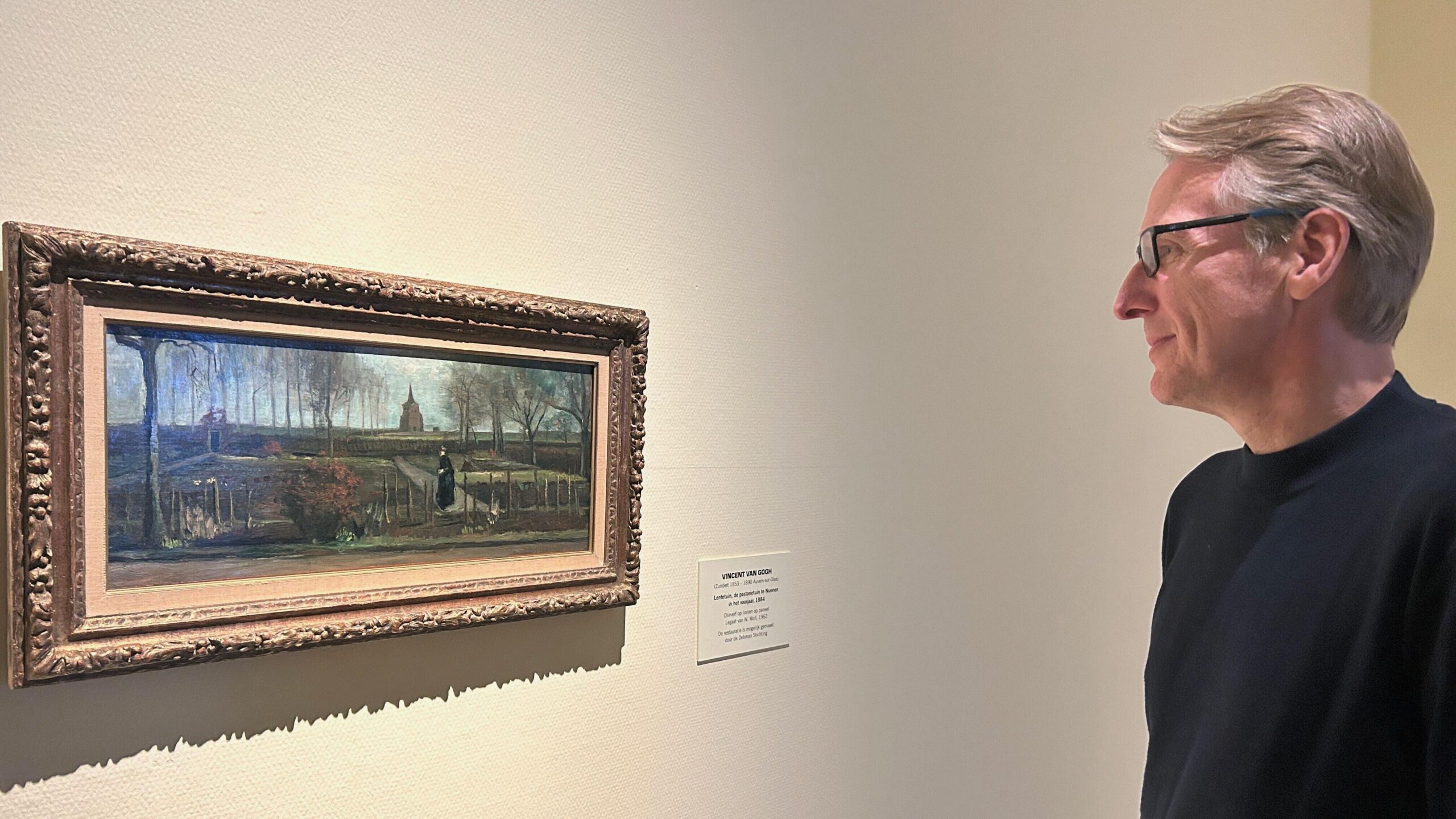
    ROSMAN: Two and a half hours north of Amsterdam, in the city of Groningen, is the Groninger Art Museum. Earlier this month, I traveled to the museum with Arthur Brand. I wanted to see him take in the Van Gogh that he and Durham had recovered, “The Parsonage Garden At Nuenen In Spring.” It’s home now, mounted on its own wall in one of the galleries.

    BRAND: When I see this, for me, it’s first of all, I think the joy, you know, the joy I experienced.

    ROSMAN: The painting was done early in Van Gogh’s career and still has these classical lines. It shows the garden, a church in the distance and a woman draped in a black coat and wearing a matching black hat. Brand has a story for her.

    BRAND: I always think – I hoped that it was Margot Begemann, his – the girl next door he wanted to marry. The parents didn’t allow them. The girl tried suicide. Van Gogh saved her. So in my imagination, this is the love of his life, Margot Begemann.

    ROSMAN: Octave Durham wasn’t with us on this tour. You can probably imagine why this museum, or, you know, really most likely any art museum in the Netherlands, wouldn’t be ready to welcome him with open arms. But we were joined by the former director, Andreas Bluhm. He’d been in the role when “The Parsonage Garden At Nuenen In Spring” was stolen. And it turns out he’d also been the director of the Van Gogh Museum in Amsterdam, back in 2002, when Durham stole the two Van Goghs there. So I had to ask Bluhm how he felt about Durham now, especially since he’d helped get this painting back.

    ANDREAS BLUHM: I’m grateful, but I’m a little bit – I’m not a friend of – I mean, it’s like…

    BRAND: Double feelings.

    BLUHM: Yeah. I have…

    ROSMAN: Mixed. You have mixed feelings.

    BLUHM: I have mixed feelings. But as he said to him, you know, it’s 2-1 now. You know, I stole two. I recovered one. Maybe I feel better when he is even, when he recovers another one (laughter).

    ROSMAN: And who knows? Maybe Durham will do just that. But for now, it was only Brand’s reaction I could get. And I couldn’t help but notice his smile as he was looking at the painting because, beyond interpretations about the art itself, he sees this whole other thing.

    BRAND: The best thing about this painting is it always gives me hope because I’m searching now for many other paintings and other stuff. Like, it’s possible, you know, we find it back. Never give up.

    ROSMAN: And maybe that’s the thing about art. The object matters, of course, but it’s the story that makes us lean in.

    BRAND: People like art, of course, of course, without a doubt, but when there is a story attached to it, it gives this extra layer.

    ROSMAN: And now “The Parsonage Garden At Nuenen In Spring” has its own story, too, about an art detective, an art thief and a stolen Van Gogh they somehow brought back home.

    RASCOE: So, Rebecca, what’s next for Brand and Durham?

    ROSMAN: Durham is teaming up with Brand on a new case. This one involving a stolen Picasso they believe is hidden somewhere in North America. Meanwhile, Brand is pursuing a separate case, a statue stolen in the Netherlands with help from two unlikely partners, Chicago-area sisters Evie (ph) and Bevy Lustig (ph), ages 6 and 9.

    RASCOE: Well, Rebecca, thank you so much for that fascinating journey through the world of art thievery and recovery. Now you got to make that movie.

    ROSMAN: I’m on it. You’re welcome, and thanks for having me.

    (SOUNDBITE OF MUSIC)

    RASCOE: This episode of The Sunday Story was produced by Andrew Mambo. It was edited by Jenny Schmidt. Production help from Ben Rappaport and Cena Loffredo. Fact-checking by Jane Gilvin. The engineer for this episode was Kwesi Lee. The Sunday Story team also includes Justine Yan and Liana Simstrom. Irene Noguchi is our executive producer.

    I’m Ayesha Rascoe. UP FIRST will be back tomorrow with all the news you need to start your week. Until then, have a great rest of your weekend.

    (SOUNDBITE OF MUSIC)

  • On to the knockout round: 4 takeaways from the FIFA World Cup so far

    On to the knockout round: 4 takeaways from the FIFA World Cup so far

    KANSAS CITY, Mo. — The worries before the World Cup were many. There were the visa wait times, the ticket prices, anxieties over hotel rooms and public transit, and countless battles between FIFA and local organizing committees.

    Now, with the group stage done and the knockout round set to begin Sunday, it is time to declare: The North American World Cup has been a success.

    No doubt there were visitors who were turned away, would-be attendees who could not afford tickets, and hotels and local businesses who feel the promised bump in tourism hasn’t materialized.

    But overall, the stadiums have been full, even for matchups that seemed lackluster on paper: nearly 70,000 people packed into stadiums to see games like Cape Verde-Saudi Arabia, Algeria-Jordan and Bosnia and Herzegovina-Qatar. And for headliner events, the environment has been top-tier, like at the U.S.-Australia game in Seattle and in Kansas City for Lionel Messi’s historic hat trick for Argentina.

    Visitors and hosts alike have been dazzled by the scenes. Kansas City was swarmed with tens of thousands of Dutch fans for a pre-game march. Boston was besieged by the Tartan Army. Australian fans seized their chance to come to the closer North American coast, where they packed the stands and belted “Waltzing Matilda.”

    And of course, the games have been terrific. Now, the knockout round is set, with some blockbusters shaping up for the Round of 16 and beyond.

    Read on for more takeaways from the tournament so far:

    France forward Kylian Mbappé (r) runs with the ball past Iraq's midfielder Zaid Ismael during a World Cup Group I match in Philadelphia on June 22, 2026.
    France forward Kylian Mbappé (r) runs with the ball past Iraq’s midfielder Zaid Ismael during a World Cup Group I match in Philadelphia on June 22, 2026. (Franck Fife | AFP via Getty Images)

    France is the best team in the tournament

    Some pre-tournament favorites have looked good, like Argentina. Others have underwhelmed, like Portugal. Some have mixed their good and bad moments, like England, Germany and Brazil.

    But one team has consistently looked a cut above the rest: France. Les Bleus had supposedly drawn one of the toughest groups at this World Cup, with dark horses Senegal and Norway competing with them for the top spot. After a sluggish first half to start their opener against Senegal, France turned on the gas and has cruised ever since. They’ve made their World Cup look downright easy, with at least three goals in each game.

    No path to the World Cup Final is easy, and France would certainly arrive battle-tested if they get there, with a potential later matchups in the Round of 16 against Germany, in the quarterfinal against the Netherlands or Morocco and in a possible semifinal against Spain. But their group stage performance leaves no doubt that they should be the favorites to win all of them, and more.

    The U.S. is better than expected, though its path to the quarterfinals isn’t easy

    Is this finally the World Cup run to remember for the USMNT? The American men were once the plucky underdogs of international soccer, always willing to run for 90 minutes and gut out a tough, gritty game. Those days seemed to fade for a decade or two after their 2002 quarterfinal run.

    U.S. players celebrate during their World Cup group match against Paraguay.
    U.S. players celebrate during their World Cup group match against Paraguay. (Dean Mouhtaropoulos | Getty Images)

    Suddenly, the results are good, the vibes are even better, and the expectations are growing by the minute. For the first time ever, the starting lineup mostly features players with key roles on teams in top European leagues. And these boys can score: The six goals they scored in their first two group stage games were twice as many as they netted across four games in the 2022 World Cup.

    The third group stage match against Turkey, in which U.S. coach Mauricio Pochettino gave most of his usual starters a rest and his backups a chance to play, cooled their momentum somewhat with a 3-2 loss.

    Still, a Round of 32 matchup against Bosnia and Herzegovina should be winnable. That would be their third win of the tournament so far, the most ever by any U.S. men’s team at a World Cup. And a potential Round of 16 matchup against Belgium (or Senegal) is tougher but should be competitive, too. A quarterfinal in Los Angeles, even if it’s a loss against Spain, would be an epic and fitting result for this team on home soil.

    This will be an epic Golden Boot race

    The stars are delivering in this World Cup. Argentina’s GOAT Lionel Messi has six goals. France’s twin titans Kylian Mbappé and Ousmane Dembélé are hot on his heels with four goals apiece. The imposing 6-foot-5 Norwegian megastar Erling Haaland has four goals despite resting on the bench for Norway’s third game. Brazil’s Vinícius Júnior also has four.

    Argentina forward Lionel Messi celebrates scoring his team's third goal during a group match against Jordan on Saturday. It was his sixth goal of the tournament, and record 19th overall World Cup goal.
    Argentina forward Lionel Messi celebrates scoring his team’s third goal during a group match against Jordan on Saturday. It was his sixth goal of the tournament, and record 19th overall World Cup goal. (Paul Ellis | AFP via Getty Images)

    Messi should have plenty more opportunities as Argentina drew perhaps the easiest route to the quarterfinal, with a Round of 32 match against Cape Verde, followed by a possible Round of 16 game against the winner of Egypt versus Australia. Plenty of other stars have two or three goals and what could be a deep run ahead, like England’s Harry Kane and Portugal’s Cristiano Ronaldo. Watch this space.

    The expansion to 48 was criticized, but it has been a lot of fun

    The biggest criticism of expansion was that there would be no real peril for top-quality teams in the group stage, both because there would be more lopsided group stage matchups and because eight third-place teams advance. That has mostly borne out.

    The highest-ranked World Cup team that failed to qualify for the knockout stage was Uruguay, which came in ranked No. 16. By contrast, the 2022 tournament had four teams ranked higher and were eliminated in the group stage — Belgium (No. 2), Denmark (No. 10), Germany (No. 11) and Mexico (No. 13). The new Round of 32 will have to do some of that work of adding surprise and peril to the big favorites.

    The expanded format has also given us moments and teams to remember like Cape Verde — which would probably not have reached the World Cup under the old format — taking the pre-tournament favorites Spain to a scoreless draw in their opening match. It’s a thrill for fans of teams who rarely have a shot, like Scotland or Haiti or the Democratic Republic of Congo, to have a chance to see their nation on this kind of stage. In fact, nine (of ten) African countries advanced to the knockout round.

    Plus, seven teams have reached the knockout stage for the first time in their country’s history: Cape Verde, Egypt, Ivory Coast, South Africa, Congo, Canada and Bosnia and Herzegovina. Sure, they won’t be favorites to make a deep run. But the games should be electric.

    A supporter of Cape Verde's national football team reacts as she watches the 2026 World Cup group match against Saudi Arabia on Friday.
    A supporter of Cape Verde’s national football team reacts as she watches the 2026 World Cup group match against Saudi Arabia on Friday. (Jose Correia | AFP via Getty Images)

    Transcript:

    AYESHA RASCOE, HOST:

    And now it’s time for sports. Before this year’s World Cup, there was a lot of concern the North American host countries might not quite capture the magic of the beautiful game’s biggest contest. Well, put those worries to rest. The World Cup has been a thrill and promises to continue to be as the knockout round starts later today. NPR sports correspondent Becky Sullivan joins us now. Hi, Becky.

    BECKY SULLIVAN, BYLINE: Hey. Good morning.

    RASCOE: You’ve been crisscrossing the country to cover this thing. Where are you now?

    SULLIVAN: Yeah. I’m in Kansas City today because last night I went to this game, Austria versus Algeria, which is one of the last two games of the whole group stage. I was sort of worried it was going to be a little bit of a dud. Could’ve been a 0-0 draw because if one team had won, then the other team would’ve been eliminated. But if there was a tie, both of them got in.

    Instead, it was actually this total roller coaster, a very wild 3-3 game. I was sitting behind an Algerian American family who was going through it. Ayesha, they were going through it with each goal. Algeria, you know, with the result – with the draw, they joined eight other teams from Africa that have advanced to the knockout round, which is a treat to see. And then tomorrow, I’m headed back to California to catch up with the U.S. men’s team for their round of 32 game on Wednesday.

    RASCOE: And it’s at the knockout stage now. So that means if you’re still in it, win or go home.

    SULLIVAN: Yep.

    RASCOE: Who do you think is going to be on the winning side of things?

    SULLIVAN: You know, I think France is an easy pick. They have been like hot knife through butter, I think, scoring with ease no matter who they play. They had sort of drawn this group that I think a lot of people thought was maybe one of the toughest ones. They had to play Senegal, Norway and Iraq, and it was just no problem for them. They have these two star scorers, Kylian Mbappe and Ousmane Dembele. Each of them have four goals. They’re each a serious threat to win the Golden Boot, which is, of course, awarded to the player who scores the most goals at the tournament. They did, however, draw potentially a tough path to the final. They could potentially face Germany, then Netherlands or Morocco, then Spain in a semifinal. That is not an easy path, but I think France is capable of winning all of those and more.

    RASCOE: So are there any Cinderellas of this World Cup?

    SULLIVAN: Yeah. I think there’s always some teams that can flirt with this. I think the really tiny one is – that’s been a ton of fun to watch is Cape Verde, which is the third smallest team to ever qualify for the World Cup, actually. So, of course, it’s their first time in the tournament and, of course, the first time in the knockout round. They might not have qualified at all, actually, if it hadn’t expanded to 48 teams this year. Yet they’ve been shockingly good. They were undefeated in the group stage. They had three draws but against some good teams, including Spain.

    However, their reward in the first round, Ayesha, is a matchup against the defending champion Argentina, and, of course, the GOAT, Lionel Messi, who scored again yesterday. He is leading all goal scorers with six in this tournament. They are a force to contend with. And Argentina, of course, will – I think, will be massive favorites in this game. They could win it all. Anything can happen in soccer, though.

    RASCOE: OK. So Argentina and France have momentum. Anyone else seem to be heading to the quarters or the semis?

    SULLIVAN: Maybe. You know, I think maybe Norway could be kind of a dark horse. They have this superstar striker Erling Haaland, who’s already scored a handful of goals. I also think Mexico looks pretty good. They were the third team besides France and Argentina to win all three of their group stage games. And now they get to play their first two knockout rounds in Mexico City as a result.

    And then, of course, the expectations could not be higher for another home team, the USA. They did not get the easy draw that they were hoping for in the knockout round, but this is the most electric team they have fielded in a very long time. So they have to play Bosnia and Herzegovina on Wednesday. If they can win that, then they would face Belgium or Senegal in the round of 16. Win that, they’d be onto a quarterfinal in Los Angeles, matching their best finish in the modern era of the World Cup.

    RASCOE: That’s NPR’s Becky Sullivan. Becky, thank you so much.

    SULLIVAN: You’re welcome.

  • Balancing the risks of catching Ebola while covering the outbreak

    Balancing the risks of catching Ebola while covering the outbreak

    Transcript:

    DON GONYEA, HOST:

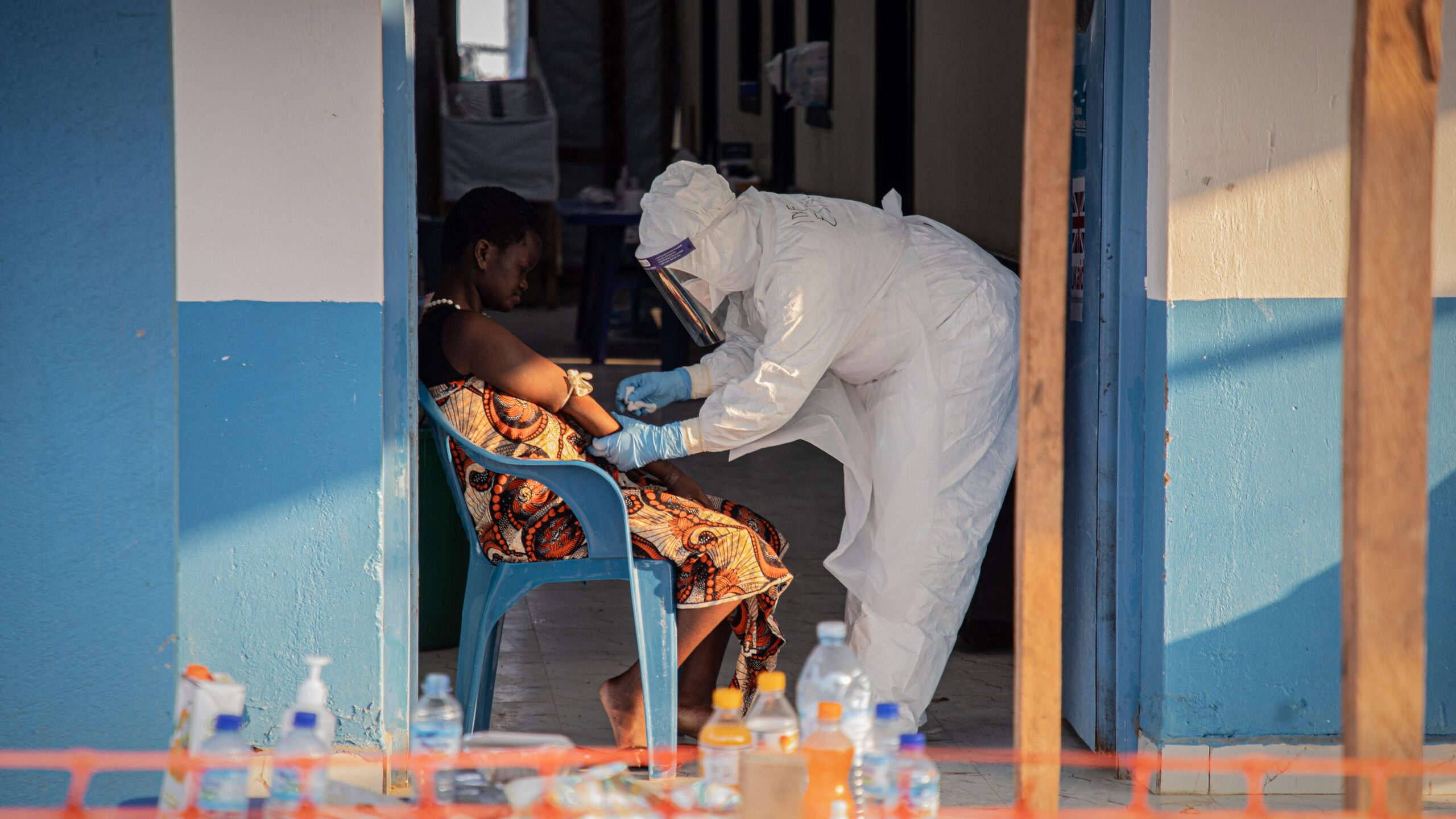
    It’s CONSIDER THIS, where every day we go deep on one big news story. NPR often relies on reporters going into dangerous places to get the story. It can mean covering a war, natural catastrophes or highly contagious deadly diseases, like the current Ebola outbreak in the Democratic Republic of the Congo, that has killed hundreds of people so far.

    (SOUNDBITE OF ARCHIVED NPR CONTENT)

    EMMET LIVINGSTONE: And I’m in an Ebola ward with doctors going from isolated room to isolated room checking on Ebola patients.

    GONYEA: CONSIDER THIS – how do you manage the risk of catching a deadly disease and balance it with the need to report the story to a wide audience? Coming up, we’ll hear from a reporter who has traveled to the epicenter of the current Ebola outbreak to hear more about those risks and how to manage them.

    (SOUNDBITE OF MUSIC)

    GONYEA: From NPR, I’m Don Gonyea.

    (SOUNDBITE OF MUSIC)

    GONYEA: It’s CONSIDER THIS FROM NPR. Reporter Emmet Livingstone lives in Kinshasa, the capital of the Democratic Republic of Congo. When Ebola surfaced in the eastern part of the country, he traveled to the area to cover it for NPR. For this week’s Reporter’s Notebook, we wanted to understand how a reporter balances the risks of reporting from the heart of a deadly outbreak. I began by asking Emmet a very basic question – how he tries to keep safe.

    LIVINGSTONE: The reality is, if you’re going into an area with active Ebola transmission, you’re taking a risk because you will come into contact with people who either themselves are in very close contact with people who are suffering from Ebola, or you will come into contact with people who potentially have Ebola. The main way to keep yourself safe is to wash your hands all the time and to be very aware of your surroundings and not to touch people at all. That is pretty difficult in areas where, for example, if you have to go through a checkpoint or somebody has to check your documents, you’re kind of pushed into a funnel with other people and you’re trying not to touch them.

    But those are the – those – that’s what you’re supposed to do to try and remain safe. I’m not saying that when I was there it worked 100% of the time. And so now there’s a three-week incubation period, so I’ve been out of the zone for one week. I have another two weeks. If, within that three-week incubation period, I develop a fever, that’s a proper emergency and I’ll have to alert the health authorities. So that’s why I’m taking my temperature.

    GONYEA: And do you have a personal checklist that you go through every time you enter an area where there are Ebola patients?

    LIVINGSTONE: So suffice it to say, editors took it very seriously. It’s no small thing to try and do journalism when there’s active ongoing transmission of Ebola, especially in a place where there’s a lot of violence. The takeaway that I got from editors was not to do anything I was uncomfortable with. I was told several times that if I didn’t want to go, for example, even at the last minute, that it would be OK.

    And then on top of that, I was given the opportunity to do a special Ebola training, so training for journalists who are working in Ebola zones, which was extremely useful because you learn things like how far away you can stand from people to keep yourself safe, you know, and then kind of best practices about equipment and little tips that I picked up here and there, which were hard to put into practice on the ground just because we didn’t have much time.

    But, for example, having, you know, like, trash bags with you so that if something is contaminated – if you have to decontaminate something quickly, you can put it in there and then transport it with you in the car and that it won’t contaminate other people. So there was a long list of things like that that we were taught, essentially, before we set off.

    GONYEA: In one of your stories on NPR, you describe a gold mining operation and the working conditions and how people are working in such close quarters, you would never know there’s an Ebola outbreak.

    (SOUNDBITE OF ARCHIVED NPR CONTENT)

    LIVINGSTONE: I’m in a gold mine in Mongbwalu. It’s in a valley surrounded by steep green hills with lush grass, palm trees, eucalyptus trees. You can hear the sound of a generator, and that’s pushing sand down a sluice. Workers then look through that sluice to try and find bits of gold. There are, I’d say, maybe 20, 30 pits here. Dozens and dozens and dozens of people are working despite the Ebola outbreak.

    GONYEA: They seem to have no concern because they’re so concerned about just doing the work and maybe getting paid and getting through the day.

    LIVINGSTONE: Yeah. I would nuance it and say that that is probably the case across Eastern Congo and even across the whole of Congo. People that I spoke to there were aware of the disease and they were saying that they would like to take precautionary measures and that they’re afraid of getting the disease, but they just don’t really have a choice, and it doesn’t matter whether you’re in the mines or not. It’s very, very difficult to distance yourself from people. It’s very difficult to get access to running water in a place like this. So, you know, almost everyone is at risk there.

    GONYEA: You describe going from region to region, taking a four-hour car ride, and there’d be checkpoints along the way. What happens at those checkpoints? Is it just to make sure you really want to go in there or to warn you about what you’re entering? What is it?

    LIVINGSTONE: Checkpoints in Eastern Congo usually serve as a way to extract money from people who have to cross those checkpoints. So tolls are extracted. Other reasons are also to keep an eye on who’s going through. As I said, this is an area with a lot of armed conflict, so there’s a lot of edginess and kind of a feeling of tension about what people are up to and why they’re using the road.

    When I was on the road, it was fairly relaxed. We were almost always just waved through the checkpoints, including by the CODECO, which is one of the most violent militia groups in Ituri. And they don’t resemble very much – in some cases, it’s, say, a line of soldiers that are blocking the road, often hassling kind of motorbike drivers and stuff. We were in a Jeep. We were kind of mostly waved through, maybe because we looked more important than we were, and then the CODECO checkpoints, those are the militia checkpoints, it was one or two guys kind of standing by the side of the road who peer into your car and then wave you on.

    GONYEA: And I understand there are all these healthcare workers that you describe being there, but the people who live there don’t necessarily trust them and do what they suggest.

    LIVINGSTONE: There’s just a general feeling of distrust and you tend to trust your own. And if you have an outsider come in and say, this is the way it is, and you don’t know them, you’re much less likely to trust them. And I think it’s a very human reaction, and people ultimately work the same way all around the world. And interestingly, it’s really the key part of the health response at the moment is trying to gain the trust of communities.

    And the way that the WHO and other organizations are doing this is by targeting community leaders, so be they church leaders, you know, local village chiefs, that kind of thing, the main job is to get them on board and then get them to talk to the kind of mass of people who live in these areas to try and convince them. But if – mean, to put it bluntly, if you’re a white guy that turns up from Europe or from the U.S. and says, you’ve got to do this, people just aren’t going to listen.

    GONYEA: What can you say about your plans for how you will continue to track the outbreak and the challenges that do arise as you report this story?

    LIVINGSTONE: Speaking as a reporter, I think what’s going to be difficult is when media attention turns elsewhere and this turns into yet another intractable problem in Eastern Congo. This is an area where conflict has been ongoing for 30 years and, you know, with various peaks and troughs and kind of, like, atrocities that occur and then little bits of peace and peace initiatives. But, you know, broadly speaking, there’s not that much interest in the region. My worry is that the more this goes on, the less interest there’s going to be.

    GONYEA: That’s reporter Emmet Livingstone, who’s been covering the Ebola outbreak in Eastern Congo for NPR. Emmet, thank you for joining us, and be safe.

    LIVINGSTONE: Thank you so much for having me on.

    GONYEA: This episode was produced by Gabriel Sanchez. It was edited by Adam Raney. Our director is Elena Burnett, and our interim executive producer is Courtney Dorning.

    (SOUNDBITE OF MUSIC)

    GONYEA: It’s CONSIDER THIS FROM NPR. I’m Don Gonyea.

  • Search and Rescue in Venezuela, Election Security, Free Childcare

    Transcript:

    SCOTT SIMON, HOST:

    Countries around the world are rushing aid to Venezuela. Individuals are, too.

    AYESHA RASCOE, HOST:

    The earthquake was another blow to a country that was already straining under multiple crises.

    SIMON: I’m Scott Simon.

    RASCOE: I’m Ayesha Rascoe, and this is UP FIRST from NPR News.

    (SOUNDBITE OF MUSIC)

    SIMON: Firefighters, hospitals and rescue crews are overwhelmed. Volunteers are pouring in to help.

    RASCOE: Also President Trump wants everyone to provide proof of citizenship before voting. His bill isn’t passing, and that might be a way for him to contest election results this fall.

    SIMON: Democratic socialists are on a roll in New York City, but what’s the appetite for progressive policies in the rest of America? A look at New Mexico, where childcare is now free for everyone.

    RASCOE: So stay with us. We have the news you need to start your weekend.

    (SOUNDBITE OF MUSIC)

    SIMON: Three da ys after a powerful double earthquake struck Venezuela, the country struggles to cope with the aftermath.

    RASCOE: The quakes hit within a minute of each other, causing widespread destruction near the capital, Caracas. The government says more than 900 people have been killed and more than 3,000 injured. Thousands more people are missing.

    SIMON: International search and rescue teams are arriving, but limited equipment and an overstretched health system are slowing them down. In some areas, residents are using their bare hands to dig for survivors. John Otis has just arrived in Caracas. John, thanks for being with us.

    JOHN OTIS, BYLINE: Thanks for having me, Scott.

    SIMON: You have been to Caracas many times before. What were your first impressions as you came in this time?

    OTIS: Yeah. Well, the fact is we had to drive in all the way from the Colombian border into Caracas, and that’s quite telling because, you know, the international airport just outside of the city was badly damaged in the earthquake. And it remains closed, so we really had no other way to get here. And as for Caracas, many areas were spared, but parts of some neighborhoods, like Altamira, were devastated.

    (SOUNDBITE OF CHAINSAW RUNNING)

    OTIS: Now, that’s the sound of rescue workers using a chainsaw to cut a tunnel through the remains of this high-rise apartment building that collapsed. Nearby were piles of mangled rebar and a crushed car. For their part, many survivors of quake-damaged buildings are too scared to sleep indoors, and so they’re camping in the Altamira Park. I saw one couple curled up in blankets, sleeping with their pet poodle next to a sculpture in the park. For me, this is an especially surreal sight. Altamira is this beautiful upscale neighborhood. I’ve stayed here on previous reporting trips, and it’s just really sad to see.

    SIMON: John, that critical window of 48 to 72 hours to find survivors is obviously closing. Aid is arriving from abroad and locally, but is it enough?

    OTIS: Well, while we were driving into Caracas, we passed convoy after convoy of aid trucks trying to get to the disaster zone. But one problem is that the government lacks heavy equipment, like bulldozers and backhoes. That’s partly why you see a lot of average folks taking matters into their own hands. One of them is Carlos Ramirez (ph), a lawyer whose aunt and cousin were in that high-rise that collapsed.

    CARLOS RAMIREZ: (Non-English language spoken).

    OTIS: So he’s wearing a yellow helmet and gloves, and he’s saying that he’s been here for the past three days helping to remove debris and also praying that his loved ones somehow survive.

    SIMON: John, what’s the government’s response been so far?

    OTIS: Acting President Delcy Rodriguez and her team appear to be doing what they can with very limited resources. But these limitations are also the government’s own fault. Remember, Rodriguez took power after U.S. troops ousted President Nicolás Maduro back in January, and she was Maduro’s vice president, as well as a big, big cheerleader for his authoritarian regime for many years. And that regime ended up strangling the country’s democracy and badly mismanaging its economy.

    One reason there’s a shortage of heavy equipment is because so many Venezuelan factories have shut down. Hospitals were defunded, and now they lack everything from antibiotics to, in some cases, even running water. Rescue workers and firefighters lack protective gear. So in the end, previous mistakes are making it a lot harder for the government to deal with this ongoing disaster.

    SIMON: John Otis in Caracas, thank you so much.

    OTIS: Thanks, Scott.

    (SOUNDBITE OF MUSIC)

    RASCOE: For months, years even, President Trump has complained that lawmakers in Congress aren’t taking election security seriously enough. And this week, he refused to sign a bipartisan plan to bring down housing costs because of it.

    SIMON: The standoff centers on a bill called the SAVE America Act. We have NPR voting correspondent Miles Parks with us. Miles, thanks so much for being with us.

    MILES PARKS, BYLINE: Hey. Good morning, Scott.

    SIMON: So the SAVE Act, as it’s called, is not new. The President mentioned it in this year’s State of the Union in February, falsely accusing Democrats of fighting it because he said they wanted to cheat in elections.

    (SOUNDBITE OF ARCHIVED RECORDING)

    PRESIDENT DONALD TRUMP: And their policy is so bad that the only way they can get elected is to cheat. And we’re going to stop it. We have to stop it, John.

    SIMON: Miles, what would this bill actually do?

    PARKS: So honestly, it’s a pretty major election overhaul, which is notable, considering, Scott, primaries are already underway, and we’re just a few months away from the general election in the midterms. The biggest change would be on the registration side of things. It would require people to provide proof of citizenship when they register to vote, which might not sound like a big deal. Most Americans believe only citizens should vote in American elections but having the right documentation to prove that citizenship is not a given. We’re talking about a passport or a birth certificate in most cases, and research has shown that roughly 1 in 10 Americans could potentially have trouble coming up with those documents if this bill were to go into effect.

    SIMON: And is that why Republicans have never been able to pass the bill? It narrowly passed the House.

    PARKS: It’s definitely part of it. Also noncitizen voting has never been found to be a major issue in American elections, so Democrats have been universally opposed, and Republicans would need to blow up the Senate filibuster to overcome that opposition, which does not have broad support in that caucus. Honestly, part of the reason for that is that this legislation does not seem drafted to garner wide support.

    SIMON: Now, fill that out a little bit for us.

    PARKS: So experts I’ve talked to say if this bill was narrowly focused, specifically at requiring photo ID at polling places, for instance, that has wide support from voters that could have potentially put some political pressure on, especially on some swing-state Democrats. But President Trump has pushed the maximalist version of this thing, at one point saying it should include restrictions to vote by mail, at one point saying it should include provisions regarding transgender athletes in sports. So not only are those controversial policies, but conservatives have also traditionally been opposed to any policies that would federalize election administration in the way that this bill would.

    SIMON: But President Trump has said he thinks the country should nationalize voting. How widely held is that belief among Republicans?

    PARKS: It is not widely held at all. Senator Mitch McConnell, for instance, has spent most of his career fighting against efforts to move the U.S. towards a more top-down election system. But the SAVE Act would do that. Derek Muller, an election law professor at Notre Dame, said earlier this year that if the SAVE Act were passed, it would be one of the most significant nationalizations of elections in American history.

    SIMON: Why is President Trump continuing to push this if his own party isn’t behind him?

    PARKS: That is the question that voting officials have been noodling on for much of the year, Scott, whether it’s with this bill or the executive orders the president has tried to push through, which have mostly been blocked by the courts so far, voting officials see this as part of a bigger plan to cast doubt on upcoming elections, should the president not like the results. I was at an event this past week with Gabriel Sterling. He’s a Republican election official in Georgia that some listeners may remember from 2020, pushing back on President Trump’s election claims then. He said all signs are pointing to Republicans losing ground in Congress this year, and then Trump contesting the results.

    (SOUNDBITE OF ARCHIVED RECORDING)

    GABRIEL STERLING: The reality of this is my Republicans, my team are going to lose seats. But they’re going to say, if we’d won these lawsuits, if we’d passed the SAVE America Act, if we did all these things, we would have won. And that’s what they’re building towards. So it’s a win-win either way.

    PARKS: Another person at this event was Michigan Secretary of State Jocelyn Benson. She’s a Democrat who’s also running for governor there. She said she’s worried that all this noise about the rules and potential restrictions to voting will mean that some people just say, you know, man, this does not seem worth it this year.

    (SOUNDBITE OF ARCHIVED RECORDING)

    JOCELYN BENSON: So much of the work to undermine democracy is about creating this narrative that democracy can’t be trusted, so that even if you lose in court, people have lost so much faith in the system that they give up on it and walk away, which we know when it comes to undermining democracies writ large in history, it’s when citizens lose faith in their democracy that democracies die.

    PARKS: Benson told me that people need to reject that and still turn up to vote this November.

    SIMON: NPR voting correspondent Miles Parks. Thanks so much.

    PARKS: Thanks, Scott.

    (SOUNDBITE OF MUSIC)

    SIMON: New Mexico is establishing a system of free childcare for nearly anyone in the state. It’s a popular, if progressive, idea for this largely rural state.

    RASCOE: Reporter Katerina Barton has been following the program’s rollout in Santa Fe and joins us now. Welcome.

    KATERINA BARTON: Thanks for having me.

    RASCOE: New Mexico rolled out what they’re calling universal free childcare in November. How’s that supposed to work?

    BARTON: Well, the idea is that any parent in the state, regardless of how much money they make, can have the state pay 100% for the cost of childcare for kids up to 13. The only requirement is that a parent has to either be in school or working or looking for work.

    RASCOE: Childcare is a huge burden on parents across the country, and there have been some other states that have talked about trying to provide free childcare. How is New Mexico able to pay for this?

    BARTON: Mostly from oil and gas tax revenues. New Mexico is America’s No. 2 crude oil producer behind only neighboring Texas, so this probably isn’t an avenue for most states. Back in 2020, New Mexico made a trust fund that earmarked some of that revenue for early childhood education. It started with $300 million, and now that’s grown to $11 billion. The state has slowly been expanding its childcare subsidies over the years, raising the income limits, and now it’s open to everyone.

    RASCOE: So it sounds like money is not an issue here. How’s the system working so far?

    BARTON: Well, the program has been popular, so popular, in fact, that the main challenge is that there’s not enough availability of childcare. The state isn’t giving exact numbers for how big the supply and demand gap is, but since the state started, they say that they’ve added licensed childcare capacity for nearly 4,000 kids. But we also know that before this program started, it was estimated that there were about 15,000 kids under the age of 6 in New Mexico who couldn’t find childcare.

    There’s six counties that have the highest gap between supply and demand, and one of those is Santa Fe County. Here’s Lilia Doyle (ph), a mother in Santa Fe County. She says that her 2-year-old son has been on a waitlist at six different daycares since November, and she works as a librarian. She’d like to go back to work, but she needs to find childcare first. And she says the process has been really tedious. She wants to find an open spot for her son, but she also wants to vet some of the daycares, and she says it’s been a lot of work.

    LILIA DOYLE: I’m so thankful we have universal childcare, but I just think it needs some tweaking to be 100% effective for parents.

    RASCOE: How many kids are on the waiting list?

    BARTON: Well, state officials say they don’t have that number because that’s specific to each childcare center. But in an interview, the Early Childhood Education and Care Department that runs the program told me that they have this ambitious goal to close that gap in the next one to two years.

    RASCOE: What else is the state working on to make the program, I guess, sustainable going forward?

    BARTON: I think there’s still a lot to flesh out. The department that runs the program is in the process of making new rules to codify the program with a bill that was signed into law earlier this year. They’re working on incentives to make it easier for new childcare centers to open, and recently, the state changed zoning regulations for home-based childcare centers. And at the start of the program, they raised the rates that childcare centers are getting per kid, and they’re now working on increasing wages for people working in those centers. They’re also giving loans to providers to build and expand their centers, which is also adding more capacity, so there’s lots of capacity building going on.

    RASCOE: That’s Katerina Barton, a reporter in Santa Fe, New Mexico. Thank you so much for speaking with us today.

    BARTON: Thanks for having me.

    (SOUNDBITE OF MUSIC)

    SIMON: And that’s UP FIRST for Saturday, June 20, 2026. I’m Scott Simon.

    RASCOE: And I’m Ayesha Rascoe. Dave Mistich produced today’s podcast, along with Samantha Balaban, Gabe O’Connor, and Ryan Benk. Dianna Douglas was our editor with help from Tara Neill, Benjamin Swasey and Eric Whitney.

    SIMON: Our director is Andy Craig, and he worked alongside Technical Director David Greenburg.

    RASCOE: He got engineering support from Jay Czys and Simon-Laslo Janssen

    SIMON: Shannon Rhodes is our senior supervising editor, our executive producer is Evie Stone, and Catherine Laidlaw is our deputy managing editor.

    RASCOE: Tomorrow, on The Sunday Story, the secret life of a stolen Van Gogh painting.

    SIMON: You’re going to want to tune in. Check your closet, see if you’ve got it. Thanks for listening and for supporting your local NPR station. If you need to find yours, and of course, we all do, go to stations.npr.org.

    RASCOE: Well, if you have that Van Gogh, think about donating to your local (laughter)…

    SIMON: Oh, that would be so nice.

    RASCOE: …Your local NPR station (laughter).

    SIMON: At least a scintilla of it, don’t you think?

    RASCOE: Yes. Yes. You know, just…

    SIMON: Just rip it in half and give half to your local – no, I’m kidding.

    RASCOE: No, no. no.

    SIMON: You don’t rip a Van Gogh.

    RASCOE: No, no, but give us a little piece of it. We OK.

    SIMON: Yeah. A little…

    RASCOE: A little piece of the profit.

    SIMON: …Corner of it. Yeah. Exactly.

    RASCOE: (Laughter).

    (SOUNDBITE OF MUSIC)

  • Opinion: Ranch dressing is a winner at the World Cup games

    Opinion: Ranch dressing is a winner at the World Cup games

    Soccer fans visiting the U.S. for World Cup matches seem to be delighted by American friendliness and dazzled by the way our highways roll from skyscrapers into wide-open spaces, abounding with monster trucks, big-box stores, “Big Gulp” drinks, central air conditioning, and ranch dressing.

    Elsa Thora, a visitor from Sweden, wrote in what’s become a widely quoted post on X, “EUROPE WE NEED RANCH ASAP.” Hidden Valley had already hired six “Ranchbassadors” this summer to spread the “sauce-pel” on the other side of the Atlantic.

    Then World Cup soccer brought more than a million international fans to the heart of ranch country. The TSA cautioned on Instagram, “If you’re visiting for a very large sporting event & you happen to discover RANCH while you’re here… please pack it in your CHECKED BAG on the way home.”

    I am not a fan of ranch dressing. I think it tastes like creamy, curdled pillow stuffing. But I am outnumbered. In 2024, ranch eclipsed ketchup to become the nation’s top-selling condiment.

    The food industry research firm Datassential says 75% of Americans like or love ranch dressing. These days, it’s hard to imagine 75% of Americans agreeing they like puppies.

    As it happens, ranch dressing has a distinctly American creation story. In 1949, a Nebraska plumbing contractor named Steve Henson was working in Anchorage, Alaska and concocted a salad dressing out of buttermilk, mayonnaise, and herbs to help feed his crew on remote job sites.

    A few years later, Henson and his wife bought a California dude ranch, which they called the Hidden Valley Ranch, and served the dressing at their restaurant. Guests loved it. Then Henson started selling packets of his seasoning mix by mail. The dude ranch went under. But ranch flavor was just getting started.

    Today, hundreds of companies produce “ranch-style” dressings and dips, and “ranch” flavor has been infused into popcorn, taco shells, ice cream, and even a lip balm that sold out in hours. You can have a ranch fountain at your wedding or bat mitzvah! Glub-glub-glub.

    Maybe World Cup visitors’ passion for America’s favorite condiment has reawakened some national pride here. Steve Henson didn’t need to be a Michelin-starred chef or culinary scientist to change people’s tastes. He was a journeyman plumbing contractor, giving a treat to friends. And now, much of the world.

    Transcript:

    SCOTT SIMON, HOST:

    Soccer fans visiting the U.S. for World Cup matches seem to be delighted by American friendliness and dazzled by the way our highways roll from skyscrapers into wide-open spaces, abounding with monster trucks, big-box stores, Big Gulp drinks, central air conditioning and ranch dressing. Elsa Thora, a visitor from Sweden, wrote in what’s become a widely quoted post on X, “Europe, we need ranch ASAP.”

    Hidden Valley had already hired six ranchbassadors this summer to spread the sauce-pel on the other side of the Atlantic. Then World Cup soccer brought more than a million international fans to the heart of ranch country. The TSA cautioned on Instagram, if you’re visiting for a very large sporting event and you happen to discover ranch while you are here, please pack it in your checked bag on the way home.

    I am not a fan of ranch dressing. I think it tastes like creamy, curdled pillow stuffing. But I am outnumbered. In 2024, ranch eclipsed ketchup to become the nation’s top-selling condiment. The food industry research firm Datassential says 75% of Americans like or love ranch dressing. These days, it’s hard to imagine 75% of Americans agreeing they like puppies.

    As it happens, Ranch dressing has a distinctly American creation story. In 1949, a Nebraska plumbing contractor named Steve Henson was working in Anchorage, Alaska, and concocted a salad dressing out of buttermilk, mayonnaise and herbs to help feed his crew on remote job sites. A few years later, Henson and his wife bought a California dude ranch, which they called the Hidden Valley Ranch, and served their dressing at their restaurant. Guests loved it. Then Henson started selling packets of his seasoning mixed by mail. The dude ranch went under, but ranch flavor was just getting started.

    Today, hundreds of companies produce ranch-style dressings and dips, and ranch flavor has become infused into popcorn, taco shells, ice cream and even a lip balm that sold out in hours. You can have a ranch fountain at your wedding or bat mitzvah – glub, glub, glub. Maybe World Cup visitors’ passion for America’s favorite condiment has reawakened some national pride here. Steve Henson didn’t need to be a Michelin-starred chef or culinary scientist to change people’s tastes. He was a journeyman plumbing contractor giving a treat to friends, and now much of the world.

    (SOUNDBITE OF THE CANCEL’S “BLOOM”)

  • Trump administration partially lifts export ban on Anthropic’s most advanced AI model

    Transcript:

    SCOTT SIMON, HOST:

    U.S. government’s asserting a new level of control over AI. Earlier this month it banned foreigners from using two of Anthropic’s most powerful new models. It partially reversed the ban yesterday but retains control over which companies have access. Meanwhile, Anthropic’s rival OpenAI said yesterday that it had agreed to let the administration screen users of its newest model. NPR’s tech correspondent John Ruwitch joins us. John, thanks so much for being with us.

    JOHN RUWITCH, BYLINE: Sure thing, Scott.

    SIMON: And how powerful are these new AI models?

    RUWITCH: Yeah. I’ve talked with a couple of people who’ve used related models, and they say they are really powerful. The AI model that kind of kicked all this off is called Mythos. It’s from Anthropic. It’s not public yet, but a small number of tech companies have been getting exclusive access to a preview version. That includes companies like Google, Microsoft. It also includes Cisco. I spoke with the head of security at Cisco, Anthony Grieco.

    ANTHONY GRIECO: AI is a game changer for security, period. The world is changing. Mythos has amped up that change.

    RUWITCH: He’s talking about cybersecurity, of course. That’s one of the things that Mythos was designed to be good at. And what it does is find vulnerabilities in software and help fix them. These are the kind of vulnerabilities that hackers might want to exploit. Grieco says his team had Mythos scan 1.8 billion lines of code across several coding languages, and he says it did that deftly.

    GRIECO: And allowed us to cover that amount of territory and amount of complexity in just eight weeks, which would have otherwise taken humans mixed with machines and tools eight-plus years to do.

    SIMON: I mean, John, eight years of work in just eight weeks is astounding, but it also creates some concern, doesn’t it?

    RUWITCH: Yeah. These are double-edged swords, right? So good guys can use tools like this to find and fix problems. Bad guys could use them to find and exploit holes, to hijack networks or steal data, that kind of thing. In fact, that’s happening actually already with widely available, less powerful AI tools. There’s been an explosion in the number of AI-assisted cyberattacks, and, you know, fear of that getting supercharged could be what’s behind the administration’s shift from being pretty hands-off about AI to wanting more control.

    SIMON: So are AI models being seen now as a potential national security risk?

    RUWITCH: Yeah. It seems like the cutting-edge ones might be. I mean, Anthropic, in early June, put out two AI models that were based on Mythos. They were weaker. Now, they had guardrails built in so they couldn’t do the most powerful cyber stuff. Within days, though, the Trump administration told Anthropic it knew of a way that those safeguards could be circumvented, and so it slapped an export ban on those models, basically, meaning no foreigners could use them, including Anthropic employees. So the company took them offline.

    Fast-forward to Friday, the Commerce Department partially lifted the export ban on one of those two models. According to a letter from the commerce secretary that NPR has seen, it’s now allowing a small list of American companies, including their foreign staffers, to use the model. In a statement emailed to NPR, Anthropic said it was pleased with this change, and it’ll continue to work with the government.

    SIMON: And is working with the government now a new expectation?

    RUWITCH: Yeah. It seems to be. OpenAI said just yesterday also that it had let the government vet a list of companies that would have access to its latest and greatest model. You know, the company said this was the strongest path to broader availability of the model in the coming weeks but that this kind of vetting should not be the norm long term.

    SIMON: You’ve been talking to cybersecurity experts. What do they see in the future for these tools?

    RUWITCH: Yeah. The tools are powerful. Some think these models will tilt the balance in their sort of arms race against hackers. Lee Klarich is with Palo Alto Networks, a cybersecurity company that’s had access to some of these models. He says there’s a wave now of companies like his finding and fixing vulnerabilities.

    LEE KLARICH: And then as we come down the other side of that as an industry, we’ll actually go to a level where we are – have more secure software than we’ve had before because we’re finding and fixing things before they ever get released in the first place.

    RUWITCH: That may be the case. It may be a little optimistic, but experts say, you know, this now AI-enabled cat-and-mouse game between cyberattackers and defenders is not ending anytime soon.

    SIMON: John Ruwitch. Thanks so much. And we want to note, Anthropic, Microsoft and Google are all financial supporters of NPR.

  • Texas will require students to read Bible passages in a new state curriculum

    Transcript:

    SCOTT SIMON, HOST:

    The Texas State Board of Education approved a required student reading list yesterday. It includes Bible passages, along with classics by writers like Shakespeare. Trustees also rewrote a social studies curriculum to include biblical references, biblical influences and a stronger focus on the U.S. and Texas. Bill Zeeble with member station KERA in Dallas joins us. Bill, thanks for being with us.

    BILL ZEEBLE, BYLINE: Good morning.

    SIMON: And what’s behind this decision?

    ZEEBLE: Well, for years, the state basically has been rewriting its Texas Essential Knowledge and Skills, what officials here call the TEKS. That’s for social studies, and for changing which books Texans have to read in school. Yesterday, the board made it official by approving the social studies requirements. They take Texas and U.S. exceptionalism perspective. So there’s less of a world history and less about cultures and more of a focus on patriotism and the state’s history here. As for the reading list, it adds at least one Bible passage for every grade. So passages like the prodigal son or Psalm 23.

    SIMON: Of course, Bible passages have officially been kept out of school curricula across the country for years to honor the idea of separating church and state. This is a big change, isn’t it?

    ZEEBLE: Yeah. I mean, I’m reading that it’s a first. Those who favor the Bible passages say, in part, it basically follows recent state law that called for their inclusion, and that the First Amendment lets you mention religion in schools as long as you don’t make that religion official. The majority of the 15 elected board members say Christianity was key to the founding of this state and the country. Brandon Hall is one of the board members. He’s also a minister.

    BRANDON HALL: America and Texas have been a Christian nation and a Christian state forever. Of course, there are other faiths that are represented, but they’ve had a minimal impact.

    SIMON: Bill, I gather nearly 500 people signed up to address the board about these changes. I’m going to guess a lot of them disagreed.

    ZEEBLE: A lot of them agreed, but yes, hundreds disagreed. They signed up to oppose the biblical passages and changes to the social studies curriculum. They said it ignores other religions, and it pushes Christianity over Islam, Judaism, other faiths, and those who don’t believe in God at all. Rabbi Joshua Fixler – he told the board there’s a difference between teaching religion and teaching about religion.

    JOSHUA FIXLER: My fourth grader would have to read three religious texts. All three center on Christian messages of faith and theology to which my family does not ascribe.

    ZEEBLE: Fixler said using Christian passages and the reading requirements puts teachers in a really tough spot, and he basically wasn’t alone.

    SIMON: What happens next?

    ZEEBLE: Well, the board approved the required reading list, changes to social studies and history for grades K-8 were approved. Most of the work for high school has been put off until the board meets again in September. The changes are scheduled to start in 2030, 2031, that school year. So that gives publishers time to make their changes.

    SIMON: Bill Zeeble out of KERA in Dallas. Thanks so much.

    ZEEBLE: It’s been a pleasure.