Blog

  • Actor Scott Eastwood shares insights about his role in the film, ‘Lucky Strike’

    Transcript:

    SCOTT SIMON, HOST:

    World War II’s Battle of the Bulge began in December 1944 in the forests of Belgium, and it sent the German army into retreat, but at the cost of more than 80,000 U.S. casualties. The new film “Lucky Strike” tells the story of one soldier, John Castle, who must walk nearly 20 miles across German-occupied territory with just a backpack field radio as his only link to U.S. forces.

    (SOUNDBITE OF FILM, “LUCKY STRIKE”)

    SCOTT EASTWOOD: (As John Castle) I’m walking. Confirm there’s no closer stragglers I can move to. Over.

    UNIDENTIFIED ACTOR #1: I don’t know who we have down there, but we can’t deal with this now. We’re under intense artillery fire.

    SIMON: “Lucky Strike” stars Scott Eastwood as that soldier, John Castle, along with Colin Hanks and Aunjanue Ellis-Taylor. And Scott Eastwood, who’s also starred in “The Outpost,” “Wrath Of Man,” “Flags Of Our Fathers” and other films, joins us now. Thanks so much for being with us.

    EASTWOOD: Thanks for having me.

    SIMON: The film begins by saying it’s inspired by true events. What does that mean? How much really happened?

    EASTWOOD: So our producer, Mark Frydman, was living in France at the time. He’s a French national, post World War II. And as a high school project, he was meant to write a report. So what he did was he interviewed a bunch of veterans who had survived, and this story really had stuck with him. He held on to this story for almost 50 years after writing a script and many iterations, trying to get it made. Now we’re releasing it.

    SIMON: And radio plays an important role, doesn’t it? Tell us about the Motorola on his back.

    EASTWOOD: Yeah. It’s an interesting piece of equipment that, you know, not many people talked about in World War II, but it was, you know, some of the earlier technology of the time. Obviously, Motorola became a massive telecom giant, but it was really sort of the early days.

    SIMON: Yeah. I’d like to take a moment to listen with you to a short, tough speech that’s delivered towards the end of the film.

    (SOUNDBITE OF FILM, “LUCKY STRIKE”)

    UNIDENTIFIED ACTOR #2: (As characters) Soldiers die in war. Your job is not to keep your men alive. Your job is to keep my mother alive. Your job is to keep your mother alive. Your job is to keep all our children alive.

    SIMON: Boy, what kind of thoughts does that stir up for you?

    EASTWOOD: It really asks the question, why do we survive? Why do we? We do it for those at home, you know? If – every time you send off young men or women off to war, you’re fighting for what we believe in – our way of life, democracy, the pursuit of the American dream, pursuit of people having a better way of life. And, you know, that’s an interesting thing to examine.

    SIMON: Well, the implication, of course, is that soldiers, that’s part of the bargain you make when you become a soldier.

    EASTWOOD: Yeah. There’s a price. You know, you pay that price, and America’s sort of built on the backs of soldiers who have paid that price.

    SIMON: Yeah. May I ask – Colin Hanks is also in the film with you – do the two of you ever talk about – I don’t know – (laughter) the obvious (laughter)?

    EASTWOOD: Yeah. I didn’t – you know, it’s kind of like – a sailor always sees another sailor from afar. We didn’t have to say much, but we both knew. You know, we both had a – probably a similar experience, and it made us who we are today, and it kind of gave us both the inspiration for wanting to continue on telling stories and be a part of a creative endeavor and creating a – you know, a body of work. You know, we both work in an industry where you – that’s kind of what you do. You sort of commit to creating, and it’s a tough thing, but it’s also a beautiful thing.

    SIMON: Every time I see a new World War II film or read a new World War II book, it amazes me that all these decades later, we’re not through telling that story, are we?

    EASTWOOD: You know, it’s the only war that, you know, everybody knew there was a common enemy to the world. There was, you know, evil being done, and it was a fight for justice. You know, other wars, I think there’s a lot of ambiguity. There’s a lot of, were we supposed to be there, why are we doing this? But that war, I think, resonates with most because it’s so clear, right and wrong.

    SIMON: Scott Eastwood stars in the new film “Lucky Strike.” It’s in theaters now. Thank you so much for being with us.

    EASTWOOD: Thanks for having me.

  • Native Americans celebrate victory at the Battle of Little Bighorn, 150 years later

    Native Americans celebrate victory at the Battle of Little Bighorn, 150 years later

    CROW AGENCY, Mont. — Under the expansive Montana sky, hundreds of members and descendants of 19 tribal nations gather at one of America’s most famous battlefields. They’re here to watch as Native American riders on horseback charge onto the same land their ancestors did 150 years ago when they defeated the U.S. Army’s 7th Cavalry under the command of Lt. Col. George Armstrong Custer.

    The riders race across the dry landscape — kicking up clouds of dust before circling at the top of a hill at Little Bighorn Battlefield National Monument. Some of them are wearing headdresses and regalia, others are wearing tank tops and T-shirts. Many of them are carrying their tribal flags in a show of unity — the same unity that made possible their swift victory on June 25, 1876.

    “It was so important then, 150 years ago. … It’s important today still,” said Gaby Strong, who is Sisseton-Wahpeton and Mdewakanton. “Our victories are still possible.”

    Custer’s goal was to force Native Americans onto reservations. After the 1874 discovery of gold in the Black Hills, Indigenous peoples living off reservations were directed to report to their U.S. field offices, called Indian Agencies, or be deemed hostile.

    Native American leaders, including Crazy Horse and Sitting Bull, organized villages and tribes together in a resistance effort.

    Several battles broke out in what is now Montana and South Dakota as military forces attempted to push remaining groups onto reservations.

    “Crazy Horse, he went from band to band, leader to leader, to tell them about this idea of our relatives coming together for a much greater cause than themselves,” said Christopher Eagle Bear. He is Sicunga Lakota from the Rosebud Sioux Tribe.

    In 1876, Custer was tracking a nomadic village of various peoples, including the Oceti Sakowin (Sioux), Cheyenne and Arapaho. Custer was tracking that camp with the help of about three dozen Arikara and Crow scouts. Scouting for the U.S. government was a common practice among many tribes.

    Custer divided his forces of around 700 men into three columns, hoping to surround the village.

    By June 25, the village had swelled to an estimated 8,000 people. Custer decided to attack early out of fear the allied tribes would disband and escape — a decision which proved to be a fatal mistake.

    “It was early morning, they were camped. Then all of a sudden they’d seen Custer’s platoon coming over the ridge,” Eagle Bear said, recounting the battle known to the Lakota as the Battle of Greasy Grass.

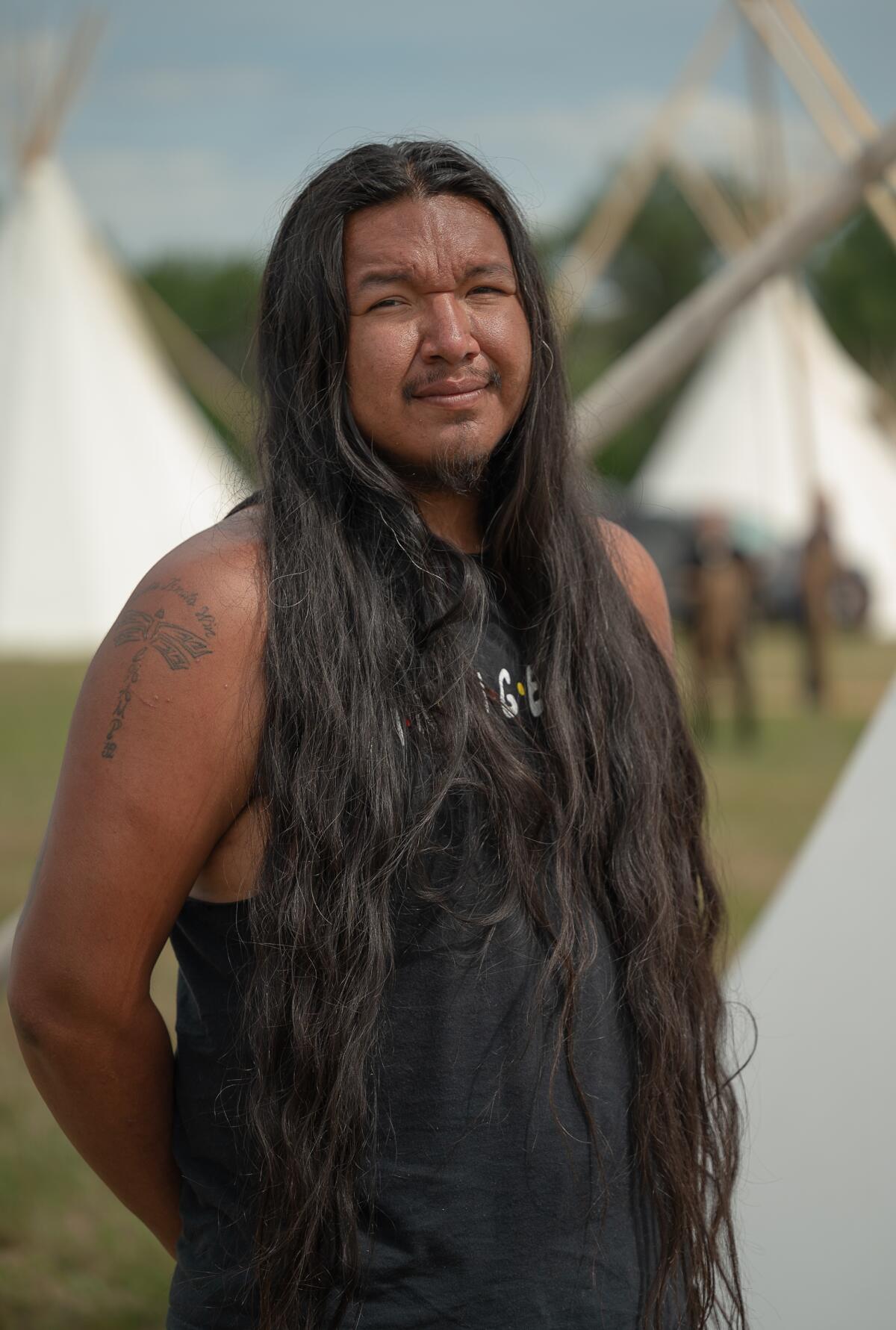
    Christopher Eagle Bear, 27, is the youngest tribal council member for the Rosebud Sioux Tribe. He said the commemoration was about reclaiming and celebrating their identity. 
    Christopher Eagle Bear, 27, is the youngest tribal council member for the Rosebud Sioux Tribe. He said the commemoration was about reclaiming and celebrating their identity.  (Jessica Plance for NPR)

    “They say the battle lasted as long as it took you to make a cup of coffee and drink it,” he said.

    Custer was outnumbered. By the battle’s end, 268 of Custer’s forces were killed, mostly U.S. soldiers. Custer was among those killed. On the other side, fewer than 100 Native Americans were killed, including women and children.

    Custer’s crushing defeat sparked fear and outrage nationwide. The U.S. government responded by changing its approach to Indian policy, shifting to forced assimilation. Just three years after the battle, the first off-reservation federal Indian Boarding School opened in Carlisle, Pa. Hundreds more followed, beginning a century of abuse that attempted to erase Native ways of life.

    “They realized that they couldn’t destroy us head on. … So after that, they did the next best thing that you could do to tear apart a nation, and that was take away the children,” said Eagle Bear.

    Youth leaders hope to inspire the next generation

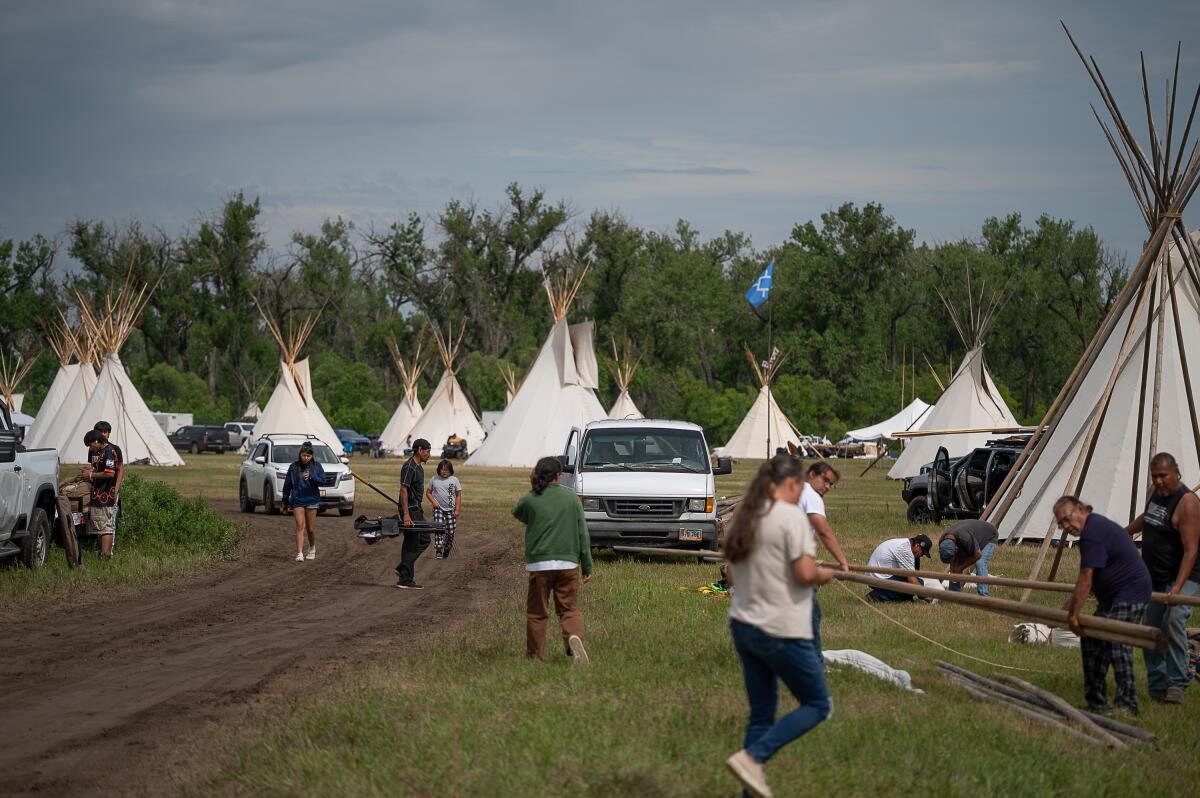
    People are taking down tipis at an encampment along the Little Bighorn River during the 150th anniversary commemoration of the Battle of the Little Bighorn near Little Bighorn Battlefield National Monument. The encampment brought together tribal members from across the Plains for ceremonies, storytelling and remembrance.
    People are taking down tipis at an encampment along the Little Bighorn River during the 150th anniversary commemoration of the Battle of the Little Bighorn near Little Bighorn Battlefield National Monument. The encampment brought together tribal members from across the Plains for ceremonies, storytelling and remembrance. (Jessica Plance for NPR)

    Eagle Bear is camping at the site of that historic village. To commemorate their victory, people from various tribal nations have set up their tipis here, and there is a council lodge in the middle of the camp.

    Eagle Bear is here as one of the coordinators for the Rosebud Sioux Tribe’s camp, and he said he wants to set an example for the next generation.

    “Someday from now, you know, the kids that are here today, they’re going to come together during the 200th anniversary and they’re going to talk about what they witnessed as kids,” he said. “My prayers are being answered every single day with the fact that these kids are here.”

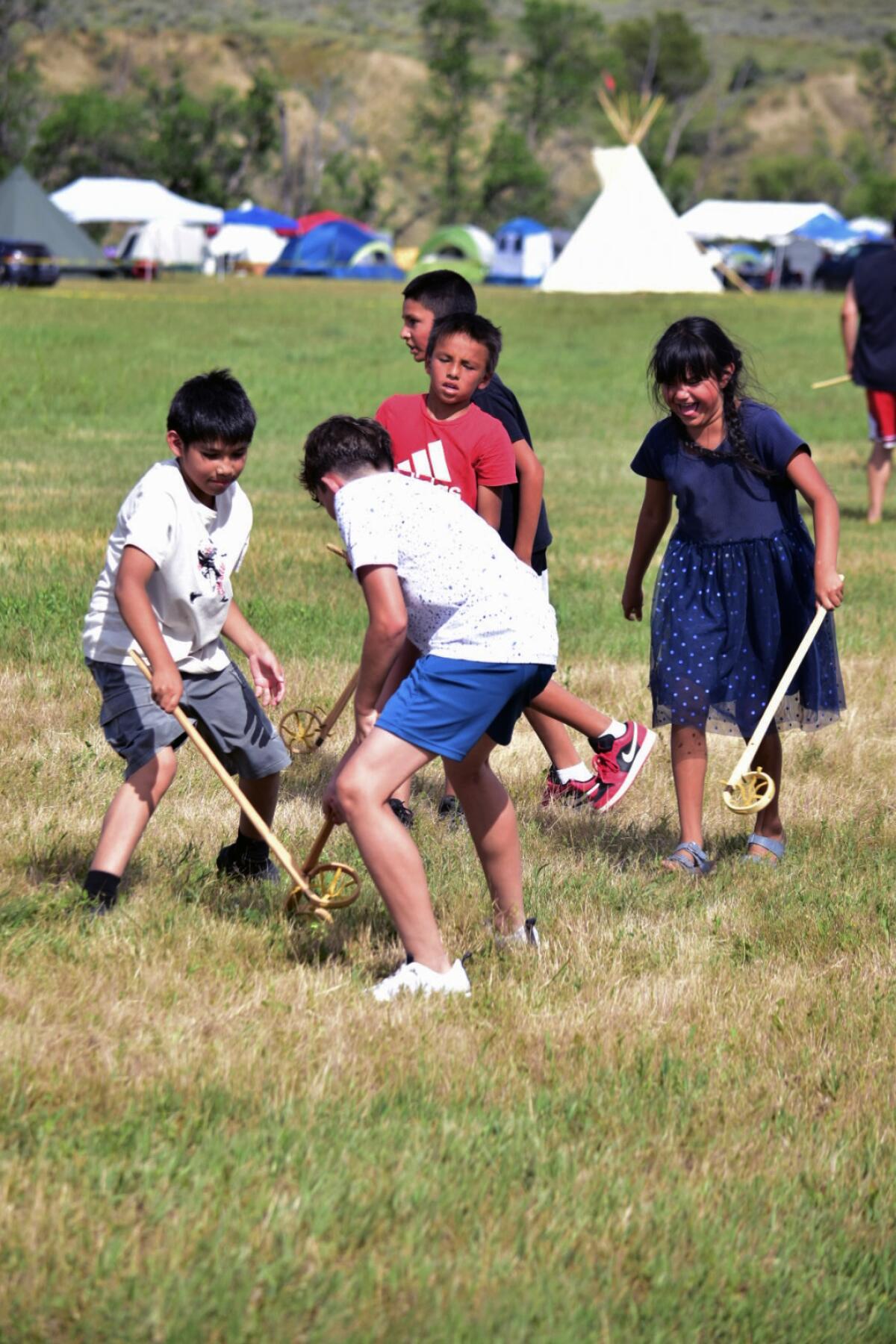
    Just feet away, a group of children are playing lacrosse with traditional sticks to the sound of drumming. And cooking for the camp are members of the Sicunga Youth Council.

    “We’ve been planning this for roughly eight months now. So it’s very heartwarming to see everyone that actually showed up and that’s here,” said Ashlen Bonshirt, a member of the youth council.

    “We did plan the lacrosse, and there’s yoga, and there are all these different amazing things for our youth,” she said. “But on the other side of it is the garbage, the showers — everything that is here, we had to plan for it.”

    The camp is full of young people. School groups, youth councils and kids with their families are staying in tipis all around. Many of them are learning things about the battle that weren’t covered in school.

    “I feel like a lot of it is whitewashed,” said 13-year-old Gianna Larocque-Mahto. She’s Dakota, of the Sisseton-Wahpeton Oyate, and she’s here with her grandmother.

    “We didn’t get to learn about the Native people’s side, like the Dakota people’s side. We only got to learn from one perspective,” she said. “And I feel like that’s not fair. … I think it’s important that we learn from all different people’s perspectives and not just one person.”

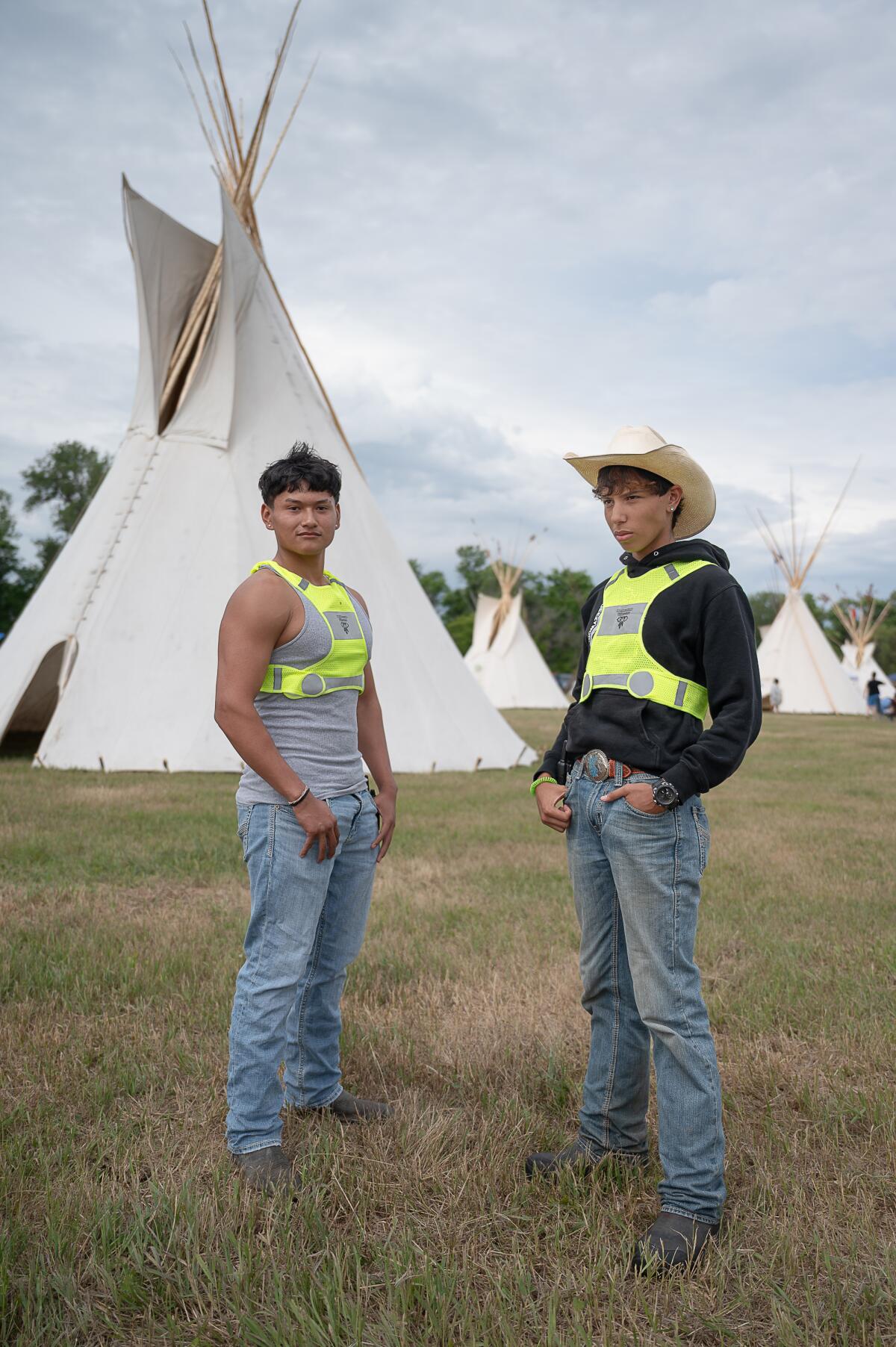
    Champion Marquez and his friend Elijah Wallowing pose in front of a tipi in the encampment.
    Champion Marquez and his friend Elijah Wallowing pose in front of a tipi in the encampment. (Jessica Plance for NPR)
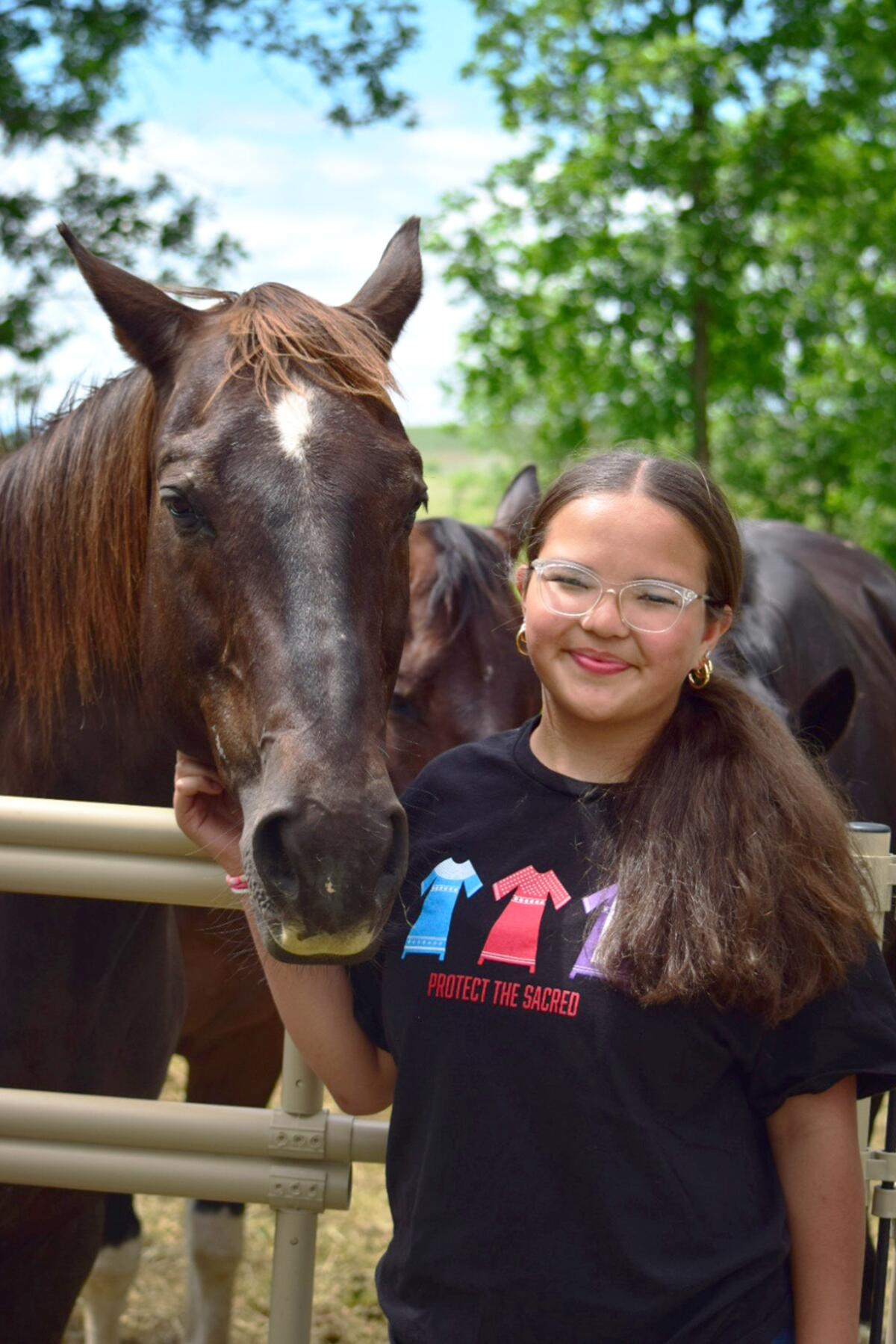
    Gianna Larocque-Mahto rode her horse to the camp from nearby Busby, Mont., joining a group of other riders. They started their 'Victory Ride' in Ashland, Mont., roughly 60 miles away.
    Gianna Larocque-Mahto rode her horse to the camp from nearby Busby, Mont., joining a group of other riders. They started their “Victory Ride” in Ashland, Mont., roughly 60 miles away. (Kadin Mills | NPR)

    Eighteen-year-old Champion Marquez is Cheyenne. He’s also staying at the camp, and he’s been volunteering here this week — working security, helping elders and setting up tipis.

    Marquez said the commemoration gives him hope for the future. “Hope that a bunch of new generations are going to learn about what happened at the Battle of Little Bighorn. Seeing all these kids having fun, playing with each other, all these events for them happening.”

    “Seeing all this here just [reassures] that … we’re still here.”

    A group of children from different tribal nations play lacrosse together using traditional equipment.
    A group of children from different tribal nations play lacrosse together using traditional equipment. (Kadin Mills | NPR)

    Transcript:

    SCOTT SIMON, HOST:

    One hundred and fifty years ago this week, Lieutenant Colonel George Armstrong Custer launched an attack on an encampment of Native tribes in what is now Montana. Often called Custer’s Last Stand, the Battle of Little Bighorn was a decisive victory for Plains tribes. It was also a significant moment in the nation’s history as the U.S. government moved to force Indigenous peoples onto reservations. NPR’s Kadin Mills takes us to the site of that historic battle.

    KADIN MILLS, BYLINE: Much like their ancestors did 150 years ago, members and descendants of over a dozen tribes charged on horseback onto the historic battlefield.

    (SOUNDBITE OF HORSES WHINNYING)

    MILLS: They race across the dry landscape, kicking up clouds of dust before circling at the top of a hill at Little Bighorn Battlefield National Monument.

    (SOUNDBITE OF ARCHIVED RECORDING)

    UNIDENTIFIED RIDERS: (Ululating).

    MILLS: It looks like a scene from 1876, except in addition to headdresses and war paint, many of the riders are also wearing tank tops and T-shirts. And they pose for pictures in front of the crowds that have gathered here.

    UNIDENTIFIED RIDER: (Whooping).

    MILLS: The riders are also carrying the flags of their numerous tribal nations in a show of unity – the same unity that led to Custer’s demise in what many Native people call the Battle of Greasy Grass.

    CHAMPION MARQUEZ: And we were ready to charge until Custer then came and tried to sneak attack us.

    MILLS: That’s 18-year-old Champion Marquez.

    MARQUEZ: We, like, fought back and basically beat them. Kind of like the “Avatar” movie.

    MILLS: He’s Cheyenne, and he’s been volunteering here this week, working security, helping elders and setting up tepees. Plus learning a lot more about this battle than he has in school.

    MARQUEZ: I learned that we just fought them. I didn’t know that we actually, like, gathered up as a tribe, like, of 2,000 people and then we fought.

    MILLS: When Custer and his troops were tasked with dealing with, quote, “hostile Indians,” they thought disbanding the camp would be easy.

    CHRISTOPHER EAGLE BEAR: It was the biggest victory that our people had against the United States government.

    MILLS: That’s Christopher Eagle Bear. He’s Sicangu Lakota of the Rosebud Sioux Tribe. He said the allied tribes hoped this would be the final blow to the U.S. military and that the government would leave them alone.

    EAGLE BEAR: They realized that they couldn’t destroy us head-on. So after that, they did the next best thing that you could do to tear apart a nation. And that was take away their children.

    MILLS: Just three years later, the first federal Indian boarding school opened in Pennsylvania. Hundreds more followed, beginning a century of abuse that attempted to erase Native ways of life.

    EAGLE BEAR: A couple of my grandfathers, my grandmothers, my uncles and aunties – they were all products of boarding schools. And over the course of that, we lost one thing. And that was our identity. That was our spirit.

    MILLS: Eagle Bear is here today with his grandfather, reclaiming that identity. Together, they’re the main event organizers for their tribe’s camp, where they’re surrounded by the sounds of drumming and kids playing traditional games like lacrosse.

    UNIDENTIFIED CHILDREN: Four. Five.

    ASHLEN BONSHIRT: We’ve been planning this for roughly eight months now. So it’s very heartwarming to see everyone that actually showed up and that’s here.

    MILLS: That’s Ashlen Boneshirt. She and her friend Mylah Gabriel are both 18 and members of the Sicangu Youth Council.

    MYLAH GABRIEL: You know, this is us telling people we’re still here, you know, and we’re proud. And we’re not just, you know, hiding.

    MILLS: They’re here with Dominique Harris (ph). She’s the youth council’s project coordinator.

    DOMINIQUE HARRIS: The fact that they’re so young and they’re here now – it just gives them the perfect opportunity and space to learn about the history of this battle, why it’s important to our people and the effect that it has on us to this day.

    MILLS: As we walk through the encampment, we weave between tall canvas tepees that stretch to greet Montana’s big sky. That’s when we meet Gaby Strong. She’s Sisseton-Wahpeton and Mdewakanton.

    GABY STRONG: This camp is full of youth and young people. I think one of the important messages here is this is a commemoration of a victory from 150 years ago, but our victories are still possible today.

    MILLS: As important as it is for the young people to be here, Christopher Eagle Bear says he’s grateful that his grandfather can be here, too, surrounded by a new generation learning and celebrating their cultures.

    EAGLE BEAR: I wanted my grandpa to see this before he made his journey so that whenever he goes to the spirit world, he’ll be able to tell all those leaders, like Crazy Horse and Sitting Bull, that we’re still here. And you guys did a great job.

    MILLS: Eagle Bear says he feels a duty to set that same example for future generations.

    Kadin Mills, NPR News, Crow Agency, Montana.

  • Oklahoma’s decades-long lawsuit over pollution in Illinois River Watershed faces hurdles

    Transcript:

    SCOTT SIMON, HOST:

    More than 20 years ago, the state of Oklahoma sued 14 major poultry companies, arguing that waste from their birds was harming a scenic watershed. That legal story still drags on today. Its resolution could set a precedent for agricultural pollution cases in other states. Anna Pope reports from member station KOSU.

    ANNA POPE, BYLINE: The Illinois River is a weird little backwards waterway, running east-to-west from Arkansas into northeast Oklahoma. The area around it is known for its beauty and its poultry houses. Gerald Hilsher moved here for college in the 1970s and fell in love with the river and the lake it feeds.

    GERALD HILSHER: It was a place where scuba divers loved to go because they could see 15, 20, 30 feet underwater because the lake was so clear.

    POPE: But that’s not the case anymore. He’s dedicated his career to serving on Oklahoma’s Scenic Rivers Commission and other environmental task forces. The area is also primed for chicken producers, like Steve Butler, who runs Green Country Farms.

    STEVE BUTLER: I was born on a chicken farm. My granddad had a chicken farm before that. So then I was raised in chickens.

    POPE: They both love the area, but the lawsuit between poultry companies and the state of Oklahoma has put their goals at odds. Millions of chickens and turkeys live in the watershed, defecating all the while. Poultry litter makes good fertilizer but contains a lot of phosphorus that runs off the land and into the waterway. There, it causes excessive algal growth that clouds the river and chokes out other water life. Butler acknowledges past pollution problems, but he’s been working with conservation groups to fix them, like voluntarily shipping his litter out of the watershed.

    BUTLER: We all got along and worked together to try to improve the Illinois River. That was the goal.

    POPE: It’s been the goal for decades, ever since Oklahoma Attorney General Drew Edmondson sued the poultry companies in 2005.

    DREW EDMONDSON: I was asking no money. Just stop what you’re doing and figure out some way to get rid of the waste, like every other industry in the United States of America.

    POPE: It took five years for a federal bench trial to start against the 14 poultry companies. The largest – Tyson Foods. That was 2010, but the judge did not rule until 13 years later in 2023, saying poultry companies are responsible for the pollution and need to come up with a plan to clean it up. But after years of negotiation, the parties could not agree on a plan. So the judge drew up his own cleanup order to the poultry companies last December. But then, some of the companies finally negotiated settlements with Oklahoma officials. They mapped out a less expensive cleanup plan. Edmondson, who is no longer a plaintiff in the case, didn’t like the settlements.

    EDMONDSON: Had they agreed to that 20 years ago, I’d have been tickled pink. Right now, I wish it was more.

    POPE: That’s because he says 20 years of legal fees and continued pollution have piled up. The judge agreed. He rejected the settlements in March. That means environmental advocates like Hilsher and producers like Butler are still in limbo. Tyson Foods said it would not renew grower contracts in the watershed unless the settlements went through.

    BUTLER: I’m sitting here wondering if I will get to stay in business. And so it’s frustrating that way.

    POPE: Tyson and other defendants who settled did not respond to requests for comment. Neither did federal Judge Gregory Frizzell, who’s handling the case. Legal experts say this case could serve as a template for other states who want to sue over phosphorus pollution. For Hilsher, who wants to restore the watershed, the wait is worth it.

    HILSHER: Well, this has taken a lot of time and effort, and I just had to trust Judge Frizzell that he has moved it along as quickly as he could.

    POPE: Multiple appeals are pending from both the poultry companies and the state of Oklahoma. Meanwhile, the people who love the river and those who rely on poultry production are left waiting for a resolution.

    For NPR News, I’m Anna Pope in Watts, Oklahoma.

    SIMON: And that story was field produced by Graycen Wheeler.

  • Mary Beard discusses her book, ‘Talking Classics: The Shock of the Old’

    Transcript:

    SCOTT SIMON, HOST:

    Mary Beard was about 5 years old when her mother took her to the British Museum and they saw a 4,000-year-old piece of bread in a display case. The curator noticed that young Mary had to jump up to see it, so he opened the case, took out the bread, and held it out for her to see. And that set off a career studying ancient Greek and Rome for Mary Beard, professor at Cambridge and the Royal Academy, classics editor of The Times Literary Supplement and author of many admired books on the ancient world. Her new book “Talking Classics: The Shock Of The Old” is bold enough to ask, why do we continue to have this fascination with the ancient world – Greeks, Romans, Caesars, Sophocles and worlds more? Mary Beard joins us now from Cambridge in the U.K. Thanks so very much for being with us.

    MARY BEARD: It’s great to be with you.

    SIMON: What do you think got stirred up in you that day that you saw this bread excavated from the ancient kingdom of Thebes?

    BEARD: Partly, it was that sheer amazement, that wonderment, that I could be allowed to get so close to something that was both so impossibly old and also amazingly ordinary. We’d been on the same trip to see the Egyptian mummies, which kind of every curious 5-year-old, I think, wants to see. But this ordinary piece of bread just hit the spot for me even more than the mummies.

    SIMON: And yet, you say in this book, you don’t love the Greeks and Romans any more than virologists love viruses.

    BEARD: No. I don’t love them. You know, I think, in all kinds of ways, they are vicious, brutal people I don’t want to replicate. But they are unfailingly interesting. What they write is really interesting, even when I don’t agree with it.

    SIMON: I’ve got to say, one of my favorite sections is when you talk about a graffiti next to a lavatory…

    BEARD: (Laughter).

    SIMON: …In the ruins of Herculaneum, destroyed by a volcano. Maybe I should ask you, the distinguished scholar, to repeat what it says.

    BEARD: Well, it’s in very simple Latin. This is some graffiti which must have been written just a few days before the eruption destroyed the town of Herculaneum, which was kind of Pompeii’s twin sister town. And then it says what did he do? Hic cacavit bene. Now, I have to say I’m sorry. There is no other way of translating hic cacavit bene than had a good crap here. He’s boasting, really, boasting about his bowel movements. Now, at that point, you think, I feel quite close to that world.

    SIMON: There’s also a baby’s cradle nearby, isn’t there?

    BEARD: A wooden cradle. And in this cradle, there was the skeleton of a little baby, and the little baby was sleeping, resting. And a pretty cynical, hard-hearted person touching that cradle and knowing that it didn’t survive. That’s tear-jerking for me.

    SIMON: You write, at one point, the Greeks and Romans have never stopped staring us in the face. How so?

    BEARD: I’m sure that there is not a day since 19 BCE, when the poet Virgil died, when someone has not been reading his great epic poem, “The Aeneid,” telling the story of the foundation of Rome. So I think, you know, you can’t really go out in the world and avoid the Greeks and Romans. I mean, look, we’re all expecting Christopher Nolan’s movie soon. It’s adapting a book that was composed almost 3,000 years ago. You can’t ignore them. You know, they are there. You read James Joyce’s “Ulysses” – he couldn’t have done that without “The Odyssey.” You look at the Coen Brothers’ “O Brother, Where Art Thou?” Right? You can’t do that without “The Odyssey.” We might not like the ancient world. I don’t think I like it very much, but we can’t just ignore it, or we have an impoverished view of our own culture if we try to ignore it.

    SIMON: How do you make the argument which you hear nowadays that the classical world is nothing like the world right now, they were the embodiment of imperialism, privilege and exclusion, and they’re nothing to learn from?

    BEARD: They are that, but I think there are some aspects about the modern world which replicate that. I’ve never wanted to say that the classical world offers us ready-made lessons to solve our own problems. But whatever I morally think about some of the things that the ancient world, in general, stood for, I do know that the ancient writers faced the same kind of problems that we face.

    SIMON: Given your status as a classicist, are you often asked to weigh in on current leadership all over the world?

    BEARD: (Laughter) I am. The commonest question I get from journalists is, which Roman emperor is Donald Trump most like? And I don’t think there’s much point, actually, in comparing any modern political figure to any single Roman emperor. You know, Donald Trump is not like Nero. Sorry, everybody. He’s not. You can see in the way that power operates in the modern world, the way populist power operates, the way autocrats or would-be autocrats operate, you can see some of the structures of that back in antiquity.

    And I – you know, one thing would be leaders’ heads on the coins goes back to Julius Caesar. Autocratic leaders want to see their heads on the currency. In Britain, we’re very used to our monarchs being on the currency. But Julius Caesar was the first person to do this, and he didn’t come to a happy end.

    SIMON: Mary Beard, her new book “Talking Classics.” Thank you so much for being with us.

    BEARD: Scott, thank you. It’s been a great pleasure.

  • As Supreme Court expands Trump’s immigration power, experts warn of steeper U.S. population decline

    As Supreme Court expands Trump’s immigration power, experts warn of steeper U.S. population decline

    Even before the Supreme Court ruled Thursday that President Trump has broad power to deport hundreds of thousands of migrants living legally in the U.S. under temporary protected status, David Bier feared the U.S. was slipping toward a demographic cliff.

    “We’re destined to be there, in short order, there’s no question,” Bier said. “We’re already seeing a situation where most counties in the United States had more deaths than births.”

    An expert on population and immigration at the libertarian Cato Institute, Bier believes the U.S. is beginning to look more like China, Italy and South Korea. Those nations face rapid aging and population decline.

    U.S. birthrates have been declining for decades. There are far too few children born each year to maintain a stable population.

    Until last year, high rates of foreign immigration largely offset that trend. But for the first time since the 1930s, during the Great Depression, the U.S. now faces record low birthrates and low numbers of migrants at the same time.

    “Our higher birthrates of a century ago are not coming back. There’s no way to have a sustainable fiscal and economic situation that doesn’t involve immigration,” Bier said.

    Trump’s legal fight to end temporary protected status for hundreds of thousands of Haitians, Syrians and others living in the U.S. legally is only one part of a wider administration effort to squeeze immigration.

    The Supreme Court also ruled this week that the administration has authority to block most asylum seekers from entering the country. Federal agents have also conducted raids in cities across the U.S., to accelerate deportations.

    Last month, Trump issued an executive order that could make it harder for many migrants living in the U.S. without full legal status to use banking and financial services.

    Many immigration opponents see these changes as progress. In a statement following this week’s Supreme Court decisions. A spokesman for the Federation for Immigration Reform said Trump should have full authority to direct who enters the U.S.

    “Our immigration laws are written to be pro-enforcement, not anti-enforcement,” said FAIR’s Christopher Hajec.

    But according to Cato’s Bier, Trump’s policies are already reshaping the demographics of communities, meaning there are fewer workers, consumers, taxpayers, and children in schools.

    “If you’re not allowing immigration, you’re going to have [an aging and] a declining population and that creates all kinds of problems,” Bier said.

    Economists say that without migrants, the number of young workers paying into Social Security will fall more rapidly; schools in many areas will close; and the number of young families having children will decline.

    Census data already shows big changes to U.S. population

    The immigration decline under Trump is dramatic. In 2024, roughly 2.7 million foreign migrants entered the U.S., according to the Census Bureau. This year, census experts predict that number could drop as low as 300,000. Some demographers believe the U.S. may be reaching a point where more migrants are leaving than entering.

    Impacts of this massive shift on America’s wider population are already emerging. Studies by the Census Bureau, the Congressional Budget Office, and the Federal Reserve all point to a more rapidly aging national population under Trump.

    Population growth in the U.S. fell by half in 2025 from the previous year, with five states losing population. Census data shows the total number of young Americans, those under age 25, is already falling nationwide.

    William Frey, a demographer at the liberal-leaning Brookings Institution, described last week’s Supreme Court rulings as “alarming.” He believes without robust foreign immigration, more states will quickly see their populations stagnate or decline.

    “Not just in big immigration states, but in places that have relatively small numbers of immigrants, you know, Iowa, Kansas, Nebraska — those states require immigrants to get any population growth,” Frey said.

    Even before Trump’s policies curbed immigration, the U.S. population was expected to decline later this century. Experts say low immigration rates will cause that downward trend to happen much sooner.

    According to Frey, the U.S. has time to reverse course. But he believes the Trump administration is committed to lowering both legal and illegal immigration over the long term, a policy he described as dangerous.

    “This is as clear as the nose on your face,” he said. “You’ve got to have this growth in the younger population if you’re going to survive. Immigration is a key part of that going forward.”

    “America’s doors are closed”

    Stephen Miller, White House deputy chief of staff for policy, speaks with reports at the White House, Thursday, June 25, 2026, in Washington.
    Stephen Miller, White House deputy chief of staff for policy, speaks with reports at the White House, Thursday, June 25, 2026, in Washington. (Jacquelyn Martin | AP)

    The Trump administration sees this very differently, describing foreign migrants not as people who sustain state populations and economies, but as a social burden and a threat.

    “America’s doors are closed fully to asylum seekers,” Stephen Miller, one of Trump’s top White House policy advisors, said on Thursday.

    Speaking with reporters, Miller described the Supreme Court rulings as a victory and said ending birthright citizenship for the children of migrants born in the U.S. is the next step.

    “This country doesn’t have a future if we don’t end birthright citizenship,” Miller said. Justices are expected to rule on birthright citizenship as early as next week.

    This kind of opposition to both legal and illegal immigration is now widespread among conservatives, said Cato’s David Bier, who worked as a Republican congressional staffer on immigration policy.

    He told NPR that when he talks to conservatives about the economic and demographic risks of closing the country’s doors to migrants, many answer with a cultural argument. “[They] would rather have a declining population of ‘true Americans’ than have an economy kept afloat by people who don’t share [their] values,” Bier said.

    But if extremely low or zero-level immigration does become the new normal for the U.S., experts say it would swiftly remake the fabric of the country. The Census Bureau estimates that without robust migration in the coming years, total population loss by the end of this century could exceed 107 million people.

    Transcript:

    AYESHA RASCOE, HOST:

    A little more now on immigration. Mara gave us the political angle. NPR’s Brian Mann brings us this look at the demographic concerns about the administration’s push to limit immigration to the U.S.

    BRIAN MANN, BYLINE: When the Trump administration began cracking down hard on foreign migrants, David Bier, an expert on population and immigration at the libertarian Cato Institute, says it moved the U.S. toward a demographic crisis, similar to those playing out in countries like Italy and South Korea.

    DAVID BIER: We’re destined to be there in short order. There’s no question we are already seeing a situation where most counties in the United States have more deaths than births.

    MANN: For the first time since the 1930s – the era of the Great Depression – the U.S. now has historically low birth rates and historically low foreign immigration at the same time. Bier says the Trump administration squeezed the flow of foreign migrants in large part by targeting those here legally. The result, he says, are fewer workers, fewer consumers, also fewer taxpayers and fewer kids in schools.

    BIER: Our high birth rates of a century ago are not coming back. There’s no way to have a sustainable fiscal and economic situation that doesn’t involve immigration.

    MANN: Demographer William Frey, at the liberal-leaning Brookings Institution, is also alarmed. He says at first he hoped Trump’s anti-immigrant efforts would be fairly brief, not large enough in scale to slow the long-term pattern of high immigration. But the Supreme Court’s rulings this week impact hundreds of thousands of people now living in the U.S. legally. If birthright citizenship for the children of migrants is stripped, it would affect millions more. This is happening at a time when, because of historically low birth rates in the U.S., the population of young people under age 25 was already falling.

    WILLIAM FREY: This is as clear as the nose at your face. You’ve got to have this growth in the younger population if we’re going to survive, and immigration is a key part of all of this going forward.

    MANN: Under Trump, the decline in immigration is dramatic. In 2024, roughly 2.7 million migrants entered the U.S., according to the U.S. Census Bureau. This year, census experts predict that number could drop as low as 300,000. Some demographers believe the U.S. may actually be reaching a point where more migrants are leaving the U.S. than entering. Studies by the U.S. Census Bureau, the Congressional Budget Office and the Federal Reserve all point to a more rapidly aging U.S. population under Trump. Population growth in the U.S. fell by half last year, with five states losing population. Frey thinks more states will join that decline.

    FREY: Not just in big immigration states, but in places that have relatively small numbers of immigrants – you know, Iowa, Kansas, Nebraska. Those states require immigrants to get any population growth.

    MANN: The Trump administration sees this very differently, describing foreign migrants not as people who sustain state populations and economies, but as a social burden. Stephen Miller, one of Trump’s top policy advisers, celebrated the Supreme Court’s rulings on Thursday.

    (SOUNDBITE OF ARCHIVED RECORDING)

    STEPHEN MILLER: America’s doors are closed fully to asylum seekers.

    MANN: Speaking with reporters, Miller said ending birthright citizenship for the children of migrants born in the U.S. is the next step. This country doesn’t have a future if we don’t end birthright citizenship, he said.

    David Bier worked as a Republican congressional staffer on immigration policy before joining the Cato Institute. He says when he talks to conservatives about the economic and demographic risks of keeping migrants out and forcing migrants with legal status to leave, most answer with a cultural argument.

    BIER: We would rather have a declining population of true Americans than have the economy kept afloat by people who don’t share our values.

    MANN: Experts say if extremely low immigration becomes the new normal in the U.S., it would remake the fabric of the country, with the U.S. Census Bureau predicting population loss of tens of millions of people by the end of this century.

    Brian Mann, NPR News.

  • What would George Washington say? It’s a busy year for people who portray him

    What would George Washington say? It’s a busy year for people who portray him

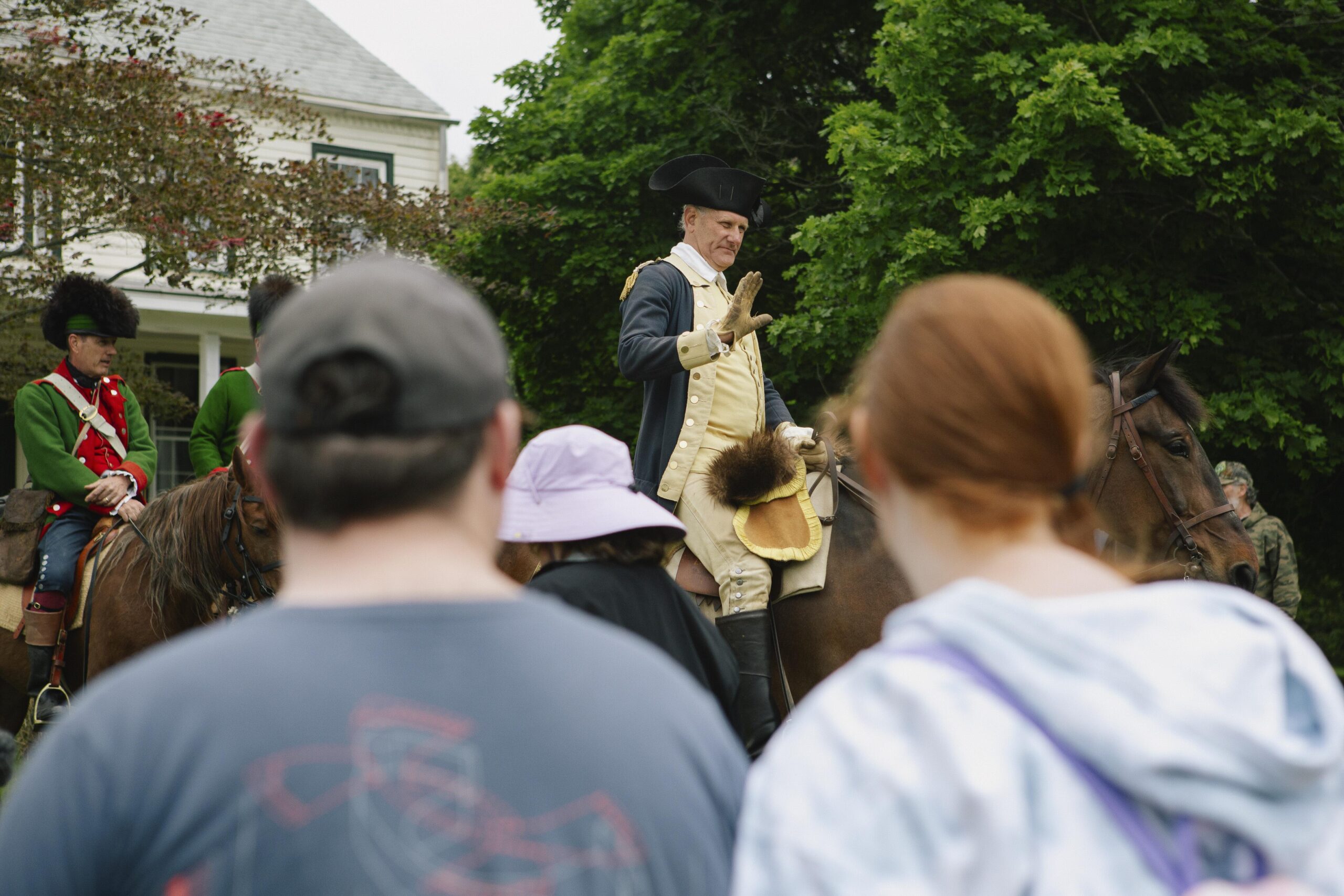
    MILLSTONE TOWNSHIP, N.J. — One recent day in central New Jersey, the grass field around a historic farmhouse was transformed into a Gen. George Washington Revolutionary War encampment, with tents, people in costume and families taking photos.

    Suddenly, an unmistakable figure appeared on horseback, wearing a long navy wool coat and a black tricorn hat.

    “March!” yelled a man, as a drum and fife (piccolo, actually) struck up a Revolutionary battle tune. Three people dressed as soldiers lined up for review by Washington, then fired shots from long muskets.

    Scenes like these have played out across the country as America celebrates its 250th birthday and more people look for ways to take part.

    “Anything that pops up, I try to go to,” said Robin Fox, who’s lived nearby for 21 years but never been to this site.

    The semiquincentennial has meant a banner year for historical reenactors and interpreters, especially those who portray the ever-popular Founding Father. Some have driven hundreds of miles a week to meet the demand. And whether it’s a hobby or a career, they believe George Washington’s life holds important lessons for today, especially at a time of such divided politics.

    “Exactly what Washington predicted”

    John Koopman III looks straight out of a history book. It’s not just his angular face and hair tied back with a ribbon, but his entire tall frame, as he learned from the tailor who made his military costume.

    “Where my sleeves fall and my wrist, the size of my chest, where my breaches fall, is all identical to Washington,” he explained. “That made my day.”

    We met under a shade tree as he stood next to his beloved horse, Bear. Koopman started this hobby nearly three decades ago, when his Connecticut town put on a reenactment to mark the 300th anniversary of its founding.

    “Of course, now my wife regrets it, but she said, ‘You know, John, you should join one of these units,’” he said. “And now she’s sitting there, ‘What was I thinking?’”

    He liked the Revolutionary War time period and its sense of chivalry, so he stuck with it. The hobby inspired him to learn how to ride a horse. In 2006, a friend said he should try playing Washington because he looked so much like him.

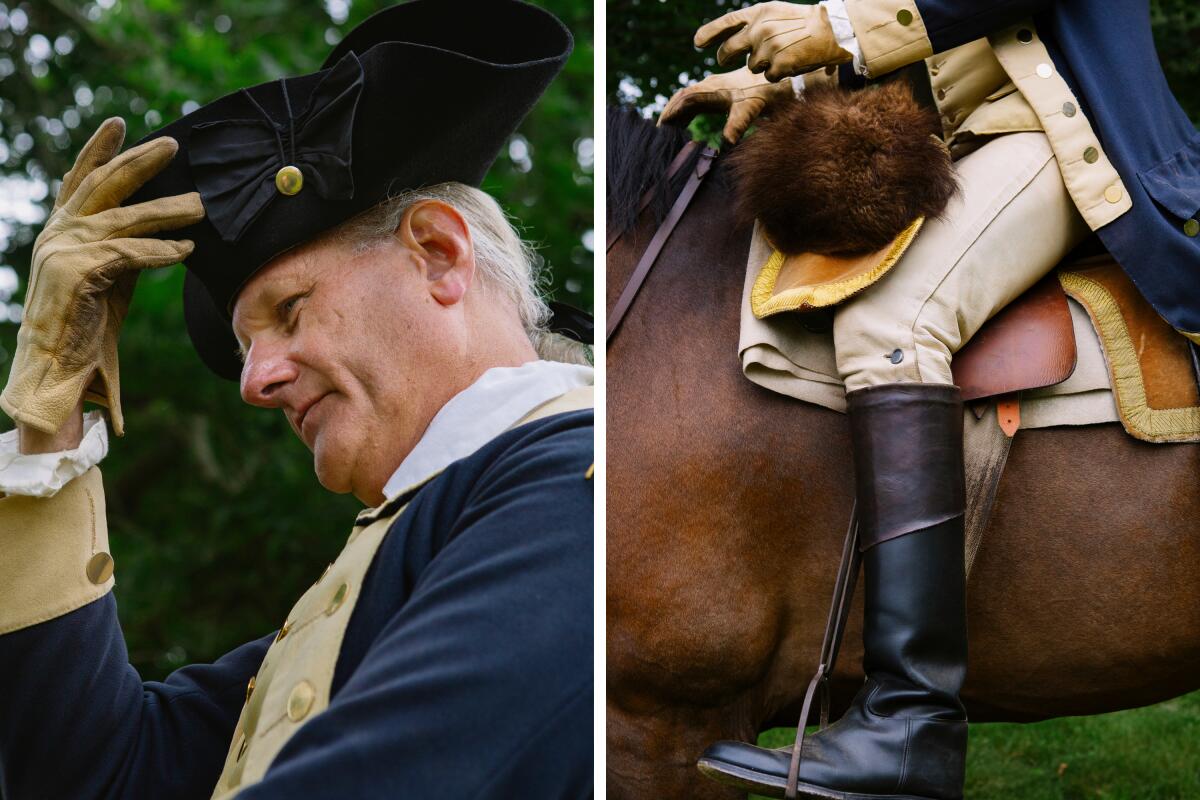
    Koopman used a small inheritance to pay for an appropriate saddle and the costume, which cost several thousand dollars each. For an authentic version of Washington’s uniform, he commissioned a friend who’d been a tailor for the first president’s historic home at Mount Vernon.

    John Koopman III dons his replica of George Washington's military uniform before the event in New Jersey.  He said the tailor told him his dimensions are nearly the same as the general's, and 'that made my day.'
    John Koopman III dons his replica of George Washington’s military uniform before the event in New Jersey. He said the tailor told him his dimensions are nearly the same as the general’s, and “that made my day.” (Michelle Gustafson for NPR)
    Koopman used a small inheritance to purchase a period-accurate saddle and specially tailored costume.
    Koopman used a small inheritance to purchase a period-accurate saddle and specially tailored costume. (Michelle Gustafson for NPR)

    Since then, Koopman has performed in a film shown at Mount Vernon and multiple other documentaries. He even branched out to write a historical novel on the Revolutionary War.

    He retired a year ago from his “regular job” at an alternative energy company and is reenacting full time these days, while the heightened interest lasts. He and his horse recently set a personal best with three separate events in one weekend.

    “We had to get in the trailer and go to a different place,” he said, adding that Bear “did very well.”

    Koopman concedes Washington was hardly perfect. He and his wife owned hundreds of slaves, freeing those he owned personally in his will. Still, he finds Washington’s call for national unity more relevant than ever. Especially his warning that political parties would put their own needs before those of the people.

    “And then you get the situation you have today,” he said, where lawmakers oppose good legislation simply because it’s proposed by the other party. “That’s exactly what Washington predicted would happen.”

    Koopman’s manager, Brad Fay, has had a lifelong fascination with Washington because a distant ancestor was an officer for him during the Revolutionary War. The family inherited a famous painting of the first president, “and it was literally over my shoulder, you know, for my entire teenage years,” he said.

    Fay believes the significance of America’s birth, with its ideals of freedom and equality, has the power to unite.

    “It’s the one story we all subscribe to,” he said, “and so I think it’s more important than ever for us to feel a connection to our founding.”

    A surging hunger for that has kept him and his small team of reenactors busy: He booked 31 events from May through July 4. Beyond the battlefield, a popular experience is an evening dinner with Washington, which often includes the traditional 13 toasts for 13 colonies.

    “They would usually be given to Washington, and then Washington would give a return toast,” he said.

    Comfort looking back in time

    The central New Jersey encampment included a hospital tent, farm animals and a table where a woman demonstrated how laundry was done. Visitors also packed inside the farmhouse where Leslie Bramlett portrayed the enslaved cook Hannah Till, who traveled with Washington.

    “She ends up being freed, and she still stays with George Washington, for seven years of the war,” she explained to one family.

    Bramlett is part of a broader push to tell the stories of those who made Washington’s success possible but were long ignored.

    Reenactor Leslie Bramlett, playing George Washington's enslaved cook Hannah Till, stands for a portrait after preparing a display that represents the women of color who played a pivotal role in Washington's army.
    Reenactor Leslie Bramlett, playing George Washington’s enslaved cook Hannah Till, stands for a portrait after preparing a display that represents the women of color who played a pivotal role in Washington’s army. (Michelle Gustafson for NPR)

    “There were 850 women and children encamped with George Washington at Valley Forge, the beginning of the war, and then that number grows,” she said. “So every time you see soldiers, you should remember that there are women and children following them.”

    Outside the farmhouse, Anthony Privetera said he brought his 7-year-old son to the day’s event “because you always learn about history, because if not history repeats itself.”

    Down the hill, Lee Ann Folk said she became more focused on history in the past few years. Looking back in time helps her feel less worried about today’s political divides.

    “We’ve been through hard times,” she said. “So it helps to calm the soul, to know that we’ve been there and we’ll get through this.”

    Sharing Washington’s ideals with a new generation

    A few hours south, at historic Mount Vernon, more fife and drum music heralded a recent ribbon-cutting for an updated exhibit. And another person portraying General Washington was on hand to work the crowd.

    “Would you have changed anything in your life?” asked a middle school student on a class trip from Bettendorf, Iowa.

    “I would not have stood for a second term,” replied Doug Thomas, in full military uniform.

    Thomas stayed in character as the students asked about his horses and his religion, and he explained how he made a point of attending different houses of worship to show that “bigotry had no place in America.”

    He also poked gentle fun at the shorts all the students wore, when he said at one point, “The thought is as absent as the rest of your trousers!”

    And there was laughter when several middle schoolers from California tried to explain a “selfie” as they gathered around the Founding Father and mugged for the camera.

    First-person interpreter Doug Thomas poses for a photo at Mount Vernon's education center on June 11. The students, from El Dorado Hills, Ca., had fun trying to explain a 'selfie' while he stayed in character as George Washington.
    First-person interpreter Doug Thomas poses for a photo at Mount Vernon’s education center on June 11. The students, from El Dorado Hills, Ca., had fun trying to explain a “selfie” while he stayed in character as George Washington. (Tyrone Turner/WAMU)

    This is a career for Thomas, who is not a reenactor but a first-person interpreter. He’s played more than 20 people in theater and at historic sites in Philadelphia and “aged into” Washington about seven years ago.

    The 250th anniversary amped up his workload. In the past week, he’d driven hundreds of miles to various gigs, including one at a financial group in New York City. There, he talked about lessons from Washington the businessman, such as the importance of branding.

    “Branding is literally because he used a branding iron to brand the barrels of flour that he sold at his mill,” he explained. “They said ‘G. Washington,’ so you knew you were getting the finest quality flour that was out there.”

    Thomas said the nation has not always lived up to the ideals of Washington and its founding documents. But he sees his work as helping to pass them on to new generations, so they can keep building on what’s come before.

    “The fact that we have a government by the people, for the people, is really absolutely astounding,” he said. “And we just need to make sure that we inform the populace that they are, in fact, in charge.”

    Doug Thomas poses for a portrait as Gen. George Washington in front of the Mount Vernon mansion in Virginia. He's made a career as a first-person interpreter and aims to pass along the ideals of America's founding to new generations.
    Doug Thomas poses for a portrait as Gen. George Washington in front of the Mount Vernon mansion in Virginia. He’s made a career as a first-person interpreter and aims to pass along the ideals of America’s founding to new generations. (Tyrone Turner | WAMU)

    Also on hand for the ribbon cutting was Mount Vernon CEO Doug Bradburn, a scholar of early American history. He pointed out that Washington’s government, too, had political division.

    “Even in his own Cabinet, he had people that hated each other,” Bradburn said, “and he constantly had to remind them, until we are governed by angels, we have to allow for differences of opinion.”

    Transcript:

    SCOTT SIMON, HOST:

    It’s a banner year for people who portray George Washington. America’s 250th birthday has brought more events, new crowds for Revolutionary reenactors and interpreters. NPR’s Jennifer Ludden caught up with a couple to see what they hope comes of all the attention.

    JENNIFER LUDDEN, BYLINE: On a recent day in central New Jersey, a grass field is transformed into one of General George Washington’s Revolutionary War encampments. There are tents, people in costume. Families mill about and snap photos.

    UNIDENTIFIED PERSON #1: One…

    UNIDENTIFIED PERSON #2: Let’s do three.

    (SOUNDBITE OF CAMERA SHUTTER CLICKING)

    UNIDENTIFIED PERSON #1: …Two, three.

    UNIDENTIFIED PERSON #2: Thank you.

    JOHN KOOPMAN III: You’re welcome.

    LUDDEN: Then an unmistakable figure appears on horseback.

    UNIDENTIFIED PERSON #3: March.

    (SOUNDBITE OF DRUM AND FIFE MUSIC)

    LUDDEN: Washington in long navy coat, tricorne hat, makes his way over to review the troops. Well, three soldiers who form a short line. Dotted across the field, there are also farm animals, a hospital tent. One woman demonstrates how laundry was done. Another is set up inside a historic farmhouse to portray the enslaved cook who traveled with Washington. Locals who’ve come to soak it all in say they wanted to mark the nation’s Semiquincentennial.

    ROBIN FOX: We’ve lived here for 21 years and never came to this house.

    ANTHONY PRIVETERA: Because you always learn about history. Because if not, history repeats itself.

    LEE ANN FOLK: All of a sudden, in the last maybe four years, I’m a history person (laughter). My mother did bring us up that way anyway, but even more so these days.

    LUDDEN: That’s Robin Fox, Anthony Privetera and Lee Ann Folk. She says looking back in time makes her feel less worried about today’s political divides.

    FOLK: We’ve been through hard times, so it helps to calm the soul to know that we’ve been there, and we’ll get through this.

    LUDDEN: Behind the farmhouse, I meet the man of the moment. And it is uncanny talking to someone who looks straight out of a history book. John Koopman III, dressed as George, stands under a tree next to his beloved horse, Bear.

    KOOPMAN: So this is the big guy.

    LUDDEN: He’s gorgeous.

    KOOPMAN: Oh, thank you.

    LUDDEN: Koopman retired a year ago from his regular job at an alternative energy company. He’s full-time reenacting these days, while the heightened interest lasts. One recent weekend, he and Bear set a personal best for busy.

    KOOPMAN: Three different events altogether. You know, we had to get in the trailer and go to a different place.

    LUDDEN: Koopman started this hobby nearly three decades ago, when his Connecticut town marked its 300th anniversary.

    KOOPMAN: And so they had a reenactment in town. And then, of course, now my wife regrets it. But she said, you know, John, you should join one of these units. And now she said, what was I thinking?

    LUDDEN: He likes the Revolutionary time period and its sense of chivalry. So he stuck with it, and that’s what led him to learn horseback riding. Then, in 2006, a friend said he should try playing Washington because he looks like him. Koopman used a small inheritance to pay for the costume and a saddle, several thousand dollars each. And he commissioned a friend who’d been a tailor for Washington’s historic home at Mount Vernon. It turns out…

    KOOPMAN: Where my sleeves fall at my wrist, the size of my chest, where my breeches fall is all identical to Washington. So when I learned that, it made my day (laughter).

    LUDDEN: Koopman has since appeared in a film at Mount Vernon and other documentaries. He admits Washington was hardly perfect. He and his wife enslaved hundreds of people, freeing those he owned personally in his will. Still, Koopman thinks his message as president holds lessons for today, like his warning that political parties would put their own needs before those of the people.

    KOOPMAN: And then you get the situation you have today. Let’s say a legislator has good legislation. Well, the opposing party will say, even though it’s good legislation, I’m going to oppose it. So that’s exactly what Washington predicted would happen.

    (SOUNDBITE OF DRUM AND FIFE MUSIC)

    LUDDEN: A few hours south, I stopped by a ribbon cutting for an updated exhibit at historic Mount Vernon.

    DOUG THOMAS: Three cheers for George Washington and a revolutionary life. Hip, hip.

    UNIDENTIFIED CROWD: Hurrah.

    THOMAS: Hip, hip.

    UNIDENTIFIED CROWD: Hurrah.

    THOMAS: Hip, hip.

    UNIDENTIFIED CROWD: Hurrah.

    LUDDEN: Another George Washington is on hand to work the crowd.

    UNIDENTIFIED STUDENT #1: Did you know that you were, like, about to die, when you died?

    THOMAS: (As George Washington) I am quite healthy and hale, Miss.

    UNIDENTIFIED STUDENT #1: OK. Well, I…

    THOMAS: (As George Washington) My secretary of state?

    UNIDENTIFIED STUDENT #2: Aaron Burr.

    THOMAS: (As George Washington) No. No. Thomas Jefferson.

    UNIDENTIFIED STUDENT #2: I knew that.

    UNIDENTIFIED STUDENTS: Oh. I knew that.

    THOMAS: (As George Washington) You did not.

    UNIDENTIFIED STUDENT #2: OK.

    THOMAS: (As George Washington) You did not.

    (LAUGHTER)

    UNIDENTIFIED STUDENT #2: Yeah. Yeah.

    THOMAS: (As George Washington) The thought was as absent as the rest of your trousers.

    (LAUGHTER)

    LUDDEN: This is a career for Thomas, who’s not a reenactor but a first-person interpreter. He’s played more than 20 people in theater and at historic sites in Philadelphia and says he aged into Washington about seven years ago. Just this past week, he drove hundreds of miles to various gigs, including at a financial group in New York City, where he talked about lessons from Washington the businessman, like the importance of branding.

    THOMAS: Branding is literally because he used a branding iron to brand the barrels of flour that he sold at his mill. So they said, G. Washington, so you knew you were getting the finest quality flour that was out there.

    LUDDEN: Thomas says the nation has not always lived up to the ideals of Washington or its founding documents, but he sees his work as helping to pass them on to new generations so they can keep building on what’s come before.

    THOMAS: The fact that we have a government by the people for the people is really absolutely astounding, and we just need to make sure that we inform the populace that they are, in fact, in charge.

    LUDDEN: Back at the exhibit, an older couple complains to Thomas about corrupt politicians. He tells them that’s nothing new. Then more schoolgirls want a selfie.

    UNIDENTIFIED STUDENT #3: But what he said in the hall…

    THOMAS: (As George Washington) A self-portrait…

    UNIDENTIFIED STUDENT #4: That is an awkward angle.

    THOMAS: (As George Washington) Because it is poor artistry.

    LUDDEN: They crowd around the Founding Father and mug for the camera.

    Jennifer Ludden, NPR News, Mount Vernon, Virginia.

    (SOUNDBITE OF MUSIC)

  • We almost had a smartphone in the 90s. Why did it fail?

    We almost had a smartphone in the 90s. Why did it fail?

    In the early 90’s, a company called General Magic began working on a portable device that would allow people to check email, make phone calls, even play games. It was basically a smartphone. But it never caught on.

    On today’s show, a theory about why this device failed. General Magic had generous investors, world-class talent and creative freedom. But is it possible what they needed was constraints?

    Further reading and viewing:
    David Epstein’s book is Inside the Box: How Constraints Make Us Better.
    Tony Fadell’s book is Build: An Unorthodox Guide to Make Things Worth Making.
    Sarah Kerruish and Matt Maude’s documentary is called General Magic.

    Support:

    Read: 

    Follow: 

    This episode was hosted by Erika Beras and Emma Peaslee. It was produced by Emma Peaslee with help from Sam Yellowhorse Kesler and James Sneed. It was edited by Marianne McCune and fact-checked by Charlotte Isidore. It was engineered by Jimmy Keeley with help from Cena Loffredo. Alex Goldmark is Planet Money‘s executive producer.

    Music: Universal Production Music – “Level It Up,” “The Void,” and “Dragon Lounge”

    Transcript:

    [COIN RATTLES]

    ANNOUNCER: This is Planet Money from NPR.

    ERIKA BERAS: OK. How many times have you sat and thought about how much more you could accomplish if you had more– more time, more money, more resources?

    EMMA PEASLEE: Like, how good project could be if you had just one more day.

    BERAS: Or a bigger budget or more help.

    PEASLEE: Well, this is the story of a company that did have all of that, and they were making something amazing, something most of us touch every day– a smartphone.

    BERAS: But, and this is the part that is bonkers, this was happening nearly two decades before the iPhone came out.

    TONY FADELL: Before the internet, before Wi-Fi, before data, before cell phones even–

    PEASLEE: Tony Fadell was employee number 29 at that company.

    FADELL: –before even email really existed for people, before anything like Amazon or e-tailing existed, before downloadable games or downloadable music existed, all of that stuff, we were creating all the technology that would later become what the iPhone was.

    PEASLEE: Nowadays, Tony is a businessman. He’s always been a computer geek– his words, not ours.

    FADELL: I was making fake IDs on a Mac in high school because you had a laser printer, and a laser printer was like, oh my god, I could replicate things in the world. So I was making fake IDs on laser printers.

    BERAS: You must have been very popular.

    FADELL: Oh, yeah, yeah, yeah. I made a lot of money, too.

    BERAS: Tony was brought up in the ’70s and ’80s to build things.

    FADELL: I was fixing things. I was changing electrical sockets.

    BERAS: You’re describing yourself as kind of being like a shop class kind of kid.

    FADELL: Yeah, my grandfather taught shop class.

    BERAS: Oh, seriously, a shop class kid? OK.

    FADELL: He always had the mantra, “If a human made it, a human can fix it and build other things, too.”

    BERAS: Tony’s favorite thing to tinker with was computers.

    FADELL: It was your own world. You could make anything you wanted.

    PEASLEE: And around the time Tony was in high school, mid-’80s, computer geeks actually started to become cool.

    FADELL: In Rolling Stone, there was a huge article by Stephen Levy about the original Mac team. And I was like, oh my god, there’s computer guys like me, guys and gals like me, building this thing that I love, the Macintosh, and they’re in a rock and roll magazine. I’m like, superstars!

    BERAS: He’s 15, and he became obsessed with these computer engineers.

    FADELL: Oh, I could be like that. So they were my heroes. And so I would just track them obsessively. Yeah, stalking, you could say.

    BERAS: Tony went to college, launched a few startups, and he kept reading tech magazines. And then one day, he saw something buried in the gossipy type pages in the back of one of those magazines. Tony learned his heroes were working on this top secret project. It was at a brand-new company called General Magic.

    FADELL: And I was like, General Magic, what? What is this?

    PEASLEE: And he didn’t care how, he just wanted in.

    FADELL: I had no idea what they were doing, but whatever it is, I needed to get involved.

    PEASLEE: He found a number, started calling sometimes 10, 15 times a day.

    BERAS: This is your favorite band. You’re like, I want to get on the road with the band.

    FADELL: Yeah. I’ll be a roadie, whatever it takes. I just want to be with this band. So after, you know, six to seven month knocking on the door, getting rejected, and pestering the hell out of everyone there, they gave me a job. And I went crazy.

    BERAS: Tony moved to Silicon Valley to work with his heroes. He was 21. His dream had come true. He was hired as a software engineer in the hardware team at General Magic to make the first smartphone, this thing that was going to in 1991.

    [THEME MUSIC]

    BERAS: Hello, and welcome to Planet Money. I’m Erika Beras.

    PEASLEE: And I’m Emma Peaslee. General Magic had everything– the vision, the talent, the money. But having everything might have been its undoing.

    BERAS: Today on the show, what the push to create the first smartphone can teach us about how genius ideas come to life or don’t.

    [THEME MUSIC]

    PEASLEE: General Magic was creating basically an iPhone, but in the early ’90s.

    BERAS: At that time, I was carrying quarters around to use payphones. Computers were in, like, of American homes.

    PEASLEE: And yet here was General Magic creating this ultimate portable interconnectivity device, where from your palm, you’d call people, send them faxes. You’d be able to buy things on it, book travel, navigate yourself around, play games. And none of this existed. Tony was part of the team that was building all of it.

    FADELL: We were creating the entire operating system. We were creating all the chips. We were creating the devices. We were creating all the network servers and network server software, all the user interface, all the applications. We were creating–

    PEASLEE: That is a lot.

    FADELL: We were creating the touch screen. We were creating everything–

    PEASLEE: What? All of it?

    FADELL: –in this little company– all of it at this company.

    PEASLEE: Research, development, and engineering were all happening at once. And they had the talent to do it. General Magic was started by those rock stars, and they hand-picked other budding rock stars to work there too.

    BERAS: It was so exciting. General Magic even hired an in-house film crew–

    [AUDIO PLAYBACK]

    CREW: Oh, smile, you’re on Candid Camera.

    [END PLAYBACK]

    BERAS: –that ended up making a documentary about the company. So we’ve seen footage of younger, long-haired Tony hunched over a small screen with a bunch of wires connected to a keyboard.

    [AUDIO PLAYBACK]

    FADELL: I’m hooking up a demo so that we can see keyboards working with the device.

    [END PLAYBACK]

    PEASLEE: He’s building an early version of the USB.

    [AUDIO PLAYBACK]

    INTERVIEWER: Is it important?

    FADELL: If you want to hook up disk drives and things of that nature, yeah, it’s really important.

    [END PLAYBACK]

    PEASLEE: Another employee, Megan Smith, was working on a touch screen

    [AUDIO PLAYBACK]

    MEGAN SMITH: You can figure out where you are, whether you’re touching T or whether you’re touching Caps Lock.

    INTERVIEWER: And how small will it finally be, do you think?

    SMITH: Someday, Dick Tracy wristwatch.

    [END PLAYBACK]

    BERAS: And the money was there to fuel all these experiments. The company’s investors included all these telecom and electronics giants, like Apple and AT&T and Motorola and Sony and Panasonic, to name a few. They literally threw many, many millions of dollars at this Silicon Valley startup because they all wanted a piece of what could potentially be the next big thing. People from those companies would sometimes come visit.

    FADELL: They were just, like, mesmerized. Like, what is this you’re building? They had no reference point because it was so different than anything they had seen. So they’re like, whoever these people are, they’re really geniuses. It’s really cool. I don’t understand it. But we’ll just keep them going because it’s clear they think they know what they’re doing.

    BERAS: The employees called themselves magicians, and there was even a bunny in the office.

    PEASLEE: An actual bunny named Bowser because, of course, magicians need a rabbit. And the magicians worked endlessly.

    FADELL: Just people programming whatever at all times of the day and night, doing things and say, come over here and check this out. People would be sleeping there overnight. We were there so often the place smelled, you know? People would hang up their dirty clothes on the cubicle walls.

    PEASLEE: Oh, gosh. Ew.

    FADELL: It was like a huge dorm room. It smelled like one.

    PEASLEE: And their job was just to come up with ideas and try everything. And their bosses encouraged that.

    FADELL: I’m like, hey, I’m thinking about this. Yeah, that’s a good idea, go work on that. I’m like, OK. And then I’d show them. They’re like, well, maybe a little bit more of this, maybe more of that, and then go off and do it.

    BERAS: And the funders, those giant companies, they also had ideas. Tony would travel as far as Japan to meet with Mitsubishi or Sony. And those companies wanted the General Magic device to work with their systems. So Tony would come back to the office, and they’d all keep tinkering.

    PEASLEE: They had so much cash that, in 1994, they traveled around the country by private jet to show off their product, and they got lots of press attention.

    [AUDIO PLAYBACK]

    REPORTER: Some say it’s revolutionary. Others simply say it’s magic.

    [END PLAYBACK]

    BERAS: It was quite possibly the wildest, the moneyest, the most creative company of its time. And Tony was right at the center of it.

    FADELL: It was the biggest sandbox, playing with the smartest, coolest geeks. You see our founders skipping through the hall and singing.

    BERAS: So this sounds, like, ideal. Like, this sounds like the dream.

    FADELL: Yeah.

    BERAS: Yeah? OK, so you’re living the dream.

    FADELL: Living the dream.

    BERAS: Tony was having the time of his life. But a few years in, he started to think there might be problems, like they had not made anything yet. Nothing actually existed. And there was no real schedule, no real deadlines.

    FADELL: When I joined, they were like, we are going to ship this product in the next year to year and a half.

    PEASLEE: OK.

    FADELL: Sounds great to me. Well, 12 months goes by, and I’m like, OK, we’re shipping a product. I’m just trusting everyone. Like, I guess this is how you ship a product. I don’t know.

    PEASLEE: These guys should know, right?

    FADELL: I’m 22. Yeah, these guys know. They’ve done it before, so I’m just going to follow the lead. Then 18 months go by, and I’m like, wait a second, we’re not even close to shipping anything. And then it was 24 months. And I’m like, what? Then it was 32 months.

    PEASLEE: 12 months turned into four years, and they still hadn’t actually finished the product they had set out to build. And at that point, there started to be pressure. Sony and Panasonic and Motorola and all those companies were like, hello, where is the product that we invested in?

    BERAS: They had to get a product to market. So in fall of 1994, they finally did. And in true tech fashion, the company’s leaders, the tech rock stars, held a big, splashy show for its debut.

    [AUDIO PLAYBACK]

    PRESENTER: So welcome to the first public demonstration of General Magic’s technologies. I want to talk a little bit about–

    [END PLAYBACK]

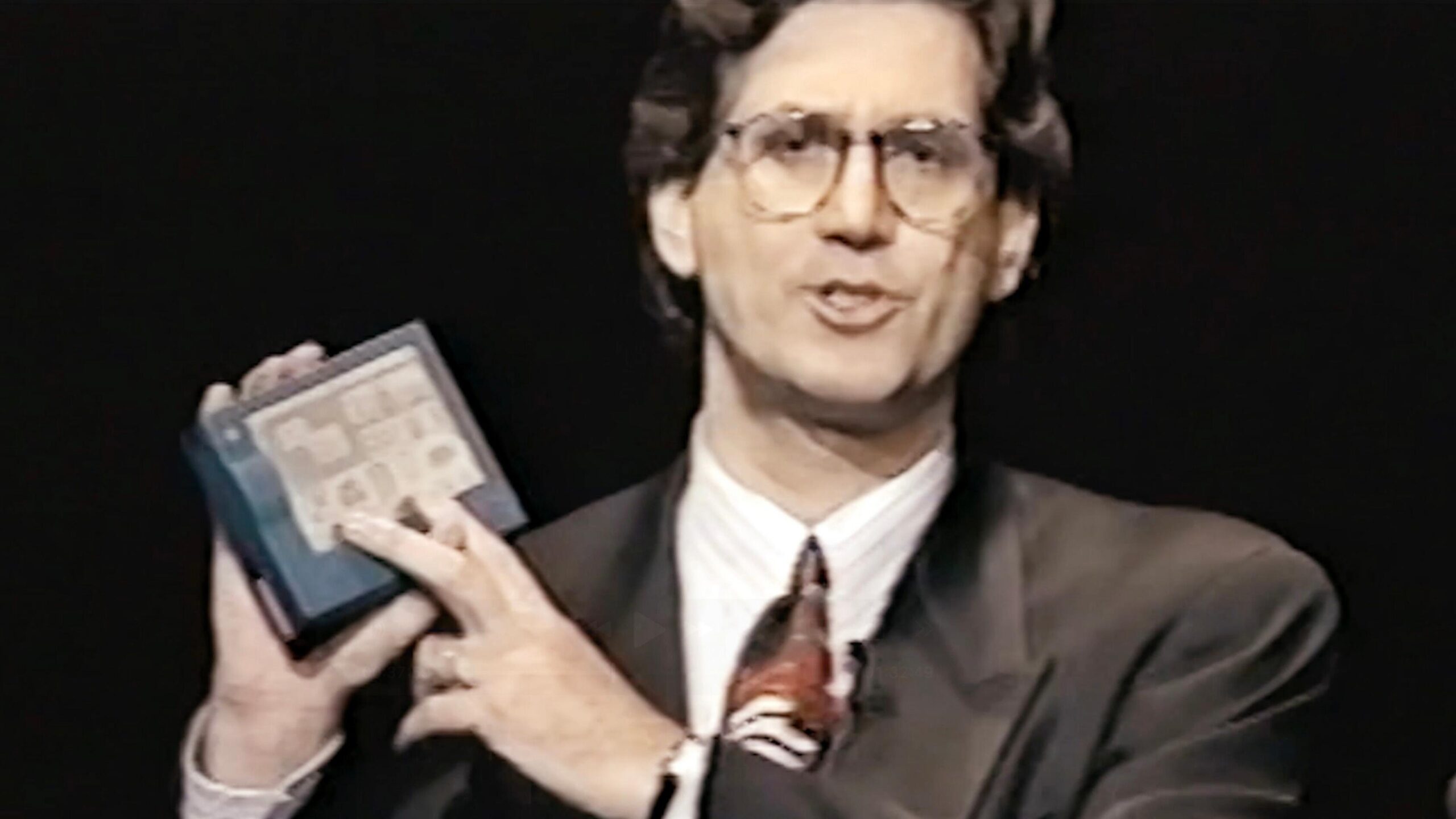
    BERAS: The device existed– the Sony Magic Link, powered by General Magic. It was like a mini tablet but chunkier. You could choose apps from a touch screen while holding it in your hands and almost fit it in your pocket. General Magic played a promotional video and all.

    [AUDIO PLAYBACK]

    ANNOUNCER: It’s a new way to reach just about anyone anywhere anytime. You’re only a press of a button away. Sony Magic Link. And what it takes off your desk is only matched by what it takes off your mind.

    [END PLAYBACK]

    PEASLEE: The future was here. The magicians, they had delivered. You could send a fax, track your checks, read a book, play a game like solitaire.

    BERAS: All for the price of $800 in 1990s dollars. And there was just one minor issue.

    FADELL: This Magic Link ended up being the biggest flop in Silicon Valley for a decade or more.

    BERAS: Yeah, they ran into a very econ 101 problem.

    FADELL: When customers, press, and everybody looked at it, and they go, what is this?

    BERAS: It is not enough to have supply. You got to have demand.

    PEASLEE: Less than 3,000 Magic Links were sold, mostly to family and friends of the magicians. And within a few years, this company that was going to change the world became a distant Silicon Valley memory.

    BERAS: How did that happen? How did this visionary idea become a nothing product? Well, that whole story you just heard– that whole story– was the reason it became a nothing product.

    PEASLEE: At least that’s the theory of one guy who spent years researching what happens when people have too much freedom.

    DAVID EPSTEIN: They were a spectacular failure because they had too much. They had too much talent. They had too much time. They had too many resources. They could do anything. And so they did do anything.

    BERAS: David Epstein is a journalist. And he says years later, when he got his hands on the thing General Magic built, this iPhone before the iPhone was actually pretty fun.

    EPSTEIN: I mean, I played with the Sony Magic Link, and it’s definitely cool. But part of the problem there was so much that it was incoherent. I mean, it shipped with a 200-page manual. Can you imagine getting a device–

    PEASLEE: [LAUGHS] Like a phone book, essentially.

    BERAS: We first learned about General Magic from a book David wrote called Inside the Box– How Constraints Make Us Better. David studied what made Dr. Seuss and Dr. Martin Luther King Jr. and Isabel Allende and NASA and Pixar successful. And his big theory that cuts across all of them is that to be creative, to be successfully creative, you need limits.

    PEASLEE: David says what happened at General Magic is a great example of why people need constraints, and you can basically distill his takeaways into three lessons. Number one, they didn’t have a clear customer in mind. They didn’t have a problem they were fixing or a need they were filling, basically nothing to guide what they were making.

    BERAS: They did have an imaginary customer in their heads named Joe Sixpack, basically a guy lazing on his couch with a beer watching TV. What they didn’t think about was what problem they were solving for him. Like, he didn’t need email in his pocket because odds are Joe Sixpack didn’t even own a computer.

    EPSTEIN: Is Joe Sixpack going to read a 200-page manual? I mean, I’ve read a lot of the manual. It’s elaborate.

    PEASLEE: They did test link on a few real people, like Tony’s mom.

    FADELL: My mom was a user tester.

    BERAS: Oh, fun.

    FADELL: So my mom came to visit me. My mom sat in user testing. She’s like, I don’t get it. What is this thing for? It didn’t work. Was it me? Did I do something wrong? I don’t understand why I even need this thing. I was like, wait a second.

    BERAS: Moms always know.

    FADELL: And I was like, yeah, who is going to purchase this? What problems are we going to solve for them with this? Why are they going to want to put their money down?

    BERAS: Tony and David agree. Sure, the technology may have been ahead of its time. But David says a big part of what tripped them up was not having a clear picture of their customer.

    EPSTEIN: It was a problem because it didn’t tell them what to do and, more importantly, what not to do. So if they had a very specific customer in mind and they identified some real customer problems, they would have had priorities.

    PEASLEE: And the fact that they weren’t listening to what customers needed was compounded by who they were listening to. That’s the second problem David identified– too much money. See, General Magic’s idea was so revolutionary that it attracted the attention and money of a lot of powerful partners, you know, those companies Tony was flying to visit, like Sony, Mitsubishi, Motorola, Philips, AT&T.

    EPSTEIN: They covered so much of the communications technology world that whenever they had meetings, the meetings had to begin with an antitrust lawyer listing all of the topics that they were not allowed to discuss so they wouldn’t run afoul of antitrust regulations.

    BERAS: But what they were talking about was this product that they were locked into because they had so much investment from all these companies.

    EPSTEIN: General Magic probably would have done better to stay really, really, really small. It might seem inefficient to stay small for years, but that’s when you’re laying the groundwork and setting the boundaries and not letting the costs explode.

    BERAS: Like, they hired way more people after Tony.

    PEASLEE: There’s this principle called Brooks’s law. It’s named after Fred Brooks, who was a computer scientist. He led the development of the operating systems that NASA used in the space program. And Brooks’s law essentially says that when you add people to a project that’s already late, it’s going to be even more late.

    EPSTEIN: They spent a lot on people. They spent on offices. They had a gigantic bush in the shape of a bunny, even when they were already having problems.

    PEASLEE: The essentials.

    EPSTEIN: Yeah, the essentials.

    BERAS: And they spent a lot on materials. General Magic was pretty much building everything from scratch. Like, at one point, Tony reinvented the technology that connected the remote to a TV, even though that had been around for many years.

    EPSTEIN: They were never forced to look around the technological environment and say, what’s realistic, and what can we borrow and build on?

    BERAS: I mean, what was the problem with all that?

    EPSTEIN: The problem was because they had time, they had money, they really ended up kind of building for each other, almost the engineers sort of trying to impress one another.

    PEASLEE: Which brings us to the third and final big lesson General Magic’s failure teaches us– it’s hard to make magic when you have no bosses and no deadlines.

    EPSTEIN: Everyone who had a good idea, they did it. Like, they very rarely told someone no, they couldn’t do something.

    BERAS: David says what they had were leaders.

    PEASLEE: What was the difference between a leader and a manager to them?

    EPSTEIN: The leaders were legendary programmers. And so I think it was, we’re going to listen to these people who are legends, are our icons. But those people were not equipped to be giving them deadlines and help clarifying what they should be doing and priorities and all those things either. They were off doing things that they thought were cool but that weren’t the priorities also.

    PEASLEE: Games, emojis, sound effects.

    EPSTEIN: Can I give an example of what I think was an emblematic case inside of General Magic?

    BERAS: Sure.

    EPSTEIN: The engineer, Steve Perlman, who was charged with creating a calendar function, and Steve wrote the calendar function to go from 1904 to 2096, and he checks it in and thinks he’s done.

    BERAS: Cool.

    EPSTEIN: And then, one of the leaders of the company comes to him and says, Steve, somebody might write historical apps. You have to write this calendar to go back farther. So he opens it up and writes it to go from year 1 to the future. OK, checks it in, thinks he’s done. Then another team comes to him and says, Steve, why are you tying it into this arbitrary religious context? You should make it go back to the beginning of astronomical time. So that’s how Steve Perlman ends up opening up the calendar function and writing it to go from the Big Bang to the future.

    BERAS: On a device that maybe doesn’t yet exist.

    EPSTEIN: And as he said, if he had stuck with 1904 to 2096, it would have been four lines of code, and he could have moved on. But because they could do anything, they did, and everything always got bigger.

    BERAS: Meanwhile, the Magic Link, what was supposed to be the first smartphone, never delivered on its most basic promise.

    EPSTEIN: This thing that was going to be a phone and a computer and more didn’t end up having a phone.

    BERAS: And we can look at the magicians and go, wow, what a disaster, what a wreck, too bad, and move on. Or we can look at General Magic the way Tony Fadell did, as a blueprint for what not to do.

    PEASLEE: After he left the company. Tony applied what he learned to future projects– like, big projects– including the real iPhone. And in the most iconic features of those products he helped create, you can actually see and touch the lessons Tony learned. That’s after the break.

    [UPBEAT MUSIC]

    PEASLEE: In the years after leaving General Magic, Tony did a lot of reflecting about what went wrong. What made this company that had all the best people, all the money, all the possibility fail? He ended up writing his own book– it’s called Build– where he talks about his time at General Magic and all the lessons he took away. He kind of turned what happened there into a list of everything not to do.

    BERAS: A few years after leaving General Magic, he was hired by Apple to work on this idea he had, a portable MP3 player. When he had a prototype, Steve Jobs saw it, and he was like–

    FADELL: Oh, this is great. I really want to do this thing. Now, you have to remember, this is March 2001. Apple was $500 million in debt. Steve goes, I’m greenlighting this project. We need to do this.

    PEASLEE: But they were going to have to do it on a budget. And Tony says that ended up working in his favor.

    FADELL: You can have too much money. You absolutely– because you don’t have constraints to make you think hard. When you know the clock is ticking, and the account is draining, and you have to really understand what it is you’re building, it focuses people.

    BERAS: Right at the outset, Tony says, he and his team knew what they were making and had a very specific customer in mind who wanted a very specific thing.

    FADELL: I want to take all my digital music with me everywhere I go. I want to take 1,000 songs in my pocket. We knew exactly what that product needed to do.

    PEASLEE: At Apple, with a limited budget and a clear scope, Tony says he looked for ways to build on what was already out there.

    BERAS: You didn’t completely build it from scratch?

    FADELL: Yeah, I went to all the different big companies and small companies around the world doing MP3 to find the right processors, ground-level software necessary, the right batteries, the screens, and everything else. So it’s like, what are the LEGO blocks I can get, stick them together, add a bunch of software, add a bunch of things to make this thing work?

    PEASLEE: Everything from the interface software to the chips to the batteries to the hard drive, even the design, in building the iPod, Tony thought of this Danish cordless phone he admired. So–

    FADELL: I ran right to Bang & Olufsen, bought a couple, tore them apart. Oh, yeah, yeah, that’s just the optocoupler, da da da da da. Like, I can just do that. No problem.

    BERAS: The result was the classic iPod design with the wheel and the button in the middle. The lesson? Literally, you do not have to reinvent the rotary wheel.

    PEASLEE: And to make it, Tony gave his team deadlines. He was not just a leader. He was a manager. So day one, he told them–

    FADELL: We’re going to need to do this by Christmas, which was less than eight months away. Why? Because Sony was the number one in every audio category. I knew how Sony worked. They’re going to come out with something this Christmas, and if it does, that means Apple is going to be canceling this project. I was like, this is going to have to work. We must ship by Christmas.

    PEASLEE: And he says that big deadline wasn’t the only constraint. He set up lots of little deadlines. Tony and Apple got the iPod done and debuted it in months.

    FADELL: When we launched the product to the world at Apple, literally two hours after that launch was done, Steve called me in and said, let’s talk about the next one.

    BERAS: Oh, wow.

    FADELL: Literally, we had not even shipped the one. He’s like, I already want to talk to you about the next one.

    PEASLEE: Iteration, they kept tinkering with the iPod, kept releasing new models. Tony worked on 18 of them.

    FADELL: General Magic, we only got one– we only got one shot because it took so long, so many years. We had no more money, and so we never had the chance to make another go at it.

    BERAS: At Apple, all those iterations of the iPod eventually led to the iPhone, and Tony worked on that too, the first three iterations. Now we’re up to the iPhone 17s.

    PEASLEE: After the iPhone, Tony went on to invent the Nest Thermostat, and that was also wildly successful and kicked off an internet of things revolution.

    BERAS: A lot of Tony’s colleagues at General Magic emerged out of that chaos to do big techie things. Some of them were early employees at Google. One of them invented the Android phone. Another one created eBay. One founded LinkedIn.

    PEASLEE: David Epstein says, when he first started researching for his book, the thing that most surprised him was how the exact thing we imagine will get in the way of creative success can be the thing that makes it possible.

    BERAS: Isn’t it like what everyone says they want is no oversight and no deadlines? Like, we could be so free and so creative if we could just, you know, fling sand into the air and make something out of nothing.

    EPSTEIN: Yeah, it’s interesting because in any way you cut it, in the abstract, people say they want more freedom. And in reality, it’s often not good for them. Our preference for complete freedom in the abstract is often a mismatch with what actually gets the best work from us and makes us the most satisfied.

    BERAS: In David’s book, he writes about Theodore Geisel, better known as Dr. Seuss. One of his most famous books came from a simple constraint. An executive at the publishing company told him he could use no more than 225 words from a vocabulary list for first graders to help them to read. Dr. Seuss picked the first two that rhymed and created the title for The Cat in the Hat.

    PEASLEE: And this concept is a hallmark of his work. This constraints idea has been called The Green Eggs and Ham hypothesis. That book has just 50 words. And the idea is when you have limits like that, you can do work that’s more creative.

    EPSTEIN: Constraints force you to do something difficult, right? You have to give up something, or you have to find a way to do something that you haven’t done it before. And that’s difficult. But it’s what psychologists call a desirable difficulty because you get the best out of yourself.

    PEASLEE: We asked David if constraints are so desirable, why do we humans so often think we want unbridled freedom?

    BERAS: The idea of like, you know, ideas will come to if you just kind of run through a big field or whatever and just have all the money pouring down on you, like, why does that, like, idea persist?

    EPSTEIN: Yeah, it’s a good question.

    BERAS: David says there’s lots of ways to answer it, but there’s one that really caught me because it’s about how we’re wired to want more.

    EPSTEIN: Humans have something called additive bias. This is a cognitive bias that’s probably a result of the fact that for most of human history, the main problem was having too little, not too much. And so it’s likely that we are not well equipped to even understand when to intuitively say like, oh, this is too much and to cut back.

    BERAS: You sort of have to force yourself to impose constraints in your life.

    PEASLEE: No gods, no masters, but maybe deadlines.

    [THEME MUSIC]

    BERAS: Listeners, we need help. We want to know how the economy is working for you. Does it feel like things cost more these days– groceries, gas, going on dates? And if it does feel that way, have you found any great life hacks that are maybe helping you get by? We want to hear from all of you. Send us an email at planetmoney@npr.org, and maybe we’ll call some of you up to chat.

    PEASLEE: This episode of Planet Money was produced by me with help from Sam Yellowhorse Kesler and James Sneed. It was edited by Marianne McCune and fact checked by Charlotte Isidore. It was engineered by Jimmy Keeley with help from Cena Loffredo. Alex Goldmark is our executive producer.

    BERAS: Big thank you to Sarah Keurrish and Matt Maude. Their documentary – parts of which you heard in this show – is called General Magic. Tony’s book is called Build and David’s is called Inside the Box. Links to the documentary and the books can be found in our show notes.

    PEASLEE: I’m Emma Peaslee. This is NPR. Thanks for listening.
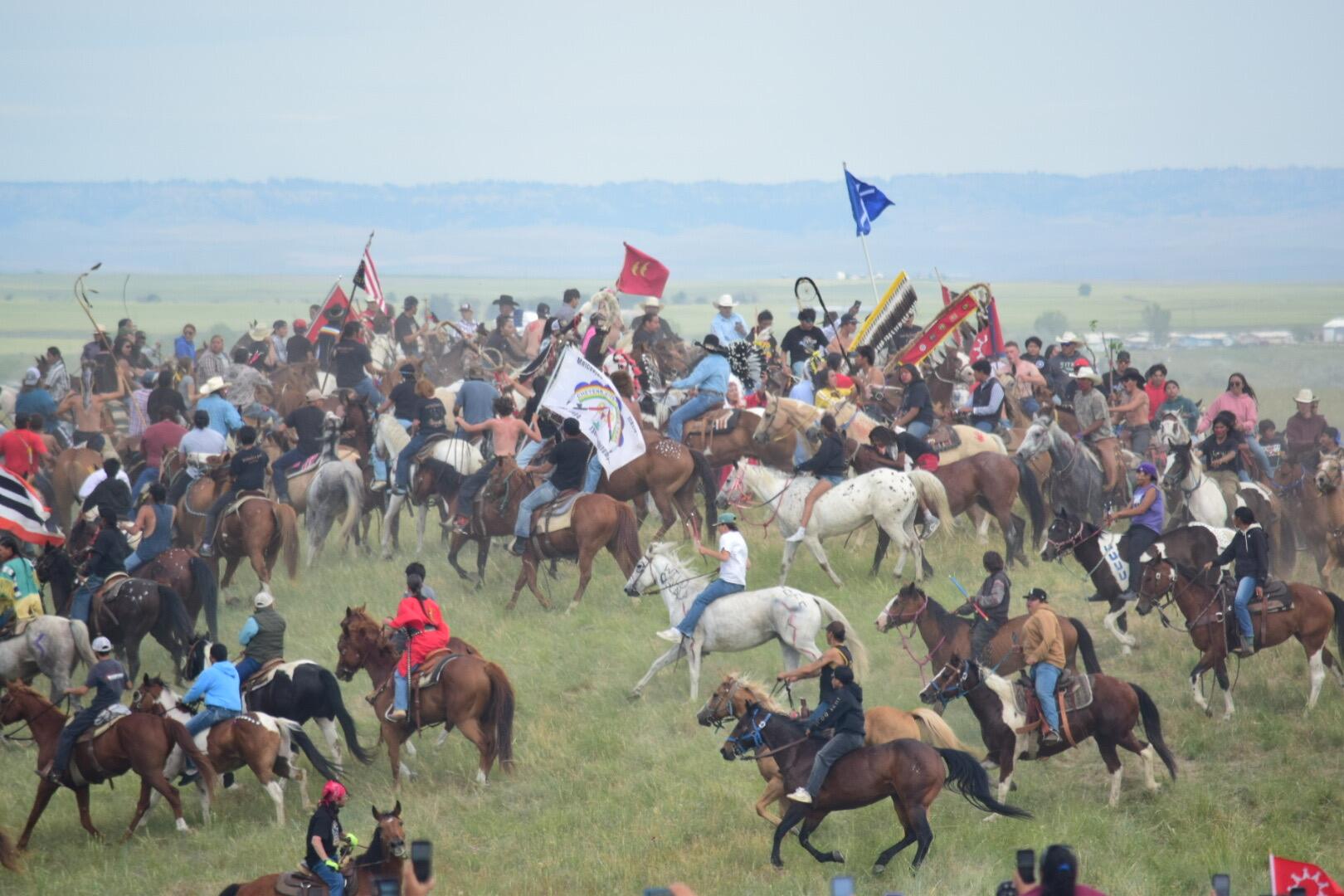
  • Trump’s State Department spokesperson discusses the administration’s foreign policy

    Trump’s State Department spokesperson discusses the administration’s foreign policy

    Transcript:

    SCOTT DETROW, HOST:

    It’s CONSIDER THIS, where every day we go deep on one big news story. Today, a closer look at President Trump’s foreign policy aims. The State Department is busy trying to end a conflict in one part of the world while helping with rescue efforts in another.

    (SOUNDBITE OF ARCHIVED RECORDING)

    MARCO RUBIO: I know the president’s made a full commitment to being supportive of Venezuela.

    DETROW: On Thursday, Secretary of State Marco Rubio addressed reporters about the back-to-back earthquakes that rocked Venezuela. The U.S. pledged $150 million toward relief efforts, but questions remain about whether the earthquake could upend Venezuela’s stabilization process just months after the U.S. took its former president into custody.

    (SOUNDBITE OF ARCHIVED RECORDING)

    RUBIO: You know, I don’t think we’re analyzing it through that lens. Obviously, it’s an – you know, it’s a setback in that regard, but we’re going to get through it. And I think Venezuela’s going to emerge stronger from it, despite the tragedy that it’s confronting right now.

    DETROW: Rubio made those marks in Bahrain. He’d been visiting several Gulf nations to talk with them about the preliminary agreement between the United States and Iran.

    (SOUNDBITE OF ARCHIVED RECORDING)

    RUBIO: If we can make a deal with Iran, that’s good for everybody. We want to do it. We’re going to get every – we’re going to give it every chance to succeed. But also, to make the point that we’re not going to do anything or agree to anything that they’re not aware of, that they’re not – that our partners in the area are not aware of, that our partners in the area are not aligned with and that in any way could undermine their security and their stability.

    (SOUNDBITE OF MUSIC)

    DETROW: CONSIDER THIS – the United States is directly involved in two major global events. What do they tell us about President Trump’s foreign policy priorities? We will hear from the State Department’s spokesperson.

    (SOUNDBITE OF MUSIC)

    DETROW: From NPR, I’m Scott Detrow.

    (SOUNDBITE OF MUSIC)

    DETROW: It’s CONSIDER THIS FROM NPR. This week, the State Department has been directly involved with two major global events – negotiations to end the war with Iran and sending foreign assistance to Venezuela after a deadly earthquake. Tommy Pigott is the spokesperson for the State Department and joins us now. Welcome.

    TOMMY PIGOTT: Thanks for having me on.

    DETROW: Let’s start with Venezuela. You know, the administration did downplay the importance of foreign aid for more than a year. Why is this different? What else is – do you have to add on that front?

    PIGOTT: Well, look, I think a couple of things here. First, when it comes to foreign assistance, what we’ve been clear is that foreign assistance needs to be effective and needs to go where it’s meant to go, and it needs to be aligned with the U.S. national interests. I think those are principles that are pretty uncontroversial. But unfortunately, what we saw under USAID was often disjointed aid, aid that took longer actually to deploy. And I think an example of this that’s so important is the fact that we were able to stand up at the State Department a task force to respond to this – to these earthquakes instantaneously that had under one roof coordination when it came to assistance, consular services for Americans, coordination with other – from other agencies. We’re seeing that incredibly fast, that incredibly large response to the people of Venezuela to assist.

    And I think it’s also important to point out that we also saw this massive response in response to Hurricane Melissa. Hurricane Melissa, we saw that quick response, that coordinated response. So I think the argument we would make – and I think this is borne out by the facts – is that by bringing these programs under the State Department to allow for better coordination, we’re allowed to move quicker. We’re allowed to move more effectively, and we’re allowed to actually deliver assistance to where it’s needed.

    DETROW: And you’re not worried about the loss of expertise, the loss of a lot of on-the-ground relationships that could have helped this aid move faster?

    PIGOTT: We’re actually seeing an expansion of on-the-ground relationships. I mean, Venezuela, of course, is a powerful example of that. The actions that President Trump took allowed for the development of so many conversations and relationships that did not exist previously, including the establishment of a U.S. Embassy in Venezuela that allows us to provide emergency services to American citizens in the region.

    But that’s also something that’s replicated across the world. We’re seeing a new type of foreign assistance. We’re building capacity in these nations, building stronger relationships. And fundamentally, this is a bit different than the earthquake example where you have to respond with this assistance in response to a national disaster. But what we see is assistance programs in general fundamentally saying, we’re building your capacity so we can have aid programs that eventually end because they’ve been successful in building capacity to respond.

    DETROW: I want to make…

    PIGOTT: But of course, in natural disasters, we’re responding as appropriate.

    DETROW: I want to make sure we have time to talk about that trip to the Gulf, but one more question on the earthquakes. The initial money being spent, there are obviously really major immediate needs here. How is the United States thinking about these longer-term issues, the rebuilding, everything that needs to come along with it once search and rescue is done? How focused will the U.S. be on that?

    PIGOTT: Well, that’s something that we’re definitely focused on. Of course, the priority now are search and rescue teams, urban search and rescue teams. We’re seeing the deployment of hundreds of personnel, including heavy equipment, in order to assist in that effort. The United States is on the ground. The United States is there. The United States is helping. Of course, we’re also working with our partners in the region, and we’re also delivering humanitarian and medical supplies. So our initial priority is to make sure that we have those search and rescue teams. We’re delivering that assistance, working with the unmatched capability and operational capacity of DOW. And then we’re going to be here. We’re going to help. And that is something that’s demonstrated by the scale of our response.

    DETROW: You’re just back from this diplomatic trip to the Gulf. There’s been a lot of skepticism, a lot of worries from leaders of our Gulf allies about this agreement. How did Secretary Rubio respond to those concerns?

    PIGOTT: Well, look, as Secretary Rubio said, we’re not going to agree to something that undermines the security of our Gulf allies and partners. He made that incredibly clear at the GCC ministerial meeting, which had our Gulf partners and allies at that meeting. One of the main goals of this trip was to thank our Gulf partners and allies, especially the UAE, Kuwait and Bahrain, for their resilience, the support they gave us, the leadership they have shown in the face of Iran’s attacks. We also saw the resumption of operations of our embassy in Kuwait, with Secretary Rubio marking that by raising the flag over the embassy, taking part in that ceremony. So there is productive conversations, a clear message sent that we are not going to agree to something that undermines the security of our Gulf partners.

    DETROW: But doesn’t…

    PIGOTT: And the alliance and work together is continuing to grow.

    DETROW: Doesn’t allowing Iran to continue to have conventional missiles and have more power over commerce in the Strait of Hormuz – doesn’t that undermine their security?

    PIGOTT: Well, look, fundamentally, as we saw in the GCC joint statement, we saw a powerful statement that’s saying the GCC members, the United States rejects any circumstance where we’re going to see any sort of fees or tolls or whatever you may call it through the strait. That was a clear…

    DETROW: But it’s still happening right now.

    PIGOTT: Well, it was a clear and unambiguous message that we’re not going to agree to anything that has that. And what we saw, first of all, with Operation Epic Fury was the dismantling of a conventional weapons military shield. The results of Operation Epic Fury have already made the region and the world safer. What we are seeing now is a clear effort to make sure Iran does not rebuild a nuclear program and a clear statement from that joint statement that we’re not going to have a scenario where nations charge tolls or fees for moving through an international waterway.

    DETROW: I guess there’s been a lot of reporting that those Iranian missile levels are the same – relatively the same level as they were before the war began. And as we saw in recent days, it’s still blocking traffic in the strait.

    PIGOTT: Well, what we saw through Operation Epic Fury is the decimation of their military capabilities, the conventional shield they were trying to build, their navy, their air force, their defense industrial capacity. We have seen that. We also saw the effects of the blockade and the maximum pressure policy. The president is a dealmaker, and there are clear things he wants to see. There’s no questioning what the president wants to see here – the Iranian regime not having a nuclear weapon. And the secretary’s trip here reinforced the strong partnership that is continuing to grow between the United States and our Gulf allies and partners.

    DETROW: When you were last a guest on NPR, you said repeatedly that when it comes to any nuclear agreement, that deal would not be another JCPOA. Many people, including many Republicans, say it’s exactly that. Why are they wrong?

    PIGOTT: Well, the vice president outlining many of those reasons – first of all, the context where we are is so important, the decisive results of Operation Midnight Hammer, the decisive results of Operation Epic Fury already making the world safer, obliterating that nuclear program. Also, the provisions that have been so clearly laid out, a conditions-based agreement where any sort of reintegration or other sort of unfreezing of funds, whatever may have you, is based off of actions taken by the Iranian regime. So the context of this is incredibly important and also the fact that we see a condition-based agreement with those objectives so clearly outlined.

    DETROW: Why is the $300 billion reconstruction plan that’s gotten a lot of attention – why is that substantially different than the Obama administration agreement?

    PIGOTT: Well, we’re talking about, it’s a conditions-based agreement, a conditions-based based off of actions. And that is so important. When we look at the JCPOA, we saw the sending of cash to the Iranian regime. We saw the Iranian regime with a time-limited agreement that did not really actually substantially address their nuclear program in our opinion. And what we’re seeing now are strong actions from the president of the United States to dismantle their conventional weapons, to obliterate their nuclear program and also to make sure we have an agreement that makes sure they never rebuild that nuclear program.

    DETROW: Tommy Pigott, spokesperson for the U.S. State Department, thanks so much for joining us.

    PIGOTT: Thanks for having me on.

    DETROW: After this conversation first ran, U.S. Central Command announced the U.S. conducted strikes on Iran in response to an Iranian drone hitting a commercial cargo ship on Thursday. It’s not clear how these actions impact the ceasefire agreement.

    This episode was produced by Christopher Harland-Dunaway and Karen Zamora, with audio engineering by Ted Mebane. Our director is Jonas Adams. It was edited by Patrick Jarenwattananon and Tinbete Ermyas. Our interim executive producer is Courtney Dorning.

    Thanks to our CONSIDER THIS+ listeners who support the work of NPR journalists and help keep public radio strong. Supporters also hear every episode without messages from sponsors and unlock bonus episodes of CONSIDER THIS. You can learn more at plus.npr.org.

    (SOUNDBITE OF MUSIC)

    DETROW: It’s CONSIDER THIS FROM NPR. I’m Scott Detrow.