Transcript:
DON GONYEA, HOST:
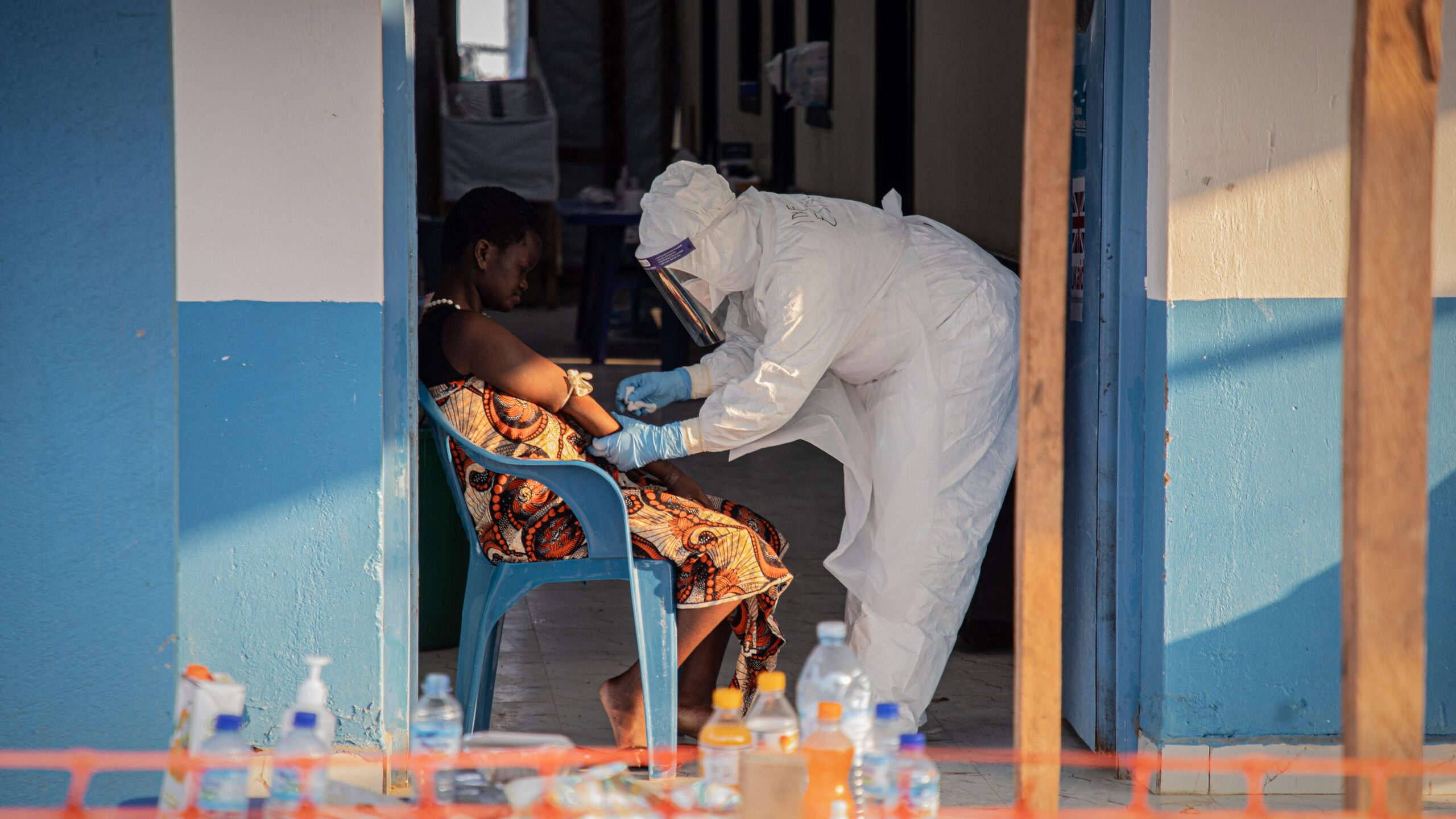
It’s CONSIDER THIS, where every day we go deep on one big news story. NPR often relies on reporters going into dangerous places to get the story. It can mean covering a war, natural catastrophes or highly contagious deadly diseases, like the current Ebola outbreak in the Democratic Republic of the Congo, that has killed hundreds of people so far.
(SOUNDBITE OF ARCHIVED NPR CONTENT)
EMMET LIVINGSTONE: And I’m in an Ebola ward with doctors going from isolated room to isolated room checking on Ebola patients.
GONYEA: CONSIDER THIS – how do you manage the risk of catching a deadly disease and balance it with the need to report the story to a wide audience? Coming up, we’ll hear from a reporter who has traveled to the epicenter of the current Ebola outbreak to hear more about those risks and how to manage them.
(SOUNDBITE OF MUSIC)
GONYEA: From NPR, I’m Don Gonyea.
(SOUNDBITE OF MUSIC)
GONYEA: It’s CONSIDER THIS FROM NPR. Reporter Emmet Livingstone lives in Kinshasa, the capital of the Democratic Republic of Congo. When Ebola surfaced in the eastern part of the country, he traveled to the area to cover it for NPR. For this week’s Reporter’s Notebook, we wanted to understand how a reporter balances the risks of reporting from the heart of a deadly outbreak. I began by asking Emmet a very basic question – how he tries to keep safe.
LIVINGSTONE: The reality is, if you’re going into an area with active Ebola transmission, you’re taking a risk because you will come into contact with people who either themselves are in very close contact with people who are suffering from Ebola, or you will come into contact with people who potentially have Ebola. The main way to keep yourself safe is to wash your hands all the time and to be very aware of your surroundings and not to touch people at all. That is pretty difficult in areas where, for example, if you have to go through a checkpoint or somebody has to check your documents, you’re kind of pushed into a funnel with other people and you’re trying not to touch them.
But those are the – those – that’s what you’re supposed to do to try and remain safe. I’m not saying that when I was there it worked 100% of the time. And so now there’s a three-week incubation period, so I’ve been out of the zone for one week. I have another two weeks. If, within that three-week incubation period, I develop a fever, that’s a proper emergency and I’ll have to alert the health authorities. So that’s why I’m taking my temperature.
GONYEA: And do you have a personal checklist that you go through every time you enter an area where there are Ebola patients?
LIVINGSTONE: So suffice it to say, editors took it very seriously. It’s no small thing to try and do journalism when there’s active ongoing transmission of Ebola, especially in a place where there’s a lot of violence. The takeaway that I got from editors was not to do anything I was uncomfortable with. I was told several times that if I didn’t want to go, for example, even at the last minute, that it would be OK.
And then on top of that, I was given the opportunity to do a special Ebola training, so training for journalists who are working in Ebola zones, which was extremely useful because you learn things like how far away you can stand from people to keep yourself safe, you know, and then kind of best practices about equipment and little tips that I picked up here and there, which were hard to put into practice on the ground just because we didn’t have much time.
But, for example, having, you know, like, trash bags with you so that if something is contaminated – if you have to decontaminate something quickly, you can put it in there and then transport it with you in the car and that it won’t contaminate other people. So there was a long list of things like that that we were taught, essentially, before we set off.
GONYEA: In one of your stories on NPR, you describe a gold mining operation and the working conditions and how people are working in such close quarters, you would never know there’s an Ebola outbreak.
(SOUNDBITE OF ARCHIVED NPR CONTENT)
LIVINGSTONE: I’m in a gold mine in Mongbwalu. It’s in a valley surrounded by steep green hills with lush grass, palm trees, eucalyptus trees. You can hear the sound of a generator, and that’s pushing sand down a sluice. Workers then look through that sluice to try and find bits of gold. There are, I’d say, maybe 20, 30 pits here. Dozens and dozens and dozens of people are working despite the Ebola outbreak.
GONYEA: They seem to have no concern because they’re so concerned about just doing the work and maybe getting paid and getting through the day.
LIVINGSTONE: Yeah. I would nuance it and say that that is probably the case across Eastern Congo and even across the whole of Congo. People that I spoke to there were aware of the disease and they were saying that they would like to take precautionary measures and that they’re afraid of getting the disease, but they just don’t really have a choice, and it doesn’t matter whether you’re in the mines or not. It’s very, very difficult to distance yourself from people. It’s very difficult to get access to running water in a place like this. So, you know, almost everyone is at risk there.
GONYEA: You describe going from region to region, taking a four-hour car ride, and there’d be checkpoints along the way. What happens at those checkpoints? Is it just to make sure you really want to go in there or to warn you about what you’re entering? What is it?
LIVINGSTONE: Checkpoints in Eastern Congo usually serve as a way to extract money from people who have to cross those checkpoints. So tolls are extracted. Other reasons are also to keep an eye on who’s going through. As I said, this is an area with a lot of armed conflict, so there’s a lot of edginess and kind of a feeling of tension about what people are up to and why they’re using the road.
When I was on the road, it was fairly relaxed. We were almost always just waved through the checkpoints, including by the CODECO, which is one of the most violent militia groups in Ituri. And they don’t resemble very much – in some cases, it’s, say, a line of soldiers that are blocking the road, often hassling kind of motorbike drivers and stuff. We were in a Jeep. We were kind of mostly waved through, maybe because we looked more important than we were, and then the CODECO checkpoints, those are the militia checkpoints, it was one or two guys kind of standing by the side of the road who peer into your car and then wave you on.
GONYEA: And I understand there are all these healthcare workers that you describe being there, but the people who live there don’t necessarily trust them and do what they suggest.
LIVINGSTONE: There’s just a general feeling of distrust and you tend to trust your own. And if you have an outsider come in and say, this is the way it is, and you don’t know them, you’re much less likely to trust them. And I think it’s a very human reaction, and people ultimately work the same way all around the world. And interestingly, it’s really the key part of the health response at the moment is trying to gain the trust of communities.
And the way that the WHO and other organizations are doing this is by targeting community leaders, so be they church leaders, you know, local village chiefs, that kind of thing, the main job is to get them on board and then get them to talk to the kind of mass of people who live in these areas to try and convince them. But if – mean, to put it bluntly, if you’re a white guy that turns up from Europe or from the U.S. and says, you’ve got to do this, people just aren’t going to listen.
GONYEA: What can you say about your plans for how you will continue to track the outbreak and the challenges that do arise as you report this story?
LIVINGSTONE: Speaking as a reporter, I think what’s going to be difficult is when media attention turns elsewhere and this turns into yet another intractable problem in Eastern Congo. This is an area where conflict has been ongoing for 30 years and, you know, with various peaks and troughs and kind of, like, atrocities that occur and then little bits of peace and peace initiatives. But, you know, broadly speaking, there’s not that much interest in the region. My worry is that the more this goes on, the less interest there’s going to be.
GONYEA: That’s reporter Emmet Livingstone, who’s been covering the Ebola outbreak in Eastern Congo for NPR. Emmet, thank you for joining us, and be safe.
LIVINGSTONE: Thank you so much for having me on.
GONYEA: This episode was produced by Gabriel Sanchez. It was edited by Adam Raney. Our director is Elena Burnett, and our interim executive producer is Courtney Dorning.
(SOUNDBITE OF MUSIC)
GONYEA: It’s CONSIDER THIS FROM NPR. I’m Don Gonyea.