Preparing a hot dog is simple enough. But what is the best way to cook this summertime staple? Chef Kenji López-Alt, the James Beard Award winner and cookbook author, has some advice.
It all starts in the supermarket.
“Look for a hot dog that has a natural casing,” he said. Natural casings are made of lamb skins and give hot dogs a bit of a curve, while the hot dogs without casing pack flat into the package.
“That’s what’s going to give you the snap no matter how you cook it,” López-Alt said.
As far as how to cook a hot dog, there are about as many opinions as there are home cooks. Boil them in water? Roast them over a fire with a stick? We investigated a few methods for cooking hot dogs just right.
A quick fix for when you need a hot dog NOW
The best flavor emerges with time, according to Kenji López-Alt. “Low and slow is always a good idea with any kind of sausages,” he said.
Ayesha Rascoe, however, confessed to cooking “hot and fast. And burnt.”
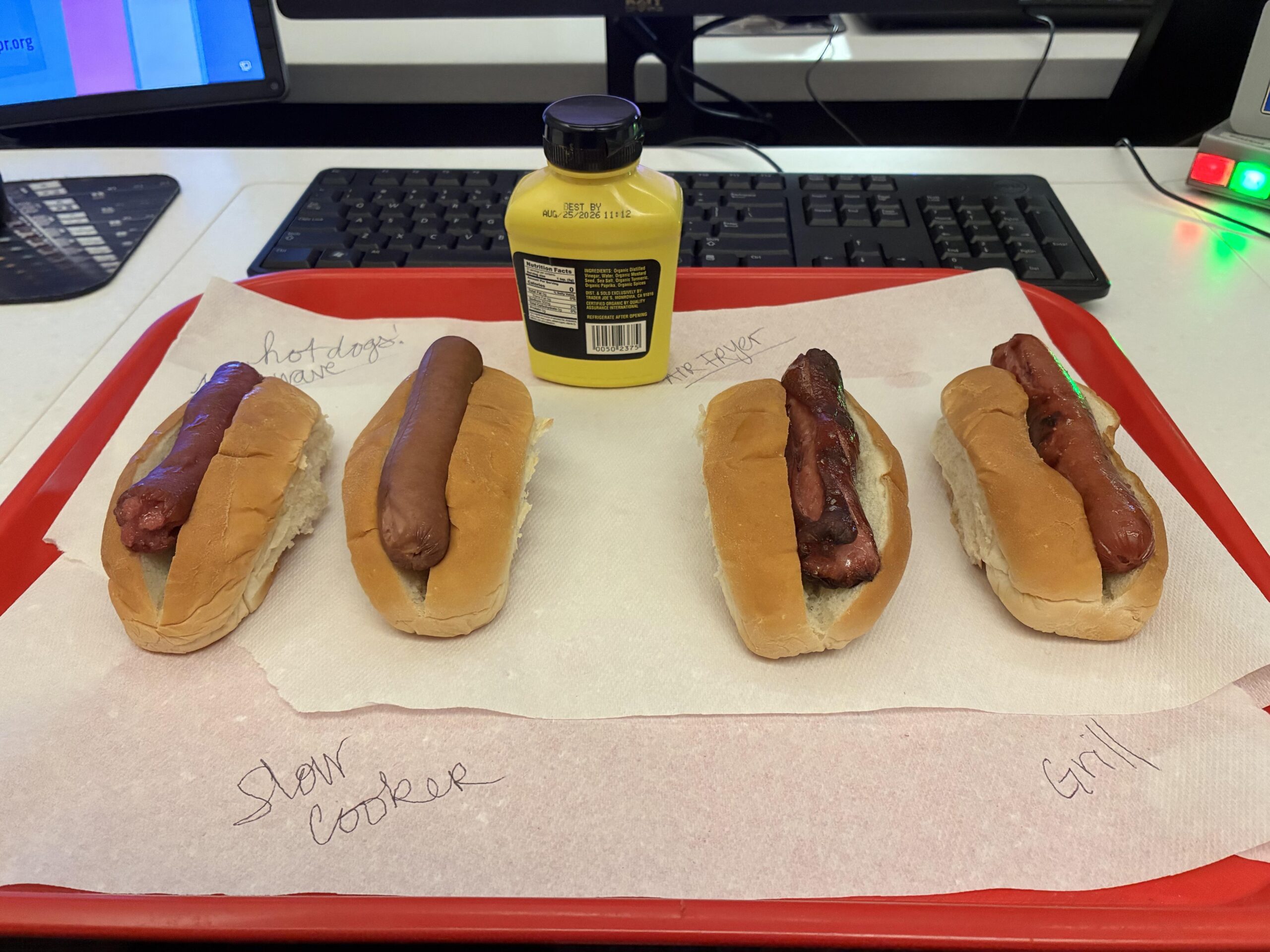
As fast as a microwave might be, it did not exactly win in our testing. We wrapped the hot dog in a paper towel and cooked it for 45 seconds. But it was a mess. The skin split, the ends were shriveled, and the texture was limp.
While not his preferred method, López-Alt conceded that microwaves have their place in any kitchen with kids.
“I’ve cooked plenty of hot dogs in the microwave,” he said. “I’ve had to get food on the table as quickly as possible.”
Our tests found that an air fryer, on the other hand, cooked a hot dog nearly as quickly, and produced a snappier skin and much better flavor.
“An air fryer has a very strong convection fan that’s pulling away excess moisture,” López-Alt explained.
Our air fryer hot dog looked crispy and the color seemed right. But structurally, it came out a little misshapen.
Online chefs suggested cutting the skin to give the hot dog more surface area. It worked for our Ballpark beef franks, but López-Alt forbade that kind of hack for hot dogs with natural casings.
Slow and steady, and a little off-color?
The slowest method we tested for a hot dog was not so different from what they’re doing at gas stations: a little heat for hours on end.
López-Alt shared a recipe from a Kentucky friend who puts cocktail weenies in a slow cooker with a cup of ketchup, a cup of brown sugar, and a cup of bourbon before a party. The flavor is rich. But the color of slow cooker hot dogs can be a little off-putting.
We put hot dogs in a slow cooker without any water for two hours on low heat.
“It looks kind of dead,” Rascoe said, as though everything good had been cooked right out of it.
After a bite, however, Rascoe changed her mind. “Looks can be deceiving,” she said.
With its wan color and swollen skin, “I would have been like, it’s NASTY!” she said. But, the slow cooker brought out the hot dog’s deep, meaty flavor.
It’s an easy way to have cooked hot dogs on hand for as long as the party lasts. A few dozen could sit in the slow cooker for hours.
Sometimes a classic is classic for a reason
A hot grill was also a winner in our testing. We put a little Weber grill on a balcony at NPR headquarters and roasted the dogs away from the coals for a minute and a half to warm them up. Then, we put them right over the coals until they were sweating and crisp. The skin had beautiful grill marks and a perfect color.
“It’s not as salty off the grill,” Rascoe concluded, although as a daughter of North Carolina, she yearned for mustard, coleslaw, onions and chili to eat with it.
López-Alt, a New Yorker, prefers sauerkraut and spicy mustard.
As a chef, López-Alt is attuned to the regional preferences in hot dog toppings. Since he’s been in Seattle, he’s seen hot dogs topped with warm cream cheese, jalapenos, and grilled onions. Sounds suspicious, but, “if you get it right, with the right person, they’re an interesting variation,” he said.
Whether it’s relish, ketchup, or cream cheese, and whether it’s the air fryer, the grill, or the slow cooker, we hope your holiday is delicious.
Transcript:
AYESHA RASCOE, HOST:
It’s a big holiday this week with plenty of reasons to fire up the grill. And I, for one, intend to eat the most delicious hot dogs. Here to help me with this goal is Kenji Lopez-Alt, the cookbook author and chef extraordinaire. Hi, Kenji.
KENJI LOPEZ-ALT: How you doing?
RASCOE: I’m doing all right. I got all these hot dogs here with me, so I’m doing well (laughter). But I got to ask you, there are so many ways to cook a hot dog – you can boil them in water, you can, you know, use a stick and roast them over a fire. Kenji, what is your favorite way to make a hot dog?
LOPEZ-ALT: For me, the first thing – the most important part is getting the right hot dog, you know? So I always look for a hot dog that has a natural casing, you know? ‘Cause that’s what’s going to give you the snap, no matter how you cook it.
RASCOE: OK. What’s the natural casing? Now, what’s that?
LOPEZ-ALT: So if you’re looking at a package of hot dogs in the supermarket, and they are perfectly straight, they were made inside, like, a plastic tube, and then the plastic was peeled off. And so they don’t have a skin on them, which means that, essentially, you know, they’re just the same consistency all the way, edge to center. Whereas, if your hot dog has, like, a little bit of a curve in it, it’s been put into a lamb casing, you know? So hot dogs that are made out of lamb casings, and that’s what’s going to give you sort of the snap when you bite into it, however you cook it.
RASCOE: OK.
LOPEZ-ALT: But, you know, whatever you’re going to do, I think, sort of low and slow is always a good idea with any kind of sausages, whether it’s a hot dog or not.
RASCOE: That’s totally the opposite of the way I make my hot dogs – hot and fast and burnt.
(LAUGHTER)
LOPEZ-ALT: That’s a personal choice, you know?
RASCOE: I’m sure your favorite way to cook a hot dog is not the microwave.
LOPEZ-ALT: I’ve cooked plenty of hot dogs in the – you know, I got two kids. I’ve had to, like, get food on the table as quick as possible. I’ve cooked plenty of hot dogs in the microwave (laughter).
RASCOE: OK. OK. So we have a hot dog cooked in the microwave first. It was wrapped in a paper towel and microwaved for one minute.
LOPEZ-ALT: OK.
RASCOE: Let me taste it. I’m tasting it without the mustard. (Mouth full) I would give this a 4 out of 10. Four out of 10.
LOPEZ-ALT: OK. That’s pretty harsh, but all right.
RASCOE: And so let’s see. So for the next hot dog, they did the slow cooker. Now, this one I’m worried about because (laughter)…
LOPEZ-ALT: Yeah. I wouldn’t put a hot dog in a slow cooker. That’s…
RASCOE: (Laughter) Yeah. Just – ’cause you – so you just throw the whole bag in there, no water. Let them sit as long as you want. It’s been in the slow cooker for two hours. Now, this one – it looks different from the other hot dogs. It looks kind of almost dead.
LOPEZ-ALT: Like, everything good has been cooked out of it.
RASCOE: Let me see. (Mouth full) That’s not bad. It’s a hot dog.
LOPEZ-ALT: Not bad.
RASCOE: (Mouth full) I’m surprised. I think it maybe tastes a little better than the microwave one.
LOPEZ-ALT: OK.
RASCOE: Now, I got to ask you, Kenji, if you’re making a perfect plate, what do you serve with your hot dog?
LOPEZ-ALT: If I’m doing them on the grill, what I actually like to do is I’ll get, like, a little disposable aluminum pan, you know? And in that pan, I’ll put my toppings. So I like sauerkraut and mustard. So I’ll put the sauerkraut in the pan and then kind of nestle the hot dogs in there, and then put that whole thing over kind of, like, the cooler side of the grill and then let them kind of really slowly heat through. So it’s essentially, like, simmer it in your toppings, and then sear it on the grill to get some grill marks on there to get a little more flavor on them.
RASCOE: OK. So for my hot dogs, I’m from North Carolina.
LOPEZ-ALT: Yeah.
RASCOE: So in North Carolina, we eat our hot dogs with mustard, chili and coleslaw and maybe onions.
LOPEZ-ALT: You know what they do here in Seattle?
RASCOE: What?
LOPEZ-ALT: Cream cheese.
RASCOE: Oh, no.
LOPEZ-ALT: Cream cheese with grilled onions and, like, jalapenos and mustard. They got, like, an open flame, and they use these kind of bigger buns that they get really nice and charred. And then the cream cheese is kind of soft already. So it kind of just, like, melts into the bun, you know?
RASCOE: Really? OK. No disrespect…
LOPEZ-ALT: And…
RASCOE: …To the people that love this, but that does not sound (laughter)…
LOPEZ-ALT: Yeah. They’re an interesting regional hot dog variation.
RASCOE: Now – OK. So the slow cooker was not that bad. I would give it a 6 out of 10. It was actually…
LOPEZ-ALT: OK.
RASCOE: It was surprisingly good. OK. Now, people are really into air fryers, and I am an air fryer person too. The air fryer makes crispy skin with a juicy dog. Let’s see how the air-fried dog comes out. These dogs were cooked at 400 for five minutes. Got a little char on it. OK. So let me see. (Mouth full) This a good hot dog (laughter). You got the flavor. You got the flavor in this, and it’s a little crunchy. This is good. This is a good hot dog.
LOPEZ-ALT: Yeah. Well, that makes sense ’cause, like, an air fryer, you know, it’s like a – got a very strong convection fan. It’s really good at – so as your hot dog kind of cooks, it’s pulling away some excess moisture, so you end up with, like, a kind of more concentrated – it’s probably saltier and a little more flavorful.
RASCOE: Eight out of 10 stars. Eight of 10. OK. So now we have the fourth and final one, which is on a hot grill. We put a little Weber grill on one of the balconies here at NPR headquarters and roasted the dogs away from the coals for a minute and a half to warm them up, and then put them right over the coals for another couple of minutes, until they were sweating and crisp. OK. So let me get this. But I want to get a little – I want to make sure I get some of the char. OK. (Mouth full) OK.
LOPEZ-ALT: Oh, boy. That sounds good.
RASCOE: It’s good, but not as good as the air fryer.
LOPEZ-ALT: OK. OK. That’s a shock.
RASCOE: I’ll give it a seven, a seven. The air fryer is the winner on this one. Although I think this is good because it’s not as salty off the grill. This would be good with the chili and the coleslaw on it.
LOPEZ-ALT: Well, I’ll come by this summer then.
RASCOE: You got to come by this summer. I’ll hook you up. It’ll be good (laughter).
LOPEZ-ALT: Sounds great.
RASCOE: That’s Kenji Lopez-Alt, chef and cookbook author. He joined me from Seattle. Thanks, Kenji, and happy grilling this weekend.
LOPEZ-ALT: Same to you.