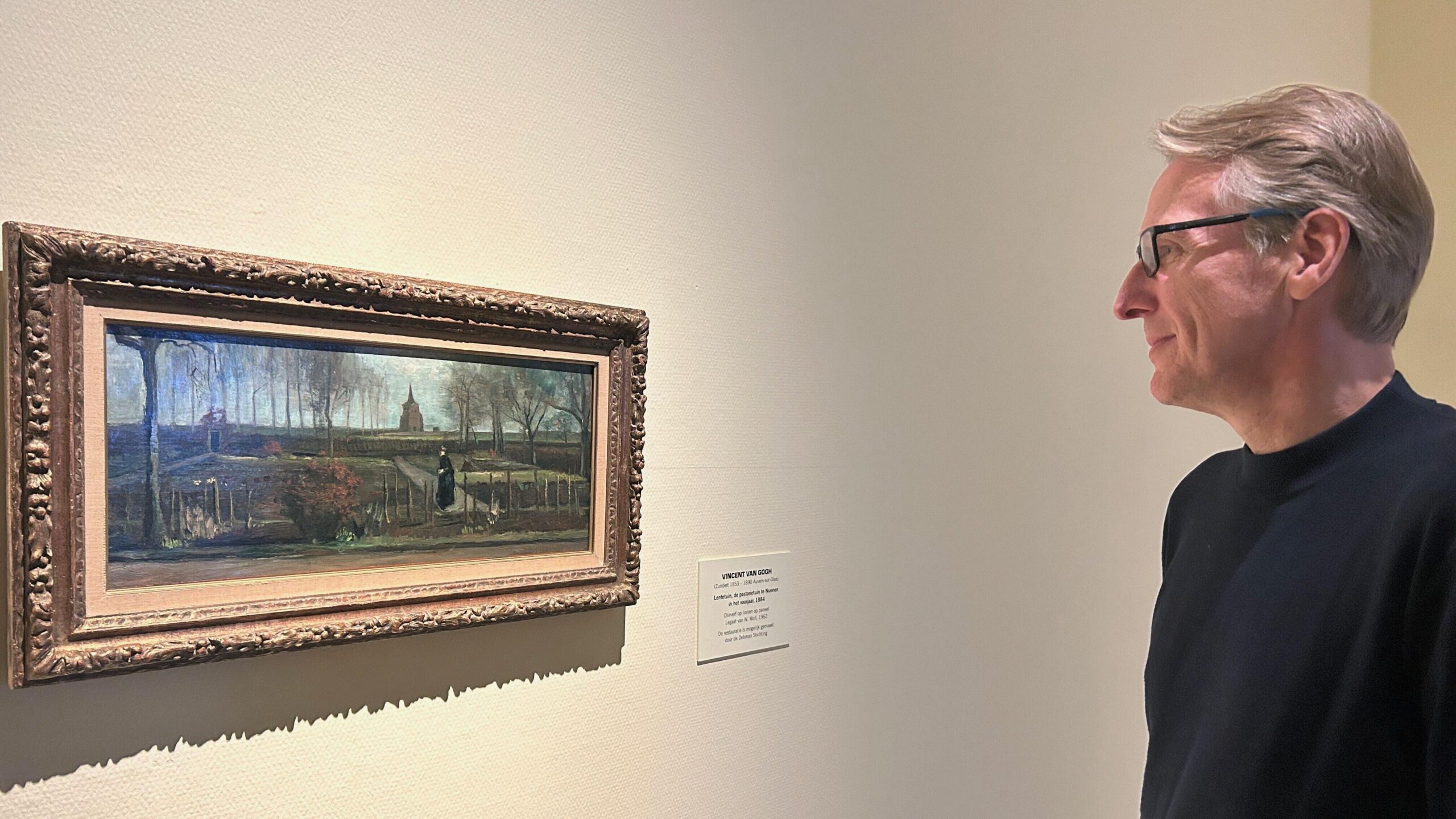
What happens to famous works of art when they are stolen from museums and private art collections? In the Netherlands, museums and collectors reach out to Arthur Brand, a self-styled art detective who works to track down art that has gone missing and fallen into the criminal underworld.
This week on The Sunday Story, when a famous Van Gogh painting is stolen from a museum, Brand teams up with an unlikely partner – art thief Octave Durham. Together, the pair work to rescue a masterpiece from the underground market and return it to its museum home.
This episode was produced by Andrew Mambo and edited by Jenny Schmidt. It was engineered by Kwesi Lee. Production help from Ben Rappaport and Sena Loffredo. Fact Checking by Jane Gilvin.
We’d love to hear from you. Send us an email at TheSundayStory@npr.org.
Listen to Up First on Apple Podcasts and Spotify.
Transcript:
AYESHA RASCOE, HOST:
I’m Ayesha Rascoe, and this is The Sunday Story from UP FIRST. Late one morning in September 2023, the famous Dutch art detective, Arthur Brand, was pacing around his Amsterdam apartment, waiting for a special delivery.
ARTHUR BRAND: And then at 12 o’clock, the doorbell rang.
RASCOE: Brand looked out the window, and on the stoop, he saw a man who he’d been expecting holding an iconic big blue bag.
BRAND: So I opened the door and he was standing there with an Ikea bag.
RASCOE: Now, what Brand was expecting inside that Ikea bag was a painting. Not just any painting, but a Vincent van Gogh that had been stolen from a Dutch museum. But when he peeked into the bag…
BRAND: The only thing I saw was a pillow full of blood.
RASCOE: A pillow full of blood. Today on the show, a story about an art detective, the criminal underworld, and what it took to solve one of the greatest art heists in recent history. We’ll be right back.
(SOUNDBITE OF MUSIC)
RASCOE: We’re back with The Sunday Story. I’m Ayesha Rascoe. And today, I’m joined by NPR contributor Rebecca Rosman, who has a stranger-than-fiction story about an art detective and his very unlikely partner, and how together they solved one of the greatest art heists in recent history. Rebecca, welcome to The Sunday Story.
REBECCA ROSMAN, BYLINE: Hi, Ayesha. Thanks for having me.
RASCOE: So, Rebecca, you cover a lot of art and culture stories from your home in Paris. And, you know, Paris sounds lovely. And (laughter) I bet…
ROSMAN: It is.
RASCOE: …It’s a pretty lovely city. But when I think about art in Paris, of course, I think of the dramatic events at the Louvre last year.
ROSMAN: Oh, yes. And I covered it when it happened last October.
(SOUNDBITE OF ARCHIVED NPR CONTENT)
STEVE INSKEEP: The thieves who broke into the Louvre over the weekend did not make off with the Mona Lisa, but the theft of jewels, described as priceless from the museum collection, was bad enough. Rebecca Rosman has more from Paris.
ROSMAN: Let’s start with some numbers – four masked robbers, nine precious jewels, seven minutes. That’s how long it took to pull off the heist.
I mean, it was like a scene from the Ocean’s 11 film, except it was real life. A daylight robbery at one of the world’s most famous museums. The police did eventually catch all the thieves, by the way, but it took weeks.
RASCOE: And remind me, like, what happened to the stolen jewels?
ROSMAN: Yeah. Over $100 million worth of precious jewels just gone. Experts think the thieves likely disassembled the pieces, sold the jewels and melted the gold and other precious metals for parts before they got caught.
RASCOE: That’s a huge loss. Is it just me or does it seem like there has been, like, an increase in these museum heists? I feel like we keep hearing about these kind of bold escapades, and you got to call it that because these are, like, art heists. So it’s like, you know, they’re just not normal break-ins, or it doesn’t feel that way.
ROSMAN: No, you’re absolutely right. You know, I felt the same way. But, you know, I wondered, is this just a case of a few recent hits that have just been so unforgettable that it’s created this sort of illusion of a wider trend, or is there actually an increase? So I did some research, and what I can say is that I counted over a dozen major museum hits since January 2025 alone. And late last year, the International Council of Museums teamed up with Interpol to respond.
RASCOE: So there is something happening here. Like, there – like, museum heists are trending, so to speak.
ROSMAN: Yeah, I would say they are trending. You know, it seems so. And when priceless objects are stolen and disappear into the underworld, you know, there’s very few people who know how to go and find them. But Dutch art detective Arthur Brand is one of them, and I went to visit him.
Hello.
BRAND: It’s freezing, isn’t it?
ROSMAN: It’s freezing.
So in February, I hopped on a train to Amsterdam, where I met with Brand at his apartment. And, Ayesha, I have so much I want to tell you about this experience, which I think can help shed some light on these recent heists.
RASCOE: Well, and I have a lot of questions, right? Like, what is an art detective?
ROSMAN: Great question, indeed.
BRAND: An art detective – that’s somebody who helps the police track stolen art or forgeries. And it’s not a real job.
ROSMAN: So just to explain what Brand means when he says that. You know, he’s saying you can’t go to university and say, I want to become an art detective. Brand actually studied a bunch of different things, but as it turned out…
BRAND: I was not that interested in, let’s say, Spanish poetry from the 17th century.
RASCOE: So then how did he do it? How did he become an art detective?
ROSMAN: Well, Brand was like a lot of college students. He studied a lot of things – history, languages, poetry. And he was also really interested in art. But for the longest time, he couldn’t find a way to turn any of these things into a real job. Then he ends up getting a gig apprenticing with this art dealer who introduced him to a shadowy ecosystem of smugglers, thieves and forgers. Eventually, Brand found his niche. He started advising art buyers.
BRAND: They call me and says, Arthur, we want to buy Picasso. Has it been stolen? What’s the price? Is it authentic or a forgery?
ROSMAN: He says that consultation work takes up about half his time, but his real passion is the other half of his time, which is spent on mostly pro bono work, helping recover stolen paintings and other artifacts. Brand told me what kind of sealed his reputation is his integrity.
BRAND: I thought the only thing I have to do is to be honest. Just be honest. You know, in a world of people who betray each other, who backstab each other, if you’re honest, you have value, you know?
ROSMAN: Soon, he was recovering missing art. And over his 20-year career, Brand says he’s helped recover more than 150 artifacts. That includes a Picasso he tracked down for a sheikh, a gold ring that belonged to Oscar Wilde and a Salvador Dali painting. His reputation has grown to the point where he is now a trusted household name in the Netherlands, and he even has his own documentary TV show…
(SOUNDBITE OF DOCUMENTARY, “ARTHUR BRAND: ART DETECTIVE”)
BRAND: (Speaking Dutch).
ROSMAN: …Called The Art Detective.
(SOUNDBITE OF DOCUMENTARY, “ARTHUR BRAND: ART DETECTIVE”)
BRAND: (Speaking Dutch).
RASCOE: Oh. I mean, so then he’s kind of a star in certain places.
ROSMAN: He is. Then, Ayesha, in March 2020, Brand got a call from the police. He didn’t know it yet, but this would become one of the biggest cases of his career. A Van Gogh had been stolen from the Singer Laren Museum, just outside of Amsterdam. The painting is called “The Parsonage Garden At Nuenen In Spring.” But Brand quickly realized this wasn’t a case he was going to be able to solve alone. He needed someone who already had experience with stolen Van Goghs.
OCTAVE DURHAM: My name is Octave Durham. I live in Amsterdam, the Netherlands. I’m 53 years old. I’m known for robbing the Van Gogh Museum in 2002. I stole two paintings.
ROSMAN: Just as Brand is the Netherlands most famous art detective, Octave or Okkie Durham is perhaps the country’s most famous art thief.
RASCOE: When we come back, Octave Durham and why Arthur Brand needed him to solve the case of the missing Van Gogh.
We’re back with The Sunday Story and NPR’s Rebecca Rosman. We’ve heard from art detective Arthur Brand, a kind of folk hero in the Netherlands, for his ability to track missing masterpieces. But when another Van Gogh is stolen from the Singer Laren Museum near Amsterdam, Brand knows he needs help. The man he turns to is an unlikely choice – art robber Octave Durham.
DURHAM: I mean, 15 big heists in the Netherlands. I’m involved with eight, at least.
RASCOE: OK. So he seemed a little proud of that, too, Rebecca. He’s basically saying that he’s a career art thief.
ROSMAN: That’s right. Beyond art, Durham has also admitted to and spent time in prison for other crimes like bank robberies and financial fraud. I have to say, Durham is fascinating. When we met in Amsterdam in February, he was wearing a black baseball cap and these designer-looking sneakers, looking as calm, cool, and collected as you’d probably expect. He says he grew up in a neighborhood in Amsterdam, where petty crime was kind of the norm.
DURHAM: And I figured out that, hey, I’m quite good at these things. You have born soccer players, born teachers, born policemen, I’m a born burglar, and I cannot explain. I don’t know. I’m very good at it.
RASCOE: How does someone become very good at being a burglar?
ROSMAN: You know, I asked Durham that exact question.
DURHAM: It’s not only the capability of doing it, but you have to have the guts. You have to figure it out the way you do it, the infrastructure of it all. It’s a combination of a lot of things. I have to be relaxed, you know, I don’t like violence. I never used violence.
ROSMAN: Durham says he was always calm under pressure, not scared of cops, not scared of prison. And he took the work seriously. He started small, stealing bikes when he was a teenager, then moving on to robbing banks as a young adult. And eventually, he sets his sights on the place that would make him famous, the Van Gogh Museum in Amsterdam.
RASCOE: Well, you know, go hard or go home, right? Like, you know, that sounds like that was his approach. But that still takes a lot of guts, right?
ROSMAN: A lot of guts and a lot of planning. The idea to rob the museum happened by chance, actually. You know, one day, back in 2002, when Durham was in his late 20s, he was walking by the Van Gogh Museum, and he noticed the walls of the building were really just floor-to-ceiling windows. So he walks up to a window and taps it.
DURHAM: I hit the glass, and I’m like, oh, my God, this is glass. It’s not even bulletproof or something, you know?
ROSMAN: So he starts to think it through. First, Durham recruited a friend to help him pull it off. This is what they did. Together, they went to the museum early in the morning, climbed a ladder to access the roof, and then smashed a glass window with a hammer. So now they’re in, right? They grabbed two of Van Gogh’s lesser-known paintings, “View Of The Sea At Scheveningen” and “Congregation Leaving The Reformed Church In Nuenen.” Then they made their escape by shimmying down a rope and running. He says the whole thing took less than 4 minutes.
RASCOE: I mean, that’s wild. And, you know, it reminds me of the Louvre break-in, which was pretty much just smash and grab.
ROSMAN: I know. Exactly.
RASCOE: And so did Durham say why they chose the paintings they took? Did they pay attention, or did they just grab what was close?
ROSMAN: You know, I was curious about that, too. Like, maybe he was a big fan of Van Gogh.
What did you think of the paintings themselves? Did you have any attachment to the paintings?
DURHAM: No, I thought they were ugly. I didn’t like them. My friends told me (laughter) the next time you steal one, take a Rembrandt. I said, OK (laughter).
ROSMAN: So the truth, Ayesha, is what you’ve already caught on to. He knew any Van Gogh would be valuable. So he and his partner just grabbed the first two that they saw. Eventually, Durham found a buyer for the paintings, a mob boss in Italy. Durham says he bought them for 350,000 euros.
RASCOE: So, I mean, was this mob boss, like, a big Van Gogh fan?
ROSMAN: Well, I haven’t spoken to the mob boss, so I couldn’t tell you whether he was a Van Gogh fan. But that’s not really why criminals want paintings like these. Famous stolen art is almost impossible to sell on the open market. But in the underworld, art can become leverage. It’s a bargaining chip, which is exactly what made Durham’s stolen Van Goghs useful, not as art, but as leverage.
RASCOE: Now, what do you mean by leverage? What does that mean?
ROSMAN: Well, let me explain what happened after Durham sold them. So in 2016, this Naples mob boss was charged with drug trafficking. He was facing a long sentence, potentially 20 years. So he wanted to make a deal. He sent a letter to prosecutors telling them he knew where they could find a couple of missing Van Goghs.
(SOUNDBITE OF ARCHIVED NPR CONTENT)
ARI SHAPIRO: A worldwide search for two Vincent van Gogh paintings has come to an end.
ROSMAN: So authorities discovered the paintings inside a kitchen wall at the mobster’s mom’s country home in southern Italy. And in return, the sentence he was facing was reduced from 20 to only eight years.
RASCOE: Oh, OK. I mean, that is fascinating. Like, that’s definitely leverage. Basically, holding these paintings hostage. What about Durham?
ROSMAN: Well, he got caught about a year after the heist. Authorities had been able to identify him using the museum’s security cameras. And he was a little bit sloppy. he left a baseball cap at the scene, which was traced to his DNA. He served 3 1/2 years in jail and was given a 350,000 euro fine. Durham told me, though, he had trouble paying the fine, so he went back to jail to serve another nine months.
And, Ayesha, here’s where things take a strange turn in his life. So just to explain real quick, in the Netherlands, prison sentences aren’t as stiff as they are, say, in the U.S. And for nonviolent crimes, some prisoners can get leave.
DURHAM: It’s called open camp. You can go – every weekend you go home, and during the day you work outside.
ROSMAN: So one weekend, Durham’s on leave, walking through the streets of Amsterdam, near the Van Gogh Museum, in fact, and he walks by this restaurant.
DURHAM: All of a sudden, somebody tapped me on the back and he comes in front of me.
ROSMAN: It’s Arthur Brand. Brand says to Durham…
BRAND: Okkie, do you know who I am? He said, of course, I know who you are. You are the art detective.
ROSMAN: Just to give you some context here. Durham’s Van Gogh robbery in 2002 happened the year before Brand really launched his career. And like I mentioned earlier – and Brand reiterates – it was one of the biggest cases of its time.
BRAND: Of course, I was interested in that case. Everybody was always talking about, where are these two Van Goghs? I saw him as my archenemy. You know, he’s one of the most famous art thieves in the world, and I’m the art detective.
ROSMAN: But Brand couldn’t help also being intrigued. He kind of wanted to know Durham better.
BRAND: I gave him my telephone number.
ROSMAN: But Durham wasn’t interested.
DURHAM: I threw the number away.
ROSMAN: But then, shortly after that meeting, Durham’s weekend furlough is over. He’s back in jail, watching TV. And he comes across Brand’s documentary series.
DURHAM: And I found out how he works, and he works clean, you know? People don’t get arrested. It’s all about getting the stolen artifacts back. Yeah, I liked it.
ROSMAN: He liked how trustworthy Brand seemed, and to be honest, he was also curious about the guy. So he finds his number on the internet and gives him a call.
DURHAM: And I called him out of a jail cell, and I said, hey, Arthur, how are you? And he was quiet for about 10 seconds. He was in shock.
ROSMAN: They agree that when Durham gets out of jail, they’ll meet up. And when that happened, both men say they immediately hit it off. It’s not such a big surprise if you think about it. In a way, although they’re on these opposite paths, both love the thrill of the hunt, and they speak the same language. So they strike up this unusual friendship. Brand says he could tell Durham things he couldn’t tell anyone else, like the time he’d recovered what he told me was a 50-million-euro Picasso. And for one night, it was in his house before being handed over to the police.
BRAND: And then at night, I needed to tell somebody. So I thought, who will understand the feeling that I have right now, sitting here alone, watching one of the most beautiful Picassos? So I called Okkie.
ROSMAN: By this point, Durham says he’s sworn off crime. All he wants to do now is relax into retirement. So fast forward to March 2020. Brand gets that call from the police.
BRAND: And they told me, Arthur, a new Van Gogh has been stolen from the Singer Museum in Laren. I said, oh, my God. Not again.
RASCOE: So, I mean, this is sounding just like a movie. I mean, somebody has to be writing a script right now. They have to – if they do, they have to credit The Sunday Story (laughter).
ROSMAN: Absolutely. They must credit The Sunday Story copyright (laughter). All right. But you’re absolutely right, it really is just like in a movie. The first question the police ask Brand…
BRAND: They said, where’s Okkie?
ROSMAN: Luckily for Durham, he had an alibi. But the idea that he may be unjustly accused of the theft infuriates him. Brand says what irritates Durham even more is the theft itself.
BRAND: He said, because I am the Van Gogh thief, you know? I might be retired now, but I am the Van Gogh thief. Who do these guys think they are?
RASCOE: Like – yeah, it’s like they’re coming for his jersey, you know? They’re coming for his record, like, a – kind of like an athlete (laughter).
ROSMAN: Exactly. You know, there’s only one Jordan, and there’s only one Octave Durham.
RASCOE: (Laughter) Exactly.
ROSMAN: So to Brand, all of this anger that Durham has, he sees it as an opportunity. So he seizes the moment.
BRAND: I said, Okkie, what if you and I together will try to find this Van Gogh?
ROSMAN: Durham thinks about it. And after making it clear he will never snitch on another thief, he starts asking around in the criminal underworld, asking if anyone knows anything about this missing Van Gogh. Meanwhile, Brand is hitting up his own sources. Time goes by. Then one day, about six months after the painting had been stolen, a photo shows up on the dark web.
BRAND: You know, when you steal a painting, you cannot – if you want to try to find a buyer, you cannot put it on eBay, you know? What they do is they make a picture of the painting with a newspaper or fresh newspaper next to it as proof – I am the owner now. And they send it around.
RASCOE: Kind of like a proof-of-life photo.
ROSMAN: Yes, exactly. And to Durham and Brand, this post is very good news. It means the painting is out there. Maybe it’s even recoverable. So they keep hunting. The police do, too. And then a year later, the police have a breakthrough. They arrest the thief, but they didn’t find the painting. A few more years go by, and then, finally, in the late summer of 2023, Brand gets this text out of the blue.
BRAND: Which says, Mr. Brand, do you have the code of silence? And I said, no, I’m not a priest, but if I give my word, I will keep my word. And then he said, I know where the Van Gogh is, where it is hidden.
ROSMAN: This man says, look, I was not involved in this heist. I don’t want to get arrested. I just want to get rid of this thing. Because while stealing a painting may be easy for some people, it can quickly become a huge liability. Brand sends him a message back saying, OK, you know, I get it. You’re not involved. How can I help get this painting back? But the message doesn’t go through. Maybe this guy has blocked Brand.
BRAND: I thought, oh, my God, he doesn’t trust me.
ROSMAN: But then Brand quickly thinks of someone this informant will trust, someone from his own world, Octave Durham. So Brand asked Durham if he will send this informant a message on his behalf. He does. And this time, it goes through.
DURHAM: And I said, I don’t know who you are. I found out that you talked to Arthur. The only thing I can say – I guarantee you don’t get into trouble if you talk to him. Cops won’t come, nothing. It’s just to recover whatever you are have. You no worry.
ROSMAN: So here’s the Netherlands most famous art thief backing up the art detective. It’s quite the endorsement, Ayesha.
RASCOE: Yeah.
BRAND: And that guy knew me. He said, hey, I know Okkie. He said, if you didn’t gave me this recording, I wouldn’t do it because the guy was terrified. He was afraid as hell. You know, he was – he thought he was set up.
ROSMAN: A few days go by after that, though, and Brand hasn’t heard anything. Then it’s Saturday, and Brand and Durham are invited to this birthday party of a famous Dutch TV presenter. They’re in the garden when Brand gets a text from the informant, and he says, I see you.
BRAND: And I looked around and he said, behind that tree.
ROSMAN: So Brand walks behind the tree. The informant says, look, I’m sorry to scare you like this. I just had to make sure there wouldn’t be any police here. And Brand says, OK, OK.
BRAND: And he said, Arthur, I didn’t trust you, but when you send this clip from Okkie, I thought, well, if Okkie stands in for him, it must be OK. So I’m going to bring it back.
ROSMAN: They make this agreement. The informant says he will come to Brand’s house to drop off the painting. Then the big day comes, and Brand is obviously nervous, pacing around his apartment.
BRAND: And then at 12 o’clock, the doorbell rang. And I went downstairs, and I looked through the window, and I saw the guy smiling.
ROSMAN: And that takes us back to where we started, the blue Ikea bag and the pillowcase covered in blood.
BRAND: So I opened the door and he was standing there with an Ikea bag. And I didn’t see the painting in the Ikea bag. The only thing I saw was a pillow full of blood. And I said, what the heck?
ROSMAN: Human blood?
BRAND: Human blood.
RASCOE: OK. Well, I got to try to understand, like, what is the deal with this blood-filled pillowcase?
ROSMAN: Well, I can only tell you what the informant told Brand, which is that he cut his finger while he was packing the painting up and that blood got all over the pillow. And when Brand moved the pillowcase away, there it was, the painting he had been after.
BRAND: I unpacked the Van Gogh and it’s one of the most beautiful moments of my life.
ROSMAN: The informant leaves. Brand says he knows why the informant decided to return the painting but isn’t at liberty to explain the motivation. Still, with the painting now in his possession, the first thing Brand does is call the police, who had been waiting at a cafe nearby, along with the museum director. They come over.
BRAND: It was so emotional, you know? They have been searching with tens of people. It was – you know, it was such a big case, a stolen Van Gogh, and there was a lot of pressure nationally and internationally. And then we were standing here with the Van Gogh. So I asked them, can I have it one night on my wall? And they all said, Arthur, no way.
RASCOE: And what about Durham? Was he there?
ROSMAN: You know, he wasn’t. I think, given his past and tension with the police, they decided that probably wasn’t the best idea. But there’s no denying Durham’s role in this recovery.
How do you feel that you played a – such an active role in this?
DURHAM: I laughed my [expletive] off (laughter). And I was really like, yeah, because all the people say, hey, you stole two paintings and Van Gogh this, Van Gogh that. Now I bring one back. Shut up.
RASCOE: So, I mean, this kind of reminds me, of course, of, you know, “Catch Me If You Can” with Leonardo DiCaprio, where it’s, like, the main character goes from being chased by the authorities to working alongside them.
ROSMAN: Yeah. And I have to say, you know, for Durham, he loves this new role now.
DURHAM: I have something to do. I’m still involved with crime (laughter).
BRAND: The good side.
DURHAM: The good side. Because you must imagine you get in contact with people, and you do it for a good cause.
ROSMAN: So he’s still in the underworld in a way, just on the other side of it. Brand tells this funny story.
BRAND: The other day, we walked here in the neighborhood, and a woman was coming out of her home and she said, ah, I know you. You are the guy who brought back the Picasso – talking about me – and I said, yeah, that’s correct. And I said, you know who’s staying next to me? That was Okkie, of course. I said, he’s the guy who stole the two Van Goghs. And she looked, she became pale and she went inside her home.
RASCOE: I mean, that’s definitely an odd couple.
ROSMAN: They are quite the odd couple. And I can promise you they both know it, too.
DURHAM: These things are more crazier than fiction, you know? You don’t see this stuff in movies.
RASCOE: Yeah. Well, maybe it’s time for them to kind of make their debut.
ROSMAN: You know, maybe. And I think it’s fair to say both Brand and Durham are not camera-shy at all. But, Ayesha, what stayed with me most wasn’t just how cinematic their story is. It’s how unlikely their trust is. You know, Brand doesn’t pretend Durham didn’t steal those paintings. Durham doesn’t pretend Brand isn’t close to the police. But somehow they found a way to use that tension and that history to get something stolen back where it belonged. And that’s what brought us here.
(CROSSTALK)
UNIDENTIFIED PERSON: So we have lockers here.
ROSMAN: Two and a half hours north of Amsterdam, in the city of Groningen, is the Groninger Art Museum. Earlier this month, I traveled to the museum with Arthur Brand. I wanted to see him take in the Van Gogh that he and Durham had recovered, “The Parsonage Garden At Nuenen In Spring.” It’s home now, mounted on its own wall in one of the galleries.
BRAND: When I see this, for me, it’s first of all, I think the joy, you know, the joy I experienced.
ROSMAN: The painting was done early in Van Gogh’s career and still has these classical lines. It shows the garden, a church in the distance and a woman draped in a black coat and wearing a matching black hat. Brand has a story for her.
BRAND: I always think – I hoped that it was Margot Begemann, his – the girl next door he wanted to marry. The parents didn’t allow them. The girl tried suicide. Van Gogh saved her. So in my imagination, this is the love of his life, Margot Begemann.
ROSMAN: Octave Durham wasn’t with us on this tour. You can probably imagine why this museum, or, you know, really most likely any art museum in the Netherlands, wouldn’t be ready to welcome him with open arms. But we were joined by the former director, Andreas Bluhm. He’d been in the role when “The Parsonage Garden At Nuenen In Spring” was stolen. And it turns out he’d also been the director of the Van Gogh Museum in Amsterdam, back in 2002, when Durham stole the two Van Goghs there. So I had to ask Bluhm how he felt about Durham now, especially since he’d helped get this painting back.
ANDREAS BLUHM: I’m grateful, but I’m a little bit – I’m not a friend of – I mean, it’s like…
BRAND: Double feelings.
BLUHM: Yeah. I have…
ROSMAN: Mixed. You have mixed feelings.
BLUHM: I have mixed feelings. But as he said to him, you know, it’s 2-1 now. You know, I stole two. I recovered one. Maybe I feel better when he is even, when he recovers another one (laughter).
ROSMAN: And who knows? Maybe Durham will do just that. But for now, it was only Brand’s reaction I could get. And I couldn’t help but notice his smile as he was looking at the painting because, beyond interpretations about the art itself, he sees this whole other thing.
BRAND: The best thing about this painting is it always gives me hope because I’m searching now for many other paintings and other stuff. Like, it’s possible, you know, we find it back. Never give up.
ROSMAN: And maybe that’s the thing about art. The object matters, of course, but it’s the story that makes us lean in.
BRAND: People like art, of course, of course, without a doubt, but when there is a story attached to it, it gives this extra layer.
ROSMAN: And now “The Parsonage Garden At Nuenen In Spring” has its own story, too, about an art detective, an art thief and a stolen Van Gogh they somehow brought back home.
RASCOE: So, Rebecca, what’s next for Brand and Durham?
ROSMAN: Durham is teaming up with Brand on a new case. This one involving a stolen Picasso they believe is hidden somewhere in North America. Meanwhile, Brand is pursuing a separate case, a statue stolen in the Netherlands with help from two unlikely partners, Chicago-area sisters Evie (ph) and Bevy Lustig (ph), ages 6 and 9.
RASCOE: Well, Rebecca, thank you so much for that fascinating journey through the world of art thievery and recovery. Now you got to make that movie.
ROSMAN: I’m on it. You’re welcome, and thanks for having me.
(SOUNDBITE OF MUSIC)
RASCOE: This episode of The Sunday Story was produced by Andrew Mambo. It was edited by Jenny Schmidt. Production help from Ben Rappaport and Cena Loffredo. Fact-checking by Jane Gilvin. The engineer for this episode was Kwesi Lee. The Sunday Story team also includes Justine Yan and Liana Simstrom. Irene Noguchi is our executive producer.
I’m Ayesha Rascoe. UP FIRST will be back tomorrow with all the news you need to start your week. Until then, have a great rest of your weekend.
(SOUNDBITE OF MUSIC)