In the early 90’s, a company called General Magic began working on a portable device that would allow people to check email, make phone calls, even play games. It was basically a smartphone. But it never caught on.
On today’s show, a theory about why this device failed. General Magic had generous investors, world-class talent and creative freedom. But is it possible what they needed was constraints?
Transcript:
[COIN RATTLES]
ANNOUNCER: This is Planet Money from NPR.
ERIKA BERAS: OK. How many times have you sat and thought about how much more you could accomplish if you had more– more time, more money, more resources?
EMMA PEASLEE: Like, how good project could be if you had just one more day.
BERAS: Or a bigger budget or more help.
PEASLEE: Well, this is the story of a company that did have all of that, and they were making something amazing, something most of us touch every day– a smartphone.
BERAS: But, and this is the part that is bonkers, this was happening nearly two decades before the iPhone came out.
TONY FADELL: Before the internet, before Wi-Fi, before data, before cell phones even–
PEASLEE: Tony Fadell was employee number 29 at that company.
FADELL: –before even email really existed for people, before anything like Amazon or e-tailing existed, before downloadable games or downloadable music existed, all of that stuff, we were creating all the technology that would later become what the iPhone was.
PEASLEE: Nowadays, Tony is a businessman. He’s always been a computer geek– his words, not ours.
FADELL: I was making fake IDs on a Mac in high school because you had a laser printer, and a laser printer was like, oh my god, I could replicate things in the world. So I was making fake IDs on laser printers.
BERAS: You must have been very popular.
FADELL: Oh, yeah, yeah, yeah. I made a lot of money, too.
BERAS: Tony was brought up in the ’70s and ’80s to build things.
FADELL: I was fixing things. I was changing electrical sockets.
BERAS: You’re describing yourself as kind of being like a shop class kind of kid.
FADELL: Yeah, my grandfather taught shop class.
BERAS: Oh, seriously, a shop class kid? OK.
FADELL: He always had the mantra, “If a human made it, a human can fix it and build other things, too.”
BERAS: Tony’s favorite thing to tinker with was computers.
FADELL: It was your own world. You could make anything you wanted.
PEASLEE: And around the time Tony was in high school, mid-’80s, computer geeks actually started to become cool.
FADELL: In Rolling Stone, there was a huge article by Stephen Levy about the original Mac team. And I was like, oh my god, there’s computer guys like me, guys and gals like me, building this thing that I love, the Macintosh, and they’re in a rock and roll magazine. I’m like, superstars!
BERAS: He’s 15, and he became obsessed with these computer engineers.
FADELL: Oh, I could be like that. So they were my heroes. And so I would just track them obsessively. Yeah, stalking, you could say.
BERAS: Tony went to college, launched a few startups, and he kept reading tech magazines. And then one day, he saw something buried in the gossipy type pages in the back of one of those magazines. Tony learned his heroes were working on this top secret project. It was at a brand-new company called General Magic.
FADELL: And I was like, General Magic, what? What is this?
PEASLEE: And he didn’t care how, he just wanted in.
FADELL: I had no idea what they were doing, but whatever it is, I needed to get involved.
PEASLEE: He found a number, started calling sometimes 10, 15 times a day.
BERAS: This is your favorite band. You’re like, I want to get on the road with the band.
FADELL: Yeah. I’ll be a roadie, whatever it takes. I just want to be with this band. So after, you know, six to seven month knocking on the door, getting rejected, and pestering the hell out of everyone there, they gave me a job. And I went crazy.
BERAS: Tony moved to Silicon Valley to work with his heroes. He was 21. His dream had come true. He was hired as a software engineer in the hardware team at General Magic to make the first smartphone, this thing that was going to in 1991.
[THEME MUSIC]
BERAS: Hello, and welcome to Planet Money. I’m Erika Beras.
PEASLEE: And I’m Emma Peaslee. General Magic had everything– the vision, the talent, the money. But having everything might have been its undoing.
BERAS: Today on the show, what the push to create the first smartphone can teach us about how genius ideas come to life or don’t.
[THEME MUSIC]
PEASLEE: General Magic was creating basically an iPhone, but in the early ’90s.
BERAS: At that time, I was carrying quarters around to use payphones. Computers were in, like, of American homes.
PEASLEE: And yet here was General Magic creating this ultimate portable interconnectivity device, where from your palm, you’d call people, send them faxes. You’d be able to buy things on it, book travel, navigate yourself around, play games. And none of this existed. Tony was part of the team that was building all of it.
FADELL: We were creating the entire operating system. We were creating all the chips. We were creating the devices. We were creating all the network servers and network server software, all the user interface, all the applications. We were creating–
PEASLEE: That is a lot.
FADELL: We were creating the touch screen. We were creating everything–
PEASLEE: What? All of it?
FADELL: –in this little company– all of it at this company.
PEASLEE: Research, development, and engineering were all happening at once. And they had the talent to do it. General Magic was started by those rock stars, and they hand-picked other budding rock stars to work there too.
BERAS: It was so exciting. General Magic even hired an in-house film crew–
[AUDIO PLAYBACK]
CREW: Oh, smile, you’re on Candid Camera.
[END PLAYBACK]
BERAS: –that ended up making a documentary about the company. So we’ve seen footage of younger, long-haired Tony hunched over a small screen with a bunch of wires connected to a keyboard.
[AUDIO PLAYBACK]
FADELL: I’m hooking up a demo so that we can see keyboards working with the device.
[END PLAYBACK]
PEASLEE: He’s building an early version of the USB.
[AUDIO PLAYBACK]
INTERVIEWER: Is it important?
FADELL: If you want to hook up disk drives and things of that nature, yeah, it’s really important.
[END PLAYBACK]
PEASLEE: Another employee, Megan Smith, was working on a touch screen
[AUDIO PLAYBACK]
MEGAN SMITH: You can figure out where you are, whether you’re touching T or whether you’re touching Caps Lock.
INTERVIEWER: And how small will it finally be, do you think?
SMITH: Someday, Dick Tracy wristwatch.
[END PLAYBACK]
BERAS: And the money was there to fuel all these experiments. The company’s investors included all these telecom and electronics giants, like Apple and AT&T and Motorola and Sony and Panasonic, to name a few. They literally threw many, many millions of dollars at this Silicon Valley startup because they all wanted a piece of what could potentially be the next big thing. People from those companies would sometimes come visit.
FADELL: They were just, like, mesmerized. Like, what is this you’re building? They had no reference point because it was so different than anything they had seen. So they’re like, whoever these people are, they’re really geniuses. It’s really cool. I don’t understand it. But we’ll just keep them going because it’s clear they think they know what they’re doing.
BERAS: The employees called themselves magicians, and there was even a bunny in the office.
PEASLEE: An actual bunny named Bowser because, of course, magicians need a rabbit. And the magicians worked endlessly.
FADELL: Just people programming whatever at all times of the day and night, doing things and say, come over here and check this out. People would be sleeping there overnight. We were there so often the place smelled, you know? People would hang up their dirty clothes on the cubicle walls.
PEASLEE: Oh, gosh. Ew.
FADELL: It was like a huge dorm room. It smelled like one.
PEASLEE: And their job was just to come up with ideas and try everything. And their bosses encouraged that.
FADELL: I’m like, hey, I’m thinking about this. Yeah, that’s a good idea, go work on that. I’m like, OK. And then I’d show them. They’re like, well, maybe a little bit more of this, maybe more of that, and then go off and do it.
BERAS: And the funders, those giant companies, they also had ideas. Tony would travel as far as Japan to meet with Mitsubishi or Sony. And those companies wanted the General Magic device to work with their systems. So Tony would come back to the office, and they’d all keep tinkering.
PEASLEE: They had so much cash that, in 1994, they traveled around the country by private jet to show off their product, and they got lots of press attention.
[AUDIO PLAYBACK]
REPORTER: Some say it’s revolutionary. Others simply say it’s magic.
[END PLAYBACK]
BERAS: It was quite possibly the wildest, the moneyest, the most creative company of its time. And Tony was right at the center of it.
FADELL: It was the biggest sandbox, playing with the smartest, coolest geeks. You see our founders skipping through the hall and singing.
BERAS: So this sounds, like, ideal. Like, this sounds like the dream.
FADELL: Yeah.
BERAS: Yeah? OK, so you’re living the dream.
FADELL: Living the dream.
BERAS: Tony was having the time of his life. But a few years in, he started to think there might be problems, like they had not made anything yet. Nothing actually existed. And there was no real schedule, no real deadlines.
FADELL: When I joined, they were like, we are going to ship this product in the next year to year and a half.
PEASLEE: OK.
FADELL: Sounds great to me. Well, 12 months goes by, and I’m like, OK, we’re shipping a product. I’m just trusting everyone. Like, I guess this is how you ship a product. I don’t know.
PEASLEE: These guys should know, right?
FADELL: I’m 22. Yeah, these guys know. They’ve done it before, so I’m just going to follow the lead. Then 18 months go by, and I’m like, wait a second, we’re not even close to shipping anything. And then it was 24 months. And I’m like, what? Then it was 32 months.
PEASLEE: 12 months turned into four years, and they still hadn’t actually finished the product they had set out to build. And at that point, there started to be pressure. Sony and Panasonic and Motorola and all those companies were like, hello, where is the product that we invested in?
BERAS: They had to get a product to market. So in fall of 1994, they finally did. And in true tech fashion, the company’s leaders, the tech rock stars, held a big, splashy show for its debut.
[AUDIO PLAYBACK]
PRESENTER: So welcome to the first public demonstration of General Magic’s technologies. I want to talk a little bit about–
[END PLAYBACK]
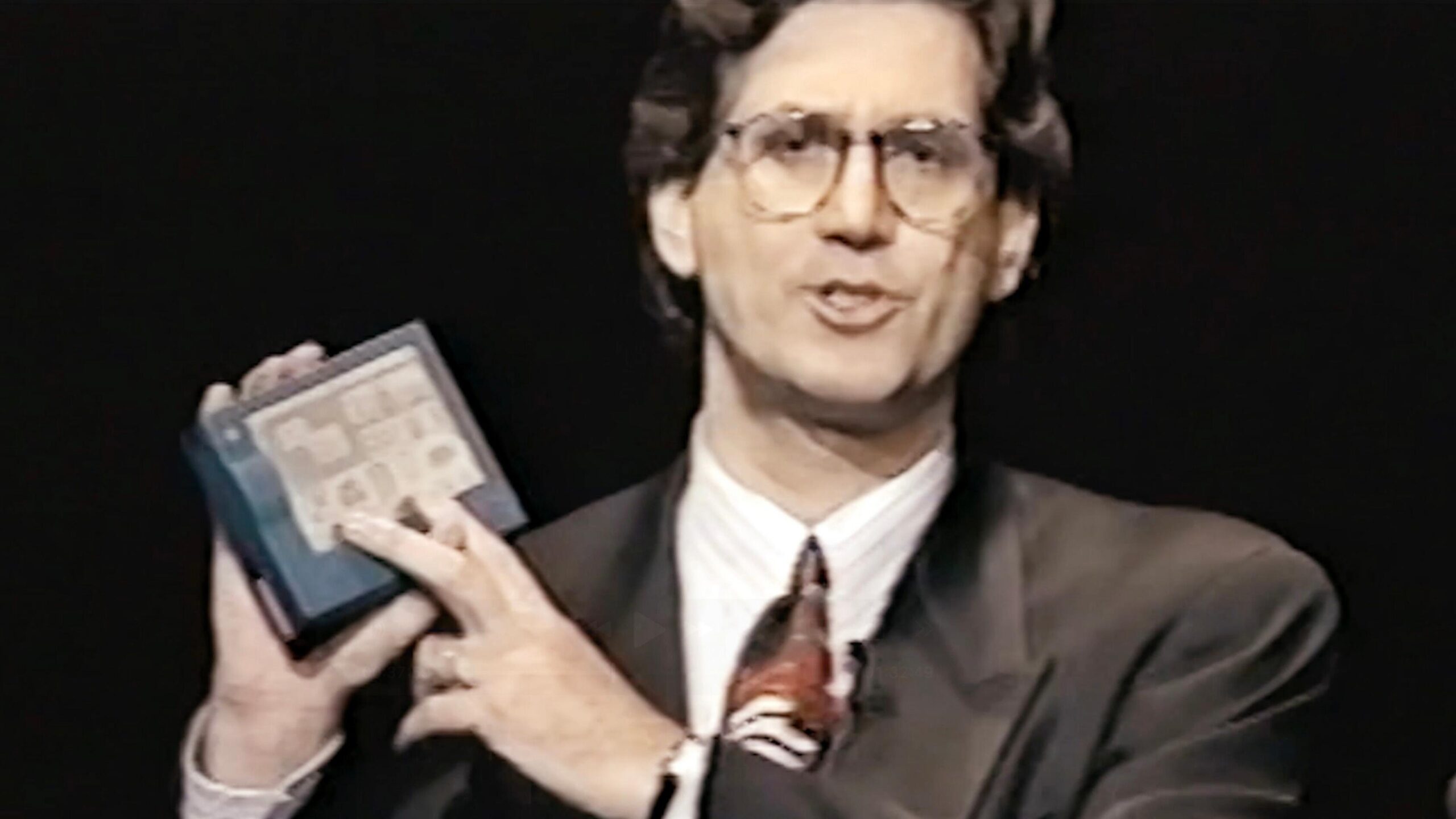
BERAS: The device existed– the Sony Magic Link, powered by General Magic. It was like a mini tablet but chunkier. You could choose apps from a touch screen while holding it in your hands and almost fit it in your pocket. General Magic played a promotional video and all.
[AUDIO PLAYBACK]
ANNOUNCER: It’s a new way to reach just about anyone anywhere anytime. You’re only a press of a button away. Sony Magic Link. And what it takes off your desk is only matched by what it takes off your mind.
[END PLAYBACK]
PEASLEE: The future was here. The magicians, they had delivered. You could send a fax, track your checks, read a book, play a game like solitaire.
BERAS: All for the price of $800 in 1990s dollars. And there was just one minor issue.
FADELL: This Magic Link ended up being the biggest flop in Silicon Valley for a decade or more.
BERAS: Yeah, they ran into a very econ 101 problem.
FADELL: When customers, press, and everybody looked at it, and they go, what is this?
BERAS: It is not enough to have supply. You got to have demand.
PEASLEE: Less than 3,000 Magic Links were sold, mostly to family and friends of the magicians. And within a few years, this company that was going to change the world became a distant Silicon Valley memory.
BERAS: How did that happen? How did this visionary idea become a nothing product? Well, that whole story you just heard– that whole story– was the reason it became a nothing product.
PEASLEE: At least that’s the theory of one guy who spent years researching what happens when people have too much freedom.
DAVID EPSTEIN: They were a spectacular failure because they had too much. They had too much talent. They had too much time. They had too many resources. They could do anything. And so they did do anything.
BERAS: David Epstein is a journalist. And he says years later, when he got his hands on the thing General Magic built, this iPhone before the iPhone was actually pretty fun.
EPSTEIN: I mean, I played with the Sony Magic Link, and it’s definitely cool. But part of the problem there was so much that it was incoherent. I mean, it shipped with a 200-page manual. Can you imagine getting a device–
PEASLEE: [LAUGHS] Like a phone book, essentially.
BERAS: We first learned about General Magic from a book David wrote called Inside the Box– How Constraints Make Us Better. David studied what made Dr. Seuss and Dr. Martin Luther King Jr. and Isabel Allende and NASA and Pixar successful. And his big theory that cuts across all of them is that to be creative, to be successfully creative, you need limits.
PEASLEE: David says what happened at General Magic is a great example of why people need constraints, and you can basically distill his takeaways into three lessons. Number one, they didn’t have a clear customer in mind. They didn’t have a problem they were fixing or a need they were filling, basically nothing to guide what they were making.
BERAS: They did have an imaginary customer in their heads named Joe Sixpack, basically a guy lazing on his couch with a beer watching TV. What they didn’t think about was what problem they were solving for him. Like, he didn’t need email in his pocket because odds are Joe Sixpack didn’t even own a computer.
EPSTEIN: Is Joe Sixpack going to read a 200-page manual? I mean, I’ve read a lot of the manual. It’s elaborate.
PEASLEE: They did test link on a few real people, like Tony’s mom.
FADELL: My mom was a user tester.
BERAS: Oh, fun.
FADELL: So my mom came to visit me. My mom sat in user testing. She’s like, I don’t get it. What is this thing for? It didn’t work. Was it me? Did I do something wrong? I don’t understand why I even need this thing. I was like, wait a second.
BERAS: Moms always know.
FADELL: And I was like, yeah, who is going to purchase this? What problems are we going to solve for them with this? Why are they going to want to put their money down?
BERAS: Tony and David agree. Sure, the technology may have been ahead of its time. But David says a big part of what tripped them up was not having a clear picture of their customer.
EPSTEIN: It was a problem because it didn’t tell them what to do and, more importantly, what not to do. So if they had a very specific customer in mind and they identified some real customer problems, they would have had priorities.
PEASLEE: And the fact that they weren’t listening to what customers needed was compounded by who they were listening to. That’s the second problem David identified– too much money. See, General Magic’s idea was so revolutionary that it attracted the attention and money of a lot of powerful partners, you know, those companies Tony was flying to visit, like Sony, Mitsubishi, Motorola, Philips, AT&T.
EPSTEIN: They covered so much of the communications technology world that whenever they had meetings, the meetings had to begin with an antitrust lawyer listing all of the topics that they were not allowed to discuss so they wouldn’t run afoul of antitrust regulations.
BERAS: But what they were talking about was this product that they were locked into because they had so much investment from all these companies.
EPSTEIN: General Magic probably would have done better to stay really, really, really small. It might seem inefficient to stay small for years, but that’s when you’re laying the groundwork and setting the boundaries and not letting the costs explode.
BERAS: Like, they hired way more people after Tony.
PEASLEE: There’s this principle called Brooks’s law. It’s named after Fred Brooks, who was a computer scientist. He led the development of the operating systems that NASA used in the space program. And Brooks’s law essentially says that when you add people to a project that’s already late, it’s going to be even more late.
EPSTEIN: They spent a lot on people. They spent on offices. They had a gigantic bush in the shape of a bunny, even when they were already having problems.
PEASLEE: The essentials.
EPSTEIN: Yeah, the essentials.
BERAS: And they spent a lot on materials. General Magic was pretty much building everything from scratch. Like, at one point, Tony reinvented the technology that connected the remote to a TV, even though that had been around for many years.
EPSTEIN: They were never forced to look around the technological environment and say, what’s realistic, and what can we borrow and build on?
BERAS: I mean, what was the problem with all that?
EPSTEIN: The problem was because they had time, they had money, they really ended up kind of building for each other, almost the engineers sort of trying to impress one another.
PEASLEE: Which brings us to the third and final big lesson General Magic’s failure teaches us– it’s hard to make magic when you have no bosses and no deadlines.
EPSTEIN: Everyone who had a good idea, they did it. Like, they very rarely told someone no, they couldn’t do something.
BERAS: David says what they had were leaders.
PEASLEE: What was the difference between a leader and a manager to them?
EPSTEIN: The leaders were legendary programmers. And so I think it was, we’re going to listen to these people who are legends, are our icons. But those people were not equipped to be giving them deadlines and help clarifying what they should be doing and priorities and all those things either. They were off doing things that they thought were cool but that weren’t the priorities also.
PEASLEE: Games, emojis, sound effects.
EPSTEIN: Can I give an example of what I think was an emblematic case inside of General Magic?
BERAS: Sure.
EPSTEIN: The engineer, Steve Perlman, who was charged with creating a calendar function, and Steve wrote the calendar function to go from 1904 to 2096, and he checks it in and thinks he’s done.
BERAS: Cool.
EPSTEIN: And then, one of the leaders of the company comes to him and says, Steve, somebody might write historical apps. You have to write this calendar to go back farther. So he opens it up and writes it to go from year 1 to the future. OK, checks it in, thinks he’s done. Then another team comes to him and says, Steve, why are you tying it into this arbitrary religious context? You should make it go back to the beginning of astronomical time. So that’s how Steve Perlman ends up opening up the calendar function and writing it to go from the Big Bang to the future.
BERAS: On a device that maybe doesn’t yet exist.
EPSTEIN: And as he said, if he had stuck with 1904 to 2096, it would have been four lines of code, and he could have moved on. But because they could do anything, they did, and everything always got bigger.
BERAS: Meanwhile, the Magic Link, what was supposed to be the first smartphone, never delivered on its most basic promise.
EPSTEIN: This thing that was going to be a phone and a computer and more didn’t end up having a phone.
BERAS: And we can look at the magicians and go, wow, what a disaster, what a wreck, too bad, and move on. Or we can look at General Magic the way Tony Fadell did, as a blueprint for what not to do.
PEASLEE: After he left the company. Tony applied what he learned to future projects– like, big projects– including the real iPhone. And in the most iconic features of those products he helped create, you can actually see and touch the lessons Tony learned. That’s after the break.
[UPBEAT MUSIC]
PEASLEE: In the years after leaving General Magic, Tony did a lot of reflecting about what went wrong. What made this company that had all the best people, all the money, all the possibility fail? He ended up writing his own book– it’s called Build– where he talks about his time at General Magic and all the lessons he took away. He kind of turned what happened there into a list of everything not to do.
BERAS: A few years after leaving General Magic, he was hired by Apple to work on this idea he had, a portable MP3 player. When he had a prototype, Steve Jobs saw it, and he was like–
FADELL: Oh, this is great. I really want to do this thing. Now, you have to remember, this is March 2001. Apple was $500 million in debt. Steve goes, I’m greenlighting this project. We need to do this.
PEASLEE: But they were going to have to do it on a budget. And Tony says that ended up working in his favor.
FADELL: You can have too much money. You absolutely– because you don’t have constraints to make you think hard. When you know the clock is ticking, and the account is draining, and you have to really understand what it is you’re building, it focuses people.
BERAS: Right at the outset, Tony says, he and his team knew what they were making and had a very specific customer in mind who wanted a very specific thing.
FADELL: I want to take all my digital music with me everywhere I go. I want to take 1,000 songs in my pocket. We knew exactly what that product needed to do.
PEASLEE: At Apple, with a limited budget and a clear scope, Tony says he looked for ways to build on what was already out there.
BERAS: You didn’t completely build it from scratch?
FADELL: Yeah, I went to all the different big companies and small companies around the world doing MP3 to find the right processors, ground-level software necessary, the right batteries, the screens, and everything else. So it’s like, what are the LEGO blocks I can get, stick them together, add a bunch of software, add a bunch of things to make this thing work?
PEASLEE: Everything from the interface software to the chips to the batteries to the hard drive, even the design, in building the iPod, Tony thought of this Danish cordless phone he admired. So–
FADELL: I ran right to Bang & Olufsen, bought a couple, tore them apart. Oh, yeah, yeah, that’s just the optocoupler, da da da da da. Like, I can just do that. No problem.
BERAS: The result was the classic iPod design with the wheel and the button in the middle. The lesson? Literally, you do not have to reinvent the rotary wheel.
PEASLEE: And to make it, Tony gave his team deadlines. He was not just a leader. He was a manager. So day one, he told them–
FADELL: We’re going to need to do this by Christmas, which was less than eight months away. Why? Because Sony was the number one in every audio category. I knew how Sony worked. They’re going to come out with something this Christmas, and if it does, that means Apple is going to be canceling this project. I was like, this is going to have to work. We must ship by Christmas.
PEASLEE: And he says that big deadline wasn’t the only constraint. He set up lots of little deadlines. Tony and Apple got the iPod done and debuted it in months.
FADELL: When we launched the product to the world at Apple, literally two hours after that launch was done, Steve called me in and said, let’s talk about the next one.
BERAS: Oh, wow.
FADELL: Literally, we had not even shipped the one. He’s like, I already want to talk to you about the next one.
PEASLEE: Iteration, they kept tinkering with the iPod, kept releasing new models. Tony worked on 18 of them.
FADELL: General Magic, we only got one– we only got one shot because it took so long, so many years. We had no more money, and so we never had the chance to make another go at it.
BERAS: At Apple, all those iterations of the iPod eventually led to the iPhone, and Tony worked on that too, the first three iterations. Now we’re up to the iPhone 17s.
PEASLEE: After the iPhone, Tony went on to invent the Nest Thermostat, and that was also wildly successful and kicked off an internet of things revolution.
BERAS: A lot of Tony’s colleagues at General Magic emerged out of that chaos to do big techie things. Some of them were early employees at Google. One of them invented the Android phone. Another one created eBay. One founded LinkedIn.
PEASLEE: David Epstein says, when he first started researching for his book, the thing that most surprised him was how the exact thing we imagine will get in the way of creative success can be the thing that makes it possible.
BERAS: Isn’t it like what everyone says they want is no oversight and no deadlines? Like, we could be so free and so creative if we could just, you know, fling sand into the air and make something out of nothing.
EPSTEIN: Yeah, it’s interesting because in any way you cut it, in the abstract, people say they want more freedom. And in reality, it’s often not good for them. Our preference for complete freedom in the abstract is often a mismatch with what actually gets the best work from us and makes us the most satisfied.
BERAS: In David’s book, he writes about Theodore Geisel, better known as Dr. Seuss. One of his most famous books came from a simple constraint. An executive at the publishing company told him he could use no more than 225 words from a vocabulary list for first graders to help them to read. Dr. Seuss picked the first two that rhymed and created the title for The Cat in the Hat.
PEASLEE: And this concept is a hallmark of his work. This constraints idea has been called The Green Eggs and Ham hypothesis. That book has just 50 words. And the idea is when you have limits like that, you can do work that’s more creative.
EPSTEIN: Constraints force you to do something difficult, right? You have to give up something, or you have to find a way to do something that you haven’t done it before. And that’s difficult. But it’s what psychologists call a desirable difficulty because you get the best out of yourself.
PEASLEE: We asked David if constraints are so desirable, why do we humans so often think we want unbridled freedom?
BERAS: The idea of like, you know, ideas will come to if you just kind of run through a big field or whatever and just have all the money pouring down on you, like, why does that, like, idea persist?
EPSTEIN: Yeah, it’s a good question.
BERAS: David says there’s lots of ways to answer it, but there’s one that really caught me because it’s about how we’re wired to want more.
EPSTEIN: Humans have something called additive bias. This is a cognitive bias that’s probably a result of the fact that for most of human history, the main problem was having too little, not too much. And so it’s likely that we are not well equipped to even understand when to intuitively say like, oh, this is too much and to cut back.
BERAS: You sort of have to force yourself to impose constraints in your life.
PEASLEE: No gods, no masters, but maybe deadlines.
[THEME MUSIC]
BERAS: Listeners, we need help. We want to know how the economy is working for you. Does it feel like things cost more these days– groceries, gas, going on dates? And if it does feel that way, have you found any great life hacks that are maybe helping you get by? We want to hear from all of you. Send us an email at planetmoney@npr.org, and maybe we’ll call some of you up to chat.
PEASLEE: This episode of Planet Money was produced by me with help from Sam Yellowhorse Kesler and James Sneed. It was edited by Marianne McCune and fact checked by Charlotte Isidore. It was engineered by Jimmy Keeley with help from Cena Loffredo. Alex Goldmark is our executive producer.
BERAS: Big thank you to Sarah Keurrish and Matt Maude. Their documentary – parts of which you heard in this show – is called General Magic. Tony’s book is called Build and David’s is called Inside the Box. Links to the documentary and the books can be found in our show notes.
PEASLEE: I’m Emma Peaslee. This is NPR. Thanks for listening.