Blog
-
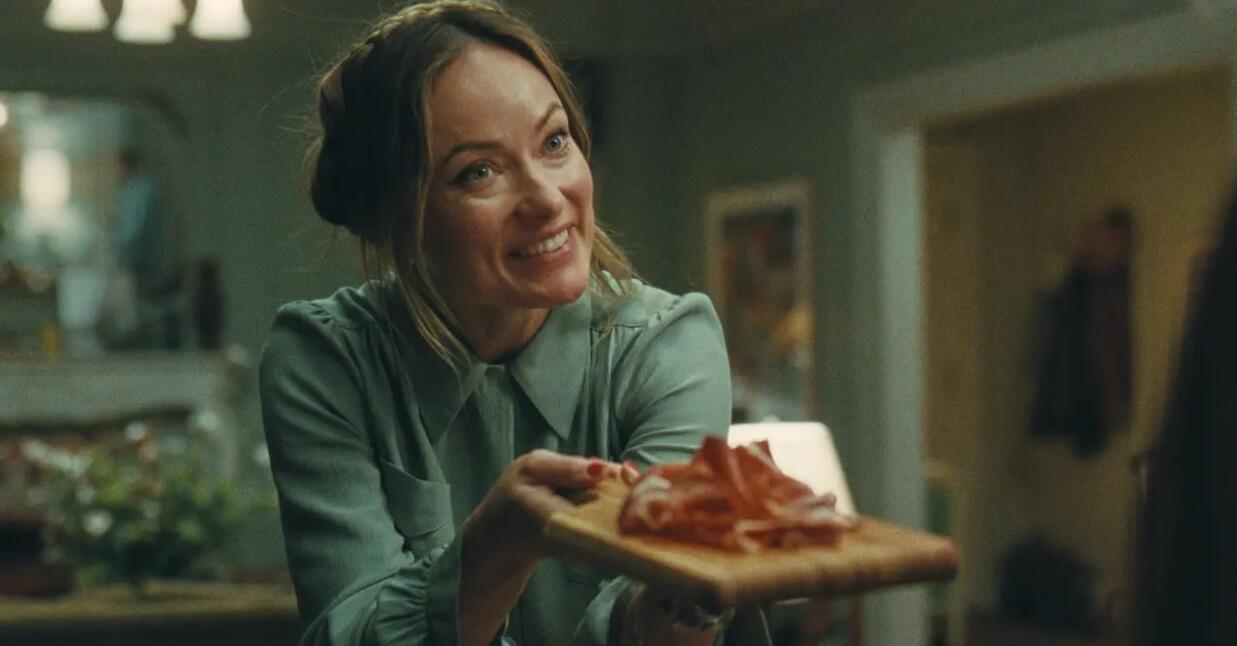
Everyone expected more from the evening ‘Invite,’ audience included
In the annals of movies about bickersome couples spending an ill-advised evening together, Olivia Wilde’s The Invite falls somewhere between two poles. No, it isn’t as good as Who’s Afraid of Virginia Woolf?, Mike Nichols‘ scalding 1966 adaptation of Edward Albee‘s classic play. But it’s significantly better than Carnage, Roman Polanski‘s annoying 2011 film of the Yasmina Reza play God of Carnage.
All these movies have a tricky needle to thread: how do you open up a story for the screen when the story is claustrophobic by design? How do you get an audience to feel the tension and heat of marital rage without driving them toward the exit?
In the case of The Invite, Wilde and her screenwriters, Will McCormack and Rashida Jones, are working from proven material. This is a remake of a Spanish stage-to-screen adaptation, The People Upstairs, which was released in 2020. It’s already inspired remakes set in Italy, Switzerland, France and South Korea.
In this new version, Wilde plays Angela, who lives in a San Francisco apartment with her husband, Joe, played by Seth Rogen. The film unfolds over a single evening. Their 12-year-old daughter is away at a sleepover, and Angela has invited their upstairs neighbors — Piña and her boyfriend, Hawk — over for wine and charcuterie.
The knives come out even before the guests show up. Angela is a ball of nerves, anxious to make a good impression. Joe, by contrast, couldn’t care less what they think, and he means to confront them about their very noisy sex life, which has woken Joe and Angela up at odd hours of the night.
Wilde is a terrific director of actors, herself included, and she and Rogen are all too persuasive as a long-married couple who know just how to push each other’s buttons. Rogen is especially strong; the boisterous good vibes that once powered many a Judd Apatow comedy have hardened into a shell of middle-aged discontent.
Piña and Hawk, played by Penélope Cruz and Edward Norton, eventually arrive. As the couples get to know each other, we get to know them, too, and we come to understand the roots of Joe and Angela’s unhappiness. Joe was a once-promising indie-rock artist whose career flamed out after one big hit; he now teaches music at a Bay Area conservatory, and his sense of failure is eating him alive. And Angela hasn’t made much use of her art-school degree, apart from renovating and redecorating the apartment — her sole creative outlet these days.
Piña and Hawk are a model couple by comparison, which makes them irritating and amusing in equal measure. Hawk lays on the flattery and the New Age sensitivity awfully thick, and Norton, not for the first time, expertly blurs the lines between charm and smarm.
Piña is a psychotherapist and sexologist, and at first, she might seem to veer toward a hot-blooded Euro-seductress caricature. But Cruz is too vivid to be reduced to a stereotype. Piña is ultimately the one character the movie refuses to mock; she’s too comfortable in her own skin, and too ruthlessly accurate in her assessments of Joe and Angela’s troubled marriage.
Wilde previously directed the enjoyable teen comedy Booksmart and, less successfully, the domestic-dystopian satire Don’t Worry Darling — an ambitious movie that ultimately proved less interesting than its much-publicized behind-the-scenes shenanigans.
It was smart of Wilde to scale back with an intimate chamber piece like The Invite, though here, as in Don’t Worry Darling, her stylistic tics sometimes get the better of her. Early on, Joe and Angela’s arguments are almost drowned out by the score’s frenzied cello strings. And Wilde is a bit too fond of using the apartment’s many, many mirrors to isolate the characters visually, as if we needed reminding of how fragmented their relationship has become.
Piña and Hawk have their own ideas about how to help, and it’s worth seeing the movie yourself to discover what they are; suffice to say that the title The Invite has more than one meaning. It’s disappointing, though not surprising, that the film pulls back from those ideas. After dangling a more audacious outcome, The Invite retreats to a zone of emotional safety — one that’s poignant in its own way, though it also feels like a missed opportunity. The movie could have been — dare I say it — a little Wilder.
Transcript:
DAVE DAVIES, HOST:
This is FRESH AIR. In the new comedy “The Invite,” Seth Rogen and Olivia Wilde play a San Francisco couple who spend an evening getting to know their upstairs neighbors, played by Penelope Cruz and Edward Norton. It’s Wilde’s third directorial effort after her earlier films, “Booksmart,” and “Don’t Worry Darling.” “The Invite” opens in theaters this week. Our film critic Justin Chang has this review.
JUSTIN CHANG, BYLINE: In the annals of movies about bickersome couples spending an ill-advised evening together, Olivia Wilde’s “The Invite” falls somewhere between two poles. No, it isn’t as good as “Who’s Afraid of Virginia Woolf?” Mike Nichols’ scalding 1966 adaptation of Edward Albee’s classic play. But it’s significantly better than “Carnage,” Roman Polanski’s annoying 2010 film of the Yasmina Reza play “God Of Carnage.” All these movies have a tricky needle to thread. How do you open up a story for the screen when the story is claustrophobic by design? How do you get an audience to feel the tension and heat of marital rage without driving them toward the exit?
In the case of “The Invite,” Wilde and her screenwriters, Will McCormack and Rashida Jones, are working from proven material. This is a remake of a Spanish stage-to-screen adaptation, “The People Upstairs,” which was released in 2020. It’s already inspired remakes set in Italy, Switzerland, France and South Korea. In this new version, Wilde plays Angela, who lives in a San Francisco apartment with her husband, Joe, played by Seth Rogen.
The film unfolds over a single evening. Their 12-year-old daughter is away at a sleepover, and Angela has invited their upstairs neighbors, Pina and her boyfriend, Hawk, over for wine and charcuterie. The knives come out even before the guests show up. Angela is a ball of nerves, anxious to make a good impression. Joe, by contrast, couldn’t care less what they think. And he means to confront them about their very noisy sex life, which has woken Joe and Angela up at odd hours of the night.
Wilde is a terrific director of actors, herself included, and she and Rogen are all too persuasive as a long-married couple who know just how to push each other’s buttons. Rogen is especially strong. The boisterous good vibes that once powered many a Judd Apatow comedy have hardened into a shell of middle-aged discontent. Pina and Hawk, played by Penelope Cruz and Edward Norton, eventually arrive. Not long afterward, Hawk, who’s nothing if not direct, tries to either diffuse or exacerbate the obvious tension in the room.
(SOUNDBITE OF FILM, “THE INVITE”)
EDWARD NORTON: (As Hawk) It took you a while to come to the door.
PENELOPE CRUZ: (As Pina, speaking Spanish).
NORTON: (As Hawk) And it sounded like you were arguing.
CRUZ: (As Pina) No filter.
NORTON: (As Hawk) No, I just want to be honest. We were at the door before we rang, and we could hear you were fighting.
OLIVIA WILDE: (As Angela) Oh, we were…
SETH ROGEN: (As Joe) We were fighting.
WILDE: (As Angela) We were fighting, yeah.
ROGEN: (As Joe) Bit of a contentious environment in here, so I understand if that’s repellent to you. No hard feelings. You know what I mean? Completely understand, you know?
NORTON: (As Hawk) We love a contentious environment. We love it.
WILDE: (As Angela) OK.
ROGEN: (As Joe) Well…
NORTON: (As Hawk) Really, it’s fine.
ROGEN: (As Joe) You hit the jackpot then, my friend.
(LAUGHTER)
CHANG: As the couples get to know each other, we get to know them, too. And we come to understand the roots of Joe and Angela’s unhappiness. Joe was a once-promising indie rock artist whose career flamed out after one big hit. He now teaches music at a Bay Area conservatory, and his sense of failure is eating him alive. And Angela hasn’t made much use of her art school degree, apart from renovating and redecorating the apartment, her sole creative outlet these days.
Pina and Hawk are a model couple by comparison, which makes them irritating and amusing in equal measure. Hawk lays on the flattery and the new-age sensitivity awfully thick. And Norton, not for the first time, expertly blurs the lines between charm and smarm. Pina is a psychotherapist and sexologist. And at first, she might seem to veer toward a hot-blooded Euro seductress caricature, but Cruz is too vivid to be reduced to a stereotype. Pina is ultimately the one character the movie refuses to mock. She’s too comfortable in her own skin and too ruthlessly accurate in her assessments of Joe and Angela’s troubled marriage.
Wilde previously directed the enjoyable teen comedy “Booksmart” and, less successfully, the domestic dystopian satire “Don’t Worry Darling,” an ambitious movie that ultimately proved less interesting than its much-publicized behind-the-scenes shenanigans. It was smart of Wilde to scale back with an intimate chamber piece like “The Invite,” though here, as in “Don’t Worry Darling,” her stylistic ticks sometimes get the better of her. Early on, Joe and Angela’s arguments are almost drowned out by the score’s frenzied cello strings, and Wilde is a bit too fond of using the apartment’s many, many mirrors to isolate the characters visually, as if we needed reminding of how fragmented their relationship has become.
Pina and Hawk have their own ideas about how to help, and it’s worth seeing the movie yourself to discover what they are. Suffice to say that the title, “The Invite,” has more than one meaning. It’s disappointing, though not surprising, that the film pulls back from those ideas. After dangling a more audacious outcome, “The Invite” retreats to a zone of emotional safety, one that’s poignant in its own way, though it also feels like a missed opportunity. The movie could have been, dare I say it, a little wilder.
DAVIES: Justin Chang is a film critic at The New Yorker. On Monday’s show, Chris Evert and Martina Navratilova. They were tennis champions, the two biggest stars of their generation. They were friends. They were rivals. And after retiring, they got cancer at the same time. Now they’re the subject of a new Netflix documentary. I hope you can join us.
(SOUNDBITE OF DAVE HOLLAND AND PEPE HABICHUELA’S “JOYRIDE”)
DAVIES: FRESH AIR’s executive producer is Sam Briger. Our senior producer today is Roberta Shorrock. Our technical director and engineer is Audrey Bentham, with additional engineering support from Julian Herzfeld, Diana Martinez and Charlie Kaier. Our interviews and reviews are produced and edited by Phyllis Myers, Ann Marie Baldonado, Lauren Krenzel, Therese Madden, Monique Nazareth, Thea Chaloner, Susan Nyakundi, Anna Bauman and Nico Gonzalez-Wisler. Our digital media producer is Molly Seavy-Nesper. For Terry Gross and Tonya Mosley, I’m Dave Davies.
(SOUNDBITE OF DAVE HOLLAND AND PEPE HABICHUELA’S “JOYRIDE”)
-
Remembering James Burrows, a prolific director of modern comedy
Transcript:
DAVE DAVIES, HOST:
This is FRESH AIR. I’m Dave Davies. Today, we remember James Burrows, one of the most respected and sought-after directors of TV comedies. In over five decades, he directed more than a thousand episodes – episodes of “Taxi,” “Cheers,” “Friends,” “Frasier,” “Will & Grace” and many other sitcoms. Burrows died June 19 at the age of 85.
A statement by the Directors Guild of America described him as an incredibly generous colleague, sharing his wisdom and warm humor with all he worked with. In a statement, his family said, Burrows understood that great comedy was never simply about laughter. It was about humanity, connection and truth. We’re going to listen to Terry’s 2006 interview with James Burrows in a few minutes. But first, we have this appreciation by our TV critic David Bianculli.
DAVID BIANCULLI, BYLINE: James Burrows was born in LA in 1940 but didn’t live there long. His family moved to New York when he was 5. His father, Abe Burrows, had written for radio and television but found his biggest success on Broadway as a director and especially as a writer. Abe Burrows wrote the books for the musicals “Guys And Dolls,” “How To Succeed In Business Without Really Trying” and “Can-Can.” His son, James, became a director, too, but went back to Los Angeles to do so. His big break was directing an episode of “The Mary Tyler Moore Show,” after which James Burrows landed jobs directing multiple episodes of many popular sitcoms of the 1970s, including “The Bob Newhart Show,” “The Tony Randall Show,” “Laverne & Shirley” and “Taxi.”
By the time he co-created “Cheers” with Glen and Les Charles in 1982, James Burrows was considered the best sitcom director in the business, a title he maintained for decades. The reasons were obvious. James Burrows made one of the most significant improvements to the sitcom genre since “I Love Lucy” popularized the three-camera format of shooting before a studio audience. Burrows added a fourth camera, which allowed him to capture more close-ups and frame the action as naturally as he could. Burrows was a master at setting the tone for a new series, working with young actors to shape their characters and find just the right comic flow. Over his career, he won 11 Emmy Awards and directed a staggering number of TV pilots – specifically, 75.
But it isn’t just the quantity of premiere episodes directed by James Burrows that’s so amazing. It’s the quality. He directed the introductory episodes of “Taxi,” “Cheers” and “Frasier” – not just the original 1993 “Frasier,” but the 2023 remake as well, 30 years later. He also directed the first episodes of “The Big Bang Theory,” “Night Court,” “Wings,” “NewsRadio,” “3rd Rock From The Sun,” “Dharma & Greg,” “Two And A Half Men,” “Friends” and “Will & Grace.” And sometimes, James Burrows stuck around for quite a while – for more than 200 episodes of both “Will & Grace” and “Cheers” and 75 episodes of “Taxi.”
For me, the absolute best example of Jim Burrows’ gifts as a TV director came in a 1979 episode of “Taxi,” written by Glen and Les Charles. It was an episode written to showcase Christopher Lloyd, who had guest-starred in a previous episode as Reverend Jim, a hippie preacher from the ’60s who was laid-back, confused and dealing with a long history of recreational drug use. At the time, Reverend Jim was an outrageous character to introduce to a primetime TV show. But “Taxi” already had triumphed by mixing types of comic styles that shouldn’t have worked.
Judd Hirsch, Tony Danza, Marilu Henner, Andy Kaufman, Jeff Conaway, Danny DeVito – all were part of the Brooklyn cab outfit that was eager for Reverend Jim to join its ranks. But to do that, he’d have to go to the DMV and pass a driver’s exam, not just behind the wheel but on paper. It’s in that DMV office where Burrows helped shape what I consider the funniest scene in TV history. He allows the comedy to build at its own pace and encourages the young Christopher Lloyd to steal the show as Reverend Jim. And most important of all, James Burrows places his cameras and frames the action to catch it all – not only intense close-ups of an increasingly frustrated Reverend Jim but group shots capturing the reactions of Jeff Conaway’s Bobby, Marilu Henner’s Elaine and everyone else trying to help him take the test. Bobby tries to speed things up by reading the application to Reverend Jim as Elaine stands nearby.
(SOUNDBITE OF TV SHOW, “TAXI”)
JEFF CONAWAY: (As Bobby Wheeler) Here, let me help you out, OK? All right. Have you ever experienced loss of consciousness, hallucinations, dizzy spells, convulsive disorders, fainting or periods of loss of memory?
CHRISTOPHER LLOYD: (As Reverend Jim) Well, hasn’t everyone?
(LAUGHTER)
MARILU HENNER: (As Elaine Nardo) Put no.
CONAWAY: (As Bobby Wheeler) Mental illness or narcotic addiction?
LLOYD: (As Reverend Jim) Now, that’s a tough choice.
(LAUGHTER)
HENNER: (As Elaine Nardo) Just put no.
CONAWAY: (As Bobby Wheeler) OK. That’s it. You’re ready for the test.
LLOYD: (As Reverend Jim) I thought this was the test.
(LAUGHTER)
HENNER: (As Elaine Nardo) No, no, no. This is the application.
LLOYD: (As Reverend Jim) Oh, man.
(LAUGHTER)
LLOYD: (As Reverend Jim) Hey, it’s getting rougher and rougher.
BIANCULLI: Eventually, Reverend Jim gets a copy of the test, slumps in his classroom-style desk and gets stuck on the first question. His cabbie friends are standing on the other side of the room, but he asks for help anyway, louder and more angrily every time. Christopher Lloyd is brilliant, and Burrows lets the scene build and flow. And listen to the studio audience. They’re not just laughing. They’re howling.
(SOUNDBITE OF TV SHOW, “TAXI”)
LLOYD: (As Reverend Jim) Psst. What does a yellow light mean?
CONAWAY: (As Bobby Wheeler) Slow down.
LLOYD: (As Reverend Jim) OK. What…
(LAUGHTER)
LLOYD: (As Reverend Jim) Does a…
(LAUGHTER)
LLOYD: (As Reverend Jim) Yellow light mean?
CONAWAY: (As Bobby Wheeler) Slow down.
LLOYD: (As Reverend Jim) OK. What…
(LAUGHTER)
LLOYD: (As Reverend Jim) Does…
(LAUGHTER)
LLOYD: (As Reverend Jim) A…
CONAWAY: (As Bobby Wheeler) Slow down.
(LAUGHTER)
LLOYD: (As Reverend Jim) What…
(LAUGHTER)
LLOYD: (As Reverend Jim) Does…
(LAUGHTER)
LLOYD: (As Reverend Jim) A yellow…
BIANCULLI: I’m guessing you had your own favorite memories and favorite laughs from a sitcom directed by James Burrows – from “Friends,” from “Cheers,” from “Frasier,” from “Big Bang Theory” or from so many others. And that’s the point, really. The legacy of James Burrows, no matter where you look, is bound to make you smile.
DAVIES: David Bianculli is our TV critic. Terry Gross spoke to James Burrows in 2006. He got his start in television directing episodes of “The Mary Tyler Moore Show,” “The Bob Newhart Show,” and “Laverne & Shirley.” But before that, he worked on some of his father’s musicals. His father, Abe Burrows, wrote the books for the musicals “Guys And Dolls,” “How To Succeed In Business Without Really Trying” and “Cactus Flower.”
(SOUNDBITE OF ARCHIVED NPR CONTENT)
JAMES BURROWS: I was an assistant stage manager or an assistant to the assistant on an ill-fated musical called “Breakfast At Tiffany’s,” where I met Mary Tyler Moore. And Mary Tyler Moore and Richard Chamberlain were the stars. And I went on subsequently to stage-manage for my father on “Cactus Flower,” the production on the road, and then in New York City in “Forty Carats.” So I got to see my father, who really wrote on his feet because he would write a scene. And then when he would get in rehearsal, he would change the scene just on his feet. And you began to see how fascinating he was.
And that’s when I – you know, I kind of have his style of directing. I’m a listener. I’m not necessarily a watcher. And Abe would always – he would say to me, when he went to a run-through of one of his shows or went to see one of his shows in the theater, he would always walk behind the set. He wouldn’t watch because he wanted to know that there was always noise happening onstage. He listened for the noise. He knew if there was no noise, that he was in trouble. So I do that when I direct my shows. So that – you know, that is the essence of the experience with my father. I – in subsequent years, a lot of his gift and a lot of his skills seem to come out of me at the strangest times. It’s not like I learned them as much as, you know, they were like osmosis. I absorbed them, and they kind of seep out of my skin in certain situations.
TERRY GROSS: So when you’re directing a TV show, you’re sometimes backstage and not looking at the action or at the monitor?
BURROWS: Well, I don’t – I never look at the monitor because it’s about – the shows I do are in front of a live audience, so it’s about the play. It’s about what’s happening there. I’ve been doing it long enough to know that I don’t have to worry about the camera shots because I know they’ll all be there. So I listen and watch. You know, I’ll walk behind the cameras not watching the action, necessarily. But a lot – you know, most of the time, I watch the play because – and I make my writers watch the play, or they can watch the cut on the screen. But they don’t watch the quad split. A quad split is a television screen that has the four cameras that I use to shoot the show on that. And if they watch the quad split, they’re always worried about mics in shots and shots not matching. So I make all the writers watch the play because that’s eventually what makes a hit show.
GROSS: So what made you realize that you wanted to switch from the stage to television?
BURROWS: In the course of doing “Cactus Flowers” and “Forty Carats” around the country, I would work at a lot of dinner theaters, a lot of regional – not regional theater – dinner theaters, summer stock theaters. I would do these – not situation comedies – comedies. You know, “Odd Couple,” “Barefoot In The Park,” even “Blithe Spirit” I did. I’m trying to think. “Never Too Late” – all these plays, the comedies that had been on Broadway, and I’d do them with stars. And I had about eight days to stage the whole thing, and I could get it done. I was good at that.
And then one night, I was at home after rehearsal, and I turned on the television. There was “The Mary Tyler Moore Show,” and they were doing 20 minutes a week in front of a live audience. And here I was doing 120 minutes a week to get ready for a live audience. And I thought I could do that. I thought I could translate my skills onstage to the skills required to do that television show because it was like filming a theatrical show.
So I wrote a letter to Mary Tyler Moore. As I said before, I had the connection because I was a stage manager on her first Broadway show, so she kind of knew me. And Grant Tinker called me, and he said, we’re interested in theatrical directors at MTM. Would you come out and do one show? And I don’t know what’s faster than a New York second, but whatever it was, I said yes. And I was – that – and the rest is history.
DAVIES: James Burrows speaking with Terry Gross in 2006. We’ll hear more after a break. This is FRESH AIR.
This is FRESH AIR. Let’s get back to Terry’s 2006 interview with TV director James Burrows, who directed over 1,000 episodes of “Cheers,” “Taxi,” “Frasier,” “Friends” and other sitcoms. He died last week at the age of 85.
(SOUNDBITE OF ARCHIVED NPR CONTENT)
GROSS: So you got started directing MTM productions like “The Bob Newhart Show,” “Mary Tyler Moore Show,” “Phyllis,” yes?
BURROWS: Yes. Yes.
GROSS: Now, were you at first, like, understudying other directors? Or did they let you just go at it?
BURROWS: Well, the first thing you have to do is you have to learn the technical stuff. So they brought me out here, and you kind of have to observe. Being an observer is, you sit in the stands, and you watch a week of rehearsals. And the first three days are with actors and writers alone. And the fourth day, the cameras come in, and the fifth day, you shoot the show. And for me, with actors and writers, I kind of got that. It was when the cameras came in that it became daunting. So I watch for maybe two months straight. I watched the Newhart show. Then I went over to “The Mary Tyler Moore Show” and I watched Jay Sandrich, who to me is the true genius of this medium.
I watched him and became very good friends with him. And so I kind of started to get a knowledge of what to do with cameras, how to figure them out. And then they assigned me to a show called “Friends And Lovers,” which was the Paul Sand show. And I would coach – I was Paul Sand’s dialogue coach. I would help him run lines. But in a time when I wasn’t doing that, I would watch cameras. And eventually, they called me and they said, we’re going to give you a shot. And I figured it would be on the Paul Sand show, and all of a sudden, it was “The Mary Tyler Moore Show.”
GROSS: Do you remember that first show that you did?
BURROWS: I do. Vividly.
GROSS: How did it go?
BURROWS: I do.
GROSS: What sticks out in your mind?
BURROWS: Oh, my God. Well, we read the script. It was a show where Lou Grant moves into Rhoda’s apartment. So he’s living above Mary, which means that he – they work together and they live together, which wasn’t good for their relationship. And so we read the script around the table, and it was a D-minus. It was awful. And I said to Grant, I said, in the sea of Danish, I get a bagel.
GROSS: (Laughter).
BURROWS: And it was literally just a – the show was awful. I mean, the initial reading, they made it better ’cause you would rewrite. The writers would rewrite all the time. And so I had to go down – back in those days, you rehearsed immediately after you read. You just went down and started running scenes. And so I was dealing with a cast who hated the script, too, and yet I had to run these scenes. And so I would do it. And I can’t tell you – I invoked Chekhov, I invoked Strindberg, I invoked Kaufman and Hart. I did anything to try to ease it for them, to try to come up with some comic business, anything that would help them get through this process.
And so I was working the first three days with the actors and cameras. And I guess we finally got the show in some sort of semblance. And then the cameras came in, and that was daunting enough for me. It was very difficult. I did it on my own. I didn’t want any help. And on the fifth day, just before we shot, Mary Tyler Moore came over to me, and they said, we feel our investment in you has worked out. And that was even before I shot the show. And I couldn’t have been higher, figuratively.
And we shot the show, and it turned out all right. And Jay Sandrich was there and helped me a little bit. And the minute that show was over, I got two Newharts and I got a Bob Crane and a Paul Sand. And next year, I was on the “Phyllis” show. So I was on my way.
GROSS: Was the show as bad after it was shot as it was when you were doing the reading?
BURROWS: It was – it’s a C-plus show. It’s not a very good show. You know, I – in fact, the script after me won an Emmy. So I…
GROSS: (Laughter).
BURROWS: By the luck of the draw, I got – I didn’t get the Emmy show. I got an OK show. And it might’ve helped me because of the amount of work I had to do and the amount of talking and inspiring I had to do, might’ve – in hindsight, might’ve really helped me succeed in there and impress the actors.
GROSS: OK. So you start off at MTM in television. And then you do “Taxi.” And about how many episodes would you estimate you did of “Taxi?”
BURROWS: I think I did 75.
GROSS: And you were there right from the beginning with “Taxi,” right?
BURROWS: I was there. It was after – no, I kind of left MTM after about three or four years and started to go other places. I went on “Laverne & Shirley,” where I had a ball, although that was a tough show. And then I did a show with Ned Beatty. I was all a hired hand. I didn’t do many pilots or anything like that. And then the boys from MTM – Ed Weinberger, Jim Brooks, Stan Daniels and Dave Davis – had created a show called “Taxi.” And they called me to direct it. And probably the most difficult show I ever did because the cast was so divergent. The writing was so outrageous. The set was so gigantic.
And I – it was my first really big show where I was in charge from the beginning. But it was like, getting all these egos in the same room, there wasn’t a room big enough. And it was a struggle. And yet, I was heard. I got out there and I said what I wanted to say, and I was heard. It was tough at times to be heard, but I fought. And the great thing about that show was that the producers of that show and the head writers were Glen Charles and Les Charles, who I’d first met on “Phyllis.” And then they were brought in on “Taxi.”
So we struck up a friendship. We were both handled by the same agent, and he thought it would be good for us to do a show together. So I think about the third year of “Taxi,” we started to think about a show. But “Taxi,” if you go back and watch that show, there is some of the funniest television I think I’ve ever done. The standard out of that show is Reverend Jim, what does the yellow light mean? Slow Down. And that is, to me, one of the biggest laughs I had ever done on “Taxi.” And so I have fond memories of that show. It was also a great learning experience.
DAVIES: James Burrows speaking with Terry Gross in 2006. He died last week at the age of 85. Here’s one of the scenes from Episode 3 of “Cheers,” with Ted Danson and Shelley Long, which Burrows directed.
(SOUNDBITE OF TV SHOW, “CHEERS”)
SHELLEY LONG: (As Diane Chambers) Why are you so upset?
TED DANSON: (As Sam Malone) You know, this week, I have gone out with all the women I know. I mean, all the women I really enjoyed. And all of a sudden, all I can think about is how stupid they are. I mean, my life isn’t fun anymore and it’s because of you.
LONG: (As Diane Chambers) Because of me?
DANSON: (As Sam Malone) Yeah. You’re a snob.
LONG: (As Diane Chambers) A snob?
DANSON: (As Sam Malone) Yeah, that’s right.
LONG: (As Diane Chambers) Well, you’re a rapidly aging adolescent.
DANSON: (As Sam Malone) Well, I would rather be that than a snob.
LONG: (As Diane Chambers) And I would rather be a snob.
(LAUGHTER)
DANSON: (As Sam Malone) Well, good, because you are.
LONG: (As Diane Chambers) Sam, do yourself a favor, go back to your tootsies and your rat parts. I’d hate to see the bowling alleys close on my account.
(LAUGHTER)
DANSON: (As Sam Malone) Hey, hey, wait. Wait a minute, wait a minute. Are you saying that I’m too dumb to date smart women?
LONG: (As Diane Chambers) I’m saying that it would be very difficult for you. A really intelligent woman would see your line of BS a mile away.
DANSON: (As Sam Malone) You think so?
LONG: (As Diane Chambers) Uh-huh, uh-huh.
(LAUGHTER)
DANSON: (As Sam Malone) Yeah. Well, you know, I’ve never met an intelligent woman that I’d want to date.
LONG: (As Diane Chambers) On behalf of the intelligent women around the world, may I just say, phew.
(LAUGHTER)
DAVIES: Coming up, we’ll hear about Burrows’ work on “Cheers” and “Frasier.” And later, Justin Chang reviews the new film “The Invite.” I’m Dave Davies, and this is FRESH AIR.
(SOUNDBITE OF SONG, “CHEERS THEME SONG (TV VERSION)”)
GARY PORTNOY: (Singing) Making your way in the world today takes everything you’ve got. Taking a break from all your worries sure would help a lot. Wouldn’t you like to get away? Sometimes you want to go where everybody knows your name and they’re always glad you came.
(SOUNDBITE OF MUSIC)
DAVIES: This is FRESH AIR. I’m Dave Davies. We’re remembering James Burrows, who was one of the most respected TV directors in the business. He directed over a thousand episodes of “Cheers,” “Taxi,” “Friends,” “Frasier,” “Will & Grace” and also “The Big Bang Theory,” “3rd Rock From The Sun,” “Mike & Molly” and “Two Broke Girls.” Burrows died last week at the age of 85. He spoke with Terry Gross in 2006.
(SOUNDBITE OF ARCHIVED NPR CONTENT)
GROSS: Now, after “Taxi,” you left with a couple of the creators of “Taxi,” Glen Charles and Les Charles, and started “Cheers.” And on “Cheers” and on “Taxi,” you had a chance to direct characters from the very start and therefore to shape them, to help shape them through your direction, as opposed to inheriting characters on an already existing series. Can you talk a little bit about what it’s like to actually create a character from scratch – a character that you hope will endure for years in a series?
BURROWS: Well, the first thing that has to happen, it has to be on the page. So I am very careful when I select scripts. And when we talked about – Glen, Les and I talked about doing “Cheers,” we spent two months talking about these characters, and then the boys went off and wrote the script. And when – a month later, when I read it, it was – I said to the boys, you have brought radio back to television, which is what they did. They wrote a really smart show that literally could have been a radio show because there wasn’t that much movement. It was all about attitudes and all about intonations and nuances and stuff like that. And I…
GROSS: Can I just stop you? That would be a terrible insult to a lot of people. If you said – there are a lot of TV people. If you said to them, you’ve just produced this brilliant radio show – you’ve just written a brilliant radio show – they would think that was a terrible insult ’cause they’re working on television. And sometimes, when you say radio to television people, it’s like saying, you don’t know what you’re doing. You’re blind. You can hear, but you’re blind.
BURROWS: No. If you watch that show, people cross occasionally. Norm comes into the bar, but you got to listen to that show. It’s all about listening.
GROSS: Absolutely. Yeah, yeah.
BURROWS: And there’s no eye candy in that show. There’s no – I’ll never forget. Originally, the boys in the first draft had some kind of hurdle race in there that we took out. But it was. They came in. They sat down. They told their stories. And that’s what it is. You could have done that show on radio. It would – you wouldn’t have had to worry about how the actors looked, as long as their voices were good. But it was a television show. But when I meant brought radio to television was it was smart. It was a smart show. It was an upscale, smart show with jokes about Schopenhauer and Updike and Freud and Jung. And we didn’t care if the audience knew who those people were. And they – it was a genius job.
And so it was my job to shape this cast. You cast them. You cast these people individually, but you don’t know what you have until you put them together. So I always – in pilots, I always will begin by sitting around a big table. And in fact, on “Cheers,” we sat around the bar, and we talked about where everybody came from, their characters. You know, I carried a conversation on with Sam and Diane and Norm and Cliff and everybody like that, and we talked. And it’s not only good for me. It’s good for the actors because they’re going to want to talk anyway. And if I can do it now and get them to talk and get them – they’ll only grow into the roles more.
So we spent – you know, we spent half a day just sitting around, all – probably a day sitting around talking, and then I went to work on it. And it was – you know, I did 240 out of, like, 275 shows, and I had a great time. I loved that show. That’s – to me, that’s my baby. And I was there from the beginning for the cast, and I was there at the end, and they trusted me. And we – you know, we – after a while, we knew what worked and what didn’t work. We didn’t have to spend a lot of time on stuff that didn’t work. And we – you know, we could make the stuff work that worked really quickly.
GROSS: Now, “Cheers” was shot in front of a live audience. Do the laughs help the actors, and does it ever work against the show? In other words, like – ’cause the actors can’t, like, pick up and say the next line until the laughs fade. And of course, the audience at home isn’t in the studio audience. So the timing – do you think the timing when you’re watching at home is any different than the timing when you’re in the theater?
BURROWS: Well, laughter is communal, so it really helps to have an audience because movies are so much better. I try to go see comedies in a theater rather than try to watch them at home in the movies because you just – it’s really tough to laugh at home. Or I’ll get the family in to watch, and then you can all laugh. But it’s infectious, and it’s communal. So those were true laughs, and you can tell they’re true laughs ’cause you can see the actors’ eyes glint on “Cheers.” The – you can see the glint in their eyes, the excitement in hearing such a big reaction to something they’ve said. And they had to wait to be heard. And sometimes they wouldn’t wait, and I’d have to back up and say, you know, let’s go back a little bit, and so they would be heard. But those are true laughs. That show was a truly funny show.
GROSS: OK. Well, say you had to back up because they were unheard, or say you want another take because it didn’t work, what happens when the audience is hearing the joke the second time, and their laughter is not going to be the same the second time around? They’ve already heard the joke. They’ve already laughed at it.
BURROWS: But you’re – yeah, they’ve laughed at that joke, but then you go the second time so that you can get the reaction of the other person to that joke. And then you can hear the other line from the person because they have previously said it into a laugh, and you didn’t hear it. So that’s why you have to do that. But you’ll use the first take of that joke because the laughter was so big. And…
GROSS: So do you ever use the laughter from one take and roll it for a second take?
BURROWS: So yeah. You use – you – when you cross takes, you’ll take the laughter from the first take and play it over the reaction in the second take.
GROSS: Right, right.
BURROWS: You have to do that, otherwise you couldn’t make sense of the show or people saying lines into laughs. You have to hear every line. So we didn’t do that a lot. Back in the “Cheers” days, we only ran the scene twice. I would back up occasionally if somebody said something and laughed. But we didn’t run the scene twice like we do now. We ran the “Cheers” scenes only once, and then I would go back if we missed something or we wanted to change one joke. I would go back and just shoot a piece of the scene again. On “Will & Grace,” we do every scene twice, and in between each scene, the writers rewrite some jokes.
GROSS: Really?
BURROWS: Yeah.
GROSS: So the audience gets to hear – gets to see two different versions of the scene?
BURROWS: Yes. It – if you’re going to do a scene twice, it really helps to change the jokes.
GROSS: Is that typical that the writers are on the set? Typical for you, maybe.
BURROWS: Oh, yeah.
GROSS: Is it typical for other shows?
BURROWS: Oh, yeah. I – any sitcom, you got to see what – I mean, if you’re not on the set, you don’t know whether the show bombs or not. You got to be there to see. It’s either your – it’s either euphoria or it’s your funeral, but you got to be there. And you got to fix what doesn’t work because that’s going off on – that’s going on the air. And you don’t want something that’s no good going on the air, so you better fix it.
DAVIES: James Burrows speaking with Terry Gross, recorded in 2006. We’ll hear more of their conversation after a break. This is FRESH AIR.
(SOUNDBITE OF MUSIC)
DAVIES: This is FRESH AIR, and we’re listening to Terry’s 2006 interview with TV director James Burrows, who directed over a thousand episodes of “Cheers,” “Taxi,” “Friends,” “Frasier” and other sitcoms. He died last week.
(SOUNDBITE OF ARCHIVED NPR CONTENT)
GROSS: Now, you know, we were talking about “Cheers.” And, of course, after “Cheers,” you worked on the spin-off “Frasier” and you directed…
BURROWS: Right.
GROSS: …Lots of episodes of that. You were there right at the start. Why was Frasier the character that you all decided to spin off?
BURROWS: We didn’t. I did not spin him off. David Angell, Peter Casey and David Lee, who were the producers of “Cheers” for years, had talked to Kelsey about doing a spin-off. So they wrote the script. And they spun him off. They asked us if he – if they could. And we said, sure. And they wrote a brilliant script. They – their genius in that script was taking an actor who had this incredible ability, which Kelsey has, and taking Frasier, making him Sam Malone – because he had to be the center – and taking David Hyde Pierce as Niles and making him Frasier.
So that was brilliant on their part. And the tone of that show was brilliant, too, the so much more upper crust than “Cheers” because other than Martin, the father, there was no other Sam Malones or Norms or Cliffs on that show. They were all upper-crust, smart people. And they did a brilliant job. And I directed the pilot, which was huge. And I think I directed about 20, 25 episodes. They did a great job, and they had a great actor in the lead and a great cast.
GROSS: I want to play a short scene from the pilot which you directed of “Frasier.” And this is a scene from early in the episode. Niles and Frasier are at a coffee shop, and Niles is suggesting it’s time to find a convalescent home for their father to live in.
(SOUNDBITE OF TV SHOW, “FRASIER”)
DAVID HYDE PIERCE: (As Niles Crane) We have a problem, and that’s why I thought we should talk.
KELSEY GRAMMER: (As Frasier Crane) Is it Dad?
PIERCE: (As Niles Crane) Afraid so. One of his bold buddies from the police force called this morning. He went over to see him and found him on the bathroom floor.
GRAMMER: (As Frasier Crane) Oh, my God.
PIERCE: (As Niles Crane) No. It’s OK. He’s fine.
GRAMMER: (As Frasier Crane) What? His hip again?
PIERCE: (As Niles Crane) Frasier, I don’t think he can live alone anymore.
GRAMMER: (As Frasier Crane) What can we do?
PIERCE: (As Niles Crane) Well, I know this isn’t going to be anyone’s favorite solution, but I took the liberty of checking out a few convalescent homes for him.
GRAMMER: (As Frasier Crane) Niles, a home? He’s still a young man.
PIERCE: (As Niles Crane) Well, you certainly can’t take care of him. You’re just getting your new life together.
GRAMMER: (As Frasier Crane) Absolutely. Well, besides, we were never simpatico.
PIERCE: (As Niles Crane) Of course, I can’t take care of him.
GRAMMER: (As Frasier Crane) Oh, yes, yes, of course, of course. Why?
(LAUGHTER)
PIERCE: (As Niles Crane) Because Dad doesn’t get along with Maris.
GRAMMER: (As Frasier Crane) Who does?
(LAUGHTER)
PIERCE: (As Niles Crane) I thought you liked my Maris.
GRAMMER: (As Frasier Crane) I do. I like her from a distance, you know, the way you like the sun. Maris is like the sun, except without the warmth.
(LAUGHTER)
PIERCE: (As Niles Crane) Well, then, we’re agreed about what to do with Dad. Golden Acres – we care so you don’t have to.
(LAUGHTER)
GRAMMER: (As Frasier Crane) It says that?
PIERCE: (As Niles Crane) Well, it might as well.
(LAUGHTER)
GRAMMER: (As Frasier Crane) All right. I’ll make up the spare bedroom.
PIERCE: (As Niles Crane) Oh. You’re a good son, Frasier.
GRAMMER: (As Frasier Crane) Oh, God, I am, aren’t I?
UNIDENTIFIED ACTOR #1: (As waitress) Two cafe supremos. Anything to eat?
GRAMMER: (As Frasier Crane) No, I seem to have lost my appetite.
PIERCE: (As Niles Crane) I’ll have a large piece of cheesecake.
(LAUGHTER)
GROSS: It’s a scene from the pilot of “Frasier” directed by my guest James Burrows. And, you know, great scene, great series. One of the things that’s really interesting to me about that scene and about, like, you know, the early “Frasier” is that Niles sounds completely different than he did later on. He is not talking with that, you know, kind of effete clipped style of speech that he develops later in the series.
BURROWS: I did not notice that. I always thought that he was – there was no other word to describe Niles than a feat for me because he was a personification of Frasier, and Frasier was certainly a feat on “Cheers.” So I did not know that. I guess I – well, you know what? Niles was a minor character. If you talk to the boys, originally, Niles only had one scene in the pilot and he was an afterthought. They thought the strong relationship would be between father and son. And then because of David, that part expanded rapidly. And thank God ’cause it was a wonderful relationship.
GROSS: Now, you know, a lot of people thought that Niles and Frasier were really two gay men cast as brothers. Do you know what I mean? That the brothers was just a cover that these were – this is a story about really two gay guys. Did you feel that way when you were directing it?
BURROWS: Oh, yeah. It’s a husband and wife, those two.
GROSS: OK.
BURROWS: They are. They’re a couple. They’re a couple. And it’s great. I never thought gay as much as a married couple. They talk like a married couple, a snobbish married couple, an effete married couple. So I totally agree with that.
GROSS: Now, on “Will & Grace,” there really is a gay character, and it was among the first, really popular gay regular characters in – on sitcoms and on broadcast. Were there issues about how broad to make the character, and, you know, how the character should be depicted?
BURROWS: Well, you know, the genius of that show is the script, is that Max and David wrote a script where there’s a love affair between a woman and a man that can’t be consummated. So the dialogue is brilliant in that script and very smart. So you have a gay man who you don’t play gay, which gives you the liberty to play gay with the other character, with Jack. Jack can be incredibly outrageous because Will is not. Will, you know, he gives you credibility, mainly among the gay community because I think if Will wasn’t on the show, we would get notes – we’d get letters from the gay community about how Jack’s portrayed, how that character’s portrayed.
But because of Will, it allows us to do that. So I always thought of the show as a really funny show that happens to have two gay characters in it. And I firmly believed that, you know, the pilot was through the roof when we ran it in front of an audience. They loved it. We shot it. They loved it. And I went to the network and I said, please don’t put us this – don’t put us after “Seinfeld.” We cannot survive there because people are not going to watch us. Please put us somewhere where we can kind of sneak into town and people can, you know, find us eventually because there’s no reason to watch this show.
And then I wanted – there’s a kiss in the pilot between Will and Grace. And I wanted that in there because I felt that if we could convince the part of the country that doesn’t appreciate gays or does not like gays or has some problems with gays, if we could convince that part of the country that maybe Will will take the super drugs and get over his gayness and marry Grace…
GROSS: (Laughter).
BURROWS: …And if they – if we let them think that they’ll get together, that they maybe tune in to watch the show because they’ve heard how funny it was. And then once they’re in there and see how funny it is, they’re never going to leave.
GROSS: So are you really glad you’ve been able to have a career in TV?
BURROWS: I’ve been blessed. I did – in 1981, I tried a movie. I – if I had tried it in ’91, the movie probably been more successful because I would have had much more self-esteem than I had in ’81. This is before “Cheers.” I didn’t like the process ’cause it took two years to get a result. I didn’t like the hours. I’m not a guy who’s meticulous with how the set looks and doing each scene three times so that you can then cut it. I’m a guy who likes to do it live in front of an audience. And I have been blessed to be able to work in this medium that I – I don’t have to work anymore. I didn’t have to do “Will & Grace.” I’m financially sound, and – but I do it because I love it. I do it because “Will & Grace” makes me feel 20 years younger. I’ve been in the business about 35 years, so I just turned 25 last year. That’s how old I am.
GROSS: (Laughter).
BURROWS: And I love laughing. I love to hear the laughter. I’ve done – I’ve been lucky enough to be associated with some extraordinary shows and shows that may not be as extraordinary, but were so wonderful, like “NewsRadio,” which I did the pilot of, and “3rd Rock” with Johnny Lithgow. And I’ve had, you know, these wonderful shows, and it just – I’m going to go on next year. I’m not – when “Will & Grace” is off the air, I’m going to try to find another show ’cause I have so much fun doing it.
GROSS: Well, James Burrows, thank you so much for talking with us. Thank you so much for all of the great programs that you’ve given us. Thank you.
BURROWS: And thank you for some questions I’ve never been asked before.
DAVIES: TV director James Burrows speaking with Terry Gross in 2006. Burrows died June 19 at the age of 85. Burrows played a fictional version of himself in the HBO series “The Comeback,” starring Lisa Kudrow. In his last appearance in May, his character is asked to direct a pilot of a show written by AI, and he makes a plea for the creativity and unpredictability of human scriptwriters.
(SOUNDBITE OF TV SHOW, “THE COMEBACK”)
BURROWS: (As Jimmy Burrows) Surprising only comes from a group of writers huddled in a corner, beating themselves up to beat out a better joke.
LISA KUDROW: (As Valerie Cherish) OK. But…
BURROWS: (As Jimmy Burrows) No, no, no. Val, it’s the chubby guy who’s a secret alcoholic. It’s the gay guy who, despite all the work he’s done, still hates himself a little.
KUDROW: (As Valerie Cherish) Yeah.
BURROWS: (As Jimmy Burrows) Or the funny woman who has been invisible for way too long. They turn all that pain into a joke. And, Val, those broken, beautiful souls are what make something great.
DAVIES: Coming up, Justin Chang reviews the new film “The Invite.” This is FRESH AIR.
-
Venezuela Earthquakes Aftermath, SCOTUS Immigration Rulings, Trump Offers Farmers Aid
Transcript:
(SOUNDBITE OF MUSIC)
LEILA FADEL, HOST:
Rescuers in Venezuela are racing to reach thousands still missing after two powerful earthquakes hit within seconds of each other.
MICHEL MARTIN, HOST:
More than 200 people have been killed, and officials say the death toll will likely climb with people still trapped under rubble.
FADEL: I’m Leila Fadel. That’s Michel Martin, and this is UP FIRST from NPR News.
(SOUNDBITE OF MUSIC)
FADEL: The Supreme Court handed President Trump two immigration wins. One lets his administration strip legal status from hundreds of thousands of immigrants from Haiti and Syria. The other makes it harder to claim asylum at the border.
MARTIN: And President Trump is courting farmers, a group his own policies have hurt. He’s offering $11 billion in additional aid after his tariffs on the Iran war squeezed their finances. Polls show people in farm country have lost confidence in the president. Is this enough to win it back? Stay with us. We’ll give you news you need to start your day.
(SOUNDBITE OF MUSIC)
MARTIN: Rescuers in Venezuela continue their search for thousands of people missing after two devastating earthquakes struck in quick succession on Wednesday night.
FADEL: The quakes hit the capital and surrounding areas, causing widespread destruction and overwhelming local response efforts. Venezuelan officials now say at least 235 people are confirmed dead and warned the toll is likely to rise as the search continues.
MARTIN: Manuel Rueda is in neighboring Colombia, and he’s with us now to tell us more about what he’s hearing. Manuel, good morning.
MANUEL RUEDA: Good morning.
MARTIN: You’ve actually been able to get in touch with people on the ground. What are they telling you about conditions there?
RUEDA: Well, basically what people are saying is that some parts of Caracas look like a war zone because many buildings have collapsed entirely and also in La Guaira, which is a city about an hour away on the Caribbean coast. And because so many buildings have collapsed, thousands of people have lost their homes. They’re sleeping in parks at night. Even people who perhaps their building didn’t collapse are sleeping outside because they’re afraid of the replicas from the earthquake. So basically, what humanitarian groups are saying in Venezuela is that this is going to be a very long effort to support these people. You know, these people are going to need food, shelter, medicines. So this is going to take several weeks. They’re going to need support for several weeks there to get back on their feet.
MARTIN: So – and what about right now? Like, how is the search and rescue operation working? I mean, it just sounds like the conditions there are really horrific.
RUEDA: Yeah. What you have right now is hundreds of people also trapped inside the rubble, inside buildings. And some of these people are still alive and desperately waiting for help. Venezuela doesn’t have much experience dealing with major earthquakes because they just don’t happen there so often. It’s not like California or Japan. Some journalists have been trying to speak to people who are trapped inside buildings. This is a clip from the city of La Guaira, where a journalist is trying to get people to scream out their names to prove that they’re alive.
(SOUNDBITE OF ARCHIVED RECORDING)
UNIDENTIFIED JOURNALIST: (Non-English language spoken).
UNIDENTIFIED PERSON #1: (Non-English language spoken) Anthony (ph).
UNIDENTIFIED JOURNALIST: Anthony. Heladro (ph).
UNIDENTIFIED PERSON #2: (Non-English language spoken) Ramon (ph).
UNIDENTIFIED JOURNALIST: Ramon. Heladro.
UNIDENTIFIED PERSON #3: (Non-English language spoken) Ari (ph).
UNIDENTIFIED JOURNALIST: Ari.
RUEDA: So you can see there that you can sort of hear their voices muffled because these people are just behind several feet of concrete, like inside a hall or very deep inside a building, and they can’t get out.
MARTIN: And it’s not exactly a secret that Venezuela’s economy has been severely strained for a number of years. You’ve certainly written reporting on that. You know, the economy is strained. You know, the health services are strained. The infrastructure in general has been under pressure. So do they think that they can cope with the scale of this disaster?
RUEDA: Yeah. I mean, the government of Venezuela is going to need major economic support for rebuilding and even for the humanitarian response. I mean, this is a government that’s only paying public servants $200 a month because they’re so broke. Any public servant in Venezuela – a teacher, a nurse – only gets paid $200 a month. It’s a place where inflation is at 500% annually. So this is going to be a big shock for Venezuela’s economy.
So it’s not only just the rescue teams right now you need – you know, the immediate response to help people – but how do you help the country recover some of its infrastructure after that? The nation’s main airport has also been damaged, so that’s going to be another investment. You’re going to need to get that up and running. So it – yeah, it seems like it’s – they’re going to need support on many fronts to recover from this earthquake.
MARTIN: That’s Manuel Rueda. He’s reporting from neighboring Colombia. Manuel, thank you.
RUEDA: Absolutely.
(SOUNDBITE OF MUSIC)
FADEL: The U.S. Supreme Court gave President Trump more power to enact his immigration agenda on Thursday.
MARTIN: One decision allows the administration to move forward with revoking temporary legal status for hundreds of thousands of immigrants. The other puts limits on how immigrants can claim asylum.
FADEL: NPR’s immigration policy correspondent Ximena Bustillo is with us in studio to help us understand what this all means in practice. Good morning, Ximena.
XIMENA BUSTILLO, BYLINE: Good morning.
FADEL: OK. Let’s start with TPS, or temporary protected status. What are the implications of this ruling?
BUSTILLO: In a 6-3 decision, the conservative majority ruled that the president has virtually unrestrained power to end the program known as TPS. This case was specifically about TPS recipients in Haiti and Syria, which total about 300,000 people, but it has broader implications. TPS provides deportation protections, and it grants work permits. And it’s given to people from specific countries affected by war, natural disasters, political instability or any other condition that might make a country unsafe to return to. Each country’s designation can last six to 18 months, and that’s at the discretion of the secretary of Homeland Security. Now the court is agreeing with the government that making those designations is up to the secretary and not subject to legal review.
FADEL: So what happens to the hundreds of thousands of people who are in the U.S. on this program?
BUSTILLO: Well, they need to either adjust their status, which has very limited ways of doing so, or they need to leave the country. But they – if they don’t, they risk falling out of status, and that could lead to an arrest, a detention or a deportation. And many also face losing their jobs as companies will not be able to continue legally employing thousands of workers. Ira Kurzban is the attorney representing the Haitian TPS holders.
IRA KURZBAN: Their families are American citizens. They have American citizen children. So we’re talking – in a practical manner, with respect to all the TPS people, you’re talking about millions of people in the United States who contribute to the economy.
BUSTILLO: He argues that Haiti, Syria and other countries are not stable enough for people to return to, and many of these people have also been here for decades. He also said that the government could immediately begin deporting people if they have received final orders of removal while the cases have been pending in courts.
FADEL: Now, there was also a second immigration decision from the court, this one related to asylum. Tell us about that one.
BUSTILLO: That was another 6-3 decision, and the court backed a policy that allows Custom and Border Protection agents to turn away asylum-seekers before they cross the U.S. border. The order says asylum-seekers need to fully cross the U.S. border to claim asylum. So essentially, migrants who are turned back by border officials under this policy technically never left the physical side of the Mexican border. So the administration argues that they are ineligible to apply for legal protections to be in the U.S., and that ruling effectively further limits who can get permission to stay in the country.
FADEL: OK. So both of these decisions make it harder for immigrants to stay here or to get here. How does this play into the administration’s goal of mass deportation?
BUSTILLO: Well, DHS General Counsel James Percival said that the decisions give the agency, quote, “several more important tools to continue securing our borders.” President Trump has a broader goal of mass deportation. So to do that, the administration has been making more people eligible for deportation, even if they were already legally here. We’ve already seen the administration terminate TPS for nearly every country that has had it since the start of Trump’s term, and the asylum ruling limits how migrants can ask for that permission to come into the U.S. These rulings allow the government to further change the immigration system.
FADEL: That’s NPR’s Ximena Bustillo. Thank you, Ximena.
BUSTILLO: Thank you.
(SOUNDBITE OF MUSIC)
MARTIN: President Trump hosted farmers in the White House Rose Garden last night, where he discussed wanting to give them more federal aid.
FADEL: It’s part of an effort to shore up the president’s relationships with a group that had been part of his base ahead of November elections after tariffs and the Iran war has squeezed their finances.
MARTIN: NPR’s Danielle Kurtzleben is here to tell us more about this. Good morning, Danielle.
DANIELLE KURTZLEBEN, BYLINE: Good morning.
MARTIN: What did the president have to say to the farmers?
KURTZLEBEN: Well, first off, Trump likes to talk about people supporting him, and farmers have heavily supported him in the past, so that came up multiple times.
(SOUNDBITE OF ARCHIVED RECORDING)
PRESIDENT DONALD TRUMP: From the day I ran, for some reason, you like me. I came from the city, a city slicker. And from the day I ran, you like me, and from the day I ran, I like you.
KURTZLEBEN: But beyond that, he talked about a few policy proposals, including that $11 billion in farm aid he wants now. Now, if Congress approves that, it would be in addition to $12 billion in aid paid out earlier this year. And like you said, this all comes amid a wave of White House attention on farmers. There was a farmer roundtable in Wisconsin a few weeks ago, and Trump’s administration has proposed a plan that would essentially force Iran to buy U.S. ag products. Though details on that are very sketchy right now. And Trump is pushing to allow higher ethanol fuel to be sold year-round. Now, right now, it’s not because it can contribute to air pollution during warmer months.
MARTIN: That is a lot of focus on one sort of particular – I don’t know – constituency, I guess, I would say. But it’s also true that the president’s own policy decisions have caused problems for this group.
KURTZLEBEN: Well, exactly. Now, it had already been a rough few years for farmers, but Trump’s actions this term really didn’t help. Tariffs made inputs like equipment more expensive. His trade wars have especially damaged the soybean market, and the war in Iran made fertilizer and diesel more costly, though prices are starting to come down. But people in farm country have lost confidence in the president. One month into this term, rural voters’ net approval of Trump was at plus 22 percentage points in the NPR/PBS News/Marist poll. This month, it was at negative 10, so that’s a huge slide.
MARTIN: Danielle, can we go back to that proposal you just mentioned about Iran? Can you tell us any more about it?
KURTZLEBEN: Well, not really because we don’t know a lot. What officials have said is that the U.S. and Qatar would oversee any unfrozen assets and use that control to require Iran to buy U.S. coin, soy and wheat. Now, we should say that Iran pretty quickly responded that they wouldn’t go along with this. And the idea raises real questions. For example, right now, Iran buys food from other countries, including U.S. allies, so it could complicate the U.S.’ relationships with those countries if the U.S. muscles them out of the Iranian market. Now, none of that has stopped Trump and other White House officials from talking up this proposal all week. But if it doesn’t happen, farmers won’t give Trump credit for simply attempting a new policy, says Republican pollster Whit Ayres.
WHIT AYRES: Promises of things that might happen in the future if things all go our way and the Iranians decide to buy a bunch of agricultural products, even though they say they’re not going to do so. That’s just like smoke and mirrors.
KURTZLEBEN: And as far as aid goes, now, that may make some farmers happier with Trump. But also a lot of farmers will tell you they just prefer good profits over government checks.
MARTIN: That is NPR’s Danielle Kurtzleben. Danielle, thank you.
KURTZLEBEN: Thank you.
MARTIN: Before you go, we need your help to create a time capsule of American stories featuring you. Connect 250 is a new project from StoryCorps and Morning Edition celebrating America’s 250th birthday. Get matched with a stranger from a different part of the country and learn about each other’s lives. The recording goes to the Library of Congress, showing future generations who we are as Americans right now in our own words. Sign up for this experiment in human connection at connect250.org. America, get ready to meet America.
(SOUNDBITE OF MUSIC)
MARTIN: And that’s UP FIRST for Friday, June 26. I’m Michel Martin.
FADEL: And I’m Leila Fadel. Today’s episode of UP FIRST was edited by Tara Neill, Anna Yukhananov and H.J. Mai. It was produced by Ziad Buchh and Nia Dumas. Our director is Christopher Thomas. We get engineering support from Stacey Abbott. Our technical director is Carleigh Strange, and our executive producer is Jay Shaylor. Join us again on Monday.
(SOUNDBITE OF MUSIC)
-
‘We are with you, Venezuela’: Houston community rallies after deadly earthquakes
KATY, Texas — Arianna Regardia had just gotten to her mother’s house when she saw the news Wednesday night. She saw apartment buildings reduced to heaps of concrete. She saw emergency crews digging through mountains of rubble, trying to reach people trapped deep within.
She saw the devastation wrought by two powerful earthquakes that struck Venezuela’s northern coast just hours earlier.
Regardia immediately called her grandmother, who lives in the capital of Caracas, near the epicenter of the quakes.
After a few seconds on the phone, she got an answer on the other side of the line. Her family was safe.
But relief quickly gave way to a different feeling: the need to help.
About 12 hours later, Regardia stood in a narrow cargo garage in this city about 30 minutes west of Houston, where bags of canned tuna, diapers and Advil lined the floor as volunteers sorted donations into cardboard boxes.
Regardia arrived Thursday morning to drop off hygiene items like pads, tampons and body soap. But shortly after, she was helping pack boxes as more and more donations came in.
“One thing I admire about being Venezuelan is our resilience,” Regardia said, as tears welled in her eyes. “Being there for each other and just supporting each other during the tough times.”
Regardia is one of roughly 83,000 Venezuelans living in the greater Houston area, home to one of the nation’s largest Venezuelan communities, according to the Pew Research Center. She said it’s been difficult to watch the disaster unfold from thousands of miles away.
“Being far away from your family, and being on the outside…it’s very important for us to come together and support our people,” Regardia said.

Arianna Regardia sorts donations at MetaBox Cargo in Katy, Texas, on Thursday. Regardia joined volunteers packing food, hygiene items and other essentials for earthquake survivors in Venezuela after learning her family back home was safe. (Lucio Vasquez | The Texas Newsroom) The Wednesday evening quakes — a 7.2-magnitude foreshock followed less than a minute later by a 7.5-magnitude quake — killed at least 235 people and injured roughly 4,300 others, according to Venezuelan officials and the U.S. Geological Survey. Officials say hundreds of people may still be trapped under debris.
On Thursday, the Trump administration pledged $150 million for relief efforts.
The U.S. military, which has had a heightened presence in Venezuela since the January arrest of then-President Nicolás Maduro on drug charges, said that it will provide aircraft to help support search-and-rescue operations and deliver aid, according to the U.S. Department of State.
In response to the quakes, several donation sites opened across the Houston area as members of the city’s Venezuelan community rushed to help from more than 2,000 miles away.
Organizers said the supplies would be shipped to Venezuela as soon as possible, though damage to Caracas’ main airport could complicate those efforts.
Similar donation efforts emerged across the U.S., where an estimated 1.2 million Venezuelans lived as of 2024, according to the Pew Research Center.
“We are outside the country, the only way we can help is — our stuff. Clothes, food, something to send to Venezuela to help,” said Alberto Avila, who dropped off three bags of canned food and clothing at Mi Querencia Latin Market, another donation site in Katy.

Jesus Nunez, owner of MeetaBox Cargo in Katy, Texas, helps sort donated food, hygiene supplies and other essentials during a donation drive on Thursday. (Lucio Vasquez | The Texas Newsroom) Outside the market, volunteers dressed in the Venezuelan flag’s yellow, blue and red greeted arriving donors. One woman quietly wiped away tears as more donations came in. By midafternoon, donation boxes were piling up inside along the market’s aisles.
“That’s what Venezuelans do for our people,” Avila said. He also feared for relatives in Venezuela, but later learned they were safe.
Within the same hour, Amelia Millan handed bags of donations to volunteers. She said she’s been in the U.S. for about 21 years, and like her compatriots Regardia and Avila, she worried for the safety of her family back in her home country.
Thankfully, they were safe, though many of her family member’s homes were badly damaged.
“I wish I could get on a plane and be there right now, believe me, my heart and my mind are there right now,” Millan said. “It’s very hard to concentrate on work or anything else, but this is something else we can do.”
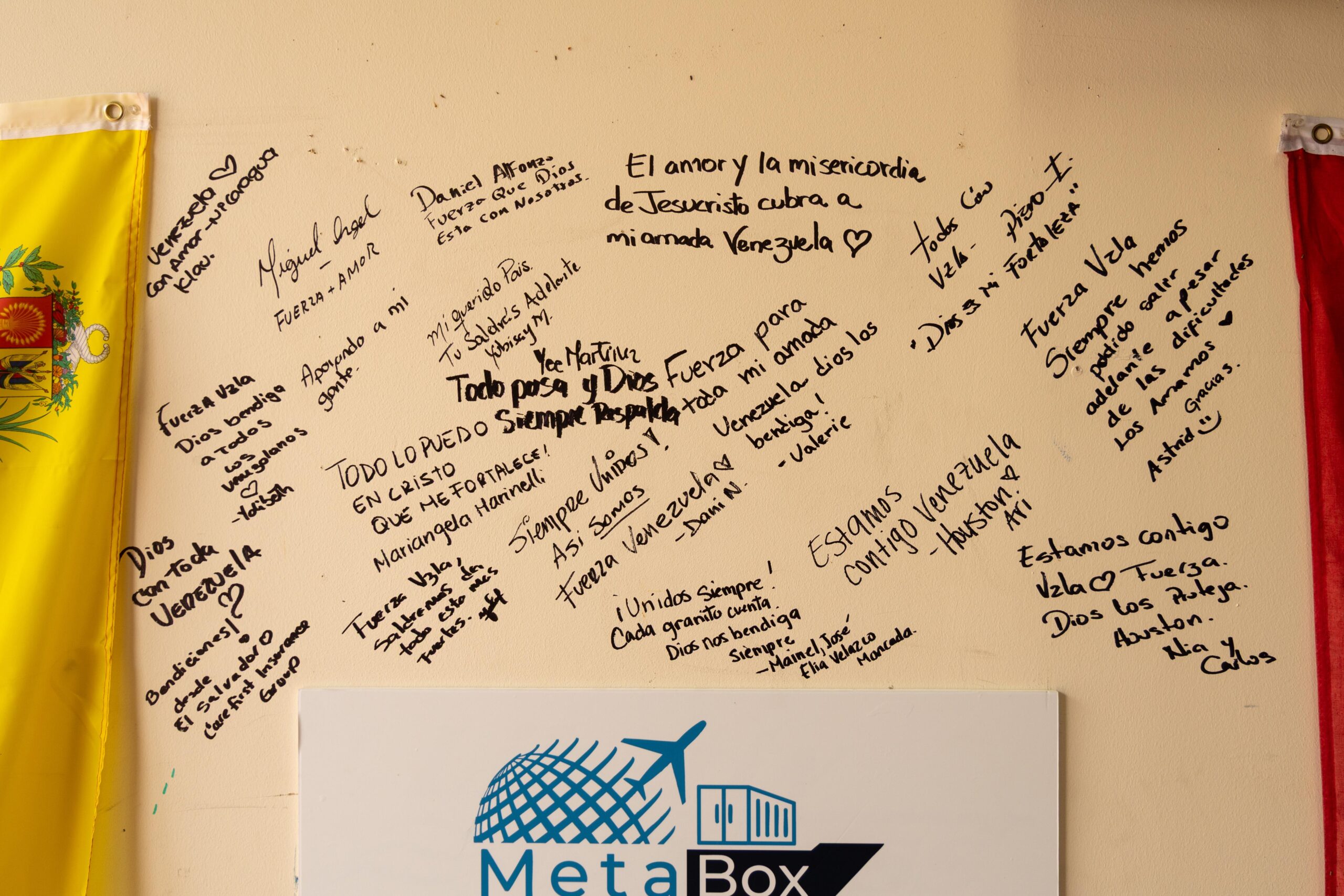
By late afternoon, the two donation sites buzzed with the sounds of ripped packing tape and conversations in Spanish. Inside the hot garage at MetaBox Cargo, between packing supplies, many paused to write messages of hope and support on the wall beside a Venezuelan flag.
One message read: “Estamos contigo, Venezuela.”
We are with you, Venezuela.
Transcript:
MICHEL MARTIN, HOST:
Houston, Texas, is home to one of the nation’s largest Venezuelan communities. After two powerful earthquakes killed at least 235 people in Venezuela, many are turning their worry into action to help families back home. Here’s Lucio Vasquez with The Texas Newsroom.
LUCIO VASQUEZ: In a hot cargo garage in Katy – a Houston suburb – volunteers at a pop-up donation drive packed boxes with canned tuna, diapers and medicine. Many were Venezuelans living in the U.S., trying to help from thousands of miles away. Arianna Regardia first came early Thursday to donate hygiene items like pads, tampons and body soap. Then she stayed to help pack boxes.
ARIANNA REGARDIA: One thing I admire about being Venezuelan is our resilience, being there for each other, and then just supporting each other during the tough times.
VASQUEZ: Regardia was with her mother when she learned of two devastating earthquakes that struck Venezuela Wednesday night. She called her grandmother in Caracas. Regardia was relieved to hear her voice. She was safe. But relief quickly gave way to a different feeling – the need to help.
REGARDIA: Being far away from a family and being outside and being part of the outside, it is very important for us to come together and support our people.
VASQUEZ: Venezuelan officials on Thursday night said there may be hundreds of people still trapped under debris. The Trump administration has already pledged $150 million for relief efforts. And throughout the country, donation drives have opened – including here in Katy, which has one of the largest Venezuelan communities in the country. People around here call it Katyzuela – a place dotted with dozens of Venezuelan-owned businesses like bakeries and restaurants.
At another nearby donation site at Mi Querencia Latin Market, Amelia Millan was also moved to donate after seeing the destruction in her home country. She says her family in Venezuela is safe, but many of their homes were badly damaged.
AMELIA MILLAN: I wish I could get on a plane and be there right now. Believe me, my heart and my mind are there right now. It’s very hard to concentrate on work or anything else.
VASQUEZ: Back inside the hot cargo garage, volunteers sorted donations for hours. Between packing boxes, many pause to write messages of support on a wall near the garage’s entrance beside a Venezuelan flag. One message read, “estamos contigo, Venezuela.” We are with you, Venezuela.
For NPR News, I’m Lucio Vasquez.
(SOUNDBITE OF MUSIC)
-
Trump axed a Black history exhibit. Former park rangers are teaching it anyway.
HARPERS FERRY, W. Va. — The summer of 2026 was going to be a triumphant debut for former National Park Ranger Elizabeth Kerwin.
Kerwin, who used to be the exhibit planner at West Virginia’s Harpers Ferry National Historic Park, had spent years building a wall of remembrance to highlight hundreds of enslaved people with ties to this historic site — best known as the place where a violent raid on the town’s armory led to an uprising that helped end American slavery.
Instead, the old stone building that was set to house Kerwin’s exhibit has sat empty. The door, locked. Its windows boarded up. The only indicator of what might have been is a green sign at the top of the entryway. “African-American History,” it says.
The would-be exhibit is one of dozens that were scrubbed from federal land by the Trump administration as the nation prepared to honor the 250th anniversary of the United States.
These removals, which began after President Trump signed an executive order aimed at “restoring truth and sanity to American history,” have prompted lawsuits and protests.

Elizabeth Kerwin, 58, poses for a photo ahead of the America 433+ teach-in at Harpers Ferry National Historic Park. Kerwin spent several years working on a new Black history exhibit, which was nixed by federal officials following an executive order from President Trump. (KT Kanazawich for NPR) “Over the past decade, Americans have witnessed a concerted and widespread effort to rewrite our Nation’s history, replacing objective facts with a distorted narrative driven by ideology rather than truth,” the order read. “Under this historical revision, our Nation’s unparalleled legacy of advancing liberty, individual rights, and human happiness is reconstructed as inherently racist, sexist, oppressive, or otherwise irredeemably flawed.”
Neither the National Park Service nor the U.S. Department of the Interior responded to multiple requests for comment for this story.
The about-face felt personal to former parks workers who spent their careers preserving artifacts that have now been deemed too radical for display.
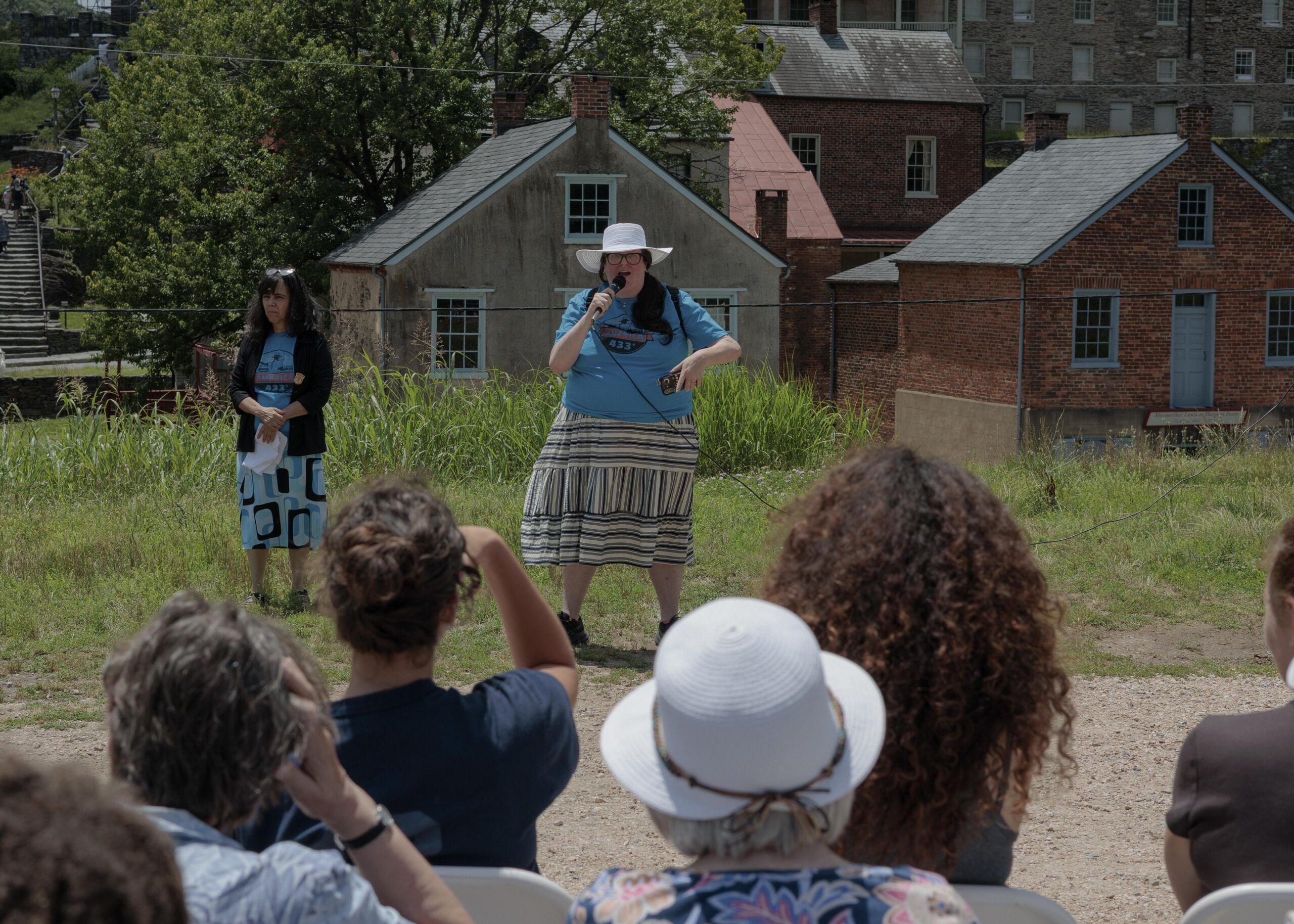
Some, like Kerwin, 58, decided to push back. They began to organize under the moniker “Resistance Rangers” and helped found an education coalition dubbed America 433+ in reference to the 433 sites that comprise the National Park System.
This summer, advocates and former federal workers say they are trying to redefine the message of the country’s 250th anniversary by hosting protests, teach-ins and other events aimed at honoring the country’s diversity and complex history.
First stop: Harpers Ferry.
Honoring Juneteenth
On the sun-drenched afternoon of June 19, the historic main street here was crowded with families. Some got ice cream or perused shops, while others read up on the historic placards that dot the stone path.
“Hello,” Anna Bakalis, a volunteer from former federal worker collective Branch4, said as she handed postcards to a group of tourists. “We’re actually doing a little exhibit talk in a few minutes about the erasure of an African American exhibit that was right around the corner that this park actually censored.”

Visitors watch an informational video at the John Brown Museum at Harpers Ferry National Historical Park. (KT Kanazawich for NPR) The ex-rangers picked Juneteenth — the federal holiday that honors the day in 1865 that enslaved people in Texas learned that slavery had been abolished — to launch their public education campaign. It’s a nod to Black history and the speed at which it was being removed from public sites, said Melissa Dalley, a Resistance Ranger and former park guide at the Martin Van Buren National Historic Site in upstate New York.
Holding it on site at Harpers Ferry meant the rangers could capture the very audience they might have reached with Kerwin’s exhibit. Only now, Dalley said, they had a more urgent message.
“The only way that change has ever happened in this country is through a small, committed group of American citizens working really hard,” Dalley said. “What we’re doing out here is trying to recruit those people into that citizen army.”
After Trump signed the 2025 executive order that redefined what stories and artifacts could be featured at national parks and historic sites, the National Parks Conservation Association and other advocacy groups sued the Department of the Interior, challenging the agency’s ability to enforce it.
A week before Juneteenth, a federal judge ordered the government to cease any further removals and replace any historic materials already taken down from national sites.
In her order, U.S. District Judge Angel Kelley wrote that “history cannot be faithfully told while excluding the experiences of communities whose contributions, struggles, and achievements form an important part of our Nation’s story.”
The removed exhibits, according to the federal judge, touch on issues of climate change, Black history, women’s suffrage, civil rights and indigenous tribes, including: information at Glacier National Park in Montana that detailed the impact of carbon dioxide emissions and hotter temperatures; roughly 80 artifacts from the Selma to Montgomery National Historic Trail in Alabama that mark the 1965 march for voting rights; and exhibits detailing historic slave rebellions or massacres of indigenous peoples.

Former National Park Service historian Ella Wagner, 35, and ex-ranger Melissa Dalley, 49, unpack activity booklets for the America 433+ teach-in at Harpers Ferry National Historical Park. (KT Kanazawich for NPR) Kelley ordered the DOI to reinstate the nixed exhibits before July 4 and the nation’s 250th anniversary celebration. When the government asked the court to push back its deadline and delay implementation, the judge declined.
Kelley ordered that 52 items be put back in place at more than 30 federal sites, beginning the week of June 22.
It was not immediately clear if Kerwin’s exhibit, which was axed before it ever opened to the public, would also be reinstated. But the Resistance Rangers are done waiting for officials to act. They’ve printed copies of banned pamphlets and made plans to bring information the government wants out of federal parks directly to visitors.
The Resistance Rangers will set out again Saturday for a national protest of Trump’s vision of the 250th celebration. Organizers intend to solicit signatures onto a “declaration of interdependence” that advocates for safety, dignity, living wages and access to a clean environment for all.
A ‘debt to the past’
A stone obelisk bearing the words “John Brown’s Fort” marks the spot where, in 1859, abolitionist John Brown and more than 20 of his followers captured a U.S. military armory. The plan was to seize the weapons and then hand them out to enslaved people who they hoped would revolt and join their cause.
But the mass rebellion Brown predicted never materialized, leaving him and his comrades trapped inside the arsenal. Days later, the U.S. Marines snuffed out the uprising, captured Brown and ultimately executed him.

The John Brown Monument at Harpers Ferry National Park. (KT Kanazawich for NPR) More than 160 years later, Brown is still remembered for giving his life to the cause of abolition. But the Black men who joined him in this battle typically get second billing.
Kerwin said she hoped her exhibition might help change that.
She and her colleagues compiled a database of names of hundreds of enslaved people who lived in the area from 1769 to 1861 — many of whom had not previously been identified publicly in historic accounts.
Visitors would have heard the account of Osborne Perry Anderson, the lone surviving Black member of John Brown’s raid, former rangers said.

An African-American history exhibit was years in the making at Harpers Ferry National Historical Park when it was abruptly cancelled by the Trump administration. A year later, the building that was supposed to house the exhibit sits empty. (KT Kanazawich for NPR) 
Informational signs are placed around Harpers Ferry National Historical Park. (KT Kanazawich for NPR) Instead, this month, tourists were greeted with a shuttered building and a scannable QR code that links to a five-paragraph overview of the park’s African American history.
That, Kerwin said, is not enough.
“The people who were overlooked and unnamed and didn’t count in the official record, they deserve to take up space in our national memory,” Kerwin said. “They are America.”
When her project was sidelined, Kerwin said, she was devastated. Not just for herself and the years she had spent on the piece, but for the public, for her country and for her teenage son — a Black boy who she hoped might see his own history reflected in the exhibit’s walls.
“He was foremost in my heart as I was working on this,” Kerwin said. “I hoped he would see strength and resilience in that story.”
Steven Mintz, a history professor at the University of Texas at Austin, did not attend the event, but said that even from afar, it seemed powerful — and necessary.
Mintz compared the former rangers’ teach-in to similar public education campaigns during the Vietnam War, and commended them for doing what they could to ensure the Black families and individuals whose history remains tied up with Harpers Ferry are not forgotten.
“The most lasting form of reparations is remembrance. We owe a debt to the past,” Mintz said. “All of the prosperity we enjoy and the freedoms we enjoy are due to the people who were willing to sacrifice for us. We have a duty to remember them.”
The work is not done
On Juneteenth, Kerwin still got her chance to tell the story of what might have been.
A steady trickle of visitors to the park made their way up the hill to the spot where the group had set up tables filled with banned books, workbooks discontinued by the Trump administration and wooden “junior Resistance Ranger” badges for those willing to take a pledge to “protect our parks, history and science by speaking up, learning and sharing the full stories of our national parks.”

Zinn Education Project’s Deborah Menkart, in the red shirt, shares examples of banned books and other reading materials during the America 433+ teach-in at Harpers Ferry National Historical Park. (KT Kanazawich for NPR) 
Newly banned booklets from other National Parks are displayed during the America 433+ pop up at Harpers Ferry National Park; Junior Resistance Ranger pins are given out at the same event. (KT Kanazawich for NPR) “It’s really disturbing to see that there’s two educational booklets for children from different Black history sites that are no longer being printed because of our government’s decision to support racism instead of justice and liberty for all,” said Cathy Fulkerson, 69, a visitor from New Hampshire.
As visitors like Fulkerson settled into folding chairs arranged along the same grassy knoll where John Brown and his followers fought their way into the red-brick armory, Kerwin rose, stepped to the microphone and looked out at the crowd gathered before her.
She remembered why she had wanted to hold this teach-in: To tell stories history had ignored or forgotten, and to set an example for her 13-year-old son. When she cast her eyes out into the crowd, searching for his small face and dyed locs, Daniel had disappeared.
The eighth grader later said what he did next would surprise them both.
Kerwin began to speak on the erasure of Black history, the exhibit she had dreamed up for her son and generations of kids like him. And there was Daniel. Standing at her side.

Kerwin speaks at the America 433+ teach-in at Harpers Ferry National Historical Park alongside her son, Daniel Nisbett, 13. (KT Kanazawich for NPR) Transcript:
SCOTT DETROW, HOST:
The United States is celebrating its 250th birthday with elaborate displays of patriotism in D.C. and across the country. It all paints a very specific picture of American culture and history, one that critics say does not tell the whole story. NPR’s Marissa J. Lang visited a national park in West Virginia where a group of former park rangers is trying to make sure history is not erased.
MARISSA J LANG, BYLINE: In the town of Harpers Ferry, volunteers like Anna Bakalis are telling visitors about a Black history exhibit that the National Park Service didn’t want them to see.
ANNA BAKALIS: We’re actually doing a little exhibit and talk in a few minutes about the erasure of an African American exhibit that was right around the corner that this park actually censored.
LANG: She points to a boarded-up building with a sign hanging over the front door. It says African American history.
BAKALIS: Yes. That – there right there. And it says closed for renovation, but we know that’s not exactly true.
LANG: The Trump administration has taken down dozens of federal exhibits focusing on issues such as civil rights or climate change. An executive order issued last year said it wants to correct an effort to sow divisions and promote a sense of national shame. President Trump instead wants the Department of the Interior to focus on, quote, “the greatness of the achievements and progress of the American people.” This exhibit, which was scheduled to open this month, was nixed after Trump’s order. It would have told the stories of formerly enslaved people who lived and worked and died at Harpers Ferry.
ELIZABETH KERWIN: We were going to bring to life all of the people that got overlooked, at least some of them. We had found names of enslaved people that date us all the way back to 1769.
LANG: That’s former Park Ranger Elizabeth Kerwin, who planned the exhibit. She worked here for 25 years before she says she was forced out amid mass firings last year. This was going to be the high point of her career. But when it got shut down, she said it felt bigger than that, like the country was failing generations of African Americans.
KERWIN: They deserve to take up space in our national memory.
LANG: Harpers Ferry is known as the site of a violent uprising led by John Brown, a white abolitionist who believed slavery would never end without bloodshed. In 1859, Brown and about 20 other men attacked a federal arsenal filled with weapons he hoped to distribute to nearby slaves and encourage them to rebel. It didn’t work. After two days of fighting, many of his men were killed. Brown was captured and then executed. The men who fought alongside him have been largely forgotten, especially the Black men. History professor Steven Mintz from the University of Texas at Austin says what Kerwin is doing can go a long way to shifting that narrative.
STEVEN MINTZ: We owe a debt to the past. All of the prosperity and freedoms we enjoy are due to people who are willing to sacrifice for us. We have a duty to remember them, and the failure to remember them is a curse on us.
LANG: This month, a federal judge ordered the government to restore the exhibits before the Fourth of July. It’s not clear what that means for this exhibit that was never allowed to open. The Department of the Interior did not respond to NPR’s requests for comment, but former rangers like Melissa Dalley are taking action now. On the same hill where John Brown made his last stand, ex rangers hand out educational pamphlets the Trump administration has discontinued.
MELISSA DALLEY: So we also have another band junior ranger book (ph). Find them under here. Junior ranger books galore.
LANG: They swore kids in as junior resistance rangers and spoke about standing up to censorship. These teachings are part of a growing movement to reclaim America’s 250th anniversary and to tell the story of the United States in all of its complexity.
Marissa J. Lang, NPR News, Harpers Ferry, West Virginia.
-
‘There was a lot of love’: Man remembers his gay parents who died in the AIDS crisis
Transcript:
LEILA FADEL, HOST:
Time now for StoryCorps. This week, we revisit a story about chosen family. Stefan Lynch was raised by gay parents at the start of the AIDS crisis in the early 1980s. At StoryCorps, he told his friend, Beth Teper, about growing up.
STEFAN LYNCH: My family were mostly gay guys, who were my babysitters and the guys who, you know, took the pictures at my birthday parties. And I felt like I had this amazing family. I called them my aunties. And it was a really wonderful, amazing world that came crashing down. Starting in ’82, the first person I knew died of AIDS, a young guy named Steve.
BETH TEPER: And how old were you at the time?
LYNCH: I was 10 when he was diagnosed. And I remember I was on the beach, and I saw him. And he was covered in these purple spots. And I remember asking my dad, like, what’s wrong with Steve? And my dad said, oh, he has this skin cancer called Kaposi’s sarcoma. And I said, well, what is that? And my dad said, well, nobody really knows, but there’s some gay men that are getting it. And within, I think, two months, Steve was dead.
And it was pretty much a succession of deaths of my family throughout the next decade. My stepdad, Bill, died in ’87. My dad died in ’91 after a really grueling six months of me taking care of him. You know, I was 19. And at that point, everyone had died except for a handful of stragglers who I now hold near and dear to my heart, my aunties. It was a powerful family. There was a lot of love. And they modeled for me how to survive an epidemic, even if you were dying while doing it.
(SOUNDBITE OF MUSIC)
FADEL: Stefan Lynch and Beth Teper for StoryCorps in San Francisco. Today, Lynch is a nursing director at an LGBTQ+ health center. Their interview is archived at the Library of Congress. By the way, StoryCorps and MORNING EDITION are partnering on an experiment in human connection. Meet someone on video from another part of the country and learn about their life. Your conversation becomes part of a time capsule of stories at the Library of Congress. Sign up at connect250.org. America, get ready to meet America.
(SOUNDBITE OF MUSIC)
-
The Supreme Court sides with the Trump administration in two major immigration cases
Transcript:
JUANA SUMMERS, HOST:
It’s CONSIDER THIS, where every day we go deep on one big news story. Today, two major immigration rulings at the Supreme Court. Curbing immigration was a key promise President Trump made ahead of his second term. And today, the Supreme Court handed the administration two major victories. The first had to do with asylum.
(SOUNDBITE OF ARCHIVED RECORDING)
UNIDENTIFIED PERSON #1: The justices cleared the way to block asylum seekers from entering the United States before they can apply for protection.
SUMMERS: Prior to today’s ruling, a migrant who came to the U.S.-Mexico border and spoke to a border agent was thought of as an arrival, even if they didn’t step foot on U.S. soil. That meant they could apply for asylum and enter the U.S. as they awaited a hearing, but not anymore. And in a separate ruling, the justices addressed a program intended to offer humanitarian protection to some immigrants.
(SOUNDBITE OF ARCHIVED RECORDING)
UNIDENTIFIED PERSON #1: The court allowed the Trump administration to begin ending temporary protected status – or TPS – for thousands of migrants who have been living and working legally in the U.S.
SUMMERS: The ruling applies to migrants who fled Syria and Haiti, clearing the way for mass deportations.
UNIDENTIFIED PERSON #2: My people. They can’t go back. It’s real. The reality in Haiti is real.
SUMMERS: Currently, there are more than 330,000 immigrants who are directly affected by today’s TPS ruling, and it could affect hundreds of thousands more.
(SOUNDBITE OF MUSIC)
SUMMERS: CONSIDER THIS – the Supreme Court has struck a blow to long-standing immigration protections. What do the rulings mean, and how will they shape immigration policy in the future?
(SOUNDBITE OF MUSIC)
SUMMERS: From NPR, I’m Juana Summers.
(SOUNDBITE OF MUSIC)
SUMMERS: It’s CONSIDER THIS FROM NPR. The U.S. Supreme Court issued two decisions giving President Trump more power to pursue his immigration agenda. To better understand the implications of these rulings, I spoke with NPR’s immigration policy correspondent, Ximena Bustillo.
Ximena, let’s start with TPS, or temporary protected status. What are the implications of that ruling?
XIMENA BUSTILLO, BYLINE: In a 6-3 decision, the conservative majority ruled that the president has virtually unrestrained power to end temporary protected status, often called TPS. This was a case specifically about TPS recipients from Haiti and Syria, which total over 300,000 people, but it has broader implications. TPS provides deportation protection and grants work permits, and it’s given to people from specific countries affected by war, natural disasters, political instability or any other condition that makes the country unsafe to return to. Each country’s designation can last six to 18 months, and that’s at the discretion of the secretary of homeland security. Now, the court is agreeing with the government that making those designations is up to the secretary and not subject to legal review.
SUMMERS: OK, so what happens to the people who are on the program?
BUSTILLO: Well, they need to either adjust their status, which – there are very limited ways of doing so – or they need to leave the country. And if they don’t do either, they do risk falling out of status, and that could lead to an arrest, detention and ultimate deportation. Many face job loss as well, as companies will not be able to continue legally employing thousands of workers. Ira Kurzban is the attorney representing Haitian TPS holders.
IRA KURZBAN: The families are American citizens. They have American citizen children. So we’re talking in a practical manner – respect to all the TPS people – you’re talking about millions of people in the United States who contribute to the economy.
BUSTILLO: He argues Haiti, Syria and other countries are just not stable enough for people to return. And many of these people have also been here for decades.
SUMMERS: Now to the second immigration decision from the court today, and that one’s related to asylum. What can you tell us?
BUSTILLO: In another 6-3 decision, the court backed a policy that allows Custom and Border Protection agents to turn away asylum seekers before they cross the U.S. border. The order says asylum seekers need to fully cross the U.S. border with Mexico to claim asylum. So essentially, migrants who are turned back by officials under this policy technically never left the physical Mexican side of the border. So the administration argues they are ineligible to apply for that legal protection to be in the U.S. The ruling effectively further limits who can get permission to even stay in the country.
SUMMERS: Ximena, take stock for us. What did these rulings mean for the administration’s broader immigration priorities?
BUSTILLO: Well, both of these rulings reduce legal pathways to enter the country. The administration has a broader goal of mass deportations. And in order to reach that goal, the administration has increased the number of people who are eligible for deportation, even if they are legally here. The ruling on TPS allows the administration to strip existing protections from deportations and permissions to legally work here. The administration has also terminated TPS for nearly every country that had it at the start of President Trump’s term.
The asylum ruling also limits how migrants can ask for permission to stay. This administration is very focused on immigration enforcement in the interior of the country while also keeping border crossings as minimal as possible, and these rulings allow the government to further change the immigration system.
SUMMERS: NPR’s Ximena Bustillo. Thanks.
BUSTILLO: Thank you.
SUMMERS: As we just heard, the Supreme Court ruled in a major case involving the temporary protected status program, also known as TPS. NPR legal affairs correspondent Nina Totenberg gives us a closer look at the court’s decision.
NINA TOTENBERG, BYLINE: By a vote of 6-3, the court’s conservative supermajority ruled that the president has virtually unchecked power to end the temporary protected status program known as TPS. Congress enacted the law in 1990 to allow fully vetted and eligible migrants living in the U.S. to remain and work here legally if they cannot return safely to their home countries because of natural disasters, armed conflicts and other extraordinary conditions. Since the law’s enactment, every president – Republican or Democrat – has embraced it, but Trump has systematically tried to end the program.
And today, the Supreme Court gave him the tools to do it in two cases. One involves some 350,000 Haitians who were granted TPS status in 2010 after a devastating earthquake, and roughly 7,000 Syrians granted TPS status during that country’s Civil War. Writing for the court’s conservatives, Justice Samuel Alito said that the TPS statute bars any court review of how the president and his Department of Homeland Security have used their authority to end TPS status. At the same time, he also rejected the Haitians’ separate constitutional claim that the decision to eject them from the country was based on racial prejudice.
Quote, “political discourse by prominent public figures is increasingly couched in terms that would have scandalized the public just a short time ago,” he said. But whatever one may think of those statements, they are insufficient to show that the termination of Haiti’s TPS designations was based on the race of the Haitian people. Writing for the liberal dissenters, Justice Elena Kagan lambasted that claim, saying, quote, “the evidence is there, plain to see in the president’s own statements, which even his own lawyers cannot bear to repeat in court” – statements which she quoted at length in which Trump referred to Haiti as a filthy, dirty, disgusting s-hole country, Trump’s debunked claims that Haitians living in the U.S. were eating their neighbors’ pets and his assertions that Haitians are poisoning the blood of the country, in addition to his repeated comments asking, quote, “why can’t we have more people from Norway and Sweden?”
Jeh Johnson – who served as Secretary of Homeland Security in the Obama administration – reacted to the court’s decision this way.
JEH JOHNSON: The majority seems to be willing to give President Trump the benefit of the doubt here, although, while they’re not overtly racist, it comes about as close as you can to being overtly racist.
TOTENBERG: Ohio State law professor Cesar Garcia Hernandez had a more pointed reaction.
CESAR GARCIA HERNANDEZ: What is racial, if not describing the poisoning of our blood and the similar comments that the president has made?
TOTENBERG: And University of Chicago law professor Aziz Huq.
AZIZ HUQ: So it’s very hard to come away from this opinion with a sense that there is ever going to be a situation in which the court, even when it has record evidence in front of it, finds that there is racial discrimination against a racial minority.
TOTENBERG: That said, in practical terms, there are big consequences not just for the Haitian community, according to Krish O’Mara Vignarajah, president and CEO of Global Refuge, the largest faith-based immigration nonprofit in the U.S.
KRISH O’MARA VIGNARAJAH: This decision affects 350,000 Haitians, and a third of those Haitians work in our healthcare sector. They are caregivers. They are doctors. And I think part of the bipartisan support was a recognition of the local impact it would have on Americans, who are obviously desperately seeking care for themselves, for their kids and for their parents.
TOTENBERG: That bipartisan support was recently demonstrated when the House of Representatives passed a bill to extend TPS status for Haitians. But even if it were to pass the Senate, President Trump would almost certainly veto the bill. In a second immigration decision today – also written by Justice Alito – the court’s conservative majority sided with the Trump administration in making it much harder for those seeking asylum in the U.S.
Nina Totenberg, NPR News, Washington.
(SOUNDBITE OF MUSIC)
SUMMERS: This episode was produced by Grady Martin, Michelle Aslam and Tyler Bartlam. It was edited by Krishnadev Calamur and Tinbete Ermyas. Our interim executive producer is Courtney Dorning.
(SOUNDBITE OF MUSIC)
SUMMERS: It’s CONSIDER THIS FROM NPR. I’m Juana Summers.
(SOUNDBITE OF MUSIC)