Author: lthistle@whyy.org
-
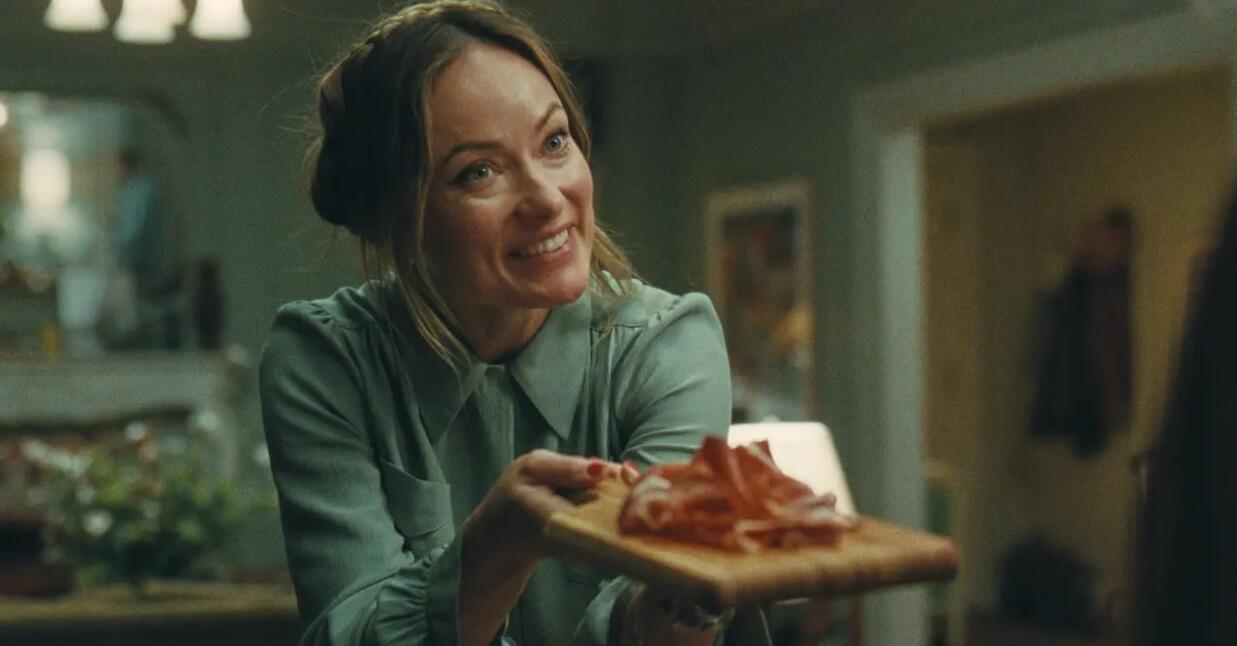
Everyone expected more from the evening ‘Invite,’ audience included
In the annals of movies about bickersome couples spending an ill-advised evening together, Olivia Wilde’s The Invite falls somewhere between two poles. No, it isn’t as good as Who’s Afraid of Virginia Woolf?, Mike Nichols‘ scalding 1966 adaptation of Edward Albee‘s classic play. But it’s significantly better than Carnage, Roman Polanski‘s annoying 2011 film of the Yasmina Reza play God of Carnage.
All these movies have a tricky needle to thread: how do you open up a story for the screen when the story is claustrophobic by design? How do you get an audience to feel the tension and heat of marital rage without driving them toward the exit?
In the case of The Invite, Wilde and her screenwriters, Will McCormack and Rashida Jones, are working from proven material. This is a remake of a Spanish stage-to-screen adaptation, The People Upstairs, which was released in 2020. It’s already inspired remakes set in Italy, Switzerland, France and South Korea.
In this new version, Wilde plays Angela, who lives in a San Francisco apartment with her husband, Joe, played by Seth Rogen. The film unfolds over a single evening. Their 12-year-old daughter is away at a sleepover, and Angela has invited their upstairs neighbors — Piña and her boyfriend, Hawk — over for wine and charcuterie.
The knives come out even before the guests show up. Angela is a ball of nerves, anxious to make a good impression. Joe, by contrast, couldn’t care less what they think, and he means to confront them about their very noisy sex life, which has woken Joe and Angela up at odd hours of the night.
Wilde is a terrific director of actors, herself included, and she and Rogen are all too persuasive as a long-married couple who know just how to push each other’s buttons. Rogen is especially strong; the boisterous good vibes that once powered many a Judd Apatow comedy have hardened into a shell of middle-aged discontent.
Piña and Hawk, played by Penélope Cruz and Edward Norton, eventually arrive. As the couples get to know each other, we get to know them, too, and we come to understand the roots of Joe and Angela’s unhappiness. Joe was a once-promising indie-rock artist whose career flamed out after one big hit; he now teaches music at a Bay Area conservatory, and his sense of failure is eating him alive. And Angela hasn’t made much use of her art-school degree, apart from renovating and redecorating the apartment — her sole creative outlet these days.
Piña and Hawk are a model couple by comparison, which makes them irritating and amusing in equal measure. Hawk lays on the flattery and the New Age sensitivity awfully thick, and Norton, not for the first time, expertly blurs the lines between charm and smarm.
Piña is a psychotherapist and sexologist, and at first, she might seem to veer toward a hot-blooded Euro-seductress caricature. But Cruz is too vivid to be reduced to a stereotype. Piña is ultimately the one character the movie refuses to mock; she’s too comfortable in her own skin, and too ruthlessly accurate in her assessments of Joe and Angela’s troubled marriage.
Wilde previously directed the enjoyable teen comedy Booksmart and, less successfully, the domestic-dystopian satire Don’t Worry Darling — an ambitious movie that ultimately proved less interesting than its much-publicized behind-the-scenes shenanigans.
It was smart of Wilde to scale back with an intimate chamber piece like The Invite, though here, as in Don’t Worry Darling, her stylistic tics sometimes get the better of her. Early on, Joe and Angela’s arguments are almost drowned out by the score’s frenzied cello strings. And Wilde is a bit too fond of using the apartment’s many, many mirrors to isolate the characters visually, as if we needed reminding of how fragmented their relationship has become.
Piña and Hawk have their own ideas about how to help, and it’s worth seeing the movie yourself to discover what they are; suffice to say that the title The Invite has more than one meaning. It’s disappointing, though not surprising, that the film pulls back from those ideas. After dangling a more audacious outcome, The Invite retreats to a zone of emotional safety — one that’s poignant in its own way, though it also feels like a missed opportunity. The movie could have been — dare I say it — a little Wilder.
Transcript:
DAVE DAVIES, HOST:
This is FRESH AIR. In the new comedy “The Invite,” Seth Rogen and Olivia Wilde play a San Francisco couple who spend an evening getting to know their upstairs neighbors, played by Penelope Cruz and Edward Norton. It’s Wilde’s third directorial effort after her earlier films, “Booksmart,” and “Don’t Worry Darling.” “The Invite” opens in theaters this week. Our film critic Justin Chang has this review.
JUSTIN CHANG, BYLINE: In the annals of movies about bickersome couples spending an ill-advised evening together, Olivia Wilde’s “The Invite” falls somewhere between two poles. No, it isn’t as good as “Who’s Afraid of Virginia Woolf?” Mike Nichols’ scalding 1966 adaptation of Edward Albee’s classic play. But it’s significantly better than “Carnage,” Roman Polanski’s annoying 2010 film of the Yasmina Reza play “God Of Carnage.” All these movies have a tricky needle to thread. How do you open up a story for the screen when the story is claustrophobic by design? How do you get an audience to feel the tension and heat of marital rage without driving them toward the exit?
In the case of “The Invite,” Wilde and her screenwriters, Will McCormack and Rashida Jones, are working from proven material. This is a remake of a Spanish stage-to-screen adaptation, “The People Upstairs,” which was released in 2020. It’s already inspired remakes set in Italy, Switzerland, France and South Korea. In this new version, Wilde plays Angela, who lives in a San Francisco apartment with her husband, Joe, played by Seth Rogen.
The film unfolds over a single evening. Their 12-year-old daughter is away at a sleepover, and Angela has invited their upstairs neighbors, Pina and her boyfriend, Hawk, over for wine and charcuterie. The knives come out even before the guests show up. Angela is a ball of nerves, anxious to make a good impression. Joe, by contrast, couldn’t care less what they think. And he means to confront them about their very noisy sex life, which has woken Joe and Angela up at odd hours of the night.
Wilde is a terrific director of actors, herself included, and she and Rogen are all too persuasive as a long-married couple who know just how to push each other’s buttons. Rogen is especially strong. The boisterous good vibes that once powered many a Judd Apatow comedy have hardened into a shell of middle-aged discontent. Pina and Hawk, played by Penelope Cruz and Edward Norton, eventually arrive. Not long afterward, Hawk, who’s nothing if not direct, tries to either diffuse or exacerbate the obvious tension in the room.
(SOUNDBITE OF FILM, “THE INVITE”)
EDWARD NORTON: (As Hawk) It took you a while to come to the door.
PENELOPE CRUZ: (As Pina, speaking Spanish).
NORTON: (As Hawk) And it sounded like you were arguing.
CRUZ: (As Pina) No filter.
NORTON: (As Hawk) No, I just want to be honest. We were at the door before we rang, and we could hear you were fighting.
OLIVIA WILDE: (As Angela) Oh, we were…
SETH ROGEN: (As Joe) We were fighting.
WILDE: (As Angela) We were fighting, yeah.
ROGEN: (As Joe) Bit of a contentious environment in here, so I understand if that’s repellent to you. No hard feelings. You know what I mean? Completely understand, you know?
NORTON: (As Hawk) We love a contentious environment. We love it.
WILDE: (As Angela) OK.
ROGEN: (As Joe) Well…
NORTON: (As Hawk) Really, it’s fine.
ROGEN: (As Joe) You hit the jackpot then, my friend.
(LAUGHTER)
CHANG: As the couples get to know each other, we get to know them, too. And we come to understand the roots of Joe and Angela’s unhappiness. Joe was a once-promising indie rock artist whose career flamed out after one big hit. He now teaches music at a Bay Area conservatory, and his sense of failure is eating him alive. And Angela hasn’t made much use of her art school degree, apart from renovating and redecorating the apartment, her sole creative outlet these days.
Pina and Hawk are a model couple by comparison, which makes them irritating and amusing in equal measure. Hawk lays on the flattery and the new-age sensitivity awfully thick. And Norton, not for the first time, expertly blurs the lines between charm and smarm. Pina is a psychotherapist and sexologist. And at first, she might seem to veer toward a hot-blooded Euro seductress caricature, but Cruz is too vivid to be reduced to a stereotype. Pina is ultimately the one character the movie refuses to mock. She’s too comfortable in her own skin and too ruthlessly accurate in her assessments of Joe and Angela’s troubled marriage.
Wilde previously directed the enjoyable teen comedy “Booksmart” and, less successfully, the domestic dystopian satire “Don’t Worry Darling,” an ambitious movie that ultimately proved less interesting than its much-publicized behind-the-scenes shenanigans. It was smart of Wilde to scale back with an intimate chamber piece like “The Invite,” though here, as in “Don’t Worry Darling,” her stylistic ticks sometimes get the better of her. Early on, Joe and Angela’s arguments are almost drowned out by the score’s frenzied cello strings, and Wilde is a bit too fond of using the apartment’s many, many mirrors to isolate the characters visually, as if we needed reminding of how fragmented their relationship has become.
Pina and Hawk have their own ideas about how to help, and it’s worth seeing the movie yourself to discover what they are. Suffice to say that the title, “The Invite,” has more than one meaning. It’s disappointing, though not surprising, that the film pulls back from those ideas. After dangling a more audacious outcome, “The Invite” retreats to a zone of emotional safety, one that’s poignant in its own way, though it also feels like a missed opportunity. The movie could have been, dare I say it, a little wilder.
DAVIES: Justin Chang is a film critic at The New Yorker. On Monday’s show, Chris Evert and Martina Navratilova. They were tennis champions, the two biggest stars of their generation. They were friends. They were rivals. And after retiring, they got cancer at the same time. Now they’re the subject of a new Netflix documentary. I hope you can join us.
(SOUNDBITE OF DAVE HOLLAND AND PEPE HABICHUELA’S “JOYRIDE”)
DAVIES: FRESH AIR’s executive producer is Sam Briger. Our senior producer today is Roberta Shorrock. Our technical director and engineer is Audrey Bentham, with additional engineering support from Julian Herzfeld, Diana Martinez and Charlie Kaier. Our interviews and reviews are produced and edited by Phyllis Myers, Ann Marie Baldonado, Lauren Krenzel, Therese Madden, Monique Nazareth, Thea Chaloner, Susan Nyakundi, Anna Bauman and Nico Gonzalez-Wisler. Our digital media producer is Molly Seavy-Nesper. For Terry Gross and Tonya Mosley, I’m Dave Davies.
(SOUNDBITE OF DAVE HOLLAND AND PEPE HABICHUELA’S “JOYRIDE”)
-
Remembering James Burrows, a prolific director of modern comedy
Transcript:
DAVE DAVIES, HOST:
This is FRESH AIR. I’m Dave Davies. Today, we remember James Burrows, one of the most respected and sought-after directors of TV comedies. In over five decades, he directed more than a thousand episodes – episodes of “Taxi,” “Cheers,” “Friends,” “Frasier,” “Will & Grace” and many other sitcoms. Burrows died June 19 at the age of 85.
A statement by the Directors Guild of America described him as an incredibly generous colleague, sharing his wisdom and warm humor with all he worked with. In a statement, his family said, Burrows understood that great comedy was never simply about laughter. It was about humanity, connection and truth. We’re going to listen to Terry’s 2006 interview with James Burrows in a few minutes. But first, we have this appreciation by our TV critic David Bianculli.
DAVID BIANCULLI, BYLINE: James Burrows was born in LA in 1940 but didn’t live there long. His family moved to New York when he was 5. His father, Abe Burrows, had written for radio and television but found his biggest success on Broadway as a director and especially as a writer. Abe Burrows wrote the books for the musicals “Guys And Dolls,” “How To Succeed In Business Without Really Trying” and “Can-Can.” His son, James, became a director, too, but went back to Los Angeles to do so. His big break was directing an episode of “The Mary Tyler Moore Show,” after which James Burrows landed jobs directing multiple episodes of many popular sitcoms of the 1970s, including “The Bob Newhart Show,” “The Tony Randall Show,” “Laverne & Shirley” and “Taxi.”
By the time he co-created “Cheers” with Glen and Les Charles in 1982, James Burrows was considered the best sitcom director in the business, a title he maintained for decades. The reasons were obvious. James Burrows made one of the most significant improvements to the sitcom genre since “I Love Lucy” popularized the three-camera format of shooting before a studio audience. Burrows added a fourth camera, which allowed him to capture more close-ups and frame the action as naturally as he could. Burrows was a master at setting the tone for a new series, working with young actors to shape their characters and find just the right comic flow. Over his career, he won 11 Emmy Awards and directed a staggering number of TV pilots – specifically, 75.
But it isn’t just the quantity of premiere episodes directed by James Burrows that’s so amazing. It’s the quality. He directed the introductory episodes of “Taxi,” “Cheers” and “Frasier” – not just the original 1993 “Frasier,” but the 2023 remake as well, 30 years later. He also directed the first episodes of “The Big Bang Theory,” “Night Court,” “Wings,” “NewsRadio,” “3rd Rock From The Sun,” “Dharma & Greg,” “Two And A Half Men,” “Friends” and “Will & Grace.” And sometimes, James Burrows stuck around for quite a while – for more than 200 episodes of both “Will & Grace” and “Cheers” and 75 episodes of “Taxi.”
For me, the absolute best example of Jim Burrows’ gifts as a TV director came in a 1979 episode of “Taxi,” written by Glen and Les Charles. It was an episode written to showcase Christopher Lloyd, who had guest-starred in a previous episode as Reverend Jim, a hippie preacher from the ’60s who was laid-back, confused and dealing with a long history of recreational drug use. At the time, Reverend Jim was an outrageous character to introduce to a primetime TV show. But “Taxi” already had triumphed by mixing types of comic styles that shouldn’t have worked.
Judd Hirsch, Tony Danza, Marilu Henner, Andy Kaufman, Jeff Conaway, Danny DeVito – all were part of the Brooklyn cab outfit that was eager for Reverend Jim to join its ranks. But to do that, he’d have to go to the DMV and pass a driver’s exam, not just behind the wheel but on paper. It’s in that DMV office where Burrows helped shape what I consider the funniest scene in TV history. He allows the comedy to build at its own pace and encourages the young Christopher Lloyd to steal the show as Reverend Jim. And most important of all, James Burrows places his cameras and frames the action to catch it all – not only intense close-ups of an increasingly frustrated Reverend Jim but group shots capturing the reactions of Jeff Conaway’s Bobby, Marilu Henner’s Elaine and everyone else trying to help him take the test. Bobby tries to speed things up by reading the application to Reverend Jim as Elaine stands nearby.
(SOUNDBITE OF TV SHOW, “TAXI”)
JEFF CONAWAY: (As Bobby Wheeler) Here, let me help you out, OK? All right. Have you ever experienced loss of consciousness, hallucinations, dizzy spells, convulsive disorders, fainting or periods of loss of memory?
CHRISTOPHER LLOYD: (As Reverend Jim) Well, hasn’t everyone?
(LAUGHTER)
MARILU HENNER: (As Elaine Nardo) Put no.
CONAWAY: (As Bobby Wheeler) Mental illness or narcotic addiction?
LLOYD: (As Reverend Jim) Now, that’s a tough choice.
(LAUGHTER)
HENNER: (As Elaine Nardo) Just put no.
CONAWAY: (As Bobby Wheeler) OK. That’s it. You’re ready for the test.
LLOYD: (As Reverend Jim) I thought this was the test.
(LAUGHTER)
HENNER: (As Elaine Nardo) No, no, no. This is the application.
LLOYD: (As Reverend Jim) Oh, man.
(LAUGHTER)
LLOYD: (As Reverend Jim) Hey, it’s getting rougher and rougher.
BIANCULLI: Eventually, Reverend Jim gets a copy of the test, slumps in his classroom-style desk and gets stuck on the first question. His cabbie friends are standing on the other side of the room, but he asks for help anyway, louder and more angrily every time. Christopher Lloyd is brilliant, and Burrows lets the scene build and flow. And listen to the studio audience. They’re not just laughing. They’re howling.
(SOUNDBITE OF TV SHOW, “TAXI”)
LLOYD: (As Reverend Jim) Psst. What does a yellow light mean?
CONAWAY: (As Bobby Wheeler) Slow down.
LLOYD: (As Reverend Jim) OK. What…
(LAUGHTER)
LLOYD: (As Reverend Jim) Does a…
(LAUGHTER)
LLOYD: (As Reverend Jim) Yellow light mean?
CONAWAY: (As Bobby Wheeler) Slow down.
LLOYD: (As Reverend Jim) OK. What…
(LAUGHTER)
LLOYD: (As Reverend Jim) Does…
(LAUGHTER)
LLOYD: (As Reverend Jim) A…
CONAWAY: (As Bobby Wheeler) Slow down.
(LAUGHTER)
LLOYD: (As Reverend Jim) What…
(LAUGHTER)
LLOYD: (As Reverend Jim) Does…
(LAUGHTER)
LLOYD: (As Reverend Jim) A yellow…
BIANCULLI: I’m guessing you had your own favorite memories and favorite laughs from a sitcom directed by James Burrows – from “Friends,” from “Cheers,” from “Frasier,” from “Big Bang Theory” or from so many others. And that’s the point, really. The legacy of James Burrows, no matter where you look, is bound to make you smile.
DAVIES: David Bianculli is our TV critic. Terry Gross spoke to James Burrows in 2006. He got his start in television directing episodes of “The Mary Tyler Moore Show,” “The Bob Newhart Show,” and “Laverne & Shirley.” But before that, he worked on some of his father’s musicals. His father, Abe Burrows, wrote the books for the musicals “Guys And Dolls,” “How To Succeed In Business Without Really Trying” and “Cactus Flower.”
(SOUNDBITE OF ARCHIVED NPR CONTENT)
JAMES BURROWS: I was an assistant stage manager or an assistant to the assistant on an ill-fated musical called “Breakfast At Tiffany’s,” where I met Mary Tyler Moore. And Mary Tyler Moore and Richard Chamberlain were the stars. And I went on subsequently to stage-manage for my father on “Cactus Flower,” the production on the road, and then in New York City in “Forty Carats.” So I got to see my father, who really wrote on his feet because he would write a scene. And then when he would get in rehearsal, he would change the scene just on his feet. And you began to see how fascinating he was.
And that’s when I – you know, I kind of have his style of directing. I’m a listener. I’m not necessarily a watcher. And Abe would always – he would say to me, when he went to a run-through of one of his shows or went to see one of his shows in the theater, he would always walk behind the set. He wouldn’t watch because he wanted to know that there was always noise happening onstage. He listened for the noise. He knew if there was no noise, that he was in trouble. So I do that when I direct my shows. So that – you know, that is the essence of the experience with my father. I – in subsequent years, a lot of his gift and a lot of his skills seem to come out of me at the strangest times. It’s not like I learned them as much as, you know, they were like osmosis. I absorbed them, and they kind of seep out of my skin in certain situations.
TERRY GROSS: So when you’re directing a TV show, you’re sometimes backstage and not looking at the action or at the monitor?
BURROWS: Well, I don’t – I never look at the monitor because it’s about – the shows I do are in front of a live audience, so it’s about the play. It’s about what’s happening there. I’ve been doing it long enough to know that I don’t have to worry about the camera shots because I know they’ll all be there. So I listen and watch. You know, I’ll walk behind the cameras not watching the action, necessarily. But a lot – you know, most of the time, I watch the play because – and I make my writers watch the play, or they can watch the cut on the screen. But they don’t watch the quad split. A quad split is a television screen that has the four cameras that I use to shoot the show on that. And if they watch the quad split, they’re always worried about mics in shots and shots not matching. So I make all the writers watch the play because that’s eventually what makes a hit show.
GROSS: So what made you realize that you wanted to switch from the stage to television?
BURROWS: In the course of doing “Cactus Flowers” and “Forty Carats” around the country, I would work at a lot of dinner theaters, a lot of regional – not regional theater – dinner theaters, summer stock theaters. I would do these – not situation comedies – comedies. You know, “Odd Couple,” “Barefoot In The Park,” even “Blithe Spirit” I did. I’m trying to think. “Never Too Late” – all these plays, the comedies that had been on Broadway, and I’d do them with stars. And I had about eight days to stage the whole thing, and I could get it done. I was good at that.
And then one night, I was at home after rehearsal, and I turned on the television. There was “The Mary Tyler Moore Show,” and they were doing 20 minutes a week in front of a live audience. And here I was doing 120 minutes a week to get ready for a live audience. And I thought I could do that. I thought I could translate my skills onstage to the skills required to do that television show because it was like filming a theatrical show.
So I wrote a letter to Mary Tyler Moore. As I said before, I had the connection because I was a stage manager on her first Broadway show, so she kind of knew me. And Grant Tinker called me, and he said, we’re interested in theatrical directors at MTM. Would you come out and do one show? And I don’t know what’s faster than a New York second, but whatever it was, I said yes. And I was – that – and the rest is history.
DAVIES: James Burrows speaking with Terry Gross in 2006. We’ll hear more after a break. This is FRESH AIR.
This is FRESH AIR. Let’s get back to Terry’s 2006 interview with TV director James Burrows, who directed over 1,000 episodes of “Cheers,” “Taxi,” “Frasier,” “Friends” and other sitcoms. He died last week at the age of 85.
(SOUNDBITE OF ARCHIVED NPR CONTENT)
GROSS: So you got started directing MTM productions like “The Bob Newhart Show,” “Mary Tyler Moore Show,” “Phyllis,” yes?
BURROWS: Yes. Yes.
GROSS: Now, were you at first, like, understudying other directors? Or did they let you just go at it?
BURROWS: Well, the first thing you have to do is you have to learn the technical stuff. So they brought me out here, and you kind of have to observe. Being an observer is, you sit in the stands, and you watch a week of rehearsals. And the first three days are with actors and writers alone. And the fourth day, the cameras come in, and the fifth day, you shoot the show. And for me, with actors and writers, I kind of got that. It was when the cameras came in that it became daunting. So I watch for maybe two months straight. I watched the Newhart show. Then I went over to “The Mary Tyler Moore Show” and I watched Jay Sandrich, who to me is the true genius of this medium.
I watched him and became very good friends with him. And so I kind of started to get a knowledge of what to do with cameras, how to figure them out. And then they assigned me to a show called “Friends And Lovers,” which was the Paul Sand show. And I would coach – I was Paul Sand’s dialogue coach. I would help him run lines. But in a time when I wasn’t doing that, I would watch cameras. And eventually, they called me and they said, we’re going to give you a shot. And I figured it would be on the Paul Sand show, and all of a sudden, it was “The Mary Tyler Moore Show.”
GROSS: Do you remember that first show that you did?
BURROWS: I do. Vividly.
GROSS: How did it go?
BURROWS: I do.
GROSS: What sticks out in your mind?
BURROWS: Oh, my God. Well, we read the script. It was a show where Lou Grant moves into Rhoda’s apartment. So he’s living above Mary, which means that he – they work together and they live together, which wasn’t good for their relationship. And so we read the script around the table, and it was a D-minus. It was awful. And I said to Grant, I said, in the sea of Danish, I get a bagel.
GROSS: (Laughter).
BURROWS: And it was literally just a – the show was awful. I mean, the initial reading, they made it better ’cause you would rewrite. The writers would rewrite all the time. And so I had to go down – back in those days, you rehearsed immediately after you read. You just went down and started running scenes. And so I was dealing with a cast who hated the script, too, and yet I had to run these scenes. And so I would do it. And I can’t tell you – I invoked Chekhov, I invoked Strindberg, I invoked Kaufman and Hart. I did anything to try to ease it for them, to try to come up with some comic business, anything that would help them get through this process.
And so I was working the first three days with the actors and cameras. And I guess we finally got the show in some sort of semblance. And then the cameras came in, and that was daunting enough for me. It was very difficult. I did it on my own. I didn’t want any help. And on the fifth day, just before we shot, Mary Tyler Moore came over to me, and they said, we feel our investment in you has worked out. And that was even before I shot the show. And I couldn’t have been higher, figuratively.
And we shot the show, and it turned out all right. And Jay Sandrich was there and helped me a little bit. And the minute that show was over, I got two Newharts and I got a Bob Crane and a Paul Sand. And next year, I was on the “Phyllis” show. So I was on my way.
GROSS: Was the show as bad after it was shot as it was when you were doing the reading?
BURROWS: It was – it’s a C-plus show. It’s not a very good show. You know, I – in fact, the script after me won an Emmy. So I…
GROSS: (Laughter).
BURROWS: By the luck of the draw, I got – I didn’t get the Emmy show. I got an OK show. And it might’ve helped me because of the amount of work I had to do and the amount of talking and inspiring I had to do, might’ve – in hindsight, might’ve really helped me succeed in there and impress the actors.
GROSS: OK. So you start off at MTM in television. And then you do “Taxi.” And about how many episodes would you estimate you did of “Taxi?”
BURROWS: I think I did 75.
GROSS: And you were there right from the beginning with “Taxi,” right?
BURROWS: I was there. It was after – no, I kind of left MTM after about three or four years and started to go other places. I went on “Laverne & Shirley,” where I had a ball, although that was a tough show. And then I did a show with Ned Beatty. I was all a hired hand. I didn’t do many pilots or anything like that. And then the boys from MTM – Ed Weinberger, Jim Brooks, Stan Daniels and Dave Davis – had created a show called “Taxi.” And they called me to direct it. And probably the most difficult show I ever did because the cast was so divergent. The writing was so outrageous. The set was so gigantic.
And I – it was my first really big show where I was in charge from the beginning. But it was like, getting all these egos in the same room, there wasn’t a room big enough. And it was a struggle. And yet, I was heard. I got out there and I said what I wanted to say, and I was heard. It was tough at times to be heard, but I fought. And the great thing about that show was that the producers of that show and the head writers were Glen Charles and Les Charles, who I’d first met on “Phyllis.” And then they were brought in on “Taxi.”
So we struck up a friendship. We were both handled by the same agent, and he thought it would be good for us to do a show together. So I think about the third year of “Taxi,” we started to think about a show. But “Taxi,” if you go back and watch that show, there is some of the funniest television I think I’ve ever done. The standard out of that show is Reverend Jim, what does the yellow light mean? Slow Down. And that is, to me, one of the biggest laughs I had ever done on “Taxi.” And so I have fond memories of that show. It was also a great learning experience.
DAVIES: James Burrows speaking with Terry Gross in 2006. He died last week at the age of 85. Here’s one of the scenes from Episode 3 of “Cheers,” with Ted Danson and Shelley Long, which Burrows directed.
(SOUNDBITE OF TV SHOW, “CHEERS”)
SHELLEY LONG: (As Diane Chambers) Why are you so upset?
TED DANSON: (As Sam Malone) You know, this week, I have gone out with all the women I know. I mean, all the women I really enjoyed. And all of a sudden, all I can think about is how stupid they are. I mean, my life isn’t fun anymore and it’s because of you.
LONG: (As Diane Chambers) Because of me?
DANSON: (As Sam Malone) Yeah. You’re a snob.
LONG: (As Diane Chambers) A snob?
DANSON: (As Sam Malone) Yeah, that’s right.
LONG: (As Diane Chambers) Well, you’re a rapidly aging adolescent.
DANSON: (As Sam Malone) Well, I would rather be that than a snob.
LONG: (As Diane Chambers) And I would rather be a snob.
(LAUGHTER)
DANSON: (As Sam Malone) Well, good, because you are.
LONG: (As Diane Chambers) Sam, do yourself a favor, go back to your tootsies and your rat parts. I’d hate to see the bowling alleys close on my account.
(LAUGHTER)
DANSON: (As Sam Malone) Hey, hey, wait. Wait a minute, wait a minute. Are you saying that I’m too dumb to date smart women?
LONG: (As Diane Chambers) I’m saying that it would be very difficult for you. A really intelligent woman would see your line of BS a mile away.
DANSON: (As Sam Malone) You think so?
LONG: (As Diane Chambers) Uh-huh, uh-huh.
(LAUGHTER)
DANSON: (As Sam Malone) Yeah. Well, you know, I’ve never met an intelligent woman that I’d want to date.
LONG: (As Diane Chambers) On behalf of the intelligent women around the world, may I just say, phew.
(LAUGHTER)
DAVIES: Coming up, we’ll hear about Burrows’ work on “Cheers” and “Frasier.” And later, Justin Chang reviews the new film “The Invite.” I’m Dave Davies, and this is FRESH AIR.
(SOUNDBITE OF SONG, “CHEERS THEME SONG (TV VERSION)”)
GARY PORTNOY: (Singing) Making your way in the world today takes everything you’ve got. Taking a break from all your worries sure would help a lot. Wouldn’t you like to get away? Sometimes you want to go where everybody knows your name and they’re always glad you came.
(SOUNDBITE OF MUSIC)
DAVIES: This is FRESH AIR. I’m Dave Davies. We’re remembering James Burrows, who was one of the most respected TV directors in the business. He directed over a thousand episodes of “Cheers,” “Taxi,” “Friends,” “Frasier,” “Will & Grace” and also “The Big Bang Theory,” “3rd Rock From The Sun,” “Mike & Molly” and “Two Broke Girls.” Burrows died last week at the age of 85. He spoke with Terry Gross in 2006.
(SOUNDBITE OF ARCHIVED NPR CONTENT)
GROSS: Now, after “Taxi,” you left with a couple of the creators of “Taxi,” Glen Charles and Les Charles, and started “Cheers.” And on “Cheers” and on “Taxi,” you had a chance to direct characters from the very start and therefore to shape them, to help shape them through your direction, as opposed to inheriting characters on an already existing series. Can you talk a little bit about what it’s like to actually create a character from scratch – a character that you hope will endure for years in a series?
BURROWS: Well, the first thing that has to happen, it has to be on the page. So I am very careful when I select scripts. And when we talked about – Glen, Les and I talked about doing “Cheers,” we spent two months talking about these characters, and then the boys went off and wrote the script. And when – a month later, when I read it, it was – I said to the boys, you have brought radio back to television, which is what they did. They wrote a really smart show that literally could have been a radio show because there wasn’t that much movement. It was all about attitudes and all about intonations and nuances and stuff like that. And I…
GROSS: Can I just stop you? That would be a terrible insult to a lot of people. If you said – there are a lot of TV people. If you said to them, you’ve just produced this brilliant radio show – you’ve just written a brilliant radio show – they would think that was a terrible insult ’cause they’re working on television. And sometimes, when you say radio to television people, it’s like saying, you don’t know what you’re doing. You’re blind. You can hear, but you’re blind.
BURROWS: No. If you watch that show, people cross occasionally. Norm comes into the bar, but you got to listen to that show. It’s all about listening.
GROSS: Absolutely. Yeah, yeah.
BURROWS: And there’s no eye candy in that show. There’s no – I’ll never forget. Originally, the boys in the first draft had some kind of hurdle race in there that we took out. But it was. They came in. They sat down. They told their stories. And that’s what it is. You could have done that show on radio. It would – you wouldn’t have had to worry about how the actors looked, as long as their voices were good. But it was a television show. But when I meant brought radio to television was it was smart. It was a smart show. It was an upscale, smart show with jokes about Schopenhauer and Updike and Freud and Jung. And we didn’t care if the audience knew who those people were. And they – it was a genius job.
And so it was my job to shape this cast. You cast them. You cast these people individually, but you don’t know what you have until you put them together. So I always – in pilots, I always will begin by sitting around a big table. And in fact, on “Cheers,” we sat around the bar, and we talked about where everybody came from, their characters. You know, I carried a conversation on with Sam and Diane and Norm and Cliff and everybody like that, and we talked. And it’s not only good for me. It’s good for the actors because they’re going to want to talk anyway. And if I can do it now and get them to talk and get them – they’ll only grow into the roles more.
So we spent – you know, we spent half a day just sitting around, all – probably a day sitting around talking, and then I went to work on it. And it was – you know, I did 240 out of, like, 275 shows, and I had a great time. I loved that show. That’s – to me, that’s my baby. And I was there from the beginning for the cast, and I was there at the end, and they trusted me. And we – you know, we – after a while, we knew what worked and what didn’t work. We didn’t have to spend a lot of time on stuff that didn’t work. And we – you know, we could make the stuff work that worked really quickly.
GROSS: Now, “Cheers” was shot in front of a live audience. Do the laughs help the actors, and does it ever work against the show? In other words, like – ’cause the actors can’t, like, pick up and say the next line until the laughs fade. And of course, the audience at home isn’t in the studio audience. So the timing – do you think the timing when you’re watching at home is any different than the timing when you’re in the theater?
BURROWS: Well, laughter is communal, so it really helps to have an audience because movies are so much better. I try to go see comedies in a theater rather than try to watch them at home in the movies because you just – it’s really tough to laugh at home. Or I’ll get the family in to watch, and then you can all laugh. But it’s infectious, and it’s communal. So those were true laughs, and you can tell they’re true laughs ’cause you can see the actors’ eyes glint on “Cheers.” The – you can see the glint in their eyes, the excitement in hearing such a big reaction to something they’ve said. And they had to wait to be heard. And sometimes they wouldn’t wait, and I’d have to back up and say, you know, let’s go back a little bit, and so they would be heard. But those are true laughs. That show was a truly funny show.
GROSS: OK. Well, say you had to back up because they were unheard, or say you want another take because it didn’t work, what happens when the audience is hearing the joke the second time, and their laughter is not going to be the same the second time around? They’ve already heard the joke. They’ve already laughed at it.
BURROWS: But you’re – yeah, they’ve laughed at that joke, but then you go the second time so that you can get the reaction of the other person to that joke. And then you can hear the other line from the person because they have previously said it into a laugh, and you didn’t hear it. So that’s why you have to do that. But you’ll use the first take of that joke because the laughter was so big. And…
GROSS: So do you ever use the laughter from one take and roll it for a second take?
BURROWS: So yeah. You use – you – when you cross takes, you’ll take the laughter from the first take and play it over the reaction in the second take.
GROSS: Right, right.
BURROWS: You have to do that, otherwise you couldn’t make sense of the show or people saying lines into laughs. You have to hear every line. So we didn’t do that a lot. Back in the “Cheers” days, we only ran the scene twice. I would back up occasionally if somebody said something and laughed. But we didn’t run the scene twice like we do now. We ran the “Cheers” scenes only once, and then I would go back if we missed something or we wanted to change one joke. I would go back and just shoot a piece of the scene again. On “Will & Grace,” we do every scene twice, and in between each scene, the writers rewrite some jokes.
GROSS: Really?
BURROWS: Yeah.
GROSS: So the audience gets to hear – gets to see two different versions of the scene?
BURROWS: Yes. It – if you’re going to do a scene twice, it really helps to change the jokes.
GROSS: Is that typical that the writers are on the set? Typical for you, maybe.
BURROWS: Oh, yeah.
GROSS: Is it typical for other shows?
BURROWS: Oh, yeah. I – any sitcom, you got to see what – I mean, if you’re not on the set, you don’t know whether the show bombs or not. You got to be there to see. It’s either your – it’s either euphoria or it’s your funeral, but you got to be there. And you got to fix what doesn’t work because that’s going off on – that’s going on the air. And you don’t want something that’s no good going on the air, so you better fix it.
DAVIES: James Burrows speaking with Terry Gross, recorded in 2006. We’ll hear more of their conversation after a break. This is FRESH AIR.
(SOUNDBITE OF MUSIC)
DAVIES: This is FRESH AIR, and we’re listening to Terry’s 2006 interview with TV director James Burrows, who directed over a thousand episodes of “Cheers,” “Taxi,” “Friends,” “Frasier” and other sitcoms. He died last week.
(SOUNDBITE OF ARCHIVED NPR CONTENT)
GROSS: Now, you know, we were talking about “Cheers.” And, of course, after “Cheers,” you worked on the spin-off “Frasier” and you directed…
BURROWS: Right.
GROSS: …Lots of episodes of that. You were there right at the start. Why was Frasier the character that you all decided to spin off?
BURROWS: We didn’t. I did not spin him off. David Angell, Peter Casey and David Lee, who were the producers of “Cheers” for years, had talked to Kelsey about doing a spin-off. So they wrote the script. And they spun him off. They asked us if he – if they could. And we said, sure. And they wrote a brilliant script. They – their genius in that script was taking an actor who had this incredible ability, which Kelsey has, and taking Frasier, making him Sam Malone – because he had to be the center – and taking David Hyde Pierce as Niles and making him Frasier.
So that was brilliant on their part. And the tone of that show was brilliant, too, the so much more upper crust than “Cheers” because other than Martin, the father, there was no other Sam Malones or Norms or Cliffs on that show. They were all upper-crust, smart people. And they did a brilliant job. And I directed the pilot, which was huge. And I think I directed about 20, 25 episodes. They did a great job, and they had a great actor in the lead and a great cast.
GROSS: I want to play a short scene from the pilot which you directed of “Frasier.” And this is a scene from early in the episode. Niles and Frasier are at a coffee shop, and Niles is suggesting it’s time to find a convalescent home for their father to live in.
(SOUNDBITE OF TV SHOW, “FRASIER”)
DAVID HYDE PIERCE: (As Niles Crane) We have a problem, and that’s why I thought we should talk.
KELSEY GRAMMER: (As Frasier Crane) Is it Dad?
PIERCE: (As Niles Crane) Afraid so. One of his bold buddies from the police force called this morning. He went over to see him and found him on the bathroom floor.
GRAMMER: (As Frasier Crane) Oh, my God.
PIERCE: (As Niles Crane) No. It’s OK. He’s fine.
GRAMMER: (As Frasier Crane) What? His hip again?
PIERCE: (As Niles Crane) Frasier, I don’t think he can live alone anymore.
GRAMMER: (As Frasier Crane) What can we do?
PIERCE: (As Niles Crane) Well, I know this isn’t going to be anyone’s favorite solution, but I took the liberty of checking out a few convalescent homes for him.
GRAMMER: (As Frasier Crane) Niles, a home? He’s still a young man.
PIERCE: (As Niles Crane) Well, you certainly can’t take care of him. You’re just getting your new life together.
GRAMMER: (As Frasier Crane) Absolutely. Well, besides, we were never simpatico.
PIERCE: (As Niles Crane) Of course, I can’t take care of him.
GRAMMER: (As Frasier Crane) Oh, yes, yes, of course, of course. Why?
(LAUGHTER)
PIERCE: (As Niles Crane) Because Dad doesn’t get along with Maris.
GRAMMER: (As Frasier Crane) Who does?
(LAUGHTER)
PIERCE: (As Niles Crane) I thought you liked my Maris.
GRAMMER: (As Frasier Crane) I do. I like her from a distance, you know, the way you like the sun. Maris is like the sun, except without the warmth.
(LAUGHTER)
PIERCE: (As Niles Crane) Well, then, we’re agreed about what to do with Dad. Golden Acres – we care so you don’t have to.
(LAUGHTER)
GRAMMER: (As Frasier Crane) It says that?
PIERCE: (As Niles Crane) Well, it might as well.
(LAUGHTER)
GRAMMER: (As Frasier Crane) All right. I’ll make up the spare bedroom.
PIERCE: (As Niles Crane) Oh. You’re a good son, Frasier.
GRAMMER: (As Frasier Crane) Oh, God, I am, aren’t I?
UNIDENTIFIED ACTOR #1: (As waitress) Two cafe supremos. Anything to eat?
GRAMMER: (As Frasier Crane) No, I seem to have lost my appetite.
PIERCE: (As Niles Crane) I’ll have a large piece of cheesecake.
(LAUGHTER)
GROSS: It’s a scene from the pilot of “Frasier” directed by my guest James Burrows. And, you know, great scene, great series. One of the things that’s really interesting to me about that scene and about, like, you know, the early “Frasier” is that Niles sounds completely different than he did later on. He is not talking with that, you know, kind of effete clipped style of speech that he develops later in the series.
BURROWS: I did not notice that. I always thought that he was – there was no other word to describe Niles than a feat for me because he was a personification of Frasier, and Frasier was certainly a feat on “Cheers.” So I did not know that. I guess I – well, you know what? Niles was a minor character. If you talk to the boys, originally, Niles only had one scene in the pilot and he was an afterthought. They thought the strong relationship would be between father and son. And then because of David, that part expanded rapidly. And thank God ’cause it was a wonderful relationship.
GROSS: Now, you know, a lot of people thought that Niles and Frasier were really two gay men cast as brothers. Do you know what I mean? That the brothers was just a cover that these were – this is a story about really two gay guys. Did you feel that way when you were directing it?
BURROWS: Oh, yeah. It’s a husband and wife, those two.
GROSS: OK.
BURROWS: They are. They’re a couple. They’re a couple. And it’s great. I never thought gay as much as a married couple. They talk like a married couple, a snobbish married couple, an effete married couple. So I totally agree with that.
GROSS: Now, on “Will & Grace,” there really is a gay character, and it was among the first, really popular gay regular characters in – on sitcoms and on broadcast. Were there issues about how broad to make the character, and, you know, how the character should be depicted?
BURROWS: Well, you know, the genius of that show is the script, is that Max and David wrote a script where there’s a love affair between a woman and a man that can’t be consummated. So the dialogue is brilliant in that script and very smart. So you have a gay man who you don’t play gay, which gives you the liberty to play gay with the other character, with Jack. Jack can be incredibly outrageous because Will is not. Will, you know, he gives you credibility, mainly among the gay community because I think if Will wasn’t on the show, we would get notes – we’d get letters from the gay community about how Jack’s portrayed, how that character’s portrayed.
But because of Will, it allows us to do that. So I always thought of the show as a really funny show that happens to have two gay characters in it. And I firmly believed that, you know, the pilot was through the roof when we ran it in front of an audience. They loved it. We shot it. They loved it. And I went to the network and I said, please don’t put us this – don’t put us after “Seinfeld.” We cannot survive there because people are not going to watch us. Please put us somewhere where we can kind of sneak into town and people can, you know, find us eventually because there’s no reason to watch this show.
And then I wanted – there’s a kiss in the pilot between Will and Grace. And I wanted that in there because I felt that if we could convince the part of the country that doesn’t appreciate gays or does not like gays or has some problems with gays, if we could convince that part of the country that maybe Will will take the super drugs and get over his gayness and marry Grace…
GROSS: (Laughter).
BURROWS: …And if they – if we let them think that they’ll get together, that they maybe tune in to watch the show because they’ve heard how funny it was. And then once they’re in there and see how funny it is, they’re never going to leave.
GROSS: So are you really glad you’ve been able to have a career in TV?
BURROWS: I’ve been blessed. I did – in 1981, I tried a movie. I – if I had tried it in ’91, the movie probably been more successful because I would have had much more self-esteem than I had in ’81. This is before “Cheers.” I didn’t like the process ’cause it took two years to get a result. I didn’t like the hours. I’m not a guy who’s meticulous with how the set looks and doing each scene three times so that you can then cut it. I’m a guy who likes to do it live in front of an audience. And I have been blessed to be able to work in this medium that I – I don’t have to work anymore. I didn’t have to do “Will & Grace.” I’m financially sound, and – but I do it because I love it. I do it because “Will & Grace” makes me feel 20 years younger. I’ve been in the business about 35 years, so I just turned 25 last year. That’s how old I am.
GROSS: (Laughter).
BURROWS: And I love laughing. I love to hear the laughter. I’ve done – I’ve been lucky enough to be associated with some extraordinary shows and shows that may not be as extraordinary, but were so wonderful, like “NewsRadio,” which I did the pilot of, and “3rd Rock” with Johnny Lithgow. And I’ve had, you know, these wonderful shows, and it just – I’m going to go on next year. I’m not – when “Will & Grace” is off the air, I’m going to try to find another show ’cause I have so much fun doing it.
GROSS: Well, James Burrows, thank you so much for talking with us. Thank you so much for all of the great programs that you’ve given us. Thank you.
BURROWS: And thank you for some questions I’ve never been asked before.
DAVIES: TV director James Burrows speaking with Terry Gross in 2006. Burrows died June 19 at the age of 85. Burrows played a fictional version of himself in the HBO series “The Comeback,” starring Lisa Kudrow. In his last appearance in May, his character is asked to direct a pilot of a show written by AI, and he makes a plea for the creativity and unpredictability of human scriptwriters.
(SOUNDBITE OF TV SHOW, “THE COMEBACK”)
BURROWS: (As Jimmy Burrows) Surprising only comes from a group of writers huddled in a corner, beating themselves up to beat out a better joke.
LISA KUDROW: (As Valerie Cherish) OK. But…
BURROWS: (As Jimmy Burrows) No, no, no. Val, it’s the chubby guy who’s a secret alcoholic. It’s the gay guy who, despite all the work he’s done, still hates himself a little.
KUDROW: (As Valerie Cherish) Yeah.
BURROWS: (As Jimmy Burrows) Or the funny woman who has been invisible for way too long. They turn all that pain into a joke. And, Val, those broken, beautiful souls are what make something great.
DAVIES: Coming up, Justin Chang reviews the new film “The Invite.” This is FRESH AIR.
-
Trump axed a Black history exhibit. Former park rangers are teaching it anyway.
HARPERS FERRY, W. Va. — The summer of 2026 was going to be a triumphant debut for former National Park Ranger Elizabeth Kerwin.
Kerwin, who used to be the exhibit planner at West Virginia’s Harpers Ferry National Historic Park, had spent years building a wall of remembrance to highlight hundreds of enslaved people with ties to this historic site — best known as the place where a violent raid on the town’s armory led to an uprising that helped end American slavery.
Instead, the old stone building that was set to house Kerwin’s exhibit has sat empty. The door, locked. Its windows boarded up. The only indicator of what might have been is a green sign at the top of the entryway. “African-American History,” it says.
The would-be exhibit is one of dozens that were scrubbed from federal land by the Trump administration as the nation prepared to honor the 250th anniversary of the United States.
These removals, which began after President Trump signed an executive order aimed at “restoring truth and sanity to American history,” have prompted lawsuits and protests.

Elizabeth Kerwin, 58, poses for a photo ahead of the America 433+ teach-in at Harpers Ferry National Historic Park. Kerwin spent several years working on a new Black history exhibit, which was nixed by federal officials following an executive order from President Trump. (KT Kanazawich for NPR) “Over the past decade, Americans have witnessed a concerted and widespread effort to rewrite our Nation’s history, replacing objective facts with a distorted narrative driven by ideology rather than truth,” the order read. “Under this historical revision, our Nation’s unparalleled legacy of advancing liberty, individual rights, and human happiness is reconstructed as inherently racist, sexist, oppressive, or otherwise irredeemably flawed.”
Neither the National Park Service nor the U.S. Department of the Interior responded to multiple requests for comment for this story.
The about-face felt personal to former parks workers who spent their careers preserving artifacts that have now been deemed too radical for display.
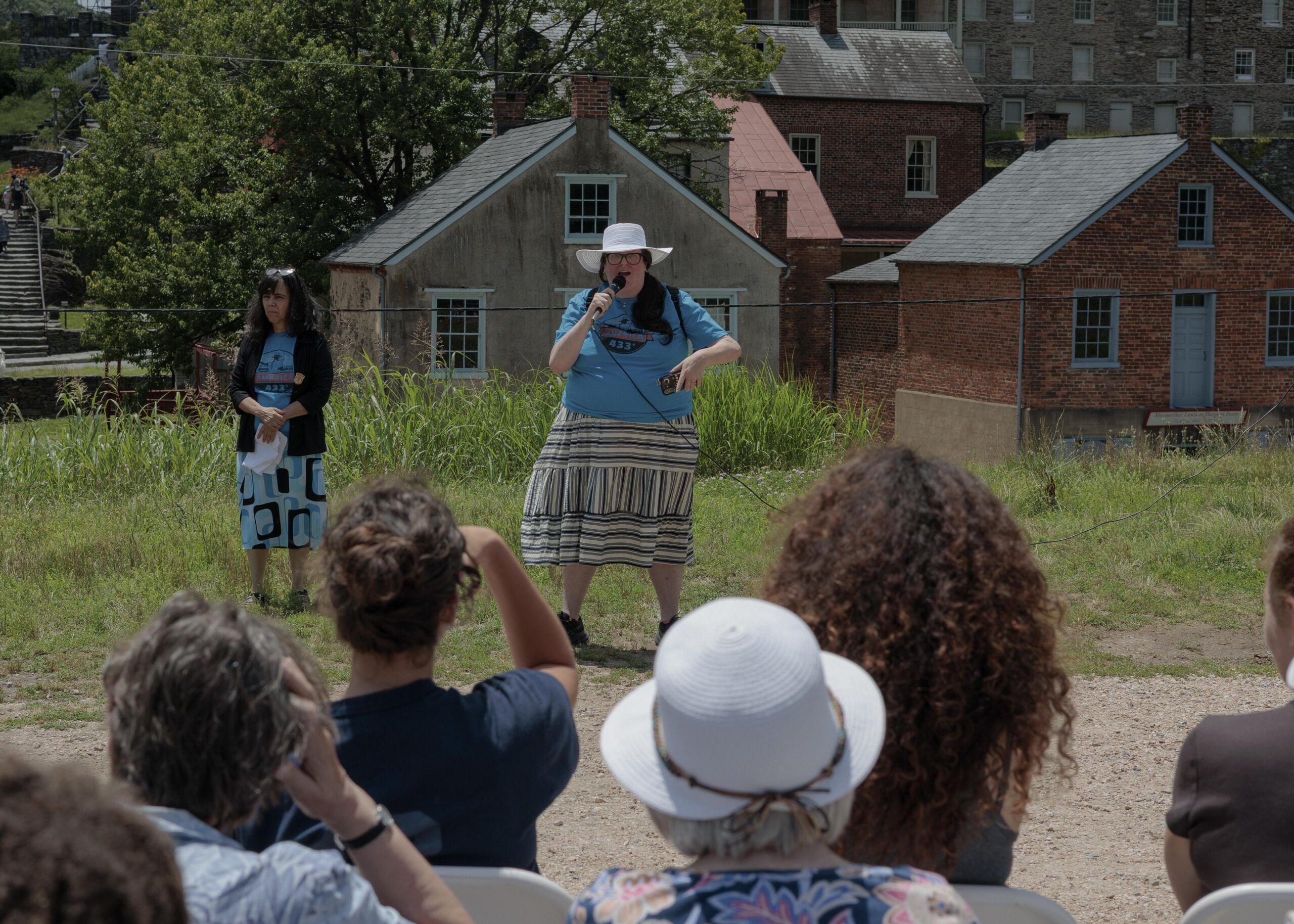
Some, like Kerwin, 58, decided to push back. They began to organize under the moniker “Resistance Rangers” and helped found an education coalition dubbed America 433+ in reference to the 433 sites that comprise the National Park System.
This summer, advocates and former federal workers say they are trying to redefine the message of the country’s 250th anniversary by hosting protests, teach-ins and other events aimed at honoring the country’s diversity and complex history.
First stop: Harpers Ferry.
Honoring Juneteenth
On the sun-drenched afternoon of June 19, the historic main street here was crowded with families. Some got ice cream or perused shops, while others read up on the historic placards that dot the stone path.
“Hello,” Anna Bakalis, a volunteer from former federal worker collective Branch4, said as she handed postcards to a group of tourists. “We’re actually doing a little exhibit talk in a few minutes about the erasure of an African American exhibit that was right around the corner that this park actually censored.”

Visitors watch an informational video at the John Brown Museum at Harpers Ferry National Historical Park. (KT Kanazawich for NPR) The ex-rangers picked Juneteenth — the federal holiday that honors the day in 1865 that enslaved people in Texas learned that slavery had been abolished — to launch their public education campaign. It’s a nod to Black history and the speed at which it was being removed from public sites, said Melissa Dalley, a Resistance Ranger and former park guide at the Martin Van Buren National Historic Site in upstate New York.
Holding it on site at Harpers Ferry meant the rangers could capture the very audience they might have reached with Kerwin’s exhibit. Only now, Dalley said, they had a more urgent message.
“The only way that change has ever happened in this country is through a small, committed group of American citizens working really hard,” Dalley said. “What we’re doing out here is trying to recruit those people into that citizen army.”
After Trump signed the 2025 executive order that redefined what stories and artifacts could be featured at national parks and historic sites, the National Parks Conservation Association and other advocacy groups sued the Department of the Interior, challenging the agency’s ability to enforce it.
A week before Juneteenth, a federal judge ordered the government to cease any further removals and replace any historic materials already taken down from national sites.
In her order, U.S. District Judge Angel Kelley wrote that “history cannot be faithfully told while excluding the experiences of communities whose contributions, struggles, and achievements form an important part of our Nation’s story.”
The removed exhibits, according to the federal judge, touch on issues of climate change, Black history, women’s suffrage, civil rights and indigenous tribes, including: information at Glacier National Park in Montana that detailed the impact of carbon dioxide emissions and hotter temperatures; roughly 80 artifacts from the Selma to Montgomery National Historic Trail in Alabama that mark the 1965 march for voting rights; and exhibits detailing historic slave rebellions or massacres of indigenous peoples.

Former National Park Service historian Ella Wagner, 35, and ex-ranger Melissa Dalley, 49, unpack activity booklets for the America 433+ teach-in at Harpers Ferry National Historical Park. (KT Kanazawich for NPR) Kelley ordered the DOI to reinstate the nixed exhibits before July 4 and the nation’s 250th anniversary celebration. When the government asked the court to push back its deadline and delay implementation, the judge declined.
Kelley ordered that 52 items be put back in place at more than 30 federal sites, beginning the week of June 22.
It was not immediately clear if Kerwin’s exhibit, which was axed before it ever opened to the public, would also be reinstated. But the Resistance Rangers are done waiting for officials to act. They’ve printed copies of banned pamphlets and made plans to bring information the government wants out of federal parks directly to visitors.
The Resistance Rangers will set out again Saturday for a national protest of Trump’s vision of the 250th celebration. Organizers intend to solicit signatures onto a “declaration of interdependence” that advocates for safety, dignity, living wages and access to a clean environment for all.
A ‘debt to the past’
A stone obelisk bearing the words “John Brown’s Fort” marks the spot where, in 1859, abolitionist John Brown and more than 20 of his followers captured a U.S. military armory. The plan was to seize the weapons and then hand them out to enslaved people who they hoped would revolt and join their cause.
But the mass rebellion Brown predicted never materialized, leaving him and his comrades trapped inside the arsenal. Days later, the U.S. Marines snuffed out the uprising, captured Brown and ultimately executed him.

The John Brown Monument at Harpers Ferry National Park. (KT Kanazawich for NPR) More than 160 years later, Brown is still remembered for giving his life to the cause of abolition. But the Black men who joined him in this battle typically get second billing.
Kerwin said she hoped her exhibition might help change that.
She and her colleagues compiled a database of names of hundreds of enslaved people who lived in the area from 1769 to 1861 — many of whom had not previously been identified publicly in historic accounts.
Visitors would have heard the account of Osborne Perry Anderson, the lone surviving Black member of John Brown’s raid, former rangers said.

An African-American history exhibit was years in the making at Harpers Ferry National Historical Park when it was abruptly cancelled by the Trump administration. A year later, the building that was supposed to house the exhibit sits empty. (KT Kanazawich for NPR) 
Informational signs are placed around Harpers Ferry National Historical Park. (KT Kanazawich for NPR) Instead, this month, tourists were greeted with a shuttered building and a scannable QR code that links to a five-paragraph overview of the park’s African American history.
That, Kerwin said, is not enough.
“The people who were overlooked and unnamed and didn’t count in the official record, they deserve to take up space in our national memory,” Kerwin said. “They are America.”
When her project was sidelined, Kerwin said, she was devastated. Not just for herself and the years she had spent on the piece, but for the public, for her country and for her teenage son — a Black boy who she hoped might see his own history reflected in the exhibit’s walls.
“He was foremost in my heart as I was working on this,” Kerwin said. “I hoped he would see strength and resilience in that story.”
Steven Mintz, a history professor at the University of Texas at Austin, did not attend the event, but said that even from afar, it seemed powerful — and necessary.
Mintz compared the former rangers’ teach-in to similar public education campaigns during the Vietnam War, and commended them for doing what they could to ensure the Black families and individuals whose history remains tied up with Harpers Ferry are not forgotten.
“The most lasting form of reparations is remembrance. We owe a debt to the past,” Mintz said. “All of the prosperity we enjoy and the freedoms we enjoy are due to the people who were willing to sacrifice for us. We have a duty to remember them.”
The work is not done
On Juneteenth, Kerwin still got her chance to tell the story of what might have been.
A steady trickle of visitors to the park made their way up the hill to the spot where the group had set up tables filled with banned books, workbooks discontinued by the Trump administration and wooden “junior Resistance Ranger” badges for those willing to take a pledge to “protect our parks, history and science by speaking up, learning and sharing the full stories of our national parks.”

Zinn Education Project’s Deborah Menkart, in the red shirt, shares examples of banned books and other reading materials during the America 433+ teach-in at Harpers Ferry National Historical Park. (KT Kanazawich for NPR) 
Newly banned booklets from other National Parks are displayed during the America 433+ pop up at Harpers Ferry National Park; Junior Resistance Ranger pins are given out at the same event. (KT Kanazawich for NPR) “It’s really disturbing to see that there’s two educational booklets for children from different Black history sites that are no longer being printed because of our government’s decision to support racism instead of justice and liberty for all,” said Cathy Fulkerson, 69, a visitor from New Hampshire.
As visitors like Fulkerson settled into folding chairs arranged along the same grassy knoll where John Brown and his followers fought their way into the red-brick armory, Kerwin rose, stepped to the microphone and looked out at the crowd gathered before her.
She remembered why she had wanted to hold this teach-in: To tell stories history had ignored or forgotten, and to set an example for her 13-year-old son. When she cast her eyes out into the crowd, searching for his small face and dyed locs, Daniel had disappeared.
The eighth grader later said what he did next would surprise them both.
Kerwin began to speak on the erasure of Black history, the exhibit she had dreamed up for her son and generations of kids like him. And there was Daniel. Standing at her side.

Kerwin speaks at the America 433+ teach-in at Harpers Ferry National Historical Park alongside her son, Daniel Nisbett, 13. (KT Kanazawich for NPR) Transcript:
SCOTT DETROW, HOST:
The United States is celebrating its 250th birthday with elaborate displays of patriotism in D.C. and across the country. It all paints a very specific picture of American culture and history, one that critics say does not tell the whole story. NPR’s Marissa J. Lang visited a national park in West Virginia where a group of former park rangers is trying to make sure history is not erased.
MARISSA J LANG, BYLINE: In the town of Harpers Ferry, volunteers like Anna Bakalis are telling visitors about a Black history exhibit that the National Park Service didn’t want them to see.
ANNA BAKALIS: We’re actually doing a little exhibit and talk in a few minutes about the erasure of an African American exhibit that was right around the corner that this park actually censored.
LANG: She points to a boarded-up building with a sign hanging over the front door. It says African American history.
BAKALIS: Yes. That – there right there. And it says closed for renovation, but we know that’s not exactly true.
LANG: The Trump administration has taken down dozens of federal exhibits focusing on issues such as civil rights or climate change. An executive order issued last year said it wants to correct an effort to sow divisions and promote a sense of national shame. President Trump instead wants the Department of the Interior to focus on, quote, “the greatness of the achievements and progress of the American people.” This exhibit, which was scheduled to open this month, was nixed after Trump’s order. It would have told the stories of formerly enslaved people who lived and worked and died at Harpers Ferry.
ELIZABETH KERWIN: We were going to bring to life all of the people that got overlooked, at least some of them. We had found names of enslaved people that date us all the way back to 1769.
LANG: That’s former Park Ranger Elizabeth Kerwin, who planned the exhibit. She worked here for 25 years before she says she was forced out amid mass firings last year. This was going to be the high point of her career. But when it got shut down, she said it felt bigger than that, like the country was failing generations of African Americans.
KERWIN: They deserve to take up space in our national memory.
LANG: Harpers Ferry is known as the site of a violent uprising led by John Brown, a white abolitionist who believed slavery would never end without bloodshed. In 1859, Brown and about 20 other men attacked a federal arsenal filled with weapons he hoped to distribute to nearby slaves and encourage them to rebel. It didn’t work. After two days of fighting, many of his men were killed. Brown was captured and then executed. The men who fought alongside him have been largely forgotten, especially the Black men. History professor Steven Mintz from the University of Texas at Austin says what Kerwin is doing can go a long way to shifting that narrative.
STEVEN MINTZ: We owe a debt to the past. All of the prosperity and freedoms we enjoy are due to people who are willing to sacrifice for us. We have a duty to remember them, and the failure to remember them is a curse on us.
LANG: This month, a federal judge ordered the government to restore the exhibits before the Fourth of July. It’s not clear what that means for this exhibit that was never allowed to open. The Department of the Interior did not respond to NPR’s requests for comment, but former rangers like Melissa Dalley are taking action now. On the same hill where John Brown made his last stand, ex rangers hand out educational pamphlets the Trump administration has discontinued.
MELISSA DALLEY: So we also have another band junior ranger book (ph). Find them under here. Junior ranger books galore.
LANG: They swore kids in as junior resistance rangers and spoke about standing up to censorship. These teachings are part of a growing movement to reclaim America’s 250th anniversary and to tell the story of the United States in all of its complexity.
Marissa J. Lang, NPR News, Harpers Ferry, West Virginia.
-
Playwright Anna Deavere Smith tells her own family story in ‘Basil Biggs’
Transcript:
TONYA MOSLEY, HOST:
This is FRESH AIR. I’m Tonya Mosley. My guest today, actor and playwright Anna Deavere Smith, has played a national security adviser on “The West Wing,” a matriarch on “Black-Ish” and a magazine editor on “Inventing Anna.” But for more than 50 years, the work she keeps returning to is America itself. Smith pioneered what we now call documentary or verbatim theater. She interviews people, sometimes hundreds of them, caught inside a national fracture, like a riot or epidemic. And then she stands alone on a stage and performs their exact words.
In her 1992 play “Fires In The Mirror,” she became Crown Heights, Brooklyn, in the aftermath of a deadly racial conflict. In “Twilight: Los Angeles, 1992,” she became the city in the days after the Rodney King verdict. And in her 2016 play “Notes From The Field,” she examined the school-to-prison pipeline. Here she is as Leticia de Santiago, a parent from Stockton, California, on the lengths she takes to keep her kids out of trouble.
(SOUNDBITE OF PLAY, “NOTES FROM THE FIELD”)
ANNA DEAVERE SMITH: (As Leticia de Santiago) And I think I was a very strict mother. Anything involving my kids, I was very involved. I used to even go at nighttime and smell them. Yes. Oh, yes. Yes, to see if they were not drinking or smoking. Oh, yes, I did so many things to keep my kids out of trouble, and thanks to the Lord, I think I did a good job.
MOSLEY: Anna Deavere Smith’s new play turns that lens on her own family. “Basil Biggs” premieres this month in Philadelphia, written for the nation’s 250th anniversary. The title character is her great-great-grandfather, a free Black man who became a prominent Gettysburg figure and the conductor of the Underground Railroad, helping to lead enslaved people to freedom. Smith first learned about him a decade ago while appearing on PBS’s “Finding Your Roots” with Henry Louis Gates Jr. In this clip, Gates explains the remarkable role Biggs played in the war’s aftermath.
(SOUNDBITE OF TV SHOW, “FINDING YOUR ROOTS”)
HENRY LOUIS GATES JR: Now, this obituary, Anna, is for Celia Biggs Penn, Basil’s daughter, who died in 1936. And it gives us a sense of what your ancestors did in the fateful days right before the battle.
SMITH: Mrs. Penn, last of kin who fled ’63 battle, dies. The only colored persons in this section, the Biggs family, was warned to leave this section with the approach of the Confederate troops.
GATES: OK. So…
SMITH: Wow.
GATES: …Your ancestors fled…
SMITH: Unbelievable.
GATES: …The Confederate invasion. Now, remember, it’s three days of combat, right?
SMITH: Right.
GATES: And Basil’s farm was converted into a field hospital by the Confederates.
SMITH: My God, that’s a story right there. That’s an amazing – that’s a play.
MOSLEY: Anna Deavere Smith, welcome back to FRESH AIR.
SMITH: Thank you for having me.
MOSLEY: That moment that we just heard, I think the audience, if they watch it, I think we all came to the same conclusion at the same time, including you, that it is a play. And now it is exactly a play. Take us to that moment.
SMITH: Sure. Well, so (laughter) that was me with my friend, Skip, aka Henry Louis Gates Jr. And it was a very powerful moment, I have to say. But maybe what’s equally as interesting is that I did nothing about it. That was in 2014. When it aired on PBS, my family raced off to Gettysburg – and that would be my generation of cousins and sisters – rushed off. And for some reason, I couldn’t go.
I mean, you know, I am an artist. I’m nomadic. I go from pillar to post. And the only thing that was in the way? Other gigs. That’s what was in the way. And then Kathy Sachs, who is an extraordinary philanthropist and arts collector, has been putting together a remarkable festival of arts here in Philadelphia, which is where I am right now, called What Now. And she asked me to write something for it. And because it was for the 250th anniversary, and because it was in Pennsylvania, I thought, oh, this is the time for me to write about Basil Biggs.
MOSLEY: What’s a detail about Basil’s life that completely surprised you? I mean, the entire story is pretty remarkable. But what was something that really stuck with you for years after?
SMITH: Well, I would say a sort of very pertinent and revolutionary discovery was that he could not read and write. And neither could my great-great-grandmother, Mary Jackson Biggs, which meant that I had nothing to go on in his words, no diaries, no letters. Now, that wouldn’t seem unusual for Black people at that time. But the way I’ve worked for 50 years is to study every single, not just word, but utterance that a person makes in order to put together an American story.
So I had no document, nothing documentary to go on. I had photographs. That was it. And, of course, you know, the Civil War, it’s been written about extensively, as has the Battle of Gettysburg. So I could sort of put together the facts of the era. But I have not – I don’t have a word out of the mouth of my great-great-grandfather or his children. So this called for me to leave my documentary form. It allows me to still be the Americanist that I believe I am. But I had to do a different kind of writing, a different kind of inquiry.
MOSLEY: Yeah. How did you bring him to life?
SMITH: I was really terrified, honestly, you know, staring at the blank page. I had a fabulous time in Gettysburg, you know, made great friends there, felt absolutely at home in Gettysburg, spent a lot of time in the archives. But I still didn’t know how to put the words on paper. And what – the best thing that happened was that I had been able to visit the farm, his first farm in Gettysburg. The farm is still there. The house is still there. The barn is still there. The creek is still there. And we believe that that’s where he did a lot of his Underground Railroad activity.
This is the house that was taken over by the Confederates and turned into the Confederate hospital. There is still blood on the floor. Walking around the barn, walking around the farm really gave me the rooting that I needed to start writing. I don’t know what I would’ve done if I hadn’t had the chance to walk around that farm. And so it’s also interesting that, especially for a Black man of that era, all three of the houses that he lived in in Gettysburg are still standing.
MOSLEY: He is the reason Lincoln had ground to stand on in that fateful November. He reburied the Union dead – right? – so that the cemetery could be dedicated, so that the Gettysburg address could be delivered.
SMITH: That’s right. And the Underground Railroad also, obviously, is a story that one has to put together shreds for. It’s underground, right? But the reason that he’s commemorated now, the reason he’s honored now in Gettysburg – what happened was that when word got out that the Confederates were coming to Gettysburg, you know, now we think about these things and, of course, you go to the battlefield. But, you know, it was a farm town, right? And when word was out that the Confederates were coming, Black people had every reason to believe that they were going to be snatched and taken back to the South, whether they were free or not. This had happened. A massive invasion and raid had happened nearby in Chambersburg.
So my great-great-grandfather took his family, my great-great-grandmother and the children, away. When they came back, really just a few days later, the farm had been taken over by the Confederates. They had claimed the house as their hospital. And I believe that my – that Basil Biggs had lost everything. I mean, he couldn’t read and write. But he was very entrepreneurial.
He had a robust farm. He had a good business as a veterinarian. And I think that he took the grisly job of disinterring the Union dead and reburying them and cleaning up the 7,000 dead bodies with a group of other Black men that he brought together, I believe that he did that because he was broke. Now, it could be that, you know, he had a huge civic responsibility. I’m not sure. But they started that in October, and they had it in good enough shape that by November, when Lincoln came to consecrate what becomes the National Soldiers’ Cemetery (ph), it was possible to do. The irony is that at least then, Black Union soldiers were not buried in that cemetery. And so Basil Biggs was a part of an organization called The Sons of Goodwill, who created a separate cemetery at that time for the Black Union dead.
MOSLEY: Did you ever consider playing Biggs yourself, like a one-woman show? Because this is a traditional play with a cast of actors.
SMITH: I’m very excited about these actors. And the whole part of casting the play was huge, you know, trying to find who would play these characters. And one actor walked in and looked exactly like my cousin, Basil Biggs, and like my brother. And there’s a scene in the play that is just a real sort of contentious moment between Basil and this young man called Calvin. And I have to tell you, I just burst out crying in the auditions, sobbing, because it just reminded me of discord between my brother and my father.
And I made a very intentional decision in 1980, when many of us who were not white heterosexual-presenting males were encouraged, not just invited, but encouraged to write about ourselves. And I made the opposite move. And I said, I’m not going to write about myself, not going to write about my family. I’m going to chase America in terms of that which is not me. And I did that for 50 years. And so to have this kind of homecoming is very powerful in so many ways. And I think to see it outside of myself, rather than trying to embody it, is part of the power.
MOSLEY: Today, I’m talking with actor and playwright Anna Deavere Smith about her new play, “Basil Biggs.” It’s about her own great, great grandfather, a free Black man who reburied thousands of Union dead at Gettysburg and prepared the ground where Lincoln delivered his famous address. We’ll continue our conversation after a short break. This is FRESH AIR.
(SOUNDBITE OF ALLEN TOUSSAINT’S “EGYPTIAN FANTASY”)
MOSLEY: This is FRESH AIR. And today I am talking with actor and playwright Anna Deavere Smith. Her new play, “Basil Biggs,” traces the life of her great, great grandfather in the Civil War era Gettysburg. It premieres this month at the Wilma Theater in Philadelphia, written for the nation’s 250th anniversary.
Smith was born in Baltimore in 1950 and came up through the theater as a classically trained actor. Somewhere along the way, she set down a different path. Instead of playing invented characters, she started turning a tape recorder on real Americans and performing their exact words, becoming a pioneer of what we now call documentary or verbatim theater.
Anna, I want to talk a little bit about verbatim theater because you came up, as I said, as an actor, and then you did this unusual thing. Instead of looking for roles, you started collecting people. What sparked that shift?
SMITH: You know, I think everything starts with a question. And I feel, for example, that education should be about us discovering our questions rather than seeking answers. And I had that extraordinary opportunity in a Shakespeare class when I first started studying acting. I didn’t really begin that pursuit until I was 22 years old. And our Shakespeare teacher, on the first day – and I was very worried about Shakespeare class – and it’s about speaking Shakespeare; it’s not Shakespeare scholarship – made this particular suggestion that we expect the rhythm of Shakespeare to be like this, da da, da da, da da, da da, da da, what we call iambic pentameter. And she suggested in her argument that when we are trying to speak Shakespeare, we just speak the words as they are written, right? We don’t add extra emotion or anything.
In making that argument, she said, but if there is an upside down rhythm in the second beat, this tells you that something is awry with the character. So that little other beats called a trochee. So if the rhythm goes, da da, dada, da da, da da, da da, that means there’s something unsettled. And she gave the example of the end of the play King Lear, when Lear has lost everything. And he says, never, never, never, never, never. Everything’s upside down.
So when I was in the conservatory, I was trying to figure out, how did that happen? How could emotions be captured in rhythms? And I decided that I would see if I could listen in real life to how people’s rhythms changed, and if those changes would be indicative not only of disarray in a story that individual was telling me, but also in the world around them. And so this is one of those random things.
I was at a cocktail party and standing next to – like a wallflower, another woman was standing next to me. And she asked me what I did. What was my work? And I never, to this day, say I’m an actor. Like, even on a plane, if somebody says, what do you do? I never say I’m an actor because then you have that very embarrassing question, well what have I seen you in?
MOSLEY: Right. Yeah. What do you say?
SMITH: So I said, well, I’m trying to learn something about – imagine at a cocktail party – I’m trying to learn something about language and identity. And I said, and I’m trying to figure out how to get people to break their linguistic patterns when they speak. And she said, well, I’m a linguist. And she said, I’m going to give you three questions that will guarantee this can happen in the course of an hour. And the questions were, have you ever come close to death, have you ever been accused of something you didn’t do and do you know the circumstances of your birth?
And so the first show that I made was with other actors. I only played one part, and I literally walked up to people on the streets of New York or wherever they were, and I said, I know an actor who looks like you. If you’ll give me an hour of your time, I will invite you to see yourself perform. This was in 1980.
And so I talked to the lifeguard at the gym. I talked to the lady up the street, who had a secondhand clothes store. I talked to somebody who was in a fancy beauty parlor. And I made a show in which I would talk to somebody for an hour about whatever they want to talk about. Hair, you know, swimming lanes. And somewhere in that, I would ask those questions. And, lo and behold, their language took on these different patterns.
And so I trained myself how to listen by doing that. And then when you think about it, since I’ve gone to do plays about things that are upside down, are in disarray, are not iambic pentameter but are trochees, then it is the case that people speak in disrupted sentences. And they struggle to make sense, which means that they actually make these gorgeous, as far as I’m concerned, sort of architectures of language. And I’m very interested in those things, I will call them, those moments. And that’s what I perform.
MOSLEY: I’m sure you’ve heard a lot of people say, oh, that takes a lot of bravery for you to just walk up to people on the street and just ask them questions. What were those early responses to you? Because you weren’t talking to people on behalf of, say, a news organization or something tangible, specific, that people know that this would go toward.
SMITH: Well, I think, you know, it was kind of a curious thing – right? – for some girl to, you know, ask you that. Or I was doing a lot of temp work at the time. And the person I performed was Julia, who was at JCPenney. We worked in a basement. My desk was right next to hers. And I would hear Julia talking on the phone. And I thought, I’ve got to get an interview with Julia.
(LAUGHTER)
SMITH: So I know in advance, you know, of somebody who I thought was very, very interesting. And I think because nobody had ever asked them before. And by the way, this isn’t like now, where people are going around taking selfies and pictures of each other. This is when my tape recorder was, you know, it was like this Panasonic thing that was probably almost a foot long.
MOSLEY: Yeah. Yeah.
SMITH: Right? So people weren’t walking around with iPhones that they could record on. So I think it was, like, this odd thing this rather charming girl asking them to do (laughter). And they said yes.
MOSLEY: My own curiosity, what was so interesting about Julia on the phone at JCPenney in the basement?
SMITH: She was, well, see – she was just like – you know, she was one of those people who was – she was so – oh, she had a story about somebody who just had a meltdown on a bus going through the tunnel, the Lincoln Tunnel in New York. And she – as often what’s so beautiful about Black people in particular, she acted out, like, all the people, right? So that was so great, you know? And, you know, I’ll have to tell you another sort of epiphany I had about Julia.
So I said, I only played one part in that play. It was Julia. And she came. It was so exciting to see the people come to see themselves performed in this loft in New York. And Julia waited for me with her friends. And as we were walking down Leonard Street, her friend – Julia, girl, you were the star, girl, you were the star. And I thought, yeah, the character should be the star, not the actor, right? And so, I mean, she just was one of those Black women with a great sense of humor and a great ability to tell a story.
MOSLEY: Oh. See, this story – OK. I was wondering. You know, a lot of your performances remind me of an oral tradition I know some Black households have, like, the way people slide in and out of imitating others to kind of drive a point home. Did you see that growing up? What was the storytelling tradition in your house?
SMITH: Oh, yeah. I mean, Ms. Johnson next door, who weighed 400 pounds, couldn’t move very far and would, you know, give me 25 cents to go down, buy her some fatback from the grocery store, Mr. Zelman’s (ph) grocery store. And then, you know, I would sit on her porch and hear a story she had. And my maternal grandfather, who married Virginia Biggs, was a fantastic storyteller, so – as was my maternal grandmother. So I’d do anything for a story when I was little.
And you’re right. There’s that oral tradition. My Aunt Esther is the first person I ever interviewed, sitting in her kitchen. All my life, I listened to her. But the first actual interview I did knowing that I wanted to create this kind of theater, I tested it out on Aunt Esther.
MOSLEY: Our guest today is actor and playwright Anna Deavere Smith. We’ll be right back after a break. I’m Tonya Mosley, and this is FRESH AIR.
(SOUNDBITE OF RUSSELL MALONE “THE BALLAD OF HANK CRAWFORD”)
MOSLEY: This is FRESH AIR. I’m Tonya Mosley. And my guest today is the actor, playwright and professor Anna Deavere Smith. Over the last four decades, she invented and defined what’s known as documentary or verbatim theatre. She’s interviewed hundreds of people, then performed them on stage. “Fires In The Mirror,” about the Crown Heights conflict, made her a Pulitzer Prize finalist. “Twilight: Los Angeles, 1992,” about the city after the Rodney King verdict, earned her two Tony nominations. She went on to write “Let Me Down Easy,” about the body and the American healthcare system and “Notes From The Field,” about the school-to-prison pipeline. Her new play is called “Basil Biggs,” and it’s the story of her own great, great grandfather, a free Black man who played an important role in the Civil War battle of Gettysburg.
This thing that you do, this verbatim theatre, I have heard you describe it as you’re borrowing people’s stories with their permission. And there’s something very specific about the people you choose. How do you decide who to interview?
SMITH: Well, who to interview is just who – you know, say – my play “Let Me Down Easy” was about healthcare, but it was also about the vulnerability of the human body to the state, to disease. And so I did extensive interviewing. I went to, for example, South Africa during the AIDS crisis when Mbeki was an AIDS denialist. I went to Rwanda 10 years after the genocide, sort of broken societies and talked to people. And I have an abstract idea of the problem that I’m trying to investigate. And I don’t have a story. And then in the process of doing the interviews, and more importantly, in the process of being in the rehearsal room, I find a through line of a story.
MOSLEY: Where did the inspiration come for “Let Me Down Easy”?
SMITH: Dr. Ralph Horwitz was the head of internal medicine at Yale School of Medicine. And he invited me in the late ’90s to come to Yale Medical School and to interview doctors and patients and to perform at something called Medical Grand Rounds as a way of showing the doctors that they don’t listen. And I kept saying, no, no, no, no, no, no, no. And at first, I thought it was ’cause I was just too intimidated to be around all those doctors. And he didn’t give up. And when I finally went and started doing the interviews of patients, I realized the reason I was really worried was ’cause I knew it would have something to do with death.
And I did this performance at Medical Grand Rounds, and I performed doctors and some people who had been very, very sick. And after that performance, maybe a year later, he asked me to come back and do it in another situation, and I did. And those same patients, they were waiting eagerly backstage to say hello. And I thought, now, why would you want to come to see a show again that’s dealing with a moment in your life where you almost died? And it dawned on me – because dying or not, something about the performance made it all real in a good way and solid in a good way ‘Cause this was before the big healthcare conversation. But once the healthcare conversation – as we’re starting to approach Obama and the whole conversation of healthcare starts to become real, then I realize I have a real sort of political place to put this excursion, really, around death into a frame. And that’s what made me continue to work on it.
And also because, you know, people say, oh, how did you get this person to talk to you or how did you get this person to trust you? I say, oh, no, no, no, no, no, no, no, no. I’m looking for the people who are screaming from a mountaintop and I just happen to be walking by. And when you go into a palliative care unit, you sit with somebody who’s dying. If they have the strength, it’s a scream from the mountaintop. They want to be heard. They want to communicate. And that’s very dramatic and very stageworthy.
MOSLEY: In “Let Me Down Easy,” there’s a person that you embody, Brent Williams. He’s a rodeo bull rider from Idaho. You talk about him quite a bit over the last 20 years. He was someone who really taught you what seems like a lot of lessons. But I want to play a little clip because he talked to you about the ways bull riding has wrecked his body, that – he has this one story that a bull shoved his face through metal chutes, for example. And in this clip of your performance as Williams, you’re talking about his health care deductible.
(SOUNDBITE OF ARCHIVED RECORDING)
SMITH: (As Brent Williams) Yeah, I got insurance. Blue Cross of Idaho, family policy, 260 bucks a month cover all of us. Then we got a $7,500 deductible, (laughter) which is stupid. I mean, you know, we don’t ever meet that. I mean, all this paying money, then we got to pay 7,500 before they meet it. They’re just trying to rape us, like all the people that got the money. They rape the poor till pretty soon – or they rape the middle class till the middle class becomes poor. Then they going to start raping the rich. And they’re going to break the whole country, I think. But basically, I’m an optimist.
(LAUGHTER)
MOSLEY: That was my guest, Anna Deavere Smith, as Brent Williams in “Let Me Down Easy.” And when you watch this, there is a lot of physicality to that performance. You’re wearing a cowboy hat. Your legs are wide. You’re strutting across the stage. And these are parts of the story as well, that body language. What is it telling us? What is it telling you that words don’t convey?
SMITH: First of all, if my performance is attentive to detail, then you see the choreography. You don’t know why you’re drawn to that person. But if we were to sit down and break it down for you and show you the choreography, you’d know why. I mean, with Brent, he was kind of outrageous. You know, I actually invited Brent to New York a couple of times, and he’s a very different person than the sort of artists that I hang out with, very, very conservative. But, you know, he’s a perfect example of someone who’s game, you know, who comes with goodwill. He knows. And I have – he was in my apartment, dancing cheek to cheek with the astute legal scholar Patricia Williams.
MOSLEY: (Laughter) What? Wow.
SMITH: And so it’s about goodwill. You know, we talk about how do we get over these differences. It’s like, he doesn’t agree with anybody, in this case, sitting around the dinner and then dancing afterwards, when people had drank enough. You know, he agreed. Nobody agrees agreed with Brent. But he felt at home in my house, right?
MOSLEY: You like talking to people that you don’t agree with.
SMITH: Well, not necessarily all the time. For the purpose of putting them in a play, yes. So, you know, we have to admit that that’s also different, in a way, from real life, right? I can do things in my art that I may not be able to do in my life. So with Brent, I went to the national rodeo finals with him and standing around with all of his friends, you know, swigging Chivas and telling stories about women that weren’t so great, right? Would I be doing that just for fun? Probably not.
MOSLEY: Today, I’m talking with actor and playwright Anna Deavere Smith about her new play “Basil Biggs.” It’s about her own great-great-grandfather, a free Black man who reburied thousands of Union dead at Gettysburg and prepared the ground where Lincoln delivered his famous address. We’ll continue our conversation after a short break. This is FRESH AIR.
(SOUNDBITE OF RAY CHARLES’ “THE RAY”)
MOSLEY: This is FRESH AIR, and today, I am talking with actor and playwright, Anna Deavere Smith. Her new play, “Basil Biggs,” traces the life of her great-great-grandfather in the Civil War era Gettysburg. It premieres this month at the Wilma Theater in Philadelphia, written for the nation’s 250th anniversary. Smith’s earlier plays include “Fires In The Mirror,” Twilight: Los Angeles, 1992″ and her 2016 play “Notes From The Field.”
I want to talk briefly about the choices you made in “Notes From The Field.” You showcased a wide range of people – civil rights leaders and high school students and prisoners like Denise Dodson. She was an inmate at the Maryland Correctional Institute for Women, and she was serving time for murder. And I’m going to play a clip. Here she is talking about her children and the circumstances of her crime. You playing her. Let’s listen.
(SOUNDBITE OF FILM, “NOTES FROM THE FIELD”)
SMITH: (As Denise Dodson) I had six children. Now I have five. One of them died since I’ve been here. The oldest being 34, the youngest being 21. I had my youngest child when I was in the Baltimore Detention Center. I’ve been here 23 years. Well, my boyfriend – my former boyfriend, ’cause we wasn’t together at the time – shot and killed a guy who tried to rape me. Well, they didn’t consider it accomplice. I got the same charges he did. First degree murder. I think it’s fair. You talking about somebody’s life. Whether it’s in your control or not, somebody’s life has been taken, so I do think it’s fair. But I think that if I had had a better education, I would have been more upright, so to speak, you know, because without that education, I always felt less than. And I think if I had had that education, I would have known that I am somebody. I am a good person.
MOSLEY: That was my guest Anna Deavere Smith as inmate Denise Dodson. I can almost hear your questions and her answers, Anna, of course, like, the questions you asked to elicit those answers. But it’s her demeanor. She was one of several Black women and girls at the heart of this – “Notes From The Field.” What drew you to put people like her at the center of the story?
SMITH: Well, the story really was about looking at the pressures or what we call – what are the things that pull us away from giving people an education? And why, when they are unable to fit into maybe the sorting mechanism of education, do they end up incarcerated? And I heard a chilling statistic that there’s something like in the 70% of Black and brown kids that can’t really read at the level they need to read.
MOSLEY: Just across the board in the United States.
SMITH: Yeah. And so we have to ask deeply, deeply, what’s in the way of that? And “Notes From The Field” was looking at education and the things that pull people away from school and the things that pull school away from people. And with Denise, you know, of course, sitting in a prison, I mean, she’s aware of being under surveillance all the time. You know, she’s probably about a year, maybe, from going before the review board again. She’s very conscious of every single thing she’s saying. And there was extraordinary humility in Denise and emotional power. And her job in prison was to train service dogs. And she talked about how dogs are more decent than people. And even that the amount of attention that she gives those dogs to train them, what if we gave the same type of attention to children?
And the last thing I’ll say about this is even if you go back to Thomas Jefferson and you look at his plan in the notes from the State of Virginia – on the State of Virginia, his plan for education was to find the excellent ones and throw out the rubbish. The word rubbish is in that document. So – and that’s just talking about white men. And so, our system has always been one of sorting. Let’s sort out the people that we don’t want to be bothered with.
MOSLEY: You ended up studying at the American Conservatory Theater. This theater community that you then became a part of. You know, the way we think about theater today is always talking about it in terms of keeping it alive. And this sounds like this was a vibrant place for you.
SMITH: First of all…
MOSLEY: Yeah.
SMITH: My first job (laughter) was for a Black theater company that had been started by Ed Bullins, great Black playwright. And it was called The Grass Roots Theatre Company (ph). And I went in there to see if there was something I could do, and they said, well, you could be the stage manager. I said, well, I don’t know how to do that. Oh, you’ll be fine. You look like you could be good.
MOSLEY: (Laughter).
SMITH: I was their so-called stage manager. And I had a crisis when I decided to go to school at the American Conservatory Theater, which would be like the white people’s theater, you know, in the middle of town that was very, you know, resourced, and not to work anymore at the Grass Roots Theatre Company. But the American Conservatory Theater had a company of 52 actors, and that’s where I was trained. So that was entirely different type of time than now.
And, you know, we always say the theater is dying, but I think it’s that it has another economic model now. Those were the days when the idea was to have a theater in your town that was the sort of gem, the cultural gem of a town, like a symphony. And that changed when those theaters started to see themselves as breeding places for Broadway. And so I would say it’s not that the theater is dead. It’s that it had a different economic model. And we never know when that may change again.
MOSLEY: I mean, you’re deep in the Basil Biggs story right now. But is there an American story you have your sights on for the future that’s been swirling in your head, that you’re dying to explore?
SMITH: No. Because I think that Basil Biggs’ story about approaching the Civil War, about being a part of restoring his town after this massive, massive catastrophe and following through to touch the American promise and going through the 15th Amendment, which – the play takes us through that. I think there are many things about that that are still unfinished business in our country right now. And so I’m pleased to be able to see what lessons I can learn, the actors can learn and the audience can learn by looking at that moment in history and looking at this particular family and how they came through it.
MOSLEY: Anna Deavere Smith, thank you so much for this conversation and your time. This has been a real pleasure.
SMITH: My pleasure. Thank you so much to you and your producers.
MOSLEY: Actor and playwright Anna Deavere Smith. Her new play, “Basil Biggs,” debuts at The Wilma Theater in Philadelphia this weekend. Coming up, TV critic David Bianculli reviews Larry David’s new HBO series. This is FRESH AIR.
(SOUNDBITE OF MARY LOU WILLIAMS’ “IT AIN’T NECESSARILY SO”)
-
The Obamas team up with Larry David in this irreverent look at American history
Transcript:
TONYA MOSLEY, HOST:
This is FRESH AIR. Tomorrow, HBO presents a new seven-part sketch comedy series that’s an irreverent look at American history, just in time for the country’s 250th anniversary. It’s called “Life, Larry And The Pursuit Of Unhappiness,” and it stars Larry David and comes from Higher Ground, Barack and Michelle Obama’s production company. Our TV critic David Bianculli has this review.
DAVID BIANCULLI, BYLINE: One of the first things the Obamas did for TV after forming their Higher Ground production company was build a series around a singular, American voice. That voice was Studs Terkel, the Chicago writer whose 1974 working-class oral history, “Working,” was a major influence on the young Barack Obama. In 2023, Obama saluted and continued Turkel’s vision by hosting and narrating “Working: What We Do All Day,” a very impressive, very serious four-part Netflix documentary series.
Now, Higher Ground is building another series around a singular, American voice. The results are equally impressive but much less serious because this time, the voice belongs to Larry David, America’s unofficial national curmudgeon. He’s turned being disgruntled into a massive fortune and into a lengthy, brilliant comedy career that includes “Seinfeld,” “Curb Your Enthusiasm,” and now, “Life, Larry And The Pursuit Of Unhappiness.”
This new series is created and written by Larry David and Jeff Schaffer. They’re also executive producers, as are the Obamas. Schaffer directs and is well-tuned to Larry David’s rhythms and sensibilities. Over the decades, Schaffer wrote dozens of episodes of “Seinfeld” and wrote and directed even more installments of “Curb.” Their new collaboration is much more heavily scripted than ad-libbed and is expensively mounted. Costumes, sets, even action sequences all look first rate. But even when Larry David is part of a silent tableau recreating the Continental Congress, wearing a powdered wig, while Barack Obama opens the show as the host, Larry can’t stay silent for long.
(SOUNDBITE OF DOCUMENTARY, “LIFE, LARRY AND THE PURSUIT OF UNHAPPINESS”)
BARACK OBAMA: But what truly makes America unique is the fact that we’ve always been a work in progress. We’re not perfect. We can be irascible, petty, selfish, cheap. And let’s face it, some of us will always find something to complain about. But as Americans, we have always found a way to overcome these naysayers, these deeply unpleasant people who stood in the way of progress. These miserable, intolerable – did I mention petty? – wretched…
LARRY DAVID: Hey, none of that’s in the script.
(SOUNDBITE OF UNITED STATES MARINE BAND’S PERFORMANCE OF JOHN PHILIP SOUSA’S “THE STARS AND STRIPES FOREVER”)
BIANCULLI: “Life, Larry And The Pursuit Of Unhappiness” is subtitled “An Almost History Of America” and provides just that. Each sketch, introduced by narrator Samuel L. Jackson, starts with historical fact, then veers wildly and enjoyably off the rails. In every sketch, the guest stars get the vibe David is after and add to it effortlessly. The opening sketch imagines that founding father Robert Livingston, played by Larry David, suggested some rather unusual rules for the Declaration of Independence before Thomas Jefferson took over the job of writing it. Henry Winkler plays John Hancock, and Chris Parnell plays Benjamin Franklin, who’s reading some of Livingston’s outrageous ideas to the assembled Congress.
(SOUNDBITE OF TV SHOW, “LIFE, LARRY AND THE PURSUIT OF UNHAPPINESS”)
CHRIS PARNELL: (As Benjamin Franklin) Here’s another gem. No sharing desserts. If you want a dessert, order it. None of this pass it around.
UNIDENTIFIED ACTOR #1: (As character) We’re not animals, Mr. Franklin, all eating out of a trough.
PARNELL: (As Benjamin Franklin) We can all have our own forks.
UNIDENTIFIED ACTOR #1: (As character) Then we’ll all take bites, put the forks in our mouths, put it back in the pie after it’s been in our mouths, Mr. Franklin. It’s unsanitary.
PARNELL: (As Benjamin Franklin) Sometimes I don’t want a whole slice of pie. I just want a taste of pie.
UNIDENTIFIED ACTOR #1: (As character) Get your own damn piece of pie, Franklin.
BIANCULLI: The next sketch jumps forward a full century, from 1776 to 1876, and has Larry David, as Alexander Graham Bell, unveiling his newest invention, the telephone, to a small invited group of guests. The guests, though, are quick to offer suggestions of their own.
(SOUNDBITE OF TV SHOW, “LIFE, LARRY AND THE PURSUIT OF UNHAPPINESS”)
DAVID: (As Alexander Graham Bell) My assistant Watson is in another building out of sight and sound. But with this device, I will be able to communicate with him as if he was standing right next to me.
(SOUNDBITE OF CROWD GASPING)
DAVID: (As Alexander Graham Bell) I will pick up the phone on my side, and it will ring on his.
UNIDENTIFIED ACTOR #2: (As character) What kind of ring?
DAVID: (As Alexander Graham Bell) Normal ring. It’s just a ring. It’s a ring. It’s a typical ring.
UNIDENTIFIED ACTOR #3: (As character) Maybe there could be a menu of rings that people could choose from.
UNIDENTIFIED ACTOR #4: (As character) Oh, yes. I would like mine to sound like a doorbell.
UNIDENTIFIED ACTOR #5: (As character) I’d like mine to sound like a clown horn.
UNIDENTIFIED ACTOR #6: (As character) Or perhaps a bicycle ring, you know, (imitating bicycle bell).
DAVID: (As Alexander Graham Bell) Oh, all wonderful ideas, but hardly the point. The point is, I’ll be able to communicate with someone who is miles away.
UNIDENTIFIED ACTOR #7: (As character) What if I’m at a piano recital, say, and I don’t want it to ring, so it just vibrates like a Jew’s harp in your pocket.
(CROSSTALK)
DAVID: (As Alexander Graham Bell) Oh, that’s just a fascinating idea.
UNIDENTIFIED ACTOR #8: (As character) Oh, what if you could send short little messages…
DAVID: (As Alexander Graham Bell) What if you invent your own? Go off and invent your own. That’s not this. You want something that vibrates? Go. Go invent it. This is all nonsense.
BIANCULLI: Yes, it is all nonsense. Even with some punch lines that are sharp and pointed, it’s all so whimsical it’s wonderful. Other sketches in the first show include trench warfare during World War I and Rosa Parks on a Birmingham bus ride predating her famous bus boycott.
HBO wants a lot of the sketch details kept secret, and I’m fine with that. But every sequence brings its own unexpected joys. Hey, isn’t that Richard Kind and Michael Chiklis and Sean Hayes, Kathryn Hahn, Bill Hader and Jon Hamm and Jerry Seinfeld from “Seinfeld” and Jeff Garlin, Susie Essman and J. B. Smoove from “Curb” all joining in? Yes, it is. And there are others aboard, too, as unpublicized special surprises.
Upcoming sketches are based on everything from the Lewis and Clark expedition to the Army-McCarthy hearings and the Moon Landing and are equally hilarious. I’ve seen enough to say that Larry David isn’t just having great fun with history. He’s adding to his own with yet another high concept comedy series home run.
MOSLEY: David Bianculli reviewed “Life, Larry And The Pursuit Of Unhappiness.” The series premieres on HBO tomorrow.
If you’d like to catch up on interviews you’ve missed, like our conversation with Atlantic staff writer Helen Lewis about the rise of masculinism or with actor and activist Laverne Cox on her new memoir about her life career and the attack on transgender rights, check out our podcast. You’ll find lots of FRESH AIR interviews. And to find out what’s happening behind the scenes of our show and get our producers’ recommendations on what to watch, read, and listen to, subscribe to our free newsletter at whyy.org/freshair.
(SOUNDBITE OF OLIVER NELSON’S “BUTCH AND BUTCH”)
MOSLEY: FRESH AIR’s executive producer is Sam Briger. Our technical director and engineer is Audrey Bentham. Our interviews and reviews are produced and edited by Phyllis Myers, Roberta Shorrock, Ann Marie Baldonado, Lauren Krenzel, Monique Nazareth, Thea Chaloner, Susan Nyakundi, Anna Bauman and Nico Gonzalez-Wisler. Our digital media producer is Molly Seavy-Nesper. Therese Madden directed today’s show. With Terry Gross, I’m Tonya Mosley.
(SOUNDBITE OF OLIVER NELSON’S “BUTCH AND BUTCH”)
-
Understanding ‘masculinism,’ a movement to restore the primacy of men
Transcript:
TERRY GROSS, HOST:
This is FRESH AIR. I’m Terry Gross. Repeal the 19th Amendment, which gave women the right to vote, and then let the man of the house vote for the household. If you think that anyone who advocates for that is too fringe to be taken seriously, think again. It’s the view of Christian nationalist Douglas Wilson, the pastor who co-founded CREC, the Communion of Reformed Evangelical Churches. CREC has a network of about 170 churches, including the one Secretary of Defense – or Secretary of War – Pete Hegseth belongs to. Wilson was the guest pastor in February at the Pentagon’s recently created monthly Christian prayer service. Hegseth prayed beside him. CREC also has a network of Christian schools, and Hegseth’s children attended one of them. Wilson is influential in the growing movement that’s sometimes called masculinism, which believes feminism has been emasculating men, men should have more power than women and that a woman’s place is at home raising children and following her husband’s wishes.
My guest, Helen Lewis, writes about masculinism in her Atlantic article titled “The Men Who Want Women To Be Quiet.” It’s subtitled “A Virulent Form Of Misogyny Has Become The Single Most Important Force Holding Together The American Right.” Wilson is one of the people she interviewed for the article. Lewis is a staff writer at The Atlantic with a focus on the intersection of politics, society and digital culture. She is also the author of “Difficult Women: A History Of Feminism In 11 Fights,” and “The Genius Myth: A Curious History Of A Dangerous Idea.”
Helen Lewis, welcome to FRESH AIR. So before we get to Pete Hegseth and Douglas Wilson, what is masculinism, and how does it compare to regular old misogyny, patriarchy?
HELEN LEWIS: Well, masculinism is a word that has been around for quite a long time now. It’s the idea, essentially, that men should be in charge. That that’s the way that the world should be ordered, that you get now new versions of it that are about talking about biology, you know, men’s hormones mean that they’re more suited for government. But it’s not exactly patriarchy in the sense that it is a political ideology, and it’s one that its adherents will kind of argue for. And I didn’t want to just say sexism or misogyny because I think that is a kind of conversation ender. You know, we can all agree that’s bad. Well, I say we can all agree that’s bad, obviously quite a lot of people don’t agree that’s bad. But I wanted to give this its due as being a fleshed-out set of ideas that sit behind the manosphere influencers that people might have heard of – your Andrew Tates or your Myron Gaines of “Fresh And Fit” and has got a kind of intellectual underpinning, both to them and to the MAGA movement.
GROSS: When you say it’s a political ideology, what do you mean?
LEWIS: In the sense that there is a set of governing ideas and then a series of kind of policy proposals that flow from them. In the same way that you might see this is the kind of flip side of feminism. So the idea behind feminism was that men and women should be politically and financially equal, and you should enact policies in order to make that happen. You should give women the vote. You should make them entitled to equal pay for equal work. You should stop discrimination that keeps women out of being judges, say, or serving in the military, whatever it might be. This is the other side of that. It says men and women aren’t equal. They’re suited for different things. Men are much better suited to being politicians, to being CEOs, to serving in combat roles. And women’s role is to be nurturers, supporters, mothers.
GROSS: So what’s on the political agenda?
LEWIS: You mentioned there at the start repealing the 19th Amendment. That’s the one that gave women the right to vote. And that sounds, I’m sure to some of your listeners, like the craziest, completely settled argument. However, it is one that quite serious figures advance. And they do it for two reasons. One is because they genuinely believe it. This is how they feel that society should be structured, you know, more like, in some cases, a kind of Saudi Arabian system of guardianship, you know, the idea that men are the head of the family and they should vote as a household.
GROSS: You know what? I’m going to stop you right there. Why don’t we hear Douglas Wilson say it in his own words?
LEWIS: Sure.
GROSS: ‘Cause this is him talking about why we should repeal the 19th Amendment.
(SOUNDBITE OF ARCHIVED RECORDING)
DOUGLAS WILSON: Back in the bad old days before the 19th Amendment, the men were considered to be the heads of their households and represented their families at the ballot box. So what happened when their wives were granted suffrage? Well, just take a typical presidential election to illustrate it, using the first one in 1920 after women’s suffrage was accomplished, the election between Warren Harding and James Cox. If both the husband and wife vote for Harding, say, then what you have done is simply multiply the number of total votes cast for him by two. And if the husband votes for Harding, say, and the wife votes for Cox, then what you have done is cancel out the voice of that particular household. Upon discovering how they were each going to vote, what would be the harm if the two of them just stayed home for a quiet dinner together in order to cancel out one another’s vote that way? Where was the great progress supposed to be located? The net effect of women’s suffrage was not an advance in women’s rights but rather part of a push to replace covenanted entities, like families, with raw individualism. An overweening state greatly prefers governing an atomistic populace, where each individual is like a bb thrown into an electoral sack. There’s no structural rigidity to it, especially after laxity in the law concerning porn, pot and poker has now greased all the bbs. Nothing coheres anymore. In the older system, the people were grouped in molecules, Burke’s little platoons, some of them quite complex, and molecular societies are much more capable of resisting the demands of statism. So the suffrage movement was actually not taking up the cause of women, but rather was part of a long, sustained war on the family. The nadir of this kind of thinking says that a decision to abort a child is a decision between a woman and her doctor. The father of the child is stripped of any legal ability to protect the life of his own legitimate child. We need to retrace all of our steps in order to discover how a travesty like that could ever happen. And when we do, we discover that a lot of it started at Seneca Falls.
GROSS: Can I just ask you, Is it just me, or can you actually follow his train of thought?
LEWIS: (Laughter) How do I put this, he is quite a prolix speaker. His sentences roll on. But you can see there the outlines of the argument, which is essentially that the family is the unit of society, not the individual. And that is a big challenge to liberalism, which has been focused on individual rights. And he thinks that women getting the vote has, for example, encouraged them to see their own bodies as sacrosanct, right? He thinks it’s led to the idea of abortion being about bodily autonomy rather than that being something that the fathers of those children have a stake in, too. So you can see how it’s a coherent ideology. The thing I would say to him is, you know, he says, well, it’s fine because actually, you know, the husbands voted on behalf of their wives. That’s what landowners used to say, that they used to vote on behalf of their serfs. And – you know what? – that didn’t work out particularly well for their serfs. It’s one of the things that, you know, the American Revolution was about, the idea, you know, not fulfilled, obviously, in the original Constitution, but the idea that all men are created equal. Doug Wilson doesn’t actually think that all men are created equal. He thinks that actually the family is the fundamental unit, and we should look at people in those blocks rather than as individual atoms.
GROSS: But there’s all these little questions, like, say you have two adult children living with their parents, one is male, one is female. Does the male not get to vote, even though he’s a man, because the father is the head of the household?
LEWIS: I mean, I did try and ask Joel Webbon, who’s a hard-right pastor, who is based in Austin, you know, how you would work through this. So in his view, unmarried women would also get voted for by a father, a brother, an uncle. And I said to him, having been to Riyadh reporting last year, what you’ve said there is you say this for Christian reasons, you’ve described the Saudi Arabian guardianship system. So there is – there are different versions of it. Some of them – I think Doug Wilson’s version is that unmarried women would be able to vote on their own. Other pastors would like, essentially, all women’s votes to be assigned to the nearest responsible male. And, you know, you can talk about – and they do – how this would kind of encourage people to kind of bond together. And isn’t it terrible that the votes of the husband and wife cancel each other out? Not really, not to me. That means that everybody’s had their say. And if the answer is a draw, then the answer is a draw.
GROSS: So getting back to how masculinism has become a political ideology, what else is on the agenda? And I should point out here that Douglas Wilson says that although he’d like to repeal the 19th Amendment, like, maybe in 200 years ’cause he has bigger fish to fry. So what are the bigger fish that he has to fry that are also on the larger masculinism political agenda?
LEWIS: Yeah, I know. When he said that to me, I said, the thing is, you know, if I said to you, I want all white men to be put in cages, but not now. It’s not my aspiration for now. Can I also interest you my thoughts about tax policy? No, you would be – you would want to stop and dwell on that one for a little bit. And I think that comes back to what I was saying earlier, which is the other point about the Repeal the 19th rhetoric. It is designed to be trollish and attention-catching. It is designed to be outside what political scientists call the Overton window, the kind of envelope of acceptable, debatable ideas, precisely in order to stop everybody having to kind of, you know, slow down and talk about it.
You might think about another version of this being the way perhaps the U.S. had arguments about creationism in which the great idea was you had to teach the controversy. And what that did was place creationism, which is a biblical but scientifically unsupported idea up against the best ideas of modern science and just said, well, let’s just really weigh them up about which one we should be teaching to children as fact. And this is a kind of version of that. And I think because it’s affecting half or slightly over half of the population, it’s considered more respectable to kind of dally with extreme anti-feminist ideas than it would be to say, I think Black people shouldn’t vote, or I would take the vote away from Jewish people. I think those would, even in some of the excesses that we’ve seen in the last couple of years on the right, still be considered not enjoyably spicy ideas, but kind of flat out off-the-table in a way that Repeal the 19th is not treated like that.
GROSS: Well, we need to take a break here. So let me reintroduce you. My guest is Helen Lewis. We’re talking about her article in The Atlantic called “The Men Who Want Women To Be Quiet.” We’ll be right back. This is FRESH AIR.
(SOUNDBITE OF MUSIC)
GROSS: This is FRESH AIR. Let’s get back to my interview with Helen Lewis, a staff writer at The Atlantic. We’re talking about her article about the new masculinism titled “The Men Who Want Women To Be Quiet.” It’s subtitled “A Virulent Form Of Misogyny Has Become The Single Most Important Force Holding Together The American Right.”
So you describe masculinism as the single most important force uniting the American right, bringing together an unlikely constellation of pastors, senators, preachers, influencers, podcasters and fanboys. Why do you think it’s the most important factor uniting the American right?
LEWIS: You know, when I was writing this, I was thinking about, what are the linking strands between MAGA and the kind of loose constellation of influences around that? And it was just in the middle of a very, very big split over Israel. You know, you have people like the podcaster Tucker Carlson taking a very different line from the White House, criticizing the White House very strongly on that. And you also had Tucker Carlson hosting the very, very right-wing podcaster Nick Fuentes on his show, which the Heritage Foundation refused to condemn. And then there was then a mass walkout from the Heritage Foundation. Lots of people upped sticks and went to Mike Pence’s new foundation.
You know, these things are causing really big schisms. You might think, as well, of the splits over regulating AI. For example, there are very different views on that – free trade generally versus protectionism, America First isolationism versus foreign policy adventuring. You know, these are really deep splits that I think whoever succeeds Donald Trump will have to manage very carefully.
I mean, you’ve seen – JD Vance has been given the poisoned chalice of being the face of the Iran negotiations. Any successor to Trump is going to have difficulty holding his coalition together because the only thing really they can agree on is that Trump is the alpha king. But maybe the one thing that they do all agree with is traditional gender roles are better. Men should be men, women should be women. Women have got a bit too uppity. It’s better that they should be seen and not heard, or, at least, they should succeed in kind of MAGA-approved ways. There’s a very strong aesthetic look about many of the women at the top of that movement that is very traditionally feminine, you know, iron femme, really. So I just found it was basically, apart from the persona of Donald Trump, one of the only things that I could see that really united them.
GROSS: So let’s get back to Douglas Wilson. As biblical as Douglas Wilson is, he’s called women small-breasted biddies, which doesn’t strike me as godly language. So the clip we’re about to hear is Douglas Wilson speaking in the U.K. on a Times radio show in May of this year.
(SOUNDBITE OF ARCHIVED RECORDING)
WILSON: I called certain women small-breasted biddies. I was talking about the small-breasted biddies. So it is not the case that I think that all women are like that, or – and it’s not the case that I think that all feminists are like that…
UNIDENTIFIED INTERVIEWER: OK.
WILSON: …Or that all progressive women are like that.
UNIDENTIFIED INTERVIEWER: Right.
WILSON: So let me finish the point. This is a really important point. There is a certain kind of woke scold that wants to reach into the shower and adjust the temperature of your shower for you. They want to run your life in every detail, and they want to scold you for not cooperating. And there is that kind of – I was drawing a caricature of that kind of person.
UNIDENTIFIED INTERVIEWER: Right.
WILSON: The woke scold.
GROSS: So that was from a Times radio show in the U.K. recorded in May of this year. What do you hear when you listen to that? And what do small breasts have to do with anything?
LEWIS: Well, a great question. But I think it’s about the fact you’re not conventionally feminine, right? That’s the idea. And – but this is entirely woven into the critique of feminists as unfeminine and unnatural, you know? And, you know, I wrote about the suffragettes. This was all the stuff that was being thrown at them. Like, no one wants to have sex with you. No man would ever want you. You’re ugly. You wear clumpy shoes. You’re probably lesbian. Like, all of these things are insults that are deployed to keep women in line by saying there is a correct way to be a woman.
The thing that struck me when I listened to that is, it’s really interesting to me that both the political left and political right have a problem with female authority. So his version is the woke scold who tells you to turn down the temperature of your shower. Now, some people may have put their shower on too high, and the shower may be burning them, in which case, your mum, whoever it is, is entirely right to adjust the water temperature. But that’s a vision, essentially, of women are telling me what to do, and I don’t like it.
The left had a version of that, you may remember from the 2020s, the Karen. And the Karen was somebody who also essentially wanted to tell you what to do. They were nitpickers who told you to wear a mask or told you not to wear a mask or, you know, said you can’t walk there or you can’t do this, or whatever it was. And both of them are expressing this incredibly persistent and deep belief that it is kind of emasculating and wrong for women to exercise authority. And I think the reason that some of this stuff is so successful is that it is extremely widely held a millimeter under the surface, both by people who – whose persona is overt sexism, maybe for clicks, but also for people who, you know, know that in their workplace, they can’t use this kind of language. But, it – you know, it’s there in the back of their brain, and they’d really like to when their female boss has something that annoys them.
GROSS: Do you think Wilson ever – well, you wouldn’t know. You can’t read his mind. But I wonder if Wilson ever realizes that calling certain women small-breasted biddies is so nonbiblical, and it’s so adolescent. It’s so unbecoming of somebody who considers himself a very important religious leader.
LEWIS: But I think American public life has just degraded on this front in the last decade, really – let’s be honest – driven by Donald Trump. And his final triumph might be making Democrats talk like this, too. You know, everything has just become a kind of pig wrestling in the mud, hasn’t it? We’ve lost the idea of kind of dignity in public office and public life, and it’s now really about who can own the other person harder.
I think the other thing, if you want to talk about something else that unites the MAGA movement – they’re owning the libs. There is a great desire for revenge on people, you know, who are sort of deemed to have lorded it over you and scold you. And so I don’t think that Doug Wilson’s salty language really causes him any problems because, as he’s outlining there, he’s very careful that he directs it against his political enemies.
GROSS: The fertility rate is a big thing with the masculinists. The fertility rate has been falling in the U.S. and in many countries. And there’s many explanations for that, but the explanation among many masculinists is, like, blame women. They don’t want to have children anymore, or they don’t want to have as many children. Or they’re going to work and they’re not staying home, and therefore they’re not having children. And I feel like, oh, women can’t win ’cause if women want children, then a lot of men complain, oh, women. All they want to do is have children. I don’t want to have children, or I don’t want to have that many children. I don’t want to be tied down like that.
So, like, the pendulum with this movement is swinging toward, like, fertility. Stay home. Have lots of children. What do you see that as being about? Is that connected at all to the fear that white people will no longer be the majority population in a few decades?
LEWIS: Oh, I mean, absolutely. I mean, somebody like, you know, Elon Musk has taken up, you know, a very true and upsetting story about grooming gangs in Britain. But the thesis behind it has been expanded into this all-purpose bogeyman of essentially, you know, Islam is coming to take over Europe. And those families from – that have very recently come from poorer countries have more children.
And you – you know, you will absolutely hear that said all over the manosphere, that the problem is essentially feminism has stopped white women from having enough kids. And that will lead to the kind of the end of the white race or European-descent civilization or Judeo-Christian religion or whatever you want to put it in that way.
The trouble with it is, you know, I think that this ideology is incredibly flexible because, as you say, when it was the 1950s, the idea was that, you know, women can’t vote because they don’t have enough responsibilities outside the home. They’ve silly little brains that, you know, they don’t – they just earn a bit of pin money and whatever it is. You know, they’re not full actors in civil society, so why would we want to hear from them? And now that the majority of American women go out and work, even after having children, it’s switched to, well, actually, the problem is that, you know, they’re ruining society by going and doing that. So whatever women are currently doing turns out to be wrong.
It’s not an unreasonable point in the sense that birth rates are falling in pretty much every country, and it does track with women getting increasing amounts of education. We also do know that lots of women are saying they are not having as many children as they would like to, which is something that you could potentially address through policies, although no one has really cracked that yet. Places like Hungary have tried explicitly natalist policies – you know, things like reduced income tax or whatever it might be.
But the other thing we know is that the birth rate is falling in some – in America or the U.K., we would consider still incredibly patriarchal societies like, for example, South Korea or Japan, where, you know, it is still expected that women will give up work after having children. One of the things that really just seems to be driving it is, well, in America, there’s a possibility that smartphones – I mean, the smartphone theory of everything, but the possibility that people aren’t meeting each other in the offline way that they would. They aren’t pairing up, and downstream of that, of – is fewer kids. But also, it might just be the fact that parental investment of time in children is so much greater.
GROSS: And money.
LEWIS: You know…
GROSS: It’s so expensive to have children now.
LEWIS: Right. But that’s the thing. The average American dad is now spending as much time with their child as the average American mum was in the 1960s. You know, this is the most involved generation of fathers ever. And that makes me think, well, that is quite coincidental, that people want fewer children. Men want fewer children when it’s more hard unpaid work for them. And that doesn’t seem to be – me to be maybe something we should exclude from this discussion either. Having kids is really hard work.
GROSS: Well, it’s time for another break, so let me reintroduce you. If you’re just joining us, my guest is Helen Lewis, and we’re talking about her article in The Atlantic titled “The Men Who Want Women To Be Quiet.” We’ll be right back after a short break. I’m Terry Gross, and this is FRESH AIR.
(SOUNDBITE OF MUSIC)
GROSS: This is FRESH AIR. I’m Terry Gross. Let’s get back to my interview with Helen Lewis, a staff writer at The Atlantic. We’re talking about her article about the new masculinism titled “The Men Who Want Women To Be Quiet.” It’s subtitled “A Virulent Form Of Misogyny Has Become The Single Most Important Force Holding Together The American Right.” Lewis is also the author of the books “Difficult Women: A History Of Feminism In 11 Fights” and “The Genius Myth: A Curious History Of A Dangerous Idea.”
You describe Nick Fuentes as Douglas Wilson’s intellectual heir. Now, Fuentes is one of the more extreme podcast provocateurs. You describe Fuentes as a self-professed Christian, antisemite and virgin. Why do you mention virgin in there?
LEWIS: Because it’s really interesting to me that he is not Doug Wilson’s intellectual heir in the sense of a traditional Christian family. Like, he – what he’s not preaching to his followers is settle down, find a nice woman, have some children, be the patriarch and head of your household, right? Everything that he says reeks of the fact that he hates women. He doesn’t want to be around them. He never hangs out with them. He has nothing to do with them.
There’s a theorist called Eve Kosofsky Sedgwick who wrote a book about homosociality – you know, men who only associate with other men, who see themselves in other – relationship to other men. And that’s Nick Fuentes. His is a world of actually no women at all. They don’t really matter to him, you know, which you might say is also true of somebody like Andrew Tate, who is, you know, a pimp by his own admission. The women are there just kind of as a way of keeping score to impress other men with how amazingly virile you are. And Nick Fuentes is a more extreme version of that, where he’s like, well, I – look, I – you know, I don’t even want to sleep with them.
GROSS: So let’s hear Nick Fuentes from one of his podcasts. And in this, he’s talking about the problem with women. And this is from his podcast “America First With Nick Fuentes,” and it was recorded on February 11 of this year.
(SOUNDBITE OF ARCHIVED RECORDING)
NICK FUENTES: Our No. 1 political enemy is women because women constrain everything – every conversation, every man, everything. They have to be imprisoned. They are the ones that are hurting the fertility rate. They’re the ones making us sympathetic to poor people, which are also brown people. You know, when you – when – I want you to understand something. When you’re sympathetic to poor people, you’re sympathetic to brown people because brown people are poor. OK? Not all poor people are brown, but most brown people are poor.
So women are making us sympathetic to poor people, aka brown people. Women are making us sympathetic to George Floyd. Women are the reason that the fertility rate is low because they’re getting educated, and they attack every man as a rapist and a pedophile. And they’re henpecking and controlling all the men. So just like Hitler imprisoned gypsies, Jews, communists, you know, all of his political rivals, we have to do the same thing with women.
GROSS: Well…
LEWIS: It’s not subtle, is it? It’s – he doesn’t – he’s not a man who’s ever heard the word dog whistle. It just – gone straight to the whistle. The thing I find interesting about that is it doesn’t surprise me that he’s an – also an antisemite because in both cases, the analysis of what’s wrong with the out-group is the same, right? So both Jews and women are simultaneously weak and useless, but also an evil cabal that is controlling the world. And I just find that really, really fascinating – that that is, you know, two historical groups that he’s managed to weave together into this seamless mythology.
And the other thing you see there is he’s also talking about empathy, which is the masculinists’ most hated emotion because, you know, Doug Wilson has a podcast episode called “The Sin Of Empathy.” Gad Saad, the Canadian marketing professor who’s a big favorite of Elon Musk, had a book called “Suicidal Empathy.” You also hear about toxic empathy. And this is woven completely into their critique of the problem of women having political power, is they think that women want equality and they want to help the underdog. And that means that they, for example, support immigration, or they’re not tough enough on violent crime.
GROSS: They’re not racist enough.
LEWIS: Well, in the case of Nick Fuentes, yes – that they just don’t hate brown people, as he puts it. But, you know, there are respectable versions of this argument about empathy, too. So the entrepreneur Peter Thiel wrote a very famous or infamous essay for a Cato Institute publication back in the 2000s, in which he said it’s – we haven’t had a real democracy since the 1920s, a real capitalist democracy, because women, you know, and welfare recipients won’t vote for libertarian parties.
And so to take you all the way back to Douglas Wilson, you know, the critique is the same. The problem with women voting is that they vote in a way that we wouldn’t like. And that is a problem only if you think that their political preferences aren’t equally as legitimate as yours, and actually, it’s your job to persuade them to your way of thinking. No. They’d rather go straight and say, wouldn’t it just be easier to get the political program through that we want if we only had half the electorate to convince?
GROSS: You know, I think with somebody like Nick Fuentes, I always wonder, like, how much of it is about money and power? You know, like, it’s a great way to get followers if you live on the extreme and can influence people to join you there or admire, like, your strong views. And how much does he, like, truly believe?
LEWIS: And that is almost a part of how I think about reporting on it, right? Because you’re thinking these people are attention-seeking, and I’m giving them some attention. And that’s not an uncomplicated thing to do as a reporter. At the same time, they are arguing for these things. Whether or not they’re sincere is – you know, that’s separate to the effect that they’re having on the discourse, which is real and genuine…
GROSS: Yeah.
LEWIS: …And does exist.
GROSS: Yeah.
LEWIS: So I also think, as a – you know, if you’re somebody who does believe in individual voting rights or liberalism, whatever it is, you kind of need to keep your…
GROSS: Or…
LEWIS: …You know…
GROSS: …Imprisoning women.
LEWIS: Right, but you are kind of somebody who does need to keep your debating weapons sharp. Those arguments are never really truly won in a way that I think, probably, you know, ’90s liberals were a bit complacent about. You do have to stand up and say incredibly controversial things like, I actually think that all adults should vote. I mean, you know, which is a very recent historical development. You know, even for a long time, very few people in England where I live, you know – the – only a few nobles were in charge of the government, even when we had a quote-unquotes democracy. And it took successive huge political movements to change that. So these – you know, these ideas of individual rights don’t – they – they’re not natural, or they’re not, you know, settled forever. And that, for me, is the point of writing about this stuff.
GROSS: So again, you called Fuentes Douglas Wilson’s intellectual heir, but Wilson doesn’t like Fuentes’ rhetoric about women. He says, the Bible says that a godly woman is a husband’s crown. I’ve never seen a king talk about his crown the way Fuentes talks about women. Comparing women or wives to a crown, the bejeweled headpiece that announces who is king, isn’t exactly the most humanizing description of women.
LEWIS: Right, but that is the distinction between them. You know, they both share that appetite for provocation and certain views. But, you know, Doug Wilson is presenting it as benevolent sexism. We know what’s best for you. We’ve got your best interests at heart. Nick Fuentes is malevolent sexism, which is, you’re awful and you should be put, you know, in a gulag and restrained by violence. But they both have the same fundamental underlying point, which is that men and women are not equal and men make better decisions than women.
GROSS: Well, we need to take a break here, so let me reintroduce you. My guest is Helen Lewis. We’re talking about her article in The Atlantic called “The Men Who Want Women To Be Quiet.” We’ll be right back. This is FRESH AIR.
(SOUNDBITE OF AMANDA GARDIER’S “FJORD”)
GROSS: This is FRESH AIR. Let’s get back to my interview with Helen Lewis, a staff writer at The Atlantic. We’re talking about her article about the new masculinism titled “The Men Who Want Women To Keep (ph) Quiet.”
So alongside this obsession with fertility, the masculinists also have an obsession with testosterone. Testosterone is the thing that sets apart men from women. Men have a lot of it. Women have a little of it. And it’s become, like, the defining quality for some men of, like, what real manhood is. So can you talk a little bit about testosterone?
LEWIS: I mean, this is a story with many strands, one of which it’s now never been easier to get hold of testosterone replacement therapy. So just a huge number of people, you know, particularly in that “Manosphere Podcast” zone, are on it. You know, they’re middle-aged men who are feeling a little bit more tired. You know, things are a little bit more hard than they used to be. And they get a prescription for testosterone in the same way that women have been getting HRT prescriptions. And guess what? They feel, you know, peppy and alive again. And, you know, that is not an unreasonable medical presentation, but there does seem to also be just a kind of lifestyle feeling that this is what men are. They are aggressive, and they’re go-getting, and they’re driven. And testosterone is kind of the hormonal version of that.
So one of the books that I talk about in the piece is “The Last Man (ph)” by Charles Cornish-Dale, who goes by the online alias Raw Egg Nationalist. And the reason that he believes that you should take raw eggs is that they boost your testosterone. And, you know, his whole theory is that the MAGA movement is a testosterone movement. Donald Trump is the high-T president because he, for example, doesn’t care about equality. You know, he’s about ambition and ruthlessness because the winners need to win and be dominant. And so, you know, they want to bring back, as they say, testosterone to politics. It’s all got a bit hippie drum circle, people trying to care about the weak and the poor and trying to make sure that everybody’s happy. No, that’s not the way things should be. Politics is about power and drive, and those things are symbolized by testosterone.
GROSS: And testosterone was actually figuring into the Senate race in Texas, because James Talarico, who is the Democrat running for Senate against Republican Ken Paxton, is being called by some of his opponents Low-T Talarico. And low T stands for low testosterone. There’s a lot of, like, low T commercials on cable news now, advertising testosterone replacement. So…
LEWIS: Right. Stephen Miller, the White House immigration czar, went on Fox News and said, He’s Low-T Talarico. You know, he’s the first transgender candidate for Senate. You know, if you cut him, he doesn’t bleed, he just drips soy. And that’s a very deep cut, but there is essentially the feeling that plant phytoestrogens in soy are also feminizing men. It’s one of the many things in modern life that is feminizing men. So this is a…
GROSS: That’s why they’re against soy?
LEWIS: Yes. There’s a whole background, too, like, real men eat meat and are not vegans. So one of the things that was held against him was the fact that he said he wanted to have a kind of animal product-free campaign. His girlfriend appears to be a vegan. So he’s obviously going to have to spend the summer being photographed eating kind of huge bits of brisket and turkey legs and, you know, slaw running down his chin as he goes to barbecues because, you know, this is the knock on him. Because he is quite softly spoken and looks very boyish despite being in his 30s and because he has supported gender transition, you know, the knock on him is that he’s not really a man. He doesn’t understand what it means to be a man.
This has got two things. One thing, it attacks him in an electorate, where there are lots of people, particularly Hispanic men, who do have a pretty traditional view of gender. But the second thing is it is a way of excusing Ken Paxton, who is – you know, has faced his own fair share of allegations of corruption, who’s currently in the middle of divorced on, quote-unquote, “biblical grounds,” understood to be adultery.
GROSS: She’s divorcing him.
LEWIS: She’s divorcing him, but that is understood to be – that’s man stuff. That’s the kind of thing that men do when they’re powerful. You know, these are alpha. You know, he – guess he’s got some foibls but his foibls are alpha foibles. And that has become a really, you know, big part of the discourse in Texas is, you know, driving up the male vote by calling James Talarico unmanly. And the key thing is that that is also seen as being weak. And this has just infected all of politics, even places you wouldn’t realize.
So at the beginning of the year, I published a profile of Gavin Newsom, the California governor who is widely expected to run for president. And he told me at the start that he had taken this line from Bill Clinton, which is the American voter prefers strong and wrong over weak and right. Essentially, this idea that you have to just bulldoze through, you have to be confident and aggressive about things. Now, if you see, you know, his team’s strategy on social media, which has just been very, very rude about a lot of people, you know, that’s what he’s gone from. It’s not dignified or maybe morally defensible, but it looks like power and aggression. And there are voters, clearly, who want that, and they don’t associate the Democrats with that.
GROSS: So, you know, with Ken Paxton, in terms of being an alpha male and that these are, like, alpha male accusations, CNN did a timeline of 20 years of scandals for Ken Paxton. And those scandals include securities fraud charges, an FBI investigation of bribery and abuse of office. He was sued for firing whistleblowers. The state of Texas sued him for professional misconduct. The state House voted to impeach him in 2023. He was acquitted in the Senate. His wife filing for divorce on biblical grounds after years of publicly reported infidelity by her husband. So are those the things that are considered, like, the alpha male conduct?
LEWIS: Yeah. I think that’s the thing. It’s like, that is boys will be boys. I don’t think we’ve ever stretched it to boys will embezzle before, but, you know, that’s where we’ve got to. The fact that James Talarico is kind of squeaky clean, you know, that’s – they haven’t been able to land a real kind of, like, blow on him in terms of probity, is now recast as being a bit weak, a bit vanilla, a bit soy, essentially. And, you know, you might trace that all the way back to Donald Trump and the “Access Hollywood” tape and the defense of that as locker-room talk. You know, this is just how guys talk, and you’ve got to – you know, you’ve just got to accept that, basically.
GROSS: So where do you see President Trump fitting into masculinism and how masculinists see Trump?
LEWIS: Well, they see him as, like, the ultimate bully and the ultimate patriarch, you know? Here is somebody who controls everything around them. And, you know, I’m – I see masculinism as quite an anxious ideology in a way because it’s about control. You know, it’s about needing to kind of keep a grip on your emotions. You never cry. You know, you don’t eat soup ’cause that’s gay. You don’t cross your legs because, you know, that’s – Gavin Newsom did that, and everyone mocked him on Twitter for it. You know, all these things that you kind of can’t do because they would somehow impugn your masculinity does add up to quite a kind of anxious way to live, in my view.
But the way that it’s reframed around Trump is – you know, I always think of kind of Trump as the Eric Cartman from “South Park” of American public life. You know, he just does what he wants, and everybody else has to deal with it. And that’s the kind of ultimate patriarchal fantasy. You can do whatever you want, and everyone else has to put up with it. And actually, everyone else kind of worships you and look up to you. And, you know, you’ve got a – the woman on your arm. And you’ve got the guys who love being in the status hierarchy where they all know who the – you know, the top one is.
You know, he is – he encapsules that dream, which I think is hard for people outside the movement – like me – to understand because I look at him. And I think, you know, there’s a guy who loves show tunes who’s slathered in 14 pounds of makeup and has been, you know, dying his hair a series of bizarre colors for 25 years or more. It doesn’t, to me, radiate kind of what I think of as sort of that American cowboy, Clint-Eastwood-in-a-poncho kind of masculinity. But there’s clearly something about it that codes to those people as very, very alpha indeed. Maybe more alpha, right? Maybe the ultimate alpha thing is you can wear bronzer, and no one’s allowed to mention it. They just have to get on with it.
GROSS: You point out something that I hadn’t quite put together before, which is that, you know, Trump had a surprising number of women in important positions in his second term. And then he fired several of them – Tulsi Gabbard, Pam Bondi, Kristi Noem – and they were all replaced by men.
LEWIS: Yeah. I mean, in some cases, they were replaced briefly by Marco Rubio, who is the kind of universal solvent for the Trump administration’s hardest problems. But yeah. It seems to me that it’s quite hard to be a woman in MAGA. There are extremely high demands on you. The one who has survived and thrived, I think, is Susie Wiles. You know, Trump is, you know, unexpectedly, the person who brought the first female chief of staff into the White House, and she’s made it all the way so far. There hasn’t been that revolving door that there was in his first term.
So – but I think she occupies an interesting position. The way that people talk about her is essentially as a kind of grandma figure. You know, she doesn’t challenge Trump. She doesn’t see it as her job, like some of the previous chiefs of staff with a military background, to kind of challenge him or stand up to him or give him the alternate view. She sees her role as being to carry out and enable, which I – you know, it would be probably demeaning to say that that’s the role of a really good secretary or executive PA. But it is not a – an authority role in the way that some other chiefs of staff have kind of presented themselves or carried themselves, I think, whereas the women who’ve tried to claim personal authority within MAGA have had a really difficult time.
GROSS: And Linda McMahon has survived, too – secretary of education. And of course, she was, like, a co-founder with her husband of WWE – you know, the big wrestling franchise.
LEWIS: I mean, she’s in a fortunate position, really, because her belief is that the Department of Education shouldn’t really exist. So when that’s your kind of guiding principle, it’s quite hard to fail, right? It’s not that you can sort of say, this department hasn’t been doing well, when you don’t think it should exist at all.
But she – yeah. She’s a very interesting case because she, like Trump, understands the idea of kind of storylining your life. You know, he approaches his presidency like a WWE season, where you have heels and faces and reversals and slightly shocking things and that, you know, she participated in. And there were whole storylines about how Vince was, you know, cheating on her and how humiliating it was, and she was tied to a chair in the arena. So she’s someone who’s willing to endure public humiliation by, you know, overbearing men, which I imagine was a pretty good preparation for serving in the Trump administration.
GROSS: Let me reintroduce you. We need to take another short break. My guest is Helen Lewis, and we’re talking about her article in The Atlantic titled “The Men Who Want Women To Be Quiet.” We’ll be right back. This is FRESH AIR.
(SOUNDBITE OF BEBO VALDES TRIO’S “LAMENTO CUBANO”)
GROSS: This is FRESH AIR. Let’s get back to my interview with Helen Lewis, a staff writer at The Atlantic. We’re talking about her article about the new masculinism titled “The Men Who Want Women To Be Quiet.” It’s subtitled “A Virulent Form Of Misogyny That’s Become The Single Most Important Force Holding Together The American Right.”
Who are some of the people in Congress or in state or city-elected officials or influential writers or thinkers who are part of this masculinist movement?
LEWIS: Someone I would say who was very early to this is Senator Josh Hawley, who wrote a book about manhood a couple of years ago. You know, he spotted quite early on that there were lots of men in policy circles and elite circles who felt very annoyed that we’d heard a lot of, you know, the future is female and about the various oppressions suffered by women in American life, and that maybe, you know, there would be a constituency that would like to hear a bit more about the ways in which men are oppressed or men have been disadvantaged. So that’s – you know, I think that’s really important.
The Trump administration has been using the Equality Office essentially to say, are you a white man? You know, do you feel you’ve been discriminated at work? Do you want to come and, you know, talk about that? So it’s kind of flipping that idea of the kind of DEI bureaucracy to address a different minority group in white men.
GROSS: So I want to mention Scott Yenor, whose name I didn’t know, but you write about him. He worked with Florida Governor Ron DeSantis in rolling back DEI programs, and he recently became the chair of the Heritage Foundation’s American Citizenship Initiative. And they published a report in January that called for a culture-wide Manhattan Project to promote family building. Can you say a little bit more about that?
LEWIS: Yeah, I think Scott Yenor is a really influential and interesting figure. He believes in the family wage, which I guess is the kind of workplace corollary to family voting. Essentially, you should be able to preferentially hire and promote married men to encourage them to be the breadwinners and women to stay at home and be the homemakers. He also has used Douglas Wilson-style language. He talked about women being – modern women are medicated, meddlesome and quarrelsome. You know, the analysis is very similar. And you do see echoes of this language, I think, you know, JD Vance is very steeped in all this stuff. So bits of this language dribble through to him. The interesting thing about Scott Yenor is we published a piece by Henry Olsen in The Atlantic when he was appointed to The Heritage Foundation, saying, you do realize that this guy’s views are really on gender are really quite extreme. It caused the most awful stink in kind of, you know, post liberal and MAGA Twitter. Essentially, the main criticism seemed to be don’t air our dirty laundry in public, you know, don’t tell people about this guy, which I thought – that was really fascinating to me. It was an acknowledgment of the fact that, you know, in certain spaces, his views would be received as kind of titillating. But actually, for wider consumption, they were probably pretty repellent to the median voter.
GROSS: Now, I want to make it clear. You think that there are really concerning problems facing men and boys right now. And I’d like to end with you talking about some of those.
LEWIS: I think that’s really – should be an important part of the conversation. You know, I’ve written about feminism and the – you know, the things that affect women throughout my career, but it is very important, too, to talk about the fact. So, I think it’s really tough to be a young man right now. My colleague, Derek Thompson, once described the situation of young men as being like monks in the casino. You know, we know that they drink less, they party less, they have more – you know, they are less likely to be coupled up than previous generations of men.
At the same time, via their smartphones, they can access any amount of porn and crypto and gambling. This is a bit where I think I do have some overlap with Doug Wilson, and I think that lots of bits of modern life are really tough for young people. They are being urged into funnels to make money for big social media corporations that are not necessarily the way that, you know, you would choose for anybody to live. And I think that, you know, the decline of traditional manufacturing has meant that the workplace has become easier for women to get a job in, in some respects, harder for men at the entry level. Then there has been, I think, in some places, overt discrimination against men and white men because lots of companies in the last 10 years have looked at their diversity statistics and kind of vomited at how bad they were and gone on what will probably turn out to be unconstitutional hiring binges to try and make those statistics look better. That’s an advance for equal rights. It’s tough on the individual men that that has affected. So I think, you know, when you are taking on some of these more outrageous ideas, you have to acknowledge that some people feel hard done by in the last decade, and that is not a completely preposterous situation to take.
GROSS: I don’t know how much social media you do, but what kind of reaction are you getting from the manosphere on this piece that you wrote?
LEWIS: I think a mixture. I mean, I had some quite hostile responses, as you would expect. You know, there were people saying that, you know, I make the kind of classic face that all liberal women do when they are, you know, confronted with facts that they can’t debunk, all that kind of, like, blah, blah, blah, whatever. There were loads of really thoughtful responses, too. I think some of the people just like being mentioned in the mainstream media, the kind that they could show to their own mother. You know, when you’ve got a show on Rumble, you know, your mum doesn’t really believe that you have a job. So I think there’s some – you know, there was some oddly positive responses from some people. But I also got loads and loads of really thoughtful emails. Not least, a really interesting strain from older guys who said, you know, I’m 70, and this stuff is also completely alien to me. This doesn’t speak for me, and I think I’m really worried we’ve gone backwards. And it was really interesting to hear from them because that’s not a perspective, you know, that you get to hear a lot, I think. And I don’t hear enough of that.
GROSS: Well, Helen Lewis, thank you so much for talking with us, and thank you for your article.
LEWIS: It was really lovely. Thank you so much for asking me.
GROSS: Helen Lewis is a staff writer at The Atlantic, where her article, “The Men Who Want Women To Be Quiet” is published.
Tomorrow on FRESH AIR, our guest will be Anna Deavere Smith. She’s known for writing and starring in shows about real people. She interviews them and portrays them with their actual words. Her new show is about her great-great-grandfather, a free Black man who reburied the Union dead at Gettysburg and prepared the ground for Lincoln’s most famous speech. I hope you’ll join us.
To keep up with what’s on the show and get highlights of our interviews, follow us on Instagram – @nprfreshair.
FRESH AIR’s executive producer is Sam Briger. Our technical director and engineer is Audrey Bentham. Our interviews and reviews are produced and edited by Phyllis Myers, Ann Marie Baldonado, Lauren Krenzel, Therese Madden, Monique Nazareth, Thea Chaloner, Susan Nyakundi, Anna Bauman and Nico Gonzalez-Wisler. Our digital media producer is Molly Seavy-Nesper. Roberta Shorrock directs the show. Our co-host is Tonya Mosley. I’m Terry Gross.
(SOUNDBITE OF JERRY DOUGLAS’ “WE HIDE AND SEEK”)