For months and even years, President Trump has complained that lawmakers in Congress do not take election security seriously. And this week, he refused to sign a bipartisan plan to bring down housing costs because of it. The standoff centers on a bill called the SAVE America Act. We’re going to bring in NPR voting correspondent Miles Parks right now. Miles, thanks for being with us.
MILES PARKS, BYLINE: Hey. Good morning, Scott.
SIMON: So the SAVE Act, as it’s called, is not new. President mentioned it in this year’s State of the Union in February, falsely accusing Democrats of fighting it because he said they wanted to cheat in elections.
(SOUNDBITE OF ARCHIVED RECORDING)
PRESIDENT DONALD TRUMP: And their policy is so bad that the only way they can get elected is to cheat, and we’re going to stop it. We have to stop it, John.
SIMON: Miles, what would this bill actually do?
PARKS: So honestly, it’s a pretty major election overhaul, which is notable, considering, Scott, primaries are already underway, and we’re just a few months away from the general election – the midterms. The biggest change would be on the registration side of things. It would require people to provide proof of citizenship when they register to vote, which might not sound like a big deal. Most Americans believe only citizens should vote in American elections, but having the right documentation to prove that citizenship is not a given. We’re talking about a passport or a birth certificate in most cases, and research has shown that roughly 1 in 10 Americans could potentially have trouble coming up with those documents if this bill were to go into effect.
SIMON: And is that why Republicans haven’t been able to pass the bill? It narrowly passed the House.
PARKS: It’s definitely part of it. Also, noncitizen voting has never been found to be a major issue in American elections. So Democrats have been universally opposed, and Republicans would need to blow up the Senate filibuster to overcome that opposition, which does not have broad support in that caucus. Honestly, part of the reason for that is that this legislation does not seem drafted to garner wide support.
SIMON: Now, fill that out a little bit for us.
PARKS: So experts I’ve talked to say if this bill was narrowly focused, specifically at requiring photo ID at polling places, for instance, that has wide support from voters. That could’ve potentially put some political pressure on, especially on some swing-state Democrats. But President Trump has pushed the maximalist version of this thing, at one point saying it should include restrictions to vote by mail, at one point saying it should include provisions regarding transgender athletes in sports. So not only are those controversial policies, but conservatives have also traditionally been opposed to any policies that would federalize election administration in the way that this bill would.
SIMON: But President Trump has said he thinks the country should nationalize voting. How widely held is that belief among Republicans?
PARKS: It is not widely held at all. Senator Mitch McConnell, for instance, has spent most of his career fighting against efforts to move the U.S. towards a more top-down election system. But the SAVE Act would do that. Derek Muller, an election law professor at Notre Dame, said earlier this year that if the SAVE Act were passed, it would be one of the most significant nationalizations of elections in American history.
SIMON: Why is President Trump continuing to push this if his own party isn’t behind him?
PARKS: That is the question that voting officials have been noodling on for much of the year, Scott. Whether it’s with this bill or the executive orders the president has tried to push through, which have mostly been blocked by the courts so far, voting officials see this as part of a bigger plan to cast doubt on upcoming elections should the president not like the results.
I was at an event this past week with Gabriel Sterling. He’s a Republican election official in Georgia that some listeners may remember from 2020, pushing back on President Trump’s election claims then. He said all signs are pointing to Republicans losing ground in Congress this year, and then Trump contesting the results.
(SOUNDBITE OF ARCHIVED RECORDING)
GABRIEL STERLING: The reality of this is, my Republicans, my team, are going to lose seats. But they’re going to say, if we’d won these lawsuits, if we’d passed the SAVE America Act, if we did all these things, we would’ve won. And that’s what they’re building towards. So it’s a win-win either way.
PARKS: Another person at this event was Michigan’s secretary of state, Jocelyn Benson. She’s a Democrat who’s also running for governor there. She said she’s worried that all this noise about the rules and potential restrictions to voting will mean that some people just say, you know, man, this does not seem worth it this year.
(SOUNDBITE OF ARCHIVED RECORDING)
JOCELYN BENSON: So much of the work to undermine democracy is about creating this narrative that democracy can’t be trusted so that even if you lose in court, people have lost so much faith in the system that they give up on it and walk away, which we know, when it comes to undermining democracies writ large in the history, it’s when citizens lose faith in their democracy that democracies die.
PARKS: Benson told me that people need to reject that and still turn up to vote this November.
SIMON: NPR voting correspondent Miles Parks. Thanks so much.
(SOUNDBITE OF TV SHOW, “SUPERMAN (1940S ANIMATED FILM SERIES”)
UNIDENTIFIED ACTOR #1: (As character) In the sky. It’s a bird.
UNIDENTIFIED ACTOR #2: (As character) It’s a plane.
UNIDENTIFIED ACTOR #3: (As character) It’s Superman.
SCOTT SIMON, HOST:
Well, no, it’s not wearing a cape and, kablooey, it gets trapped in a spider’s web. You see, this isn’t a “Superman” movie – more like a horror film with a tarantula.
(SOUNDBITE OF TV SHOW, “SUPERMAN (1940S ANIMATED FILM SERIES”)
UNIDENTIFIED ACTOR #4: (As character, screams).
SIMON: And it’s real life, and how a newly discovered species of spider captures green ants in Australia.
AJAY NARENDRA: My name’s professor Ajay Narendra. I’m a professor of insect neuroethology. I’m at the School of Natural Sciences Macquarie University in Sydney, Australia.
SIMON: Professor Narendra and his colleagues published a paper this week that details the ballistic speed with which a new spider hunts its prey with a hundred percent observed success rate.
NARENDRA: Most spiders typically avoid hunting ants because ants are considered to be very dangerous animals for spiders because ants have several numbers in a single colony.
SIMON: But those still unnamed spiders do not shy away from a challenge. Not only do they hunt some of the most aggressive ants Australia has to offer. They do so with engineering finesse.
NARENDRA: It takes about three to four hours for it to build an entire web high up from the ground. And then, as it builds the web, it starts to use tension lines, so all made of silk. And it starts to build a cone-like structure on a substrate. It could be a leaf in close proximity to these aggressive green tree ants.
SIMON: So the spider builds a cone-shaped receptacle, and using more webbing, it ties down that cone to a leaf very tightly, like a spring-loaded trap. And then it adds an outer layer of silk that mysteriously attracts only green tree ants. And the ants? Well…
NARENDRA: They dislodge this conical snare, and because the spider has made the silk quite sticky, the ant cannot let go. And because the spider has also added so much of tension on these silk lines, it literally propels the ant up from the substrate back to its core web – absolutely unheard of and brilliant.
SIMON: Well, brilliant for us. The ant is catapulted. Using fast cameras, professor Narendra and his colleagues calculated that the ants fly at amazing speeds.
NARENDRA: The acceleration at which the ant gets propelled is about 1,360 meters per second squared. That’s equal to about 140 G’s.
SIMON: A hundred forty times the force of gravity. That’s over five times what trained fighter pilots can handle. Ha – try that, Tom Cruise.
(SOUNDBITE OF FIGHTER JET ACCELERATING)
SIMON: Remarkably, the ant survives impact, but it remains trapped until the spider decides to eat it. The spiders are part of the Propostira genus of spiders. They’re new to Australia, and professor Narendra says these mavericks have never been seen hunting like this before. For now, the professor says they’ve given the spider an informal name after a similar ancient weapon.
NARENDRA: The best analogy we could think of was the medieval Roman weapon, which is the ballist. And we said, let’s call it the ballista spider.
SIMON: Narendra says the study of ballista spider is still in its early days, but there could be some practical applications based on what they discover from how these spiders trap their prey and how the ants survive a g-force that is double that of surface-to-air missiles. Nature, as they say, is metal.
China’s northeast region borders Russia, Siberia and North Korea. It’s a cold, vast area known for its gritty industrial history. But now the northeast is also the source of some of the country’s most popular music and culture, and it’s come to represent both nostalgia for China’s past and apprehension for the country’s economic future. NPR’s Emily Feng brings us this story.
EMILY FENG, BYLINE: China’s northeast – or Dongbei as it’s called in Mandarin – looms large in the Chinese cultural imagination…
(SOUNDBITE OF TRAIN WHISTLE BLOWING)
FENG: …Immortalized by documentaries like this one, from 2002 called “West Of The Tracks,” about Dongbei. It’s full of scenes of coal-lugging trains, smokestacks and smelting factories. Dongbei was glorified as China’s rust belt, producing model factory workers and war heroes lauded for holding off advancing American-led forces during the Korean War. But the region has fallen on harder times, says Tony Hao, a U.S.-based translater of Dongbei literature, whose family lived in Dongbei during its boom years, the ’70s and ’80s.
TONY HAO: Back then, people working for state factories were able to, like, work for a decent amount and also get a comfortable living situation.
FENG: But starting in the late 1990s, he says tens of millions of state factory workers were laid off.
HAO: Good education, good healthcare, and then all of that collapsed.
FENG: Dongbei shrunk in population as people moved away. Property prices in places cratered. But over the last decade, its creative influence has only grown with a large number of popular rappers like this one, named Dong Baoshi…
(SOUNDBITE OF SONG, “WILD WOLF DISCO”)
DONG BAOSHI: (Rapping in non-English language).
FENG: …As well as prominent writers and filmmakers hailing from Dongbei. Dong Baoshi went on a talk show called the “Roast” in 2018 and half-jokingly dubbed this phenomenon…
(SOUNDBITE OF TV SHOW, “ROAST”)
BAOSHI: (Speaking Mandarin).
FENG: …The Dongbei Renaissance, a topic now studied by academics both in and out of China and which has inspired podcasts and themed comedy clubs.
CHEN DONG: (Speaking Mandarin).
FENG: Dongbei was the engine of modern China says Dongbei native Chen Dong. Chen is one of the founders of a fan club in the Dongbei city of Shenyang, which gets together to study this slapstick television show called “Ma Dashuai”…
(SOUNDBITE OF TV SHOW, “MA DASHUAI”)
UNIDENTIFIED ACTOR #1: (As character, speaking Mandarin).
UNIDENTIFIED ACTOR #2: (As character, speaking Mandarin).
UNIDENTIFIED ACTOR #1: (As character, speaking Mandarin).
UNIDENTIFIED ACTOR #2: (As character, speaking Mandarin).
FENG: …A cult classic in the 2000s, whose bumbling Dongbei bumpkin and the big-city character struck a chord in a China that was then urbanizing. And the show’s main actor, Zhao Benshan, has been a household name in China since the ’90s because of his distinctive, earthy Dongbei accent.
(SOUNDBITE OF TV SHOW, “MA DASHUAI”)
ZHAO BENSHAN: (As character, speaking Mandarin).
(LAUGHTER)
FENG: Zhao launched jokes that probed at rural urban divides and referenced stereotypes of Dongbei people as brash and direct.
JESSE APPELL: There’s a lot of comedy writers and sketch comedy people that come out of Dongbei.
FENG: That’s Jesse Appell. He’s an American comedian and a longtime student of Chinese comedy. And he says many Chinese comedians have been inspired by Dongbei’s saucy comedy styles, all delivered in the Dongbei dialect, which adds a blustery, sometimes corn liquor-infused touch.
APPELL: Yeah. There’s a bunch of, like, Dongbei video-sketch channels on, like, social media, where there’ll be just this girl, and she looks cute, but then she’ll take some sort of, like, bottle and smash it against a second bottle and open both of them and swirl it around and, like, chug the whole bottle.
FENG: But the Dongbei aesthetic can also be dark. A whole genre of true crime Dongbei noir has blossomed, tapping into the region’s reputation for corruption and violent crime…
(SOUNDBITE OF DING KE’S “INFINITE DAYS OF WHITENESS”)
FENG: …As epitomized by this TV show, “The Long Season,” a 1990s period drama about a gruesome dismemberment at a state steel factory.
(SOUNDBITE OF TV SHOW, “THE LONG SEASON”)
UNIDENTIFIED ACTOR #3: (As character, speaking Mandarin).
UNIDENTIFIED ACTOR #4: (As character, speaking Mandarin).
FENG: It is one of the most watched shows in the last three years in China, and based off a short story by one of the most famous Dongbei writers, Ban Yu. Researcher Shiqi Lin specializes in Dongbei literature at Cornell University, and she studies Ban Yu’s writings and many others. She detects not just nostalgia, but a shift in recent years to using Dongbei films and stories as a way to make sense of the future.
SHIQI LIN: I actually always say Dongbei is the future of the world, and people are really catching up on this consciousness. What happened in the ’90s Dongbei is what’s happening in the current moment for a lot of Chinese workers, American workers with mass layoffs going on where, like, the kind of economic prosperity and stability that they projected was no longer there.
FENG: But another Dongbei writer, Shuang Xuetao, tells NPR there’s also magic to be found in the region. He’s one of China’s most translated writers, and in his dreamy, sometimes surreal stories – many of which take place in Dongbei, -he says…
SHUANG XUETAO: (Speaking Mandarin).
FENG: He writes about individuals who achieve impossible things despite the circumstances they have been dealt.
XUETAO: (Speaking Mandarin).
FENG: And his message is that any person, including those in Dongbei, can find the will to change their lives.
The world’s attention has been gripped by the war in Iran, but the conflict in Ukraine continues. Ukraine has carried out a series of dramatic drone strikes recently that have reached deep into Russian territory, including Moscow. Could it be a sign that Kyiv is gaining some advantage in the conflict? We’re joined now by Phillips O’Brien, professor of strategic studies at St. Andrew’s University in Scotland. Professor, thanks so much for being with us.
PHILLIPS O’BRIEN: Glad to be here. Thanks for having me, Scott.
SIMON: How has the nature of the war changed in recent months?
O’BRIEN: Well, in some ways, you know, on the battlefield, when you look at the line, that hasn’t changed much at all. But that is obscuring the fact that what is happening when it comes to longer- and medium-range strike has seen the Ukrainians improve what they’re doing and the Russians sort of unable to do more.
So when you talk about long-range strike and that strike into Russia – quite far into Russia in some ways, we’re talking over a thousand miles into Russia at times – the Ukrainians have had much greater success this year than last year. And they are targeting some very important economic sites – those that deal with oil production, oil refinement, more recently, electronics sites, which make advanced components for missiles. So we can see the Ukrainians doing things they couldn’t do before, and they’re having real strategic effect – that Russia’s having a significant gas shortage right now in many regions in the country. So that’s long-range strike.
In medium-range strike, the Ukrainians are doing things they couldn’t do before. And the best example of that is they are isolating the Peninsula of Crimea, which is occupied part of Ukraine. And they’re making it very difficult for the Russians to get anything in and out of Crimea, and much of the population’s actually trying to get out. So we can see the doing these things they couldn’t do before.
SIMON: Well, could these marks of success for the Ukrainian war effort change Vladimir Putin’s calculations and the public support he’s had for the war?
O’BRIEN: Well, certainly. It is a dictatorship, so we have to be very careful about talking about Russian public opinion mattering. However, it has shattered the myth that Putin tried to get across to his population about the war. The – what the Russian government was telling the people, particularly in the two major cities, Moscow and St. Petersburg, which have a very large percentage of the Russian population – they were saying, everything is going fine. We’re winning. Your lifestyle’s going to be unaffected. You’ll still be able to get all the consumer goods you want. So let me fight the war. Let me win the war, and you can celebrate. That narrative’s gone. I mean, Russia – as, you know, Moscow and St. Petersburg are getting hit now. Targets and the – and, like, the Moscow Refinery was hit the other day.
So it’s sort of the old narrative under which Putin was operating is gone. And that is very worrying to a – any dictatorial system which is based on the idea that we are strong and successful. So that has to make for some very uncomfortable thinking among Putin’s inner circles and those that are watching it. We just have to be very careful not to think, oh, there will be a popular uprising. That’s a lot to ask for.
SIMON: But you’re suggesting maybe people in Putin’s inner circle could have a change of mind?
O’BRIEN: Well, one would think. I mean, that – Putin’s grand bargain that he’s had for many people is, let me run the military, the foreign policy. Let me make Russia a great power. I’ll keep you happy, give you money. You know, the Russian people will get what they want, and let me play the ruler. If he can’t guarantee the Russian people the material success that he’s wanted to give them or said he could give them and he can’t guarantee the oligarchs and those around him the billions of dollars he’s made sure they’ve gotten, that sort of destroys his old idea of ruling – why he was in power.
And so those who are sitting around him, by the way, must be getting very uncomfortable looking at this war going this way. I mean, this is not a success. This is a failure – a strategic failure for Russia. The Russian people are now understanding that. And therefore, being associated with that regime and being associated with its policies is going to be problematic.
SIMON: What about U.S. support for Ukraine? How would you characterize that now?
O’BRIEN: There is no U.S. support for Ukraine. United States is not giving Ukraine any aid. It stopped giving Ukraine aid almost immediately when Donald Trump became president. They’ve sold a very small amount to Europe for the Europeans – at full price – to hand to Ukraine, though the Iran war means there’s almost none of that left anyway. And the United States has actually been an agent of Putin in negotiations with the Ukrainians. So the United States government spent most of 2025 trying to bully the Ukrainians into giving up territory and people.
SIMON: Well, in the minute we have left, Europeans have stepped up, at least rhetorically. What real difference has that made?
O’BRIEN: Well, it’s made a lot. Look, they’ve stepped up with money, too. I mean, the Europeans don’t have all the weapons the Ukrainians need. There are certain weapons, such as the American Patriot system, the Europeans don’t have. But what has happened is, as the United States has left Ukraine and really is giving it no aid whatsoever, the Europeans have stepped up with money and weapons to try and fill up the gap. Now, they can’t replace the United States, but they certainly have helped. And more importantly, with the United States not able to influence Ukraine the way it has, the Europeans have not restrained Ukraine from making the long-range strike into Russia that the United States did not like them doing.
SIMON: Phillips O’Brien, professor at St. Andrew’s University in Scotland. Thank you so much for joining us.
Oliver Tree died earlier this month. The singer was known for viral stunts and creating characters like Turbo, Shawney Bravo and Cornelius Cummings, along with his garish clothing and outlandish hairstyles. He wore bowl cuts, bobs, mullets, sometimes all three. One of his biggest, most energetic hits was “Miss You.”
(SOUNDBITE OF SONG, “MISS YOU”)
OLIVER TREE: (Singing) It could be anyone else out there. Don’t fret. I don’t ever wanna see you, and I never wanna miss you again. One thing – when you’re angry, you’re a jerk and then you treat me like I’m worth nothing. Don’t fret.
SIMON: Oliver Tree was on what he called the world’s first world tour with dates set for all seven continents when he died in a helicopter crash in Brazil. He was just 32 years old. We spoke with Oliver Tree in 2023 for his record “Alone In A Crowd” and asked about his music video for his song “Bounce.” It featured sober, gray Soviet-style buildings with sharp edges and wild gangs of paparazzi.
(SOUNDBITE OF SONG, “BOUNCE”)
OLIVER TREE: (Singing) I’ma bounce you up and down. You’ll be…
(SOUNDBITE OF ARCHIVED NPR CONTENT)
OLIVER TREE: For me, this album was made at a time where I experienced a pretty unique thing which was having viral success and experiencing fame, which I went from having in two months, zero followers on TikTok to 10 million. And in that process, I became incredibly lonely. I felt isolated, Rapunzelled. It wasn’t actually a really healthy experience. Whether it’s tons of praise or tons of negativity, there’s nothing healthy about that for the psyche. But in the visual context, basically, that video expresses that people are – all want a piece of you. They’re grabbing at you. They all just want something from you. And recognizing, you know, maybe it wasn’t really what you thought it was going to be.
(SOUNDBITE OF OLIVER TREE SONG, “BOUNCE”)
OLIVER TREE: Everything has a price, and for me, my dream is to inspire people. And everything has a cost, so you can’t really expect anything different.
SIMON: And that’s where the song “Strangers” comes in?
OLIVER TREE: Yeah. That song specifically explores that.
(SOUNDBITE OF SONG, “STRANGERS”)
OLIVER TREE: (Singing) I turned into what I hated, but I can’t escape my own fate. In the mirror, I’m betrayed when I am staring at my own face. It’s hard to believe the more friends you have, the better. It’s never what it seems. I feel more alone than ever. Oh, strangers…
Especially as a guy who goes on stage and plays shows, for sometimes, you know, 30, 40,000 people at a time. Still walking off that stage, feeling lonelier than you can imagine. But on the other side of it, it’s such a beautiful thing when these people join together and maybe they’re filming on their phones, but a lot of times they’re removed out of that, and they get a second to really live and be present, to be able to have moments that everyone is unified and those moments in the show where I take out the music, and it’s just the crowd singing, and they’re the show. I’m no longer even doing anything, and that is such a beautiful moment.
(SOUNDBITE OF SONG, “ESSENCE (FEAT. SUPER COMPUTER)”)
OLIVER TREE: (Singing) Baby, you are my essence. Let me make a confession. You’re all I talk about when you’re not around. I need you in my presence. You always know…
SIMON: Is there a message that you would like people to take from your work now, something we need to hear?
OLIVER TREE: My goal is to just show people how to be themselves, how to embrace their imperfections and lean into it and be the best version of ourselves and be able to – like, through the process of this album, I’ve become, you know, fully sober. It’s been three years of being sober and learning how to love yourself, you know? That’s the thing is, like, we have so much anger in this world, and a lot of times people are just very unhappy with themselves, and then they take that out on others. So much of my goal is to be able to learn how to love myself and try to show people how to love themselves.
(SOUNDBITE OF SONG, “ELEVATOR TO THE SKY”)
OLIVER TREE: (Singing) Where do we go in the end? Gone with the wind and never seen again.
SIMON: Oliver Tree, from our interview in 2023. The musician died earlier this month. According to a post on his Instagram page, Oliver Tree’s legacy will live on through his foundation endowment, named Dr. Oliver Tree’s Extremely Epic Grant for Baby Geniuses. The post continues – this is something that Oliver had put together before his passing, written in his will. We will make sure his wish comes to fruition so that more joy, love and art can be spread into the world. That was his final wish.
The stage was set in Statuary Hall in the U.S. Capitol this week, American flags, a desk adorned with the presidential seal. But President Trump canceled his signing of a major bipartisan housing bill, saying he refuses to sign it until the Senate passes the SAVE Act, which would tighten voting ID requirements. NPR senior contributor Ron Elving joins us. Ron, thanks so much for being with us.
RON ELVING, BYLINE: Good to be with you, Scott.
SIMON: How do you analyze the President’s move here? Refusing to sign legislation aimed at making housing more affordable, then trying to force the Senate to do what he wants on voter IDs.
ELVING: It’s hard to understand, Scott. Whether you’re talking policy or politics, the country is increasingly distressed about the ordinary cost of living. Housing is among the biggest worries. So here’s a bill supported by majorities in both parties – in both House and the Senate – signing it looks like a no-brainer. In baseball, it would be a hanging curveball begging for a trip to the bleachers. But instead, we get this dramatic last-minute cancellation.
And what did it accomplish? Does it get Trump’s bill on voting procedure the votes it needs in the Senate? Did it get him closer? Does it at least unite his party on the issue? No. It shows, again, that Trump is focused not on what the country needs and wants but on his own agenda, especially his goal of changing how Americans vote. So instead of a feel-good moment and something for Republicans to run on this fall, Trump had to change the subject, talk once more about voter fraud, once again, without offering any proof of actual voter fraud affecting actual election outcomes.
SIMON: Three Democratic socialist candidates won Democratic House primaries in New York this week, all supported by New York’s Mayor Mamdani. President Trump spoke at length about this yesterday at the Faith & Freedom Coalition conference.
(SOUNDBITE OF ARCHIVED RECORDING)
PRESIDENT DONALD TRUMP: This is the greatest threat to our country since its founding, in my opinion, 250 years ago – what’s happening right now. It’s the greatest threat. People don’t look at that. Oh, three people were elected. No, no. It’s many more than three people.
SIMON: Do you think this line of attack is going to appeal to voters across the country?
ELVING: It will appeal to those who in 2026 continue to think communist encroachment is the biggest problem Americans face in their daily lives. And while that view is far less prevalent than it was when Trump was young in the 1950s and ’60s, there are people who still talk about the global communist conspiracy as though nothing had happened in the five decades since.
SIMON: John Bolton, of course – President Trump’s former national security adviser who became an ardent critic – pled guilty yesterday to mishandling classified information. He is one name on an extensive list of the president’s adversaries that have been targeted by the Justice Department. What’s your reaction?
ELVING: It seems clear Bolton broke the law with his notations from classified documents – just notations from documents. Although there is no evidence, he did this to serve the cause of some foreign power. It was wrong. It gave Trump a powerful weapon to use against a man who is a longtime hero to conservatives and defense hawks before he spent some time inside the first Trump White House and emerged as a whistleblowing critic.
SIMON: Finally, Ron, you know who’s back on the news? Richard Nixon, kind of. Vice President Vance, speaking at Nixon’s presidential library in California this week, said that Watergate would be, quote, “like a 12-hour news story if it happened now.” He said the deep state took down Richard Nixon. I wonder if that’s how you recall Watergate.
ELVING: JD Vance is 41, so he missed the reality of Watergate by a decade. But there are lots of us who remember the Nixon era from experience. Watergate was a case of bipartisan resistance to criminal acts committed by a president, elements of his staff and his reelection campaign. The acts were exposed by news reporting, first in a trickle and then in a torrent. And with the House poised to impeach Nixon in 1974, a contingent of Republican senators, led by the legendary conservative Barry Goldwater, told Nixon in the White House he would be removed from office, prompting Nixon to resign. If JD Vance thinks all of that – a matter of that magnitude wouldn’t matter in today’s Washington – we’d all better hope he is wrong.
World War II’s Battle of the Bulge began in December 1944 in the forests of Belgium, and it sent the German army into retreat, but at the cost of more than 80,000 U.S. casualties. The new film “Lucky Strike” tells the story of one soldier, John Castle, who must walk nearly 20 miles across German-occupied territory with just a backpack field radio as his only link to U.S. forces.
(SOUNDBITE OF FILM, “LUCKY STRIKE”)
SCOTT EASTWOOD: (As John Castle) I’m walking. Confirm there’s no closer stragglers I can move to. Over.
UNIDENTIFIED ACTOR #1: I don’t know who we have down there, but we can’t deal with this now. We’re under intense artillery fire.
SIMON: “Lucky Strike” stars Scott Eastwood as that soldier, John Castle, along with Colin Hanks and Aunjanue Ellis-Taylor. And Scott Eastwood, who’s also starred in “The Outpost,” “Wrath Of Man,” “Flags Of Our Fathers” and other films, joins us now. Thanks so much for being with us.
EASTWOOD: Thanks for having me.
SIMON: The film begins by saying it’s inspired by true events. What does that mean? How much really happened?
EASTWOOD: So our producer, Mark Frydman, was living in France at the time. He’s a French national, post World War II. And as a high school project, he was meant to write a report. So what he did was he interviewed a bunch of veterans who had survived, and this story really had stuck with him. He held on to this story for almost 50 years after writing a script and many iterations, trying to get it made. Now we’re releasing it.
SIMON: And radio plays an important role, doesn’t it? Tell us about the Motorola on his back.
EASTWOOD: Yeah. It’s an interesting piece of equipment that, you know, not many people talked about in World War II, but it was, you know, some of the earlier technology of the time. Obviously, Motorola became a massive telecom giant, but it was really sort of the early days.
SIMON: Yeah. I’d like to take a moment to listen with you to a short, tough speech that’s delivered towards the end of the film.
(SOUNDBITE OF FILM, “LUCKY STRIKE”)
UNIDENTIFIED ACTOR #2: (As characters) Soldiers die in war. Your job is not to keep your men alive. Your job is to keep my mother alive. Your job is to keep your mother alive. Your job is to keep all our children alive.
SIMON: Boy, what kind of thoughts does that stir up for you?
EASTWOOD: It really asks the question, why do we survive? Why do we? We do it for those at home, you know? If – every time you send off young men or women off to war, you’re fighting for what we believe in – our way of life, democracy, the pursuit of the American dream, pursuit of people having a better way of life. And, you know, that’s an interesting thing to examine.
SIMON: Well, the implication, of course, is that soldiers, that’s part of the bargain you make when you become a soldier.
EASTWOOD: Yeah. There’s a price. You know, you pay that price, and America’s sort of built on the backs of soldiers who have paid that price.
SIMON: Yeah. May I ask – Colin Hanks is also in the film with you – do the two of you ever talk about – I don’t know – (laughter) the obvious (laughter)?
EASTWOOD: Yeah. I didn’t – you know, it’s kind of like – a sailor always sees another sailor from afar. We didn’t have to say much, but we both knew. You know, we both had a – probably a similar experience, and it made us who we are today, and it kind of gave us both the inspiration for wanting to continue on telling stories and be a part of a creative endeavor and creating a – you know, a body of work. You know, we both work in an industry where you – that’s kind of what you do. You sort of commit to creating, and it’s a tough thing, but it’s also a beautiful thing.
SIMON: Every time I see a new World War II film or read a new World War II book, it amazes me that all these decades later, we’re not through telling that story, are we?
EASTWOOD: You know, it’s the only war that, you know, everybody knew there was a common enemy to the world. There was, you know, evil being done, and it was a fight for justice. You know, other wars, I think there’s a lot of ambiguity. There’s a lot of, were we supposed to be there, why are we doing this? But that war, I think, resonates with most because it’s so clear, right and wrong.
SIMON: Scott Eastwood stars in the new film “Lucky Strike.” It’s in theaters now. Thank you so much for being with us.
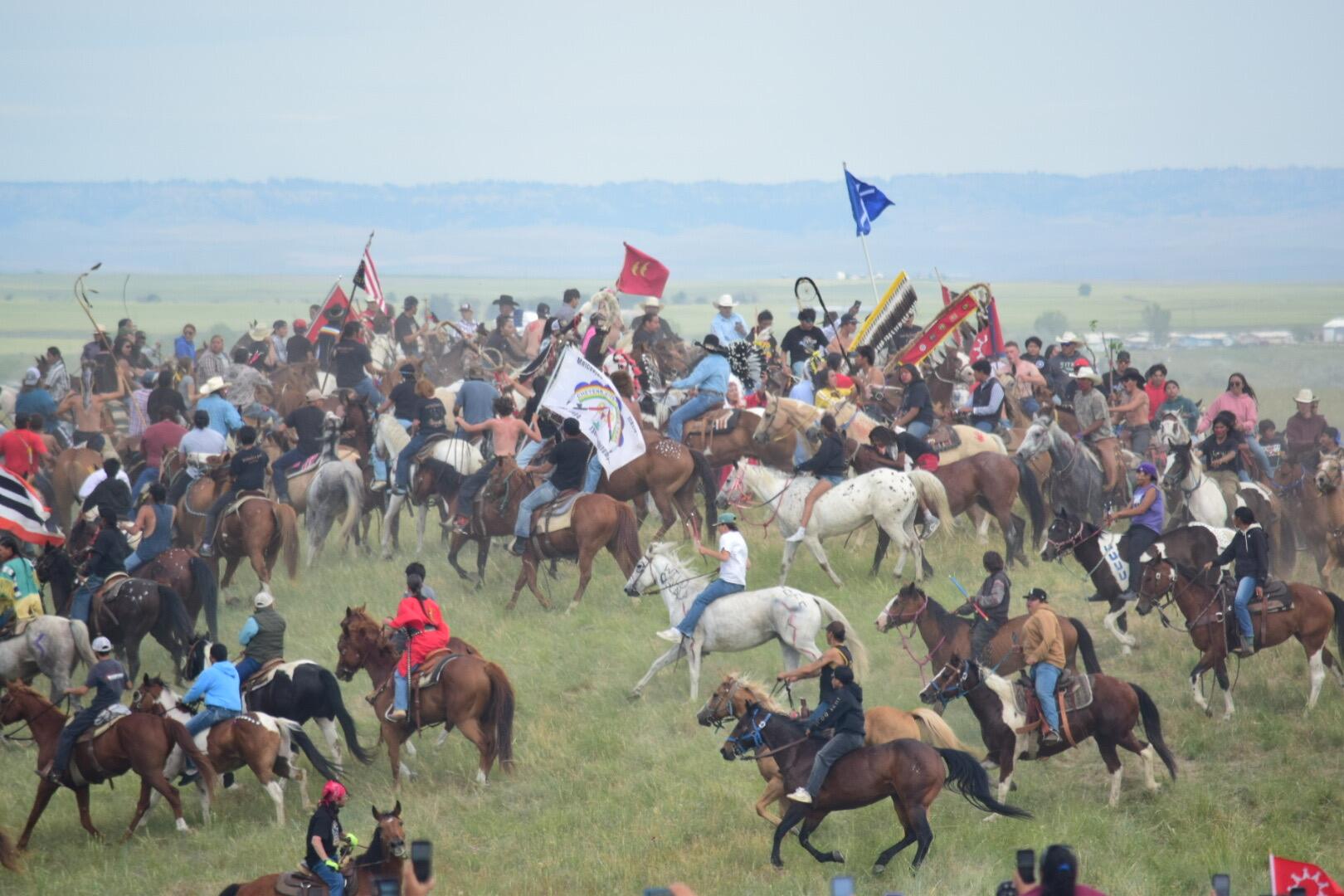
CROW AGENCY, Mont. — Under the expansive Montana sky, hundreds of members and descendants of 19 tribal nations gather at one of America’s most famous battlefields. They’re here to watch as Native American riders on horseback charge onto the same land their ancestors did 150 years ago when they defeated the U.S. Army’s 7th Cavalry under the command of Lt. Col. George Armstrong Custer.
The riders race across the dry landscape — kicking up clouds of dust before circling at the top of a hill at Little Bighorn Battlefield National Monument. Some of them are wearing headdresses and regalia, others are wearing tank tops and T-shirts. Many of them are carrying their tribal flags in a show of unity — the same unity that made possible their swift victory on June 25, 1876.
“It was so important then, 150 years ago. … It’s important today still,” said Gaby Strong, who is Sisseton-Wahpeton and Mdewakanton. “Our victories are still possible.”
Custer’s goal was to force Native Americans onto reservations. After the 1874 discovery of gold in the Black Hills, Indigenous peoples living off reservations were directed to report to their U.S. field offices, called Indian Agencies, or be deemed hostile.
Native American leaders, including Crazy Horse and Sitting Bull, organized villages and tribes together in a resistance effort.
Several battles broke out in what is now Montana and South Dakota as military forces attempted to push remaining groups onto reservations.
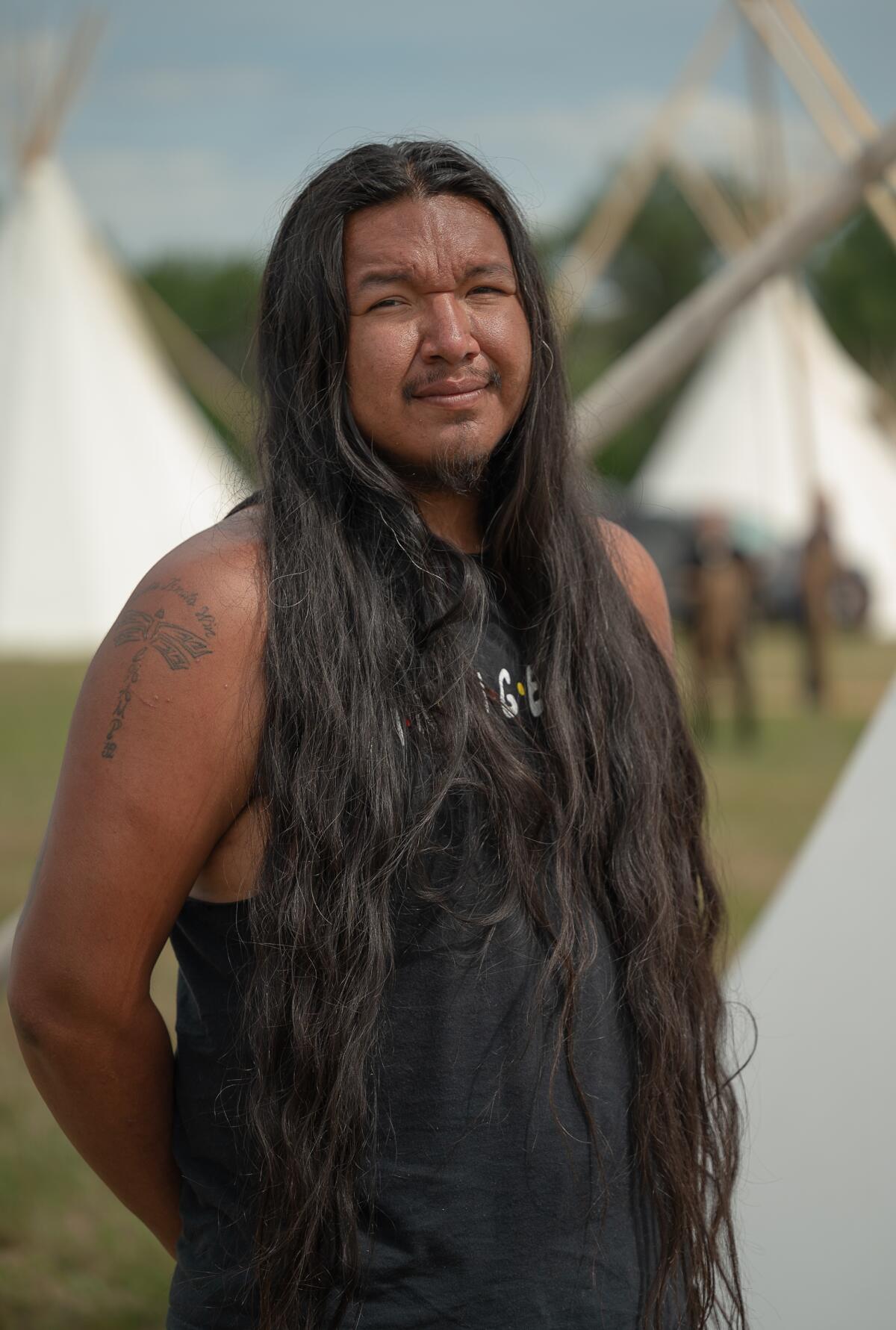
“Crazy Horse, he went from band to band, leader to leader, to tell them about this idea of our relatives coming together for a much greater cause than themselves,” said Christopher Eagle Bear. He is Sicunga Lakota from the Rosebud Sioux Tribe.
In 1876, Custer was tracking a nomadic village of various peoples, including the Oceti Sakowin (Sioux), Cheyenne and Arapaho. Custer was tracking that camp with the help of about three dozen Arikara and Crow scouts. Scouting for the U.S. government was a common practice among many tribes.
Custer divided his forces of around 700 men into three columns, hoping to surround the village.
By June 25, the village had swelled to an estimated 8,000 people. Custer decided to attack early out of fear the allied tribes would disband and escape — a decision which proved to be a fatal mistake.
“It was early morning, they were camped. Then all of a sudden they’d seen Custer’s platoon coming over the ridge,” Eagle Bear said, recounting the battle known to the Lakota as the Battle of Greasy Grass.
Christopher Eagle Bear, 27, is the youngest tribal council member for the Rosebud Sioux Tribe. He said the commemoration was about reclaiming and celebrating their identity. (Jessica Plance for NPR)
“They say the battle lasted as long as it took you to make a cup of coffee and drink it,” he said.
Custer was outnumbered. By the battle’s end, 268 of Custer’s forces were killed, mostly U.S. soldiers. Custer was among those killed. On the other side, fewer than 100 Native Americans were killed, including women and children.
Custer’s crushing defeat sparked fear and outrage nationwide. The U.S. government responded by changing its approach to Indian policy, shifting to forced assimilation. Just three years after the battle, the first off-reservation federal Indian Boarding School opened in Carlisle, Pa. Hundreds more followed, beginning a century of abuse that attempted to erase Native ways of life.
“They realized that they couldn’t destroy us head on. … So after that, they did the next best thing that you could do to tear apart a nation, and that was take away the children,” said Eagle Bear.
Youth leaders hope to inspire the next generation
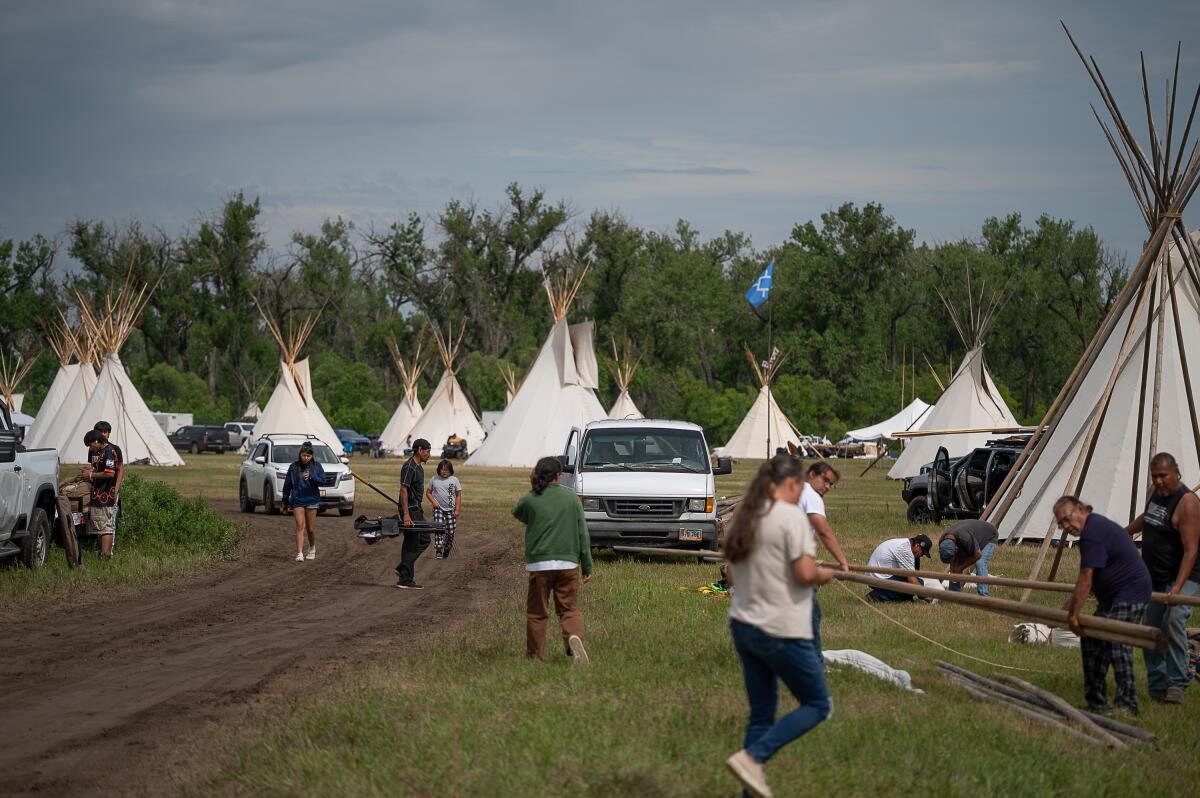
People are taking down tipis at an encampment along the Little Bighorn River during the 150th anniversary commemoration of the Battle of the Little Bighorn near Little Bighorn Battlefield National Monument. The encampment brought together tribal members from across the Plains for ceremonies, storytelling and remembrance. (Jessica Plance for NPR)
Eagle Bear is camping at the site of that historic village. To commemorate their victory, people from various tribal nations have set up their tipis here, and there is a council lodge in the middle of the camp.
Eagle Bear is here as one of the coordinators for the Rosebud Sioux Tribe’s camp, and he said he wants to set an example for the next generation.
“Someday from now, you know, the kids that are here today, they’re going to come together during the 200th anniversary and they’re going to talk about what they witnessed as kids,” he said. “My prayers are being answered every single day with the fact that these kids are here.”
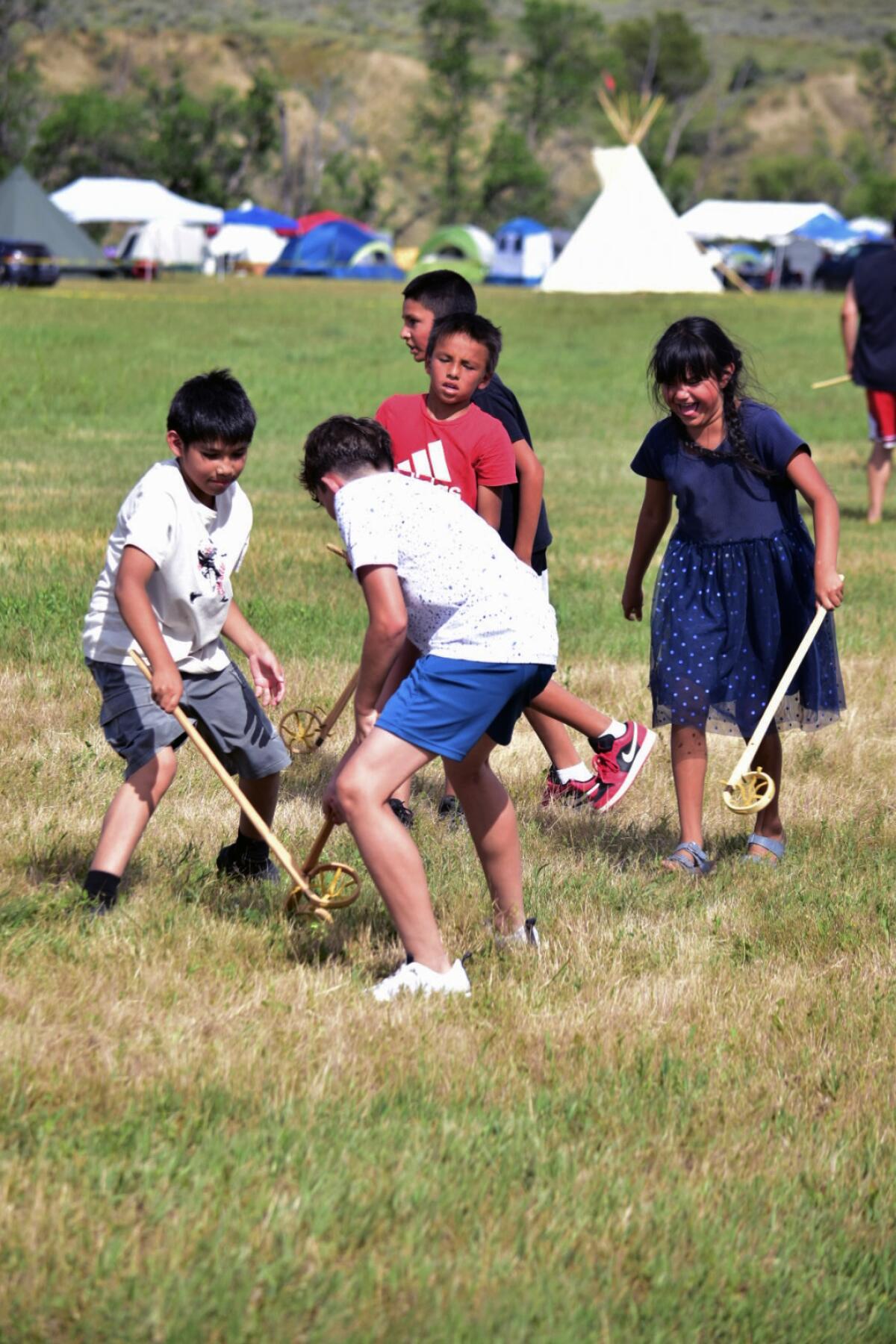
Just feet away, a group of children are playing lacrosse with traditional sticks to the sound of drumming. And cooking for the camp are members of the Sicunga Youth Council.
“We’ve been planning this for roughly eight months now. So it’s very heartwarming to see everyone that actually showed up and that’s here,” said Ashlen Bonshirt, a member of the youth council.
“We did plan the lacrosse, and there’s yoga, and there are all these different amazing things for our youth,” she said. “But on the other side of it is the garbage, the showers — everything that is here, we had to plan for it.”
The camp is full of young people. School groups, youth councils and kids with their families are staying in tipis all around. Many of them are learning things about the battle that weren’t covered in school.
“I feel like a lot of it is whitewashed,” said 13-year-old Gianna Larocque-Mahto. She’s Dakota, of the Sisseton-Wahpeton Oyate, and she’s here with her grandmother.
“We didn’t get to learn about the Native people’s side, like the Dakota people’s side. We only got to learn from one perspective,” she said. “And I feel like that’s not fair. … I think it’s important that we learn from all different people’s perspectives and not just one person.”
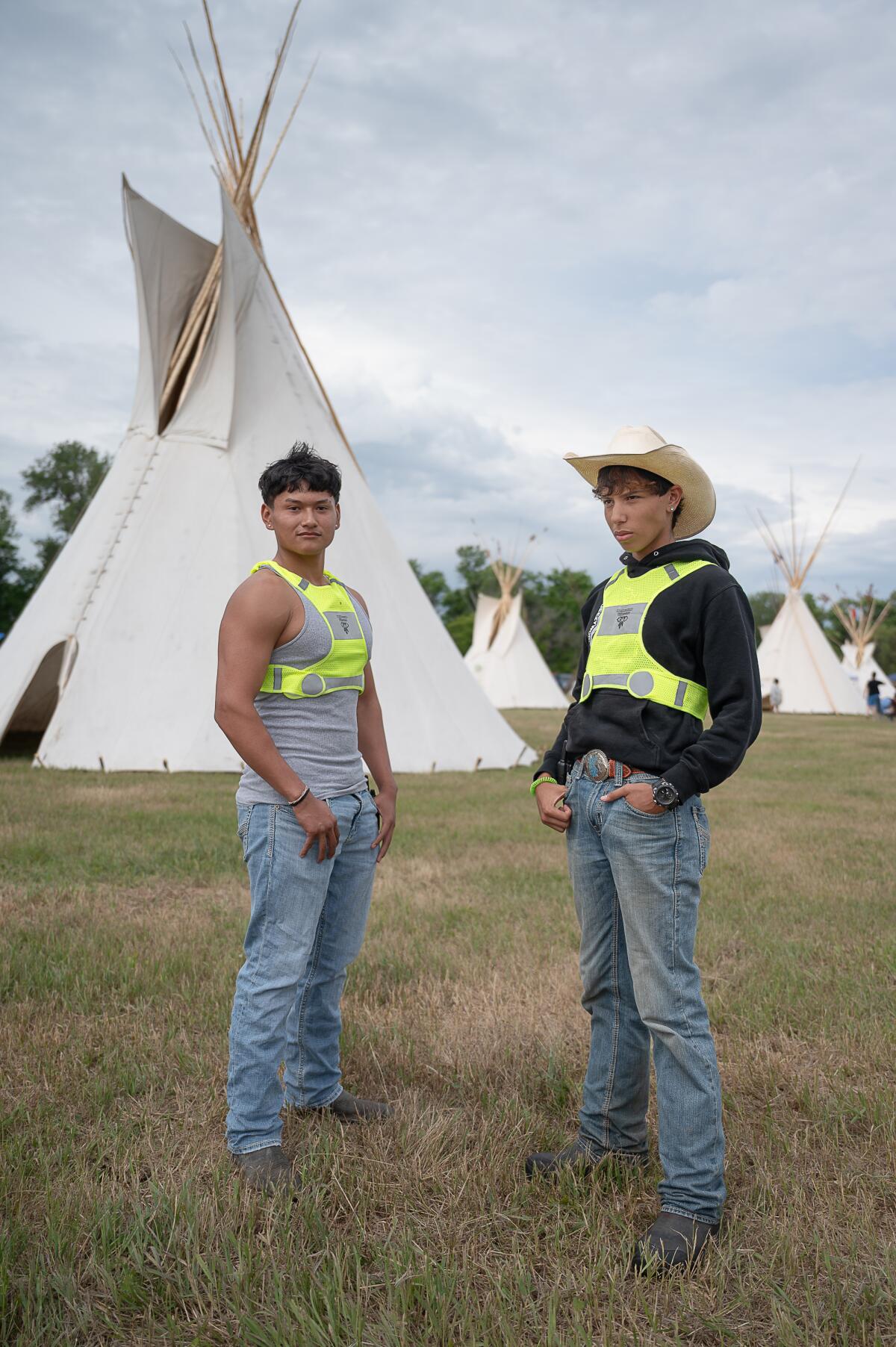
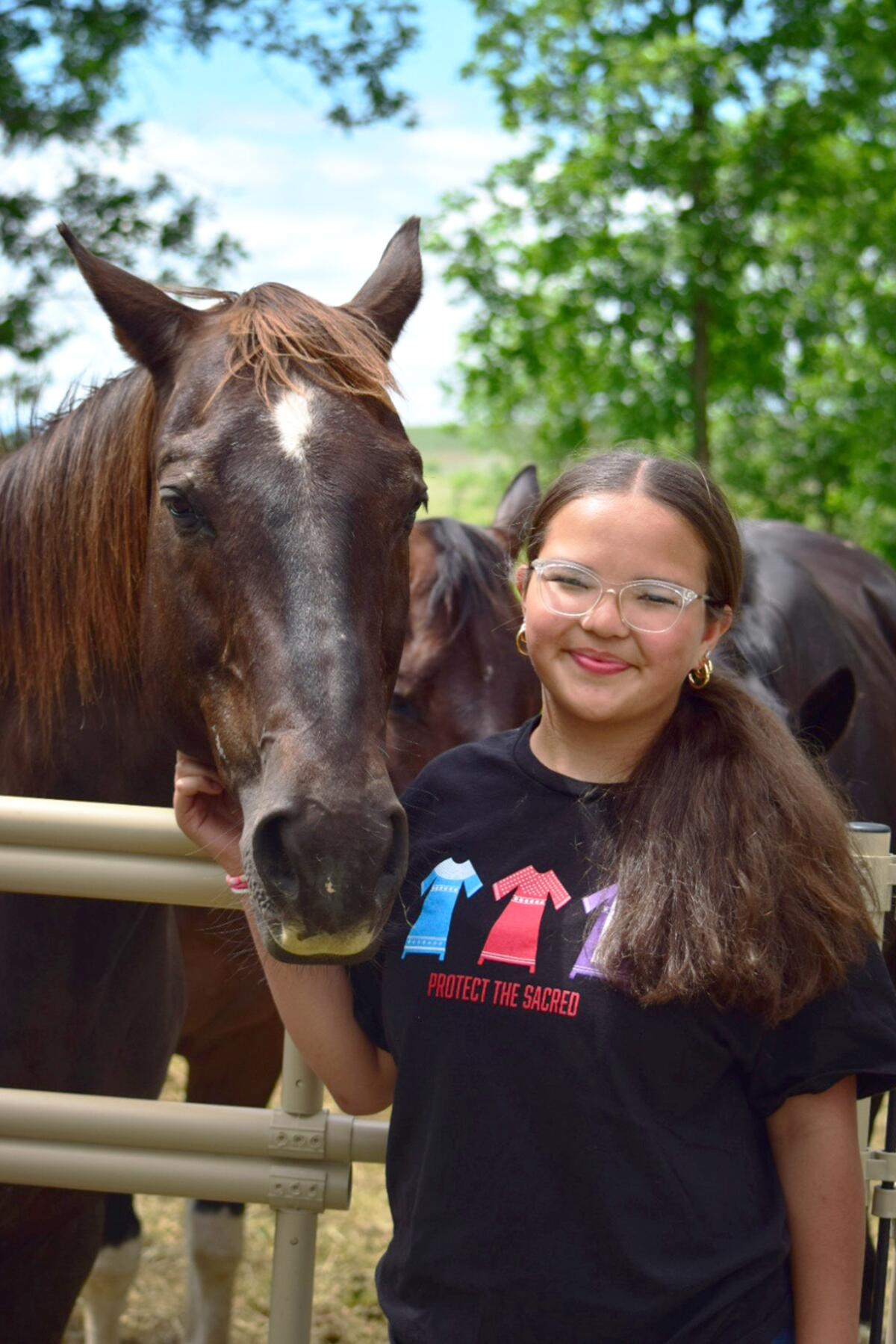
Champion Marquez and his friend Elijah Wallowing pose in front of a tipi in the encampment. (Jessica Plance for NPR)Gianna Larocque-Mahto rode her horse to the camp from nearby Busby, Mont., joining a group of other riders. They started their “Victory Ride” in Ashland, Mont., roughly 60 miles away. (Kadin Mills | NPR)
Eighteen-year-old Champion Marquez is Cheyenne. He’s also staying at the camp, and he’s been volunteering here this week — working security, helping elders and setting up tipis.
Marquez said the commemoration gives him hope for the future. “Hope that a bunch of new generations are going to learn about what happened at the Battle of Little Bighorn. Seeing all these kids having fun, playing with each other, all these events for them happening.”
“Seeing all this here just [reassures] that … we’re still here.”
A group of children from different tribal nations play lacrosse together using traditional equipment. (Kadin Mills | NPR)
Transcript:
SCOTT SIMON, HOST:
One hundred and fifty years ago this week, Lieutenant Colonel George Armstrong Custer launched an attack on an encampment of Native tribes in what is now Montana. Often called Custer’s Last Stand, the Battle of Little Bighorn was a decisive victory for Plains tribes. It was also a significant moment in the nation’s history as the U.S. government moved to force Indigenous peoples onto reservations. NPR’s Kadin Mills takes us to the site of that historic battle.
KADIN MILLS, BYLINE: Much like their ancestors did 150 years ago, members and descendants of over a dozen tribes charged on horseback onto the historic battlefield.
(SOUNDBITE OF HORSES WHINNYING)
MILLS: They race across the dry landscape, kicking up clouds of dust before circling at the top of a hill at Little Bighorn Battlefield National Monument.
(SOUNDBITE OF ARCHIVED RECORDING)
UNIDENTIFIED RIDERS: (Ululating).
MILLS: It looks like a scene from 1876, except in addition to headdresses and war paint, many of the riders are also wearing tank tops and T-shirts. And they pose for pictures in front of the crowds that have gathered here.
UNIDENTIFIED RIDER: (Whooping).
MILLS: The riders are also carrying the flags of their numerous tribal nations in a show of unity – the same unity that led to Custer’s demise in what many Native people call the Battle of Greasy Grass.
CHAMPION MARQUEZ: And we were ready to charge until Custer then came and tried to sneak attack us.
MILLS: That’s 18-year-old Champion Marquez.
MARQUEZ: We, like, fought back and basically beat them. Kind of like the “Avatar” movie.
MILLS: He’s Cheyenne, and he’s been volunteering here this week, working security, helping elders and setting up tepees. Plus learning a lot more about this battle than he has in school.
MARQUEZ: I learned that we just fought them. I didn’t know that we actually, like, gathered up as a tribe, like, of 2,000 people and then we fought.
MILLS: When Custer and his troops were tasked with dealing with, quote, “hostile Indians,” they thought disbanding the camp would be easy.
CHRISTOPHER EAGLE BEAR: It was the biggest victory that our people had against the United States government.
MILLS: That’s Christopher Eagle Bear. He’s Sicangu Lakota of the Rosebud Sioux Tribe. He said the allied tribes hoped this would be the final blow to the U.S. military and that the government would leave them alone.
EAGLE BEAR: They realized that they couldn’t destroy us head-on. So after that, they did the next best thing that you could do to tear apart a nation. And that was take away their children.
MILLS: Just three years later, the first federal Indian boarding school opened in Pennsylvania. Hundreds more followed, beginning a century of abuse that attempted to erase Native ways of life.
EAGLE BEAR: A couple of my grandfathers, my grandmothers, my uncles and aunties – they were all products of boarding schools. And over the course of that, we lost one thing. And that was our identity. That was our spirit.
MILLS: Eagle Bear is here today with his grandfather, reclaiming that identity. Together, they’re the main event organizers for their tribe’s camp, where they’re surrounded by the sounds of drumming and kids playing traditional games like lacrosse.
UNIDENTIFIED CHILDREN: Four. Five.
ASHLEN BONSHIRT: We’ve been planning this for roughly eight months now. So it’s very heartwarming to see everyone that actually showed up and that’s here.
MILLS: That’s Ashlen Boneshirt. She and her friend Mylah Gabriel are both 18 and members of the Sicangu Youth Council.
MYLAH GABRIEL: You know, this is us telling people we’re still here, you know, and we’re proud. And we’re not just, you know, hiding.
MILLS: They’re here with Dominique Harris (ph). She’s the youth council’s project coordinator.
DOMINIQUE HARRIS: The fact that they’re so young and they’re here now – it just gives them the perfect opportunity and space to learn about the history of this battle, why it’s important to our people and the effect that it has on us to this day.
MILLS: As we walk through the encampment, we weave between tall canvas tepees that stretch to greet Montana’s big sky. That’s when we meet Gaby Strong. She’s Sisseton-Wahpeton and Mdewakanton.
GABY STRONG: This camp is full of youth and young people. I think one of the important messages here is this is a commemoration of a victory from 150 years ago, but our victories are still possible today.
MILLS: As important as it is for the young people to be here, Christopher Eagle Bear says he’s grateful that his grandfather can be here, too, surrounded by a new generation learning and celebrating their cultures.
EAGLE BEAR: I wanted my grandpa to see this before he made his journey so that whenever he goes to the spirit world, he’ll be able to tell all those leaders, like Crazy Horse and Sitting Bull, that we’re still here. And you guys did a great job.
MILLS: Eagle Bear says he feels a duty to set that same example for future generations.
More than 20 years ago, the state of Oklahoma sued 14 major poultry companies, arguing that waste from their birds was harming a scenic watershed. That legal story still drags on today. Its resolution could set a precedent for agricultural pollution cases in other states. Anna Pope reports from member station KOSU.
ANNA POPE, BYLINE: The Illinois River is a weird little backwards waterway, running east-to-west from Arkansas into northeast Oklahoma. The area around it is known for its beauty and its poultry houses. Gerald Hilsher moved here for college in the 1970s and fell in love with the river and the lake it feeds.
GERALD HILSHER: It was a place where scuba divers loved to go because they could see 15, 20, 30 feet underwater because the lake was so clear.
POPE: But that’s not the case anymore. He’s dedicated his career to serving on Oklahoma’s Scenic Rivers Commission and other environmental task forces. The area is also primed for chicken producers, like Steve Butler, who runs Green Country Farms.
STEVE BUTLER: I was born on a chicken farm. My granddad had a chicken farm before that. So then I was raised in chickens.
POPE: They both love the area, but the lawsuit between poultry companies and the state of Oklahoma has put their goals at odds. Millions of chickens and turkeys live in the watershed, defecating all the while. Poultry litter makes good fertilizer but contains a lot of phosphorus that runs off the land and into the waterway. There, it causes excessive algal growth that clouds the river and chokes out other water life. Butler acknowledges past pollution problems, but he’s been working with conservation groups to fix them, like voluntarily shipping his litter out of the watershed.
BUTLER: We all got along and worked together to try to improve the Illinois River. That was the goal.
POPE: It’s been the goal for decades, ever since Oklahoma Attorney General Drew Edmondson sued the poultry companies in 2005.
DREW EDMONDSON: I was asking no money. Just stop what you’re doing and figure out some way to get rid of the waste, like every other industry in the United States of America.
POPE: It took five years for a federal bench trial to start against the 14 poultry companies. The largest – Tyson Foods. That was 2010, but the judge did not rule until 13 years later in 2023, saying poultry companies are responsible for the pollution and need to come up with a plan to clean it up. But after years of negotiation, the parties could not agree on a plan. So the judge drew up his own cleanup order to the poultry companies last December. But then, some of the companies finally negotiated settlements with Oklahoma officials. They mapped out a less expensive cleanup plan. Edmondson, who is no longer a plaintiff in the case, didn’t like the settlements.
EDMONDSON: Had they agreed to that 20 years ago, I’d have been tickled pink. Right now, I wish it was more.
POPE: That’s because he says 20 years of legal fees and continued pollution have piled up. The judge agreed. He rejected the settlements in March. That means environmental advocates like Hilsher and producers like Butler are still in limbo. Tyson Foods said it would not renew grower contracts in the watershed unless the settlements went through.
BUTLER: I’m sitting here wondering if I will get to stay in business. And so it’s frustrating that way.
POPE: Tyson and other defendants who settled did not respond to requests for comment. Neither did federal Judge Gregory Frizzell, who’s handling the case. Legal experts say this case could serve as a template for other states who want to sue over phosphorus pollution. For Hilsher, who wants to restore the watershed, the wait is worth it.
HILSHER: Well, this has taken a lot of time and effort, and I just had to trust Judge Frizzell that he has moved it along as quickly as he could.
POPE: Multiple appeals are pending from both the poultry companies and the state of Oklahoma. Meanwhile, the people who love the river and those who rely on poultry production are left waiting for a resolution.
For NPR News, I’m Anna Pope in Watts, Oklahoma.
SIMON: And that story was field produced by Graycen Wheeler.
Mary Beard was about 5 years old when her mother took her to the British Museum and they saw a 4,000-year-old piece of bread in a display case. The curator noticed that young Mary had to jump up to see it, so he opened the case, took out the bread, and held it out for her to see. And that set off a career studying ancient Greek and Rome for Mary Beard, professor at Cambridge and the Royal Academy, classics editor of The Times Literary Supplement and author of many admired books on the ancient world. Her new book “Talking Classics: The Shock Of The Old” is bold enough to ask, why do we continue to have this fascination with the ancient world – Greeks, Romans, Caesars, Sophocles and worlds more? Mary Beard joins us now from Cambridge in the U.K. Thanks so very much for being with us.
MARY BEARD: It’s great to be with you.
SIMON: What do you think got stirred up in you that day that you saw this bread excavated from the ancient kingdom of Thebes?
BEARD: Partly, it was that sheer amazement, that wonderment, that I could be allowed to get so close to something that was both so impossibly old and also amazingly ordinary. We’d been on the same trip to see the Egyptian mummies, which kind of every curious 5-year-old, I think, wants to see. But this ordinary piece of bread just hit the spot for me even more than the mummies.
SIMON: And yet, you say in this book, you don’t love the Greeks and Romans any more than virologists love viruses.
BEARD: No. I don’t love them. You know, I think, in all kinds of ways, they are vicious, brutal people I don’t want to replicate. But they are unfailingly interesting. What they write is really interesting, even when I don’t agree with it.
SIMON: I’ve got to say, one of my favorite sections is when you talk about a graffiti next to a lavatory…
BEARD: (Laughter).
SIMON: …In the ruins of Herculaneum, destroyed by a volcano. Maybe I should ask you, the distinguished scholar, to repeat what it says.
BEARD: Well, it’s in very simple Latin. This is some graffiti which must have been written just a few days before the eruption destroyed the town of Herculaneum, which was kind of Pompeii’s twin sister town. And then it says what did he do? Hic cacavit bene. Now, I have to say I’m sorry. There is no other way of translating hic cacavit bene than had a good crap here. He’s boasting, really, boasting about his bowel movements. Now, at that point, you think, I feel quite close to that world.
SIMON: There’s also a baby’s cradle nearby, isn’t there?
BEARD: A wooden cradle. And in this cradle, there was the skeleton of a little baby, and the little baby was sleeping, resting. And a pretty cynical, hard-hearted person touching that cradle and knowing that it didn’t survive. That’s tear-jerking for me.
SIMON: You write, at one point, the Greeks and Romans have never stopped staring us in the face. How so?
BEARD: I’m sure that there is not a day since 19 BCE, when the poet Virgil died, when someone has not been reading his great epic poem, “The Aeneid,” telling the story of the foundation of Rome. So I think, you know, you can’t really go out in the world and avoid the Greeks and Romans. I mean, look, we’re all expecting Christopher Nolan’s movie soon. It’s adapting a book that was composed almost 3,000 years ago. You can’t ignore them. You know, they are there. You read James Joyce’s “Ulysses” – he couldn’t have done that without “The Odyssey.” You look at the Coen Brothers’ “O Brother, Where Art Thou?” Right? You can’t do that without “The Odyssey.” We might not like the ancient world. I don’t think I like it very much, but we can’t just ignore it, or we have an impoverished view of our own culture if we try to ignore it.
SIMON: How do you make the argument which you hear nowadays that the classical world is nothing like the world right now, they were the embodiment of imperialism, privilege and exclusion, and they’re nothing to learn from?
BEARD: They are that, but I think there are some aspects about the modern world which replicate that. I’ve never wanted to say that the classical world offers us ready-made lessons to solve our own problems. But whatever I morally think about some of the things that the ancient world, in general, stood for, I do know that the ancient writers faced the same kind of problems that we face.
SIMON: Given your status as a classicist, are you often asked to weigh in on current leadership all over the world?
BEARD: (Laughter) I am. The commonest question I get from journalists is, which Roman emperor is Donald Trump most like? And I don’t think there’s much point, actually, in comparing any modern political figure to any single Roman emperor. You know, Donald Trump is not like Nero. Sorry, everybody. He’s not. You can see in the way that power operates in the modern world, the way populist power operates, the way autocrats or would-be autocrats operate, you can see some of the structures of that back in antiquity.
And I – you know, one thing would be leaders’ heads on the coins goes back to Julius Caesar. Autocratic leaders want to see their heads on the currency. In Britain, we’re very used to our monarchs being on the currency. But Julius Caesar was the first person to do this, and he didn’t come to a happy end.
SIMON: Mary Beard, her new book “Talking Classics.” Thank you so much for being with us.
BEARD: Scott, thank you. It’s been a great pleasure.