Four months after Iran’s supreme leader was killed in U.S.-Israeli airstrikes, the country is now holding his funeral.
(SOUNDBITE OF ARCHIVED RECORDING)
UNIDENTIFIED CROWD: (Chanting in non-English language).
SIMON: That’s Tehran and a huge crowd gathered for one of the series of ceremonies planned for the funeral of the Ayatollah Ali Khamenei. The mourning will take place for days across five cities. NPR’s Hadeel Al-Shalchi joins us now from Istanbul. Hadeel, thanks so much for being with us.
HADEEL AL-SHALCHI, BYLINE: Good morning, Scott.
SIMON: What’s the day look like in Iran?
AL-SHALCHI: Well, Iranian state media showed a massive crowd of people at the Imam Khomeini Grand Mosalla, which is a large prayer complex in Tehran. People were visiting Ayatollah Ali Khamenei’s casket, which was draped with the Iranian flag. The caskets of four of his killed family members were also there. We saw men and women wearing black. They wept openly. Women slapped their heads with their hands in mourning. Men beat their chests in unison, which is a tradition in Shia funerals. There were also chants of Death To America and big red signs that read Kill Trump. Some people waved flags, red ones that symbolize revenge and many yellow ones that represented the Iranian-backed Lebanese militia Hezbollah, which has been fighting with Israel since the beginning of the war.
Now, a spokesperson for the funeral preparation said the ceremonies were delayed this long because of, quote, “the war conditions” and what he called the brutal U.S. invasion. But really, Scott, right now, this week, the funeral is a way for the Iranian regime to try to show stability and power to Iranians and the rest of the world, sort of sending a message that the Islamic revolutionary power that leads the country is still enjoying popularity.
SIMON: How about the attendance by world leaders and Iranian officials?
AL-SHALCHI: Well, yesterday, a number of official foreign delegations and religious leaders attended a ceremony as Khamenei lay in state. Russia, which has supported Iran during the war, sent former president Dmitry Medvedev, and a Pakistani prime minister was there. The president of Iraq was in attendance, as well as the Afghan foreign minister. And even Saudi Arabia, which has been at odds with Iran for decades and where Iran attacked a U.S. military base in March, sent a delegation. There was also a group of officials from Hamas there.
Now, on – from the Iranian side, Iran’s president, foreign minister and the speaker of parliament, who’s been the head of the ceasefire negotiating team with the U.S., we’re all seen praying near the caskets. But so far, there’s been no sign of Iran’s current leader, Khamenei’s son Mojtaba Khamenei, who is, in fact, yet to be seen in public at all since he took over in March.
SIMON: Hadeel, what are Iranians saying about the funeral?
AL-SHALCHI: Right. So Khamenei was a divisive figure in Iran. He was supreme leader since 1989, and he oversaw the expansion of the Iranian Revolutionary Guard Corps, which is responsible for the killing of at least 10,000 protesters in Iran, according to rights groups. We spoke to a 32-year-old woman whose brother was killed during the protests in January, and she asked NPR not to use her name, fearing the government.
UNIDENTIFIED PERSON: (Non-English language spoken).
AL-SHALCHI: She says that even in the ayatollah’s death, he still causes them torment.
We also spoke to 33-year-old Fatma (ph), who also asked NPR to only use her first name because she was afraid of the government. Said she argued with her family all the time, especially her mother, who she says sees Khamenei as part of a religion.
FATMA: (Non-English language spoken).
AL-SHALCHI: “She is definitely going to take part in the funeral,” Fatma says about her mother.
SIMON: The ayatollah will be buried Thursday. What else is planned?
AL-SHALCHI: Mourners will visit the body over the weekend in Tehran. On Monday, a funeral procession will take the body to the city of Qom. The procession will then cross into Iraq, where he’ll be taken to Shia religious sites in the holy cities of Najaf and Karbala. Finally, he’ll be transported back to Iran, where he’ll be buried in his birthplace of Mashhad on Thursday. And Iranian officials are saying they expect millions of people to attend.
At cookouts later today, you might find yourself criticizing young folks for taking to the ribs and potato salad like hyenas or piranhas. The next story brings us another creature that can be compared to ravenous children, and it’s being put to good use by museums. NPR’s Ari Daniel explains.
ARI DANIEL, BYLINE: In Mashhad in northeast Iran, there’s a natural history museum associated with the local university that gets all sorts of donations.
NILOOFAR ALAEI KAKHKI: If some people find some dead animal or some injured bird, they just bring it to the museum.
DANIEL: Niloofar Alaei Kakhki is a bioinformatician who studied and worked at this museum. With all these specimens pouring in, the research team soon ran out of space.
ALAEI KAKHKI: We don’t have enough freezer to put these dead animal. Then we have to find a way to just clean them.
DANIEL: So that these animals’ skeletons can be studied and exhibited. Researchers can use a range of techniques to strip the flesh off an organism, but each has its drawbacks. There are chemical treatments, but those tend to be bad for the environment and can degrade the skeleton. There’s boiling the specimen.
ALAEI KAKHKI: That is really time consuming.
DANIEL: Then there’s the use of dermestid beetles, which quickly gobble up an animal’s flesh, but if they escape, they can destroy museum specimens elsewhere by chewing through feathers and dried skin. Then some years ago, Alaei’s colleagues in Iran turned their attention to a different organism, the superworm – a hefty, nearly finger-sized larva of another kind of beetle with large chewing mandibles.
ALAEI KAKHKI: Why not use this dead animal to feed the superworm, and superworm can help to clean them.
DANIEL: Alaei says that as long as superworms are kept together in a group, they remain as larvae, unable to wreak havoc elsewhere in the museum.
ALAEI KAKHKI: You can reuse the same larvae for almost six months.
DANIEL: In a new study, Alaei and her colleagues offered the superworms dead animals of all sizes, from mice, fish and small birds to wolves and wild cats. They prep the specimens slightly and then let the superworms have at them. Alaei says they did a remarkable job.
ALAEI KAKHKI: It’s so surprising that – how superworm can work so fast, and at the same time, super gentle, even the ribs of the fish, which is super, super tiny.
DANIEL: All picked clean with no apparent side effects, she says. The researchers found that 10 to 15 larvae do a good job cleaning a specimen. Alaei hopes the superworm’s success in this arena could be good news for all kinds of institutions.
ALAEI KAKHKI: Even the small museum from some countries that maybe they don’t have lots of these kind of fancy facilities.
DAMIEN CHARABIDZE: The study is just adding one more possibility when you need to clean something.
DANIEL: Damien Charabidze is a forensic entomologist at the University of Lille in France who wasn’t involved in the research. He says that superworms may well be easier to control than dermestid beetles, but he worries their powerful mandibles could inadvertently snap a small bone. Plus, although they’re omnivores, they prefer a vegetarian diet. So cadavers…
CHARABIDZE: It’s not their usual food.
DANIEL: Which could make them more finicky feeders.
CHARABIDZE: So that may be something to check.
DANIEL: The research appears in the journal PLOS One. As the paper was nearing publication, three of the four authors, all based in Iran, could no longer receive email due to the internet blackout that Iranian officials had imposed on the country during the war. That’s why I interviewed Alaei, who’s now based in Germany. PLOS One agreed to make her the primary contact for the paper.
ALAEI KAKHKI: PLOS One just help us a lot.
DANIEL: The study was made available to the world this week.
Fireworks and parades, hot dogs and speeches, celebrations are taking place across the U.S. as the country marks its 250th anniversary. But this year, the Fourth of July is complicated by a ferocious heat wave that’s hit much of the country and comes amid deep political and cultural divides. NPR’s Brian Mann joins us. Brian, thanks for being with us.
BRIAN MANN, BYLINE: Happy Independence Day, Scott.
SIMON: And also to you. Let’s begin with President Trump, who spoke at Mount Rushmore last night. What did he say?
MANN: Well, the speech began pretty traditionally for a Fourth of July weekend address. Trump spoke about what he sees as the exceptional nature of the United States. But then he turned to darker themes, arguing that the American way of life is under attack from immigrants and people on the left.
(SOUNDBITE OF ARCHIVED RECORDING)
PRESIDENT DONALD TRUMP: There is now a resurgence of the communist menace in our land, including from newcomers to our country who embrace ideas totally opposed to our way of life and our great success.
MANN: That was a big part of Trump’s speech. He likened what he portrayed as this internal menace to Pearl Harbor and 9/11.
SIMON: The president’s framing of this Fourth of July has been controversial and questioned, right?
MANN: That – that’s right. Trump started this by bypassing a bipartisan commission that had been created to celebrate the 250th anniversary. Democrats, last week, issued a report accusing Trump of hijacking – that was their word – this Independence Day, turning into – what they said should be a moment of unity into a partisan event that enriched Trump’s allies. NPR did reach out to Freedom 250. That’s the group Trump created to organize events for this Fourth of July. A spokesperson, Danielle Alvarez, called the Democrats’ accusations categorically false and a partisan smear.
SIMON: Brian, you’ve been talking to people on the streets of New York City about how they see the holiday. What do they tell you?
MANN: Well, you know, despite all these tensions, people are finding ways to celebrate. I spoke with two friends, Lois Hyman (ph) and Linda Sidlaskas (ph), who went to a historic tavern here in Lower Manhattan.
LOIS HYMAN: We decided to have lunch at Fraunces Tavern because it was where, you know, the rebels used to gather in the early days of the Revolution. And it’s a real revolutionary place, so we wanted to do something revolutionary.
MANN: And Sidlaskas told me, Scott, that on this holiday weekend, they’re celebrating, but they are also worried about the state of the country.
LINDA SIDLASKAS: These are the times that try men’s souls. So I think that our democracy is being stretched to the limit.
MANN: She was, of course, partially quoting Thomas Paine there from his 1776 essay, The American Crisis. I do think it’s also important to remember, for a lot of folks, the Fourth of July is still just about having fun. As I was out talking to people yesterday, I think my favorite interview was with Logan Longsworth (ph). He’s 8 years old, from New Jersey, out on holiday with his parents.
LOGAN LONGSWORTH: How I’m going to be celebrating the Fourth of July is I’m going to light some firecrackers and stuff like that. And we also saw the Statue of Liberty.
UNIDENTIFIED PERSON: That’s pretty cool.
MANN: Can you say a thing that you like about the United States?
LOGAN: The bald eagle.
MANN: I love that. I think we can all agree, Scott, bald eagles are pretty cool.
SIMON: Absolutely, the coolest.
MANN: (Laughter).
SIMON: One other kind of crisis this Fourth of July, of course, is the heat. A lot of states are celebrating, but they’re trying to keep people safe at the same time. How’s that working out?
MANN: You know, it’s a real mess. Things got so hot yesterday, President Trump’s Great American State Fair had to close to the public through the afternoon. In Washington, D.C., an Independence Day parade there has been canceled, Philadelphia also canceling parades. Fire risks across the country canceling some fireworks. But there are still some fun things happening. Boston Pops in Boston, a big fireworks show in Seattle. But take water along. Stay in the shade. People say limit your time outdoors to be safe.
SIMON: NPR’s Brian Mann in New York City. Brian, thanks so much. Happy holiday.
A year ago today, catastrophic flooding struck two neighboring parts of the Texas Hill Country. Along the Upper Guadalupe River, at least 130 people died, and a major recovery effort followed. Nine people died along nearby Sandy Creek, and now survivors say the response has been far more limited. Texas Public Radio’s David Martin Davies reports.
DAVID MARTIN DAVIES, BYLINE: Juliet and Scott Weldon are watching construction begin to rebuild their home.
JULIET WELDON: That’s where we are. That’s my house, and that’s where it happened.
DAVIES: Their new house is on the site of where their old home stood on the banks of the Guadalupe River. But this time, it’ll be raised 8 feet. It should stand up to floodwaters like what came last July Fourth.
WELDON: We watched the water enter our home, and the floors buckled, the furniture floated, rooms began collapsing and the water kept rising.
DAVIES: The current pushed the two out of the house. They managed to cling to a large bush while they watched their neighborhood ripped apart. And now the Weldons are rebuilding with a lot of help.
WELDON: It doesn’t come easy. The local community, there’s a lot of love, compassion, kindness, generosity. But the first responders, really, for our needs at that moment, are the churches, private sectors, not the government. No one.
DAVIES: Juliet figured out how to navigate the bureaucracies of disaster recovery, and they received the maximum amount from FEMA, $46,600. But other checks arrived from faith-based groups, foundations and community organizations.
WELDON: It strengthened my faith to humanity and the love of people.
(SOUNDBITE OF POWER TOOLS RUNNING)
DAVIES: It was a similar but very different story of a flood disaster nearby in Sandy Creek.
ASHLEE WILLIS: The morning of July 5, you would be probably 15, 20 feet underwater right now where we’re standing. That telephone pole, all the way in the back, the water was 10 foot up that pole. It’s hard to fathom.
DAVIES: Ashlee Willis lives with her family on a fresh herb farm that is divided by Sandy Creek southwest of Austin. The spring-fed creek is normally docile, but just after midnight on July 5, the same storm that flooded the Guadalupe River hit and turned the creek into a raging river.
WILLIS: My house was behind this tree, and it floated 10 feet.
DAVIES: Nine people died in the Sandy Creek flood. About 200 homes were damaged. Family and friends who had gathered for a festive Fourth of July instead huddled on high ground in the dark and watched by the illumination of lightning, rising water and wondered if they would survive.
WILLIS: And as horrifying as all of that sounds, easiest part of this whole ordeal was that night.
DAVIES: Ashlee’s mother, Brandy Gerstner, says they’ve been struggling to recover ever since.
BRANDY GERSTNER: We got deserted.
DAVIES: Four weeks after the flood, Willis testified to the Texas Select Committee on Disaster Preparedness and Flooding.
(SOUNDBITE OF ARCHIVED RECORDING)
WILLIS: They are marking people found when they find their body parts, and then they are not coming back to find the rest of these people. I found a hip and a leg on my property.
DAVIES: Willis says she’s not received money from FEMA. They had FEMA flood insurance, but they’re in a dispute over the payout. NPR reached out to FEMA to get details about what they provided to the flood victims and the overall rebuilding effort, but we didn’t get a response. So the rebuilding is on hold. Support has come mostly from volunteers. She said she is glad the Guadalupe flood victims are getting help, but those along Sandy Creek would also like to be remembered. As for Juliet and Scott Weldon, they plan to move into their new home in October.
For NPR News, I’m David Martin Davies in Kerrville.
Patrick “Kick” Kilpatrick is a former college swimmer who fears and hates the sea, but on a cruise one night, near midnight, he finds himself adrift alone and swimming for his life.
KATHLEEN ROONEY: (Reading) The victims of the Titanic, for example, saw a version of what I am seeing. Only they plunged into the frigid North Atlantic through no fault of their own, but, rather, a fatal combination of questionable captain meets exceptional iceberg. Me? I’m in the tepid Gulf of Mexico, and my ship is fine. Never better. Away she goes – no disaster, no emergency, except on the most personal level. Nobody aboard the Carnival Valor, your high-seas hero, here to rescue you from ordinary vacations and whisk you away to leisure, fun and amazing destinations, knows I’m here, and nobody knows how it happened, not even me.
SIMON: Will Kick survive? And as he reviews his life, does he truly want to? “Man Overboard!” – it’s an exclamation point at the end, by the way – is by Kathleen Rooney, the bestselling author of “Lillian Boxfish Takes A Walk.” She teaches creative writing at DePaul University in Chicago and joins us now from our studios at WBEZ. Thanks so much for being with us.
ROONEY: Thank you, Scott.
SIMON: Why doesn’t Kick know how he wound up fighting for his life in the middle of the ocean? Kind of a big thing not to be aware of.
ROONEY: Yes. He does not know because he was extremely drunk when he entered the water. And so in the very first chapter, the mystery he has to solve along with us is, what happened?
SIMON: Tell us about the extended family that has surrounded him on this Thanksgiving vacation cruise, ’cause he’s not – (laughter) he doesn’t like family vacations. He doesn’t like cruises.
ROONEY: Yeah. So his stepmom, Pam, is a huge cruise afficionado. She calls herself a Carnivore ’cause she loves Carnival cruises so much. And so the thinking was that for Thanksgiving, it would be easier for the extended family to just get together on a cruise with something to do for everyone. But Kick is mortally afraid of the ocean, even though he’s a former champion swimmer. He’s 33. He’s from Omaha, Nebraska. He’s sort of an every man. He’s a physical therapist by day and a fitness instructor by night. But he’s kind of going through a personal crisis and feels like there’s got to be more to life, and he’s trying to figure out himself and also why some people aggravate him so much.
SIMON: (Laughter) Let me ask you about the touchy relationship Kick has with Justeen, his girlfriend.
ROONEY: Kick is – as I mentioned, he’s 33. Justeen is 44. And Kick has this history of being kind of emotionally immature in relationships and moving from one to the next. But he does have real feelings for Justeen and even loves her, but he’s very self conscious about their age gap, and he’s also very leery, I think, because of past rejections of committing to her. And so when he’s on this cruise, they are on a break, but, you know, as he’s floating in the ocean, trying not to die, she keeps coming up in his mind in ways that…
SIMON: Yeah.
ROONEY: …Kind of indicate to him that she means a lot to him.
SIMON: Let me ask you to read a section which is a little tough to hear – 3 a.m., November 28, Kick Kilpatrick in the sea.
ROONEY: (Reading) Subtropics or not, I am hyperaware of being wet and cold, hyperaware of my blood and muscles, hyperaware of being solitary and wretched. The magnitude of what’s happened – or what I’ve done – keeps hitting me. A never ending, irrevocable uh-oh, like coming down from doing tree work in the yard and missing that last rung of the ladder, but times infinity. As much as I didn’t want to go on this cruise, as much as I didn’t want to go on living at all, maybe.
SIMON: Boy, that maybe lands with a thud to the heart, doesn’t it?
ROONEY: Yeah. I think he’s grappling with some real darkness and some questions he has to answer for himself.
SIMON: And, by the way, we want to tell people, if you or someone you know is dealing with thoughts of self-harm, help is available at the National Lifeline. You can call or text 988.
The novel is laugh-out-loud funny, even as it sails through choppy emotional waters. How do you balance that as a writer?
ROONEY: For me, funny and sad go together, kind of like chocolate and peanut butter. They enhance one another. And for me, the saddest books are the ones that have wit and humor, because I think through humor, you get those flashes of what makes life glorious and mysterious. And so I hope that people come for the comedy and stay for the existential reckoning.
SIMON: He has an encounter with a sea turtle that becomes his conversational partner. Sea Turtle is, I should explain, quite well-spoken, and he blames…
ROONEY: Yes.
SIMON: …Kick for oil spills and global warming. But he also says, you need to do more than just want to live. How does that make Kick begin to move his mind and memories?
ROONEY: I think the sea turtle and then he – if people like animals, they’re in for some treats because there’s lots of other sea creatures – sea horses and jellyfish – and they all kind of prod him in this direction of thinking of what he wants with his relationships with other people, his relationships with Justeen, and also kind of a realization that the world is maybe bigger than he thought. And I think the animals are a way to kind of point that out.
SIMON: I say this with respect to you. The sea creatures get all the best lines. Does that help Kick hear them in a way that he won’t listen to himself, or, for that matter, members of his family?
ROONEY: Yes. One of the things he’s sort of starting to realize is that he will be a little better adjusted if he thinks about other people more than just himself and his own pities and woes. And I include people to mean animals, and I think his encounters with these other sentient creatures are sort of a way – you know, as one of the creatures tells him, everybody out here is going through something, everybody from the smallest planktons up to the biggest whale sharks.
SIMON: As the story proceeds, it becomes clear that Kick needs to determine reasons to keep on going, doesn’t he?
ROONEY: One of the things that Kick experiences is something I think everybody experiences. When your life is happening, things are so quick and you’re working and you’re seeing people, and you don’t have time to stop and really contemplate. And so when Kick is just in the middle of the Gulf of Mexico, he’s kind of forced to think about a lot of stuff. And one of the things he realizes is that he’s facing death, and he thinks about things like, if I don’t want to die with these things unresolved, then that must mean I don’t want to live with them unresolved. And so I want it to be almost like a thriller, where you don’t know what’s going to happen, and every chapter is one hour in the water, but he’s kind of working his way toward finding life again.
SIMON: Kathleen Rooney – her new novel, “Man Overboard!” Thank you so much for being with us.
Most sandcastles at the beach begin with an overturned bucket and a few poked holes, but some can be truly spectacular. How do they get created? Dean Arscott has been a sand sculptor for 15 years – joins us now from St. Petersburg, Florida. Thanks so much for being with us.
DEAN ARSCOTT: Absolutely. A pleasure to be here.
SIMON: With respect, what does a sand sculptor actually do?
ARSCOTT: Well, we do all sorts of events. We do corporate events, theme parks, sporting events, weddings, all kinds of stuff, so inside, outside, on the beach, off the beach, wherever they will have us.
SIMON: And how did you fall into it?
ARSCOTT: I graduated from Ringling College of Art and Design. I was an illustration major and looking for design gigs online. One day, I saw sand sculptors wanted. So my now boss and partner took me out on the beach one day and showed me the basics, and I was in Fort Lauderdale the very next day on my first job.
SIMON: Wow. So how do you do it?
ARSCOTT: It’s very simple. It’s just sand and water. It’s just compacted wet sand – so just as you were mentioning, flipping, you know, a bucket of wet sand over – and carving. So, I mean, that is the basics, and, you know, any sort of level of intricacy or big and fanciness to it is just with time and practice.
SIMON: Are there particular sand sculptures you reflect on and remember?
ARSCOTT: Sure. Yeah. I mean, I won a couple of nice prizes at the Siesta Key Crystal Classic a couple years ago. It was a – kind of a silly one with – from an old sketchbook page I did. It was a Neanderthal riding a narwhal. So that was just super fun. And made the front page of the paper in Tampa Bay Times a handful years ago, participating in the Pier 60 Sugar Sand Festival. I did a large bust of Bob Marley that made the weekend edition of the papers. So, you know, it’s always fun to get that, you know, notoriety.
SIMON: Yeah. Any instruction you’d like to offer families who are going to make probably less ambitious sandcastles in the beach this summer?
ARSCOTT: You know, on the beach, that sand is generally a very washed sand because the tide is constantly washing all that nice sticky stuff out of the sand. Now, you can make something out of any sand. It’s just a matter of how vertical and extreme and intricate you can get with it. So you’ll just have to read the pile. Every sand has its own learning curve. But I always say it’s impossible to put too much water in the sand, especially on the beach ’cause that water’s always draining through. So if your sandcastle is crumbling, you probably didn’t add enough water or compact it hard enough.
SIMON: I have to ask…
ARSCOTT: Sure.
SIMON: …Is it sad when your sand sculptures are knocked down or washed away?
ARSCOTT: No. You know, we’re never intentionally putting anything where it’s going to wash away. And that’s the – unless that’s the specific request for some sort of, you know, social media video or something. But, you know, the old, tired joke is we call it job security. So, you know…
SIMON: (Laughter).
ARSCOTT: …It is kind of the nature and the magic of sand sculpture. It is ephemeral, so you’ve got to come and see it while it lasts ’cause it won’t last forever.
SIMON: Dean Arscott from Team Sandtastic. Thanks so much for being with us. A good weekend of sculpting to you, sir.
ARSCOTT: I appreciate it. Thanks for having me.
(SOUNDBITE OF SONG, “CASTLES MADE OF SAND”)
THE JIMI HENDRIX EXPERIENCE: (Singing) And so castles made of sand melts into the sea.
“Congo Square is ground zero of what I would consider the big bangof American music culture,” said musician and eight-time Grammy Award winner Jon Batiste, who — along with his many accomplishments as a marquee artist — is part of a multi-generational family of more than two dozen New Orleans musicians.
Batiste said that Congo Square gave the U.S. its foundational artistic elements: ritual, rhythm, song and dance that “exist in the very fabric of this country, interwoven into everything that we do. They are ubiquitous in a way that is like the air that we breathe.”
Congo Square is inside of Louis Armstrong Park, just within the Treme neighborhood of New Orleans. This May, the temperature is already blistering. Despite the heat, the park is dotted with tourists and tour guides chatting amidst the clangor of nearby renovation on the city’s Municipal Auditorium – which was devastated more than 20 years ago during Hurricane Katrina and has languished, empty, ever since.
Scholar Freddi Williams Evans has written two books on Congo Square. “Congo Square is on the other side of Rampart Street,” she observed, “meaning the end of the official town. So it evolved as a place for unofficial events like cockfights, ball games and political rallies. Eventually, it became known as the place where enslaved Africans were able to gather on Sunday afternoons. It’s not the only place they gathered, and not consistently, but it’s the place for which we have the best documentation. There was never a law saying that they had the right to gather, so they just really seized the opportunity.”
Evans said that in cities colonized by Protestant Europeans, including the Dutch and the British, Sundays were quiet days for pious religious behavior. But because New Orleans was originally under French rule, the vibe in the city on Sundays was different. “After the hours of mass, Sunday afternoons were for recreation and fun,” she said. “By law, Sundays were to be work-free for all inhabitants of the French colonies, and by default that included the enslaved people.”
She said that such gatherings were allowed, off and on, but not consistently — and in 1817, a city code restricted gatherings of enslaved Black people to one place: Congo Square. There, they gathered for religious rituals, and for singing, dancing and drumming (which in various African traditions, often includes these elements).
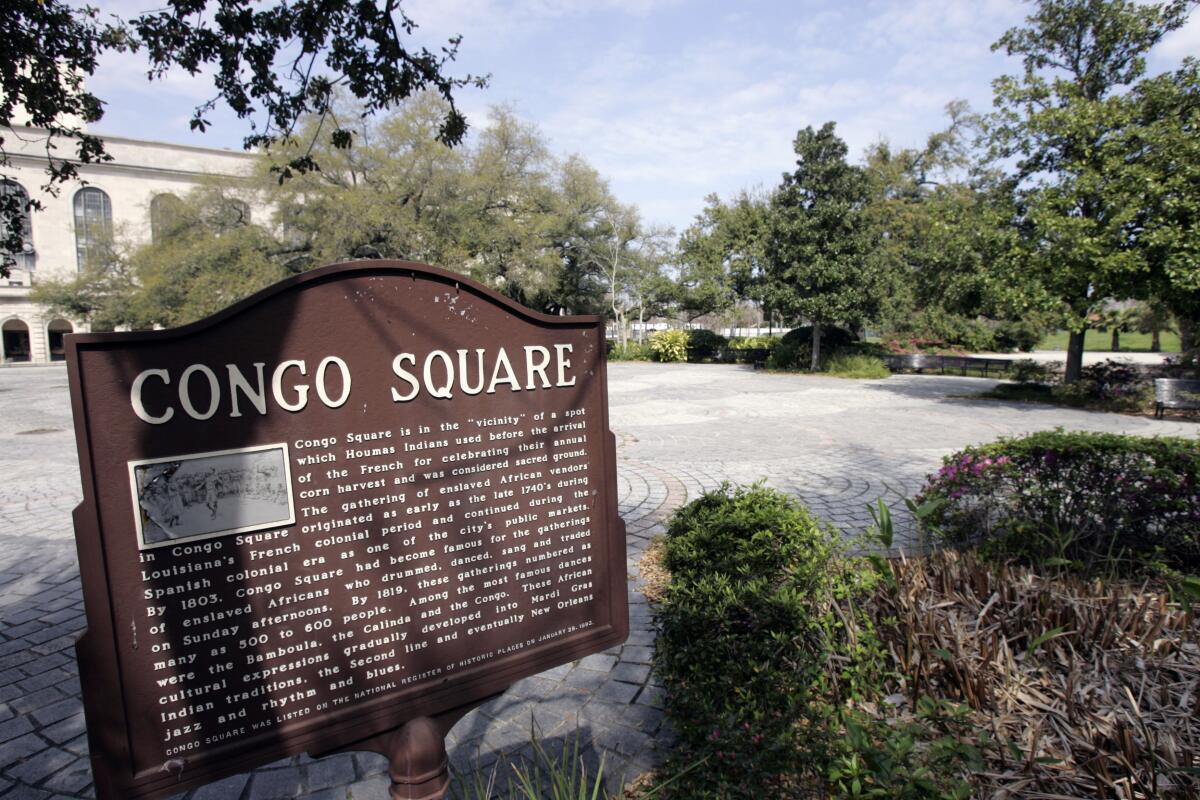
A sign at New Orleans’ Congo Square commemorating the site’s historical importance, captured shortly after the marker was posted in 2008. (Bill Haber | AP)
One of the drums they used, the bamboula, and a rhythm closely associated with it — counted as 3 + 3 + 2 — became part of a shared vocabulary between Africa, the Caribbean and the port city of New Orleans.
“In Cuba,” Evans said, “the rhythm received the name tresillo. In Haiti, it may be called something else. There are so many names for it, and that is the basis of Mardi Gras Indian music — the second line beat, the parade beat, the bamboula beat.”
It’s endured over many generations — and, like all rhythms, is not necessarily played on a drum: New Orleans native, the pianist and composer Jelly Roll Morton, is playing it with his left hand in a 1923 recording of his “New Orleans Joys” (also known as “New Orleans Blues”). You can also hear that rhythm propelling this contemporary song, “Do Watcha Wanna” by the New Orleans group Rebirth Brass Band, in which it’s played by low brass.
That bamboula rhythm, deep at the bass, is the signature sound of a New Orleans second line, passed from generation to generation. But it’s a way of life as well, Jon Batiste said.
“New Orleans is particularly unique in that we have this lineage of musicians whose families still exist and are carrying the traditions forward,” Batiste said.
Not only that: everyone within New Orleans musical families have a specific role to play in the hierarchy — just like in West African griot families, whose members are musicians, storytellers, poets, and the oral historians of their communities.
“The way it’s passed down is the same as it is in African cultural traditions, West Africa, in the Congo and Benin, with the Yoruba people, the Igbo people,” Batiste said. “It’s griot, it’s an oral tradition. It’s a way of identifying very early on, who is the drummer? Who’s the elder going to mentor to fill this position within our tribe?”
“A lot of times,” Batiste continued, “someone is identified very early in their life in the family. ‘Oh, that’s the new leader,’ or ‘That’s the one who’s going to be our arranger. That’s the one who’s going to be our orchestrator. That’s the one who’s going to continue to build the business and the infrastructure around it.’ Because villages all have this sort of hierarchy of authority, and different aspects of it need to be led by different people. And you start to understand that in musical families in New Orleans that there’s a real tribal understanding that is rooted in the way that we live and pass on the traditions. And as one of those culture bearers, I find that it’s an incredible joy and a great responsibility, and a great pressure.”
Tonya Boyd-Cannon is a New Orleans-based singer. She says she feels that weight too, as a creative descendent of those people who gathered in Congo Square.
“I am responsible for picking up what my ancestors put down,” Boyd-Cannon said. “So if they laid the foundation, I need to pick it up and be bold with it. On Sundays, they still gathered at Congo Square, where freedom was only on one day, and only until sundown, it would be remiss to not share that with those kids who are coming up and already speaking the languages.
Boyd-Cannon is a member of the current cohort of the recently established Jazz Generations Initiative, co-founded by the noted composer and pianist Courtney Bryan. Among its wide array of activities in New Orleans and New York, the program brings together cross-generational musicians and audiences to nurture and sustain this American-born style.
“One of the things I was really excited about was to have a gathering of musicians who are doing really creative work in and outside of the city, but very rooted in New Orleans,” Bryan said. The initiative, she said, is creating revolving cohorts of artists where “everybody comes together to share ideas creatively and business-wise, to produce events that are intergenerational and interdisciplinary as well.”
That’s an essential part of the Congo Square legacy: to hold onto elders’ stories and traditions, to be creative today no matter what, and to pass that heritage forward.
Transcript:
SCOTT SIMON, HOST:
Congo Square in New Orleans was one of the only places where enslaved Africans in the 18th and 19th centuries could gather – just for a few hours, just on Sundays and just until sundown. They joined together there for religious ceremonies to sing, dance and to drum. To mark the 250th anniversary of America, NPR is bringing you stories that illustrate American life, liberty and the pursuit of happiness for our series called America In Pursuit. So NPR cultural correspondent Anastasia Tsioulcas takes us now to New Orleans.
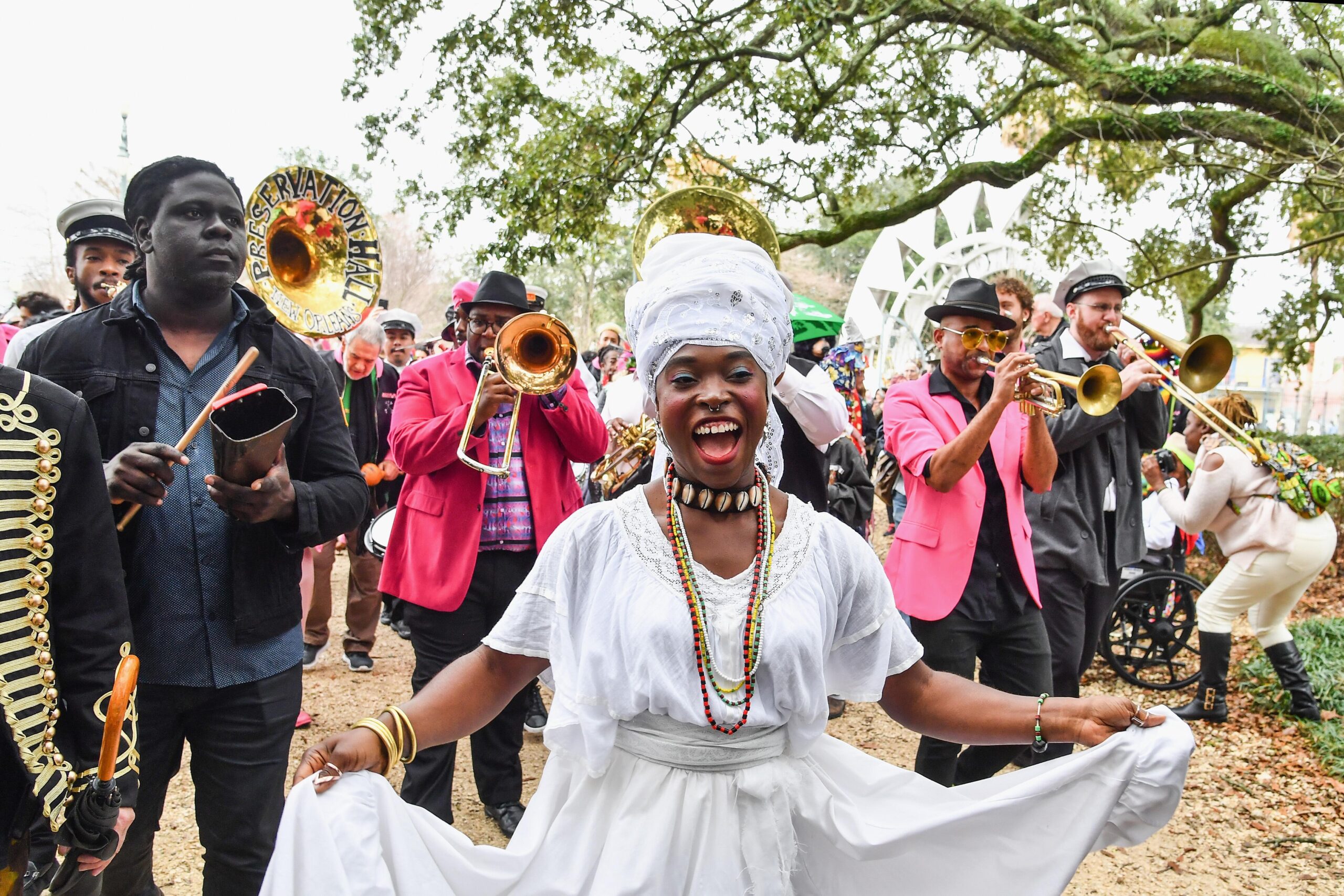
ANASTASIA TSIOULCAS, BYLINE: Congo Square is still a rich place to hear music. Every Mardi Gras, groups stage friendly musical battles underneath the live oak trees.
JON BATISTE: Congo Square is ground zero of what I would consider the big bang of American music culture.
TSIOULCAS: That’s musician and eight-time Grammy Award winner, Jon Batiste. He knows New Orleans. He’s part of a family of more than two dozen NOLA musicians. He says Congo Square gave this country its foundational elements – rhythm, song, dance and ritual that are…
BATISTE: Ubiquitous in a way that is like the air that we breathe.
TSIOULCAS: The square’s inside Louis Armstrong Park in the Treme neighborhood, and it’s where I meet historian Freddi Williams Evans.
FREDDI WILLIAMS EVANS: It evolved as a place – one of the locations for unofficial events like cock fights, ball games, political rallies. And it eventually became known as the place where enslaved Africans were able to gather on Sunday afternoons.
TSIOULCAS: Evan says in cities colonized by the Protestant Europeans, like the Dutch and the British, Sundays were quiet days for pious religious behavior. But because New Orleans was under French rule, the vibe in the city on Sundays was different.
EVANS: After the hours of mass on Sunday afternoons was a place for recreation and reverie and fun. And so that location became Congo Square.
TSIOULCAS: So enslaved people gathered for religious rituals, for singing, for dancing and for drumming. And one of those drum rhythms from Africa became part of a shared vocabulary between Africa, the Caribbean and this port city of New Orleans.
EVANS: In Cuba, the rhythms receive the name tresillo, cinquillo. In Haiti, it may be called something else, but we know that.
There are so many names for that, and that is the basis of Mardi Gras – Indian music, the second line beat – we call it that. We call it the parade beat, the bamboula beat.
TSIOULCAS: You hear it in the left hand in this 1923 recording by New Orleans native Jelly Roll Morton of his “New Orleans Joys.”
(SOUNDBITE OF JELLY ROLL MORTON’S “NEW ORLEANS JOYS”)
TSIOULCAS: And it continues to live in New Orleans’ quintessential parade music, like in this song, “Do Whatcha Wanna,” by the New Orleans group Rebirth Brass Band.
(SOUNDBITE OF SONG, “DO WHATCHA WANNA”)
REBIRTH BRASS BAND: (Singing) Everybody. Everybody. It’s a party. It’s a party. Everybody. Everybody.
TSIOULCAS: There’s that bamboula rhythm deep at the bottom. That is the signature sound of a New Orleans’ second line passed generation to generation. But it’s a way of life as well.
BATISTE: New Orleans is particularly unique in that we have this lineage of musicians whose families still exist and are carrying the traditions forward.
TSIOULCAS: Jon Batiste says everyone in New Orleans’ musical families has a role, like in West African griot families whose members are musicians, storytellers, poets and the oral historians of their communities. It’s a responsibility.
BATISTE: The way it’s passed down is the same as it is in African cultural traditions, West Africa and the Congo and Benin, the Yoruba people, the Igbo people. It’s a griot. It’s a oral tradition. It’s a way of identifying very early on who is the drummer, who’s the elder going to mentor to fill this position within our tribe. And you start to understand that in musical families in New Orleans, that there’s a real tribal understanding that is rooted in the way that we live and pass on the traditions. And as one of those culture bearers, I find that it’s an incredible joy and a great responsibility. It’s a great pressure.
(SOUNDBITE OF SONG, “IN NEW ORLEANS”)
TONYA BOYD-CANNON: (Singing) So I was walking into Washington Park.
TSIOULCAS: Tonya Boyd-Cannon is a New Orleans-based singer. She says she feels that way, too, as a creative descendant of those people who gathered in Congo Square.
BOYD-CANNON: I am responsible for picking up what my ancestors put down. So if they laid the foundation, I need to pick it up and be bold with it. On Sundays, they still gather at Congo Square where freedom was only on one day. It would be remiss to not share that with those kids who are coming up and already speaking the languages.
(SOUNDBITE OF SONG, “IN NEW ORLEANS”)
BOYD-CANNON: (Singing) New Orleans. Oh.
TSIOULCAS: She’s part of the Jazz Generations Initiative, cofounded by composer Courtney Bryan.
(SOUNDBITE OF COUNRTNEY BRYAN’S “CARNIVAL FOR UNITY: I. UNITY AMONGST YOUTH OF THE DIASPORA”)
TSIOULCAS: The program brings together cross-generational musicians.
COURTNEY BRYAN: One of the things I was really excited about was to have a gathering of musicians who were doing really creative work in and outside of the city, but very rooted in New Orleans.
TSIOULCAS: And that’s the story of Congo Square – to hold on to elders’ stories, to be creative today, no matter what, and to pass that legacy on. Anastasia Tsioulcas, NPR News.
(SOUNDBITE OF SONG, “FREEDOM”)
BATISTE: (Singing) When I move my body just like this, I don’t know why, but I feel like freedom.
Is it possible to protest and party? Low Cut Connie believes that it sure is.
(SOUNDBITE OF SONG, “GET DOWN”)
LOW CUT CONNIE: (Singing) Ain’t got no shoes. Ain’t got no clothes. Throwing our phones down a toilet bowl. Get down. Pretty, pretty get down (ph).
SIMON: That’s “Get Down” from Low Cut Connie’s new album, “Livin In The USA.” Adam Weiner, who’s pianist and lead vocalist of the Philly-based group, joins us now from South Philadelphia. Thanks so much for being with us.
ADAM WEINER: Oh, it’s such a pleasure to be with you.
SIMON: When you announced this album, you offered a lengthy and passionate statement about what you see as the need for protest music at the moment. Could you share some of those thoughts with us?
WEINER: I feel that these are times in which artists need to try to lead the way because, in a lot of ways, we are experiencing unprecedented times. I travel all over this country, and I’ve never seen so many people struggling.
(SOUNDBITE OF SONG, “LITTLE FREAKERS”)
LOW CUT CONNIE: (Singing) Living on the street for the charm with your back to the wall. Got little to live for, so you live for it all. Oh, freedom fire (ph).
WEINER: And so I’m using my music to try to galvanize people to discuss these issues and do more social commentary in their art.
(SOUNDBITE OF SONG, “LITTLE FREAKERS”)
LOW CUT CONNIE: (Singing) All these little freakers today. Everybody’s changing their name. Don’t you feel like running away?
SIMON: What are the struggles you see?
WEINER: I see poverty everywhere, every single state. I see divisions, I see racism. I see confusion. I see misinformation. I see lack of hope. My job when I get on stage is to take a temperature in the room and see how people are feeling. And so I’m like a doctor. I go out there, I see how they’re feeling emotionally. And I’m telling you, I’ve never seen people struggling in this country more than right now.
SIMON: And yet you think joy is an important part of the prescription.
WEINER: I do. You know, if we lose our ability to access joy, I mean, what do we have, you know? And joy can be an act of resistance. Every single night on stage, I have the benefit of having a job where I get to make people feel good, and the process of making people feel good is one in which they process their emotions. So it doesn’t have to be escapist. At the beginning of my show, I ask people, how are you feeling right now? Just yell it out. And we get all kinds of answers, and we talk about it throughout the show. We sing, we dance, we laugh, we cry. And at the end, I say, how are you feeling now? And they say, better.
(SOUNDBITE OF SONG, “PALPITATIONS”)
LOW CUT CONNIE: (Singing) Drop your things and come with me, babe. We’ll live like hippies in the USA. And know (ph) we may never get the chance again.
SIMON: I understand that last spring Low Cut Connie was set to perform at the Kennedy Center in Washington, D.C.
WEINER: Yes.
SIMON: And then you canceled. Why?
WEINER: Well, I was supposed to perform as part of something called the social impact series. And there was, like, a mission statement for it, and it said, music and performances that amplify voices of diversity, inclusion and promote positive social change. So it was a nice thing to be a part of. And then when the president gave a speech saying that the mission of the Kennedy Center would be changing, that a lot of programming would be canceled, that members of the board would be let go and that he felt that he should probably become the chairman, I knew immediately that mission that I was signing on to would not be completed.
I knew that my performance would not be received in the context that I intended. And so it was an easy decision for me to cancel. I didn’t think that my cancellation and the cancellation statement I made would become such a big thing and travel all over the world. I got a lot of attention, support, but I also got death threats and a lot of big backlash for me and my team because of it. I don’t regret my decision, though. I really don’t want to perform there under the current circumstances.
SIMON: Let me ask you about some of the songs on this album. Let’s begin with “Livin In The USA.”
(SOUNDBITE OF SONG, “LIVIN IN THE USA”)
LOW CUT CONNIE: (Singing) Livin’ in the USA but it ain’t my home. Livin’ in the USA, but it ain’t my home.
SIMON: Why doesn’t it feel like you’re home now?
WEINER: You can live in a place and feel like it doesn’t recognize you and you don’t recognize it. And for me personally, the America that I grew up in and the messaging of what America is and is supposed to be, it – that feels distant to me. And a lot of people that I know feel the same way. They feel lost. They don’t feel included. And I think that’s a sentiment that a lot of people share, that you can be living in a place and not feel accepted there.
SIMON: Let me ask you about another song, “Human Condition.”
(SOUNDBITE OF SONG, “HUMAN CONDITION”)
LOW CUT CONNIE: (Singing) It’s a strange thing, drowning out the words of dissention in the USA. It’s a strange thing living in a house of detention. Things are not (ph)…
SIMON: What do you observe about the human condition now in your eyes?
WEINER: When we talk about history, of ancient Rome or Greece or any part of world history, we always talk about poverty. We always talk about inequality. We always talk about corruption. We always talk about injustice. These things have always been part of the human condition, and it’s something we should never stop talking about.
(SOUNDBITE OF SONG, “HUMAN CONDITION”)
LOW CUT CONNIE: (Singing) Are you ready to talk about the human condition? Are you ready, babe, to talk about human affliction?
SIMON: Protest songs have a way of entering the mainstream of music and then getting appropriated. Bruce Springsteen’s “Born In the U.S.A.,” Woody Guthrie’s “This Land Is Your Land.”
WEINER: Yes.
SIMON: How do you feel about that?
WEINER: Yes. I mean, music is not just a song. It’s the context in which the song is received and understood and heard. And a good song is one that can resonate at different times and in different situations. I think that we will always have this issue of context, but a good song can last and be interpreted over time, and it’s OK if it means different things at different times and different things to different people. It’s still having an impact.
SIMON: How do you feel about people who might have a different view of yours, but who enjoy your music? Is that OK with you?
WEINER: I have so many fans who feel differently than me, and I’m very proud to be able to keep them at the table. It’s so important to me that we have diversity on every level, including of opinion, of political views. Everyone, as I say, is welcome at a Low Cut Connie show, just like Mr. Rogers used to say, everyone is welcome in “Mr. Rogers Neighborhood.” I welcome a difference of opinion. And if people don’t like my new album, my new song, my position, I like to hear their opinion out as long as that opinion is delivered with respect.
SIMON: Adam Weiner from Low Cut Connie. The group’s new album “Livin In The USA” is out now. Thank you so much for being with us.
WEINER: Thank you for taking the time. It was a pleasure talking with you.
(SOUNDBITE OF SONG, “EVERYBODY”)
LOW CUT CONNIE: (Singing) What time to be alive, liked to talk and learned to drive (ph).
Are you proud to be an American? That’s a question we posed to a group of swing voters from swing states, who have a history of voting for candidates from both major political parties.
Their answers reflect a nuanced view of this country at a time of partisan polarization and widespread discontent.
“The answer is yes,” said John from Pennsylvania in a voice memo shared with NPR. “I am proud to be an American. It’s a very imperfect country. There’s a lot that still needs to be worked on, a lot that still needs to be done.”
John is one of a dozen voters participating in a project called Swing Shift, where we regularly take the temperature of voters who could help decide the elections in 2026 and 2028. NPR agreed not to use the full names of these voters so they are able to speak more freely about politics.
“Yes, I am and always have been proud to be an American,” said Jason from North Carolina.
“I would still say, yes, here, but with some slight embarrassment,” said Wally from Georgia.
“I’m proud to be an American,” said Gerald, also from Georgia. “This is the greatest country on the planet Earth.”
“We live in the best country in the world,” said Theresa from Pennsylvania. “We have democracy. We have freedom.”
“I do have some pride to be an American,” said Evan from Wisconsin. “However, I also have a lot of shame.”
“Why shouldn’t I be proud to be American?” asked Lee from Nevada. “I mean, we live in one of the best countries in the world.”
To mark America’s 250th Anniversary, a new poll from NPR/PBS News/Marist asked that question and found a partisan divide in whether people express pride, and a divergence in intensity as well. Overall 65% of those surveyed say they are “proud” or “very proud” to be an American. But the partisan split is stark. 93% of Republicans are “proud” or “very proud” while that same sentiment is shared by only 45% of Democrats. .
Loading…
A pulse of the country as it turns 250
All over the country, with big fireworks shows and small backyard barbeques, Americans will mark the nation’s 250th birthday today. To get a sense of how they are feeling about the country, we asked the swing voters for one word or phrase to describe how they feel about America’s future. They are “uncertain,” “concerned,” “hopeful,” “worried,” “excited,” and “cautiously optimistic.”
And then there’s Lee, who has a new job, and his optimism is unqualified.
“I think we’re going to have a good future,” he said. “Because, why wouldn’t we?”
Gerald, who voted for Presidents Obama and Biden but has gone all in on MAGA and President Trump, sees Democrats as a threat.
“They try to take them basic freedoms away every single day,” said Gerald. “If you give them a foot, they will take 10,000 miles. We cannot let up.”
Evan, who grew up Republican and voted Democratic for the first time in 2024, says he’s worried about corruption.
“The government is not working for people or the population anymore,” Evan said. “They’re working for themselves, corporations and other countries.”
Wally says that he voted unenthusiastically for Trump in 2024, but has since soured on him.
He worries about corruption and a decline of trust in institutions.
“I feel we’re drifting further and further away from what we’re founded on,” said Wally. “America has turned into a free-for-all of sorts. People are anxious over the future, and we’re seeing in the political sphere, elected officials essentially getting richer and richer off the backs of hardworking Americans and using their status to look after themselves and not their constituents.”
Two of the swing voters, without prompting, brought up artificial intelligence.
“I’m worried what’s going to happen, if we’re going to let technology take over fundamentally who we are as human beings,” said Theresa, adding “we need people to be in control, and we need people to be in control that are kind.”
John describes AI as “challenging and scary.” But he also says he’s hopeful it could be harnessed to cure cancer or something good.
As he reflects on his own country, he’s found perspective from an unlikely source: World Cup soccer fans and tourists.
“They’re amazed at our abundance. They’re amazed at our beauty, our wealth,” John said. “They’re intrigued by our food. They’re intrigued by our air conditioning.”
Jason, from North Carolina, says watching these fans “who are experiencing the United States for the first time themselves, and seeing everything from the volume of choices, to pricing, to the freedom of movement and speech and actions,” has given him a new appreciation for what Americans have.
Transcript:
SCOTT SIMON, HOST:
And now more voices of our fellow Americans. NPR has undertaken a project that we call Swing Shift. It follows a dozen voters in swing states. NPR senior political correspondent Tamara Keith is checking in with them periodically on gas prices, their opinion on how the president is doing, and today, on how they feel about America on its 250th birthday.
(SOUNDBITE OF ARCHIVED RECORDING)
JOHN: Hello, Tamara. This is John (ph) from Pennsylvania.
TAMARA KEITH, BYLINE: I sent John and the other swing shift voters a list of questions about America 250 years in, and they sent back thoughtful answers, recorded on their phones.
(SOUNDBITE OF ARCHIVED RECORDING)
JOHN: The question is, are you proud to be an American? Why or why not? The answer is yes. I am proud to be an American. It’s a very imperfect country. There’s a lot that still needs to be worked on, a lot that still needs to be done.
KEITH: And still, he’s proud. They all are, with varying levels of nuance.
(SOUNDBITE OF MONTAGE)
JASON: Yes. I am and always have been proud to be an American.
WALLY: I would still say yes here but with some slight embarrassment.
GERALD: I’m proud to be an American. This is the greatest country on the planet Earth.
THERESA: We live in the best country in the world, you know? We have democracy. We have freedom.
EVAN: I do have some pride to be an American. However, I also have a lot of shame.
LEE: Why wouldn’t I be proud to be American? I mean, we live in one of the best countries in the world.
KEITH: That was Jason (ph), Wally (ph), Gerald (ph), Theresa (ph), Evan (ph) and Lee (ph). NPR agreed not to use their full names, so they can speak freely about politics in these polarized times. They mentioned different concerns. Gerald, who voted for presidents Obama and Biden but has gone all-in on MAGA, sees Democrats as a threat.
(SOUNDBITE OF ARCHIVED RECORDING)
GERALD: That’s what worries me. They try to take them basic freedoms away every single day. If you give them a foot, they will want to take 10,000 miles. We cannot let up.
KEITH: Evan, who grew up Republican and voted Democratic for the first time in 2024, says he’s worried about corruption.
(SOUNDBITE OF ARCHIVED RECORDING)
EVAN: The government is not working for the people or population anymore. They’re working for themselves, corporations and other countries.
KEITH: Two of these swing voters, without prompting, brought up artificial intelligence. Theresa lives in Pennsylvania.
(SOUNDBITE OF ARCHIVED RECORDING)
THERESA: I’m worried what’s going to happen if we’re going to let technology take over who we are fundamentally as human beings.
KEITH: John describes AI as challenging and scary, but he also says he’s hopeful it could be harnessed to cure cancer or something good. On America, he’s found new perspective from an unlikely source – World Cup soccer fans.
(SOUNDBITE OF ARCHIVED RECORDING)
JOHN: They’re amazed at our abundance. They’re amazed at our beauty, our wealth. They’re intrigued by our food. They’re intrigued by our air conditioning.
KEITH: Jason from North Carolina says watching these fans has given him a new appreciation for what we have.
(SOUNDBITE OF ARCHIVED RECORDING)
JASON: The reactions of others from around the world who are experiencing the United States for the first time, themselves, and seeing everything from the volume of choices to pricing to the freedom of movement and speech and actions.
KEITH: The final question I asked was for one word or phrase that explains how they feel about America’s future. These swing voters are uncertain, concerned, hopeful, worried, excited and cautiously optimistic. And then there’s Lee, who has a new job, and his optimism is unqualified.
(SOUNDBITE OF ARCHIVED RECORDING)
LEE: I think we’re going to have a good future because why wouldn’t we?