A note from Wild Card host Rachel Martin: Actor and writer Danny McBride has built a career exploring the hilarious extremes of the male psyche. He creates characters with an almost delusional sense of confidence who are flying high on their own supply, only to come crashing down when the inevitable weight of self-doubt shows up.
But no matter where these characters are on their journey through American masculinity, be it Jesse from “The Righteous Gemstones” or Kenny Powers from “Eastbound & Down,” their fragility makes them all the more endearing. Danny McBride has a new book out on these same themes. It’s called “Thrilling Tales of Modern Men.”
President Trump and his family made more than a billion dollars last year, much of it from crypto.
MICHEL MARTIN, HOST:
His enormous earnings are raising a lot of questions about possible conflicts of interest. The White House says there’s nothing wrong with it.
MARTÍNEZ: I’m A Martínez. That is Michel Martin, and this is UP FIRST from NPR News.
(SOUNDBITE OF MUSIC)
MARTÍNEZ: Democratic socialists are gaining momentum after primary wins in New York and Colorado. Republicans are betting they can paint the whole party as too extreme, which could be a challenge for Democrats eyeing midterm races. Can they tap into that democratic socialist energy without the label?
MARTIN: And the U.S. men are through to the World Cup’s round of 16. They beat Bosnia-Herzegovina, although they had to play a man down for their first knockout win in 24 years. But their top scorer is suspended for the next game. Stay with us. We’ll give you news you need to start your day.
(SOUNDBITE OF MUSIC)
MARTIN: President Trump’s financial disclosures show that the president and his family took in more than $1 billion through cryptocurrency sales and other business ventures.
MARTÍNEZ: The report released this week shows the crypto earnings sharply outpaced Trump’s real estate businesses, which had already made the president a wealthy man. They also raise questions about possible conflicts of interest.
MARTIN: NPR’s Linda Kenyon is with us this morning. Welcome, Linda. Glad to have you with us.
LINDA KENYON, BYLINE: Thank you. Good morning.
MARTIN: Now that we’ve had some time to dig into this 927-page financial disclosure document, what exactly are we learning about the crypto earnings for the president and his family?
KENYON: Well, we’re learning a lot. The 2025 report, which was filed with the Office of Government Ethics, shows the cryptocurrency venture World Liberty Financial, which was co-founded by Trump and his family members, took in more than $500 million. In addition, the sale of Trump’s souvenir-type meme coins took in more than 600 million. The official version of those meme coins with Trump’s face stamped on it was launched just days before he took his second-term inauguration. Other income included more than 50 million from settlements with media companies, millions from selling Trump-branded bibles, sneakers, watches. Those watches with the Trump imprint brought in more than $4.7 million all by themselves. And that’s all separate from the president’s overseas real estate ventures, many of them with countries that have been negotiating with the U.S. on tariffs and military aid and several other issues.
MARTIN: What’s the White House saying?
KENYON: Well, the White House has released a statement that denies any conflict of interest. Spokesperson Anna Kelly said, quote, “neither the president nor his family has ever engaged or will ever engage in conflicts of interest.” She also applauds the president for making the U.S., as she put it, the crypto capital of the world through executive actions. President Trump himself also answered reporters who asked about his earnings when he was leaving for the Dakotas yesterday at Joint Base Andrews.
(SOUNDBITE OF ARCHIVED RECORDING)
PRESIDENT DONALD TRUMP: We have funds that run my money.
UNIDENTIFIED REPORTER: But you are benefiting. I mean, you’re probably making hundreds of thousands of dollars (ph).
TRUMP: Well, I made a lot of money before I became president. And they invest my money, and I don’t talk to them. I never – I don’t even speak to them. So I have many people. I don’t know what they call it – closed accounts or something. You put your money in, and that’s it. I don’t talk to them. They’re big institutions, and they run it.
KENYON: That’s not unlike the response that White House press secretary Karoline Leavitt gave when she was asked about Trump’s meeting with top investors in his meme coin, a meeting that took place in May of 2025.
(SOUNDBITE OF ARCHIVED RECORDING)
KAROLINE LEAVITT: The president is abiding by all conflict-of-interest laws that are applicable to the president. And I think everybody – the American public believe it’s absurd for anyone to insinuate that this president is profiting off of the presidency.
KENYON: Trump on Wednesday said he’s also earning more because the stock market is doing well, saying everybody is profiting.
MARTIN: So the White House and the president deny any conflict or abuse of the office. Linda, I have to note that even some of the president’s traditional supporters – some of the podcasters, for example – are raising questions about this. But what about other people? Are there other critics of this?
KENYON: Yes, absolutely. Democrats have a lot to say. For example, California Senator Adam Schiff suggested the president has made more money in the first year of his term than in the rest of his life combined. And Congressman Jason Crow called the president’s crypto earnings another example of what he termed grift and corruption. The Colorado Democrat also pointed out that Trump, on Wednesday, was taking his first flight on a brand-new Air Force One, a gift from a foreign government – Qatar – valued at more than $400 million and will stay in the Trump realm when he leaves office. The White House says the aircraft will be a donation to Trump’s presidential library.
MARTIN: That’s NPR’s Linda Kenyon. Linda, thank you.
KENYON: Thank you.
(SOUNDBITE OF MUSIC)
MARTIN: Democratic socialists have scored some high-profile victories over the last few days.
MARTÍNEZ: And in the view of many Republicans, that should be a warning sign for voters. Here’s President Trump on Wednesday.
(SOUNDBITE OF ARCHIVED RECORDING)
TRUMP: We’re not going to let communists get in our way. We’re not going to let anyone get in our way.
(CHEERING)
TRUMP: Not the communists.
MARTÍNEZ: For Democrats, these kinds of attacks come as no surprise, but they still pose a challenge for the party as they look ahead to this year’s midterms and a path back to the majority in Congress.
MARTIN: NPR political reporter Elena Moore has been keeping an eye on all this and is with us now. Good morning, Elena.
ELENA MOORE, BYLINE: Good morning, Michel.
MARTIN: So we saw democratic socialists win big victories in New York City last week and then again this week in Denver. How are they doing it?
MOORE: Well, it’s a mix of things. Democrats have struggled to coalesce around a clear post-2024 message. But many of these successful campaigns endorsed by the Democratic Socialists of America, or DSA, do have a core message, one that’s centered around economic populism and rejecting the political status quo. They’re also not shying away from more polarizing issues, like abolishing ICE and an end to U.S. military aid in Israel. And taken together, it’s a platform that appears to be energizing people, at least in these super blue areas.
MARTIN: What did that look like in Denver?
MOORE: To back up real quick, the DSA is not a registered political party. It’s a membership group. So that’s why these candidates are running in the Democratic Party primary. And that’s what Melat Kiros did in Denver. She’s a 29-year-old first-time candidate who unseated longtime Democrat Diana DeGette. And make no mistake, DeGette is seen as a progressive on Capitol Hill, but she’s also been there since 1997, the year Kiros was born. So Kiros campaigned as an antiestablishment candidate, calling for a new type of politics. And like many leftist candidates this year, she tried to differentiate herself by vocally rejecting money from corporate PACs and pro-Israel lobbying groups and criticizing her opponent for taking those same kinds of donations in the past.
MARTIN: Can you talk about the drawbacks that some other Democrats see in these DSA victories?
MOORE: Well, several of these candidates are going from activist to politician, and skeptics are wasting no time highlighting at least one of these candidates’ past comments disparaging Democrats. Some Democrats are hesitant to associate with DSA, saying it could complicate their message in toss-up races where control of Congress will ultimately be decided. Matt Bennett with the centrist think tank Third Way argued that Republicans will paint any Democrat as a democratic socialist in hopes that it will make them seem too extreme.
MATT BENNETT: Of course, it’s possible to run as a left-leaning populist without adopting the maximalism of the extremes. But it is very hard for Democrats now to distinguish themselves.
MARTIN: What did the democratic socialists say to that?
MOORE: Well, I talked to Claire Valdez about it. She’s one of two candidates for Congress who won in New York last week. She argues this is not a radical movement.
CLAIRE VALDEZ: We’re seeing it not just in New York City, but really around the country that there’s broad consensus around the need to re-center working-class, you know, Americans in our politics and really fight to make sure that the Democratic Party is leading on these issues.
MARTIN: So with all that said, what’s the calculus for Democrats as they look ahead in November?
MOORE: Well, candidates who don’t want to be associated with DSA are going to try to strike a balance, tapping into some of that same messaging without the DSA label. And that’s not going to stop the GOP from framing people as extreme. But given how frustrated folks are with politics right now, I’ll be watching to see if voters are more willing to look past those kind of attacks.
MARTIN: That’s NPR’s Elena Moore. Elena, thank you.
MOORE: Thanks, Michel.
(SOUNDBITE OF MUSIC)
MARTIN: OK. Now, a 2-0 win may not sound like much of a nail-biter, but last night in the FIFA World Cup, the U.S. men’s national team looked like it might be on the ropes before pulling out a win against Bosnia and Herzegovina.
MARTÍNEZ: It’s the first time in almost a quarter century that the United States has won a game in the World Cup knockout stage.
MARTIN: NPR sports correspondent Becky Sullivan was there. Hopefully, she’s gotten her heart rate back down. And now she’s joining us on the line from San Jose, California. Good morning, Becky.
BECKY SULLIVAN, BYLINE: Good morning, Michel.
MARTIN: I mean, what a game. How big…
SULLIVAN: Yeah.
MARTIN: …Of a win is this?
SULLIVAN: Unbelievable. Yeah. I mean, this was a wild ride. It’s a huge win, Michel, because, I mean, just being there, the U.S. had to work and work and work to get that first goal to go up 1 to 0 just before halftime. And then there’s striker Folarin Balogun, who is this, like, the newest big star of this team, made this disastrous mistake in the second half. He got his legs tangled up with a Bosnian defender. He stepped on the defender’s ankle.
It went to a video review, and it was deemed a red card, meaning he was out for the game, of course. And the U.S. was forced to play down a man for the remainder of the game, which was, like, 25 minutes plus stoppage time. And I don’t think any fan in the stadium was confident at all in that point in a U.S. win. Bosnia was, of course, only down one. Anything could have happened. And they pulled it off for the biggest win for the U.S. men’s national team in a good long time.
MARTIN: OK. So tell us about the win. There was this hero moment…
SULLIVAN: Yes.
MARTIN: …In the second half when the U.S. went up 2-0. Tell us about it.
SULLIVAN: Yeah, exactly. Yeah. So they were playing shorthanded. They’re down a guy. But this yellow card on a Bosnian defender gave the U.S. this golden opportunity, a free kick from near the top of the penalty area. And up steps midfielder Malik Tillman. He couldn’t have hit a prettier shot, just right over the wall of defenders and into the net. He is just one of the best, most skilled players on the team, and yet he is also just one of the quietest, most understated, one of the most soft-spoken people I think I’ve ever met. Sometimes you even struggle to hear him when he’s just speaking to a small crowd of us reporters, and here is how he put it after the game.
(SOUNDBITE OF ARCHIVED RECORDING)
MALIK TILLMAN: I’m a different type of person on the pitch. Of course, maybe you don’t really see my emotions. But if you score a goal like this, I mean, I think also you guys saw my emotions, and so it’s a great feeling, and, of course, a very proud moment for me.
SULLIVAN: (Laughter) Yes, you can hear how quiet he is there. He was born in Germany. His mom is German. His dad was in the American Armed Forces. He’s American. And so, Malik is just one of these dual nationals that the U.S., of course, is very happy to have on the team right now ’cause when you can score a shorthanded goal like that, Michel, there is nothing that takes the wind out of the sails faster for an opponent in a game like that.
MARTIN: OK. But this red card – right?
SULLIVAN: Yes.
MARTIN: For…
SULLIVAN: It is a big deal. Yeah. Unfortunately, it’s a big deal because Balogun has become a huge centerpiece of this team in the World Cup. So far, he has played three games. He had three goals, which is already tied for the second most all time by any American man in a single World Cup. He’s not the type of guy who picks up a lot of yellow and red cards. This is his first-ever red card for the national team. So sitting out is going to be a big deal. Here is his teammate Christian Pulisic after the game.
(SOUNDBITE OF ARCHIVED RECORDING)
CHRISTIAN PULISIC: It’s just disappointing. Like, I understand it’s, you know, a dangerous act in a way, but, like, he’s just trying to put his foot on the ground, and it wasn’t high on his leg. It’s just so unfortunate.
SULLIVAN: You can just, like, really hear the disappointment in his voice. I mean, Pulisic is exactly the guy, by the way, who benefits from Balogun being on the field because Balogun is good. It takes away some of the pressure from Pulisic, who has long been the biggest star of the U.S. men’s national team. Now the opponent next week, Belgium, will get to focus more of that attention on Christian Pulisic.
MARTIN: So for people who don’t know the game that well yet, that means that Balogun is out for the next match, which is against Belgium. So what else are we going to see there?
SULLIVAN: Yeah. You know, it’s hard to know. You know, Belgium has been a team with some real ups and downs this year, on one hand. You had Belgium and the U.S. playing in a friendly back in March. Belgium won that one really easily, actually. It was 5-2, kind of a big blowout win. But on the other hand, they’ve looked like one of the most beatable, quote-unquote, “good teams” in this tournament so far in this World Cup. So I think it’s a difficult one to predict. The U.S. certainly has a chance even without Balogun, and a win, Michel, would bring the Americans to the quarterfinals, which would match the deepest run they’ve ever had in a modern World Cup.
MARTIN: That is NPR’s Becky Sullivan. Becky, thank you.
SULLIVAN: You’re welcome.
(SOUNDBITE OF MUSIC)
MARTIN: And that’s UP FIRST for Thursday, July 2. I’m Michel Martin.
MARTÍNEZ: And I’m A Martínez. Today’s episode of UP FIRST was edited by Jan Johnson, Russell Lewis, Jason Breslow, Alice Woelfle and Mohamad ElBardicy. It was produced by Ziad Buchh and Nia Dumas. Our director is Christopher Thomas. We get engineering support from Stacey Abbott. Our technical director is Zac Coleman, and our deputy executive producer is Kelley Dickens. Join us again tomorrow.
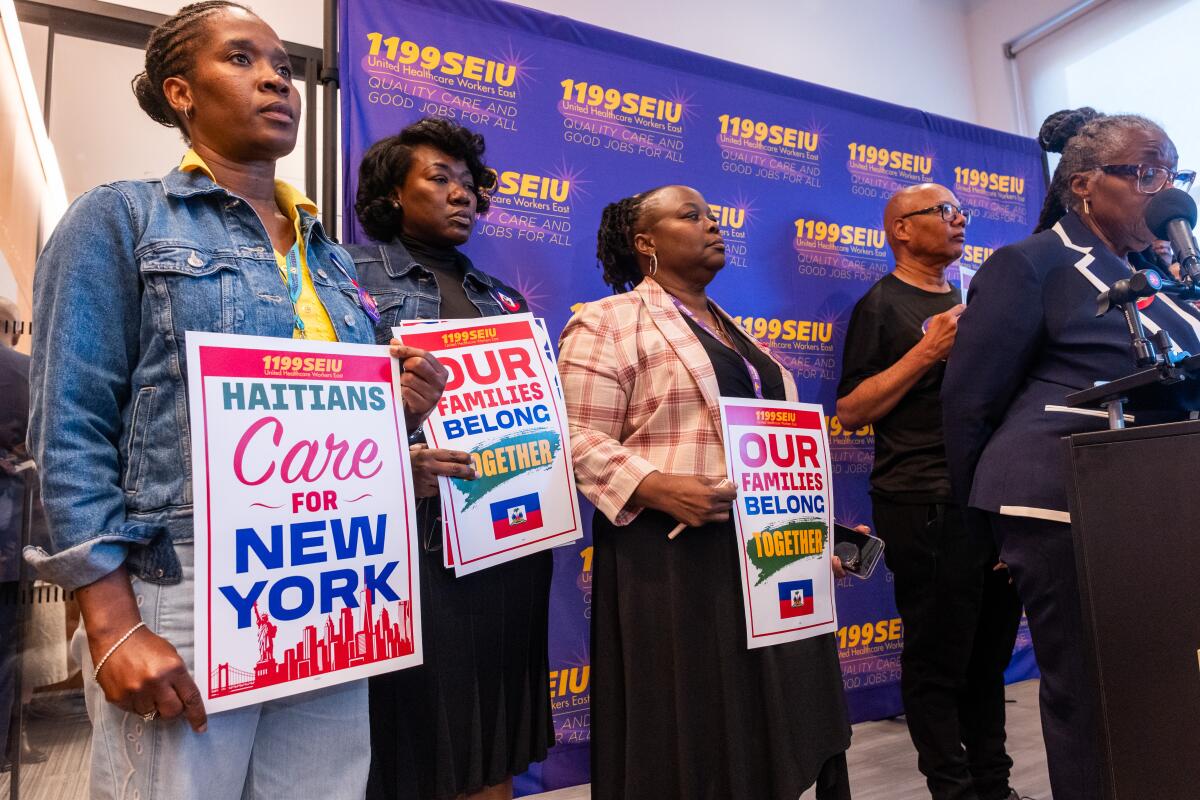
Healthcare workers rally at a Manhattan union headquarters to show support for the Haitian and Syrian communities after the U.S. Supreme Court ruled that the Trump administration could end temporary protected status for potentially millions of foreign nationals from countries experiencing conflict and violence. The decision means that over 330,000 Haitians and Syrians could lose their work authorizations and ability to remain in the country. (Spencer Platt | Getty Images)
Amid the flurry of consequential Supreme Court decisions that have come down recently, it’s the one about temporary protected status that has America’s healthcare sector the most worried.
The ruling last week cleared the way for the Trump administration to cancel TPS for Haitians and Syrians. Experts say deporting Haitian TPS recipients will have a catastrophic impact on the nationwide healthcare workforce crisis — a workforce that is hugely dependent on immigrant labor.
The pain will be felt across hospitals and emergency rooms, which already operate under persistent staffing shortfalls, but it’s the long-term care sector, including senior care facilities and home care, that will suffer the greatest disruptions, said Steffie Woolhandler, a distinguished professor of health policy at City University of New York at Hunter College and a faculty member at Harvard Medical School.
“It’s going to be a disaster in the Boston area, where a lot of our nursing home and home care aides are Haitian,” Woolhandler told NPR. But beyond that, she added, “If the United States becomes inhospitable to noncitizens, which I think Trump is doing, we’re going to have a lot of problems staffing our entire healthcare system.”
Massachusetts has the third largest population of Haitians with TPS (19,000), behind Florida (158,000) and New York (40,000), respectively.
Woolhandler is one of three authors of a 2025 report analyzing the impact of Trump’s mass deportation plans, including the potential effects of stripping TPS protections from people from the 17 countries that the federal government deemed eligible. The status is meant to protect individuals from those countries who are livingin the U.S. from having to return to places where armed conflicts, natural disasters or other conditions make living there unsafe. Pulling from census data, theresearch team found that roughly 50,000 physiciansin the U.S.are noncitizens, the category that includes people with TPS protections. That’s about 9% of all doctors in the U.S. Another 145,000 are registered nurses.
FWD.us breaks down the numbers even further, estimating that 21,000 Haitian TPS holders are in hard-to-fill jobs as nursing assistants and caregivers.
The dearth of qualified healthcare workers is already putting existing institutions under tremendous strain. Woolhandler said two-thirds of hospitals report they’ve had to close beds because they don’t have enough staff, and about half of nursing homes similarly say that they can’t take new admissions because they don’t have enough personnel.
“The thing that has to be said is that the healthcare of everybody is going to be compromised by this. If you start throwing out workers that play a key role in the whole continuum of care … it tends to create a bottleneck or a backup,” she said.
If a family can’t find a bed in a nursing home or home aid caregiver, then those people may end up stuck in a hospital or in emergency rooms, Woolhandler said.
Katie Smith Sloan, president and CEO of LeadingAge, which represents more than 5,300 aging service providers nationwide, called the ruling a direct threat to the delivery of much-needed care and services.
“It puts older adults and the providers who care for them in an untenable position,” Sloan said in a statement. “Staff and caregivers who support older adults every day — legal employees who in some of our communities represent 8% or more of the entire workforce — can now lose their jobs overnight.”
The legal limbo has communities wracked with worry, particularly in Springfield, Ohio, where 1 in 4 residents is of Haitian descent. Hours after the ruling, dozens of panicked TPS holders were calling Viles Dorsainvil asking for advice. The 40-year-old is the co-founder and executive director of Haitian Support Center, a nonprofit that provides a range of services to Haitian nationals and refugees, including legal assistance.
“They’re wondering if they can still keep their assets or money at the bank, if they can still go to work because TPS came with the work permit, and with the driver’s license privilege,” Dorsainvil told NPR. “The community is devastated.”
The Trump administration has released little information about how it will withdraw protections under the program for more than 330,000 Haitian and 4,000 Syrian TPS holders affected by the high court’s ruling last week. On Wednesday, the Department of Homeland Security announced that existing Employment Authorization Documents, which permit TPS recipients to legally work in the country, will expire on July 10.
Dorsainvil said he’s advising people that the most important step they can take is to sign a power of attorney to someone they trust. Parents with American-born children should also plan to sign over guardianship of their kids, in case DHS pursues family separations, he said.
For now, he said, he’s got little else to share with the people calling, but he shares their anxiety.
Dorsainvil is also a TPS recipient, but unlike those who fled the destruction of the 2010 earthquake, he came to the U.S. in 2020 on a visitor visa. At the time, he did not intend to stay more than six months. But during his stay, Haiti’s already fragile political system devolved into unrest and violence that led to the assassination of President Jovenel Moïse, and continues to today.
“There was no way I could go home,” Dorsainvil said, adding that it was the Biden administration’s extension of the TPS program for Haitians that allowed him and his brother to stay in the country. It wasn’t until 2024, when Trump first set his eyes on ending the TPS program for Haitians, that Dorsainvil and his sibling, a former doctor in Haiti who now works as a nurse in Chicago, both applied for asylum. Those applications have still not been resolved.
Over the next few weeks, he said, he’s forging ahead with his life, trusting that somehow things will work out. He’s trying to finish his graduate studies at Wright State University in Dayton, Ohio — he’s in a dual master’s degree program for international relations and public administration.
When he first decided to stay in the U.S., phone calls home to his mother and daughter revolved around the dangers of the armed gangs that have taken over much of the country because of the political vacuum that exists. Now they spend most of their calls discussing the political turmoil in the U.S.
“When I was outside of the U.S., the way they sell it to you, you would believe that if you came to this country everything would be okay. But it’s totally different,” he said.
When it comes to music, the concept of “best” might be a lie, but our love stays true. The 24 albums and songs on you’ll find on this page are our most fervent answers to the question we probably get asked most often, by friends and family and new acquaintances alike: What should I listen to?
In celebration of the mid-point of the year and in an effort to spread the love, a dozen members of NPR Music’s team — podcast hosts, critics and editors — each distilled their affections down to one song and one album from the first half of 2026. These are our highest recommendations.
Nate Chinen recommends: Kacey Musgraves, Middle of Nowhere
Everybody knows this is Kacey Musgraves’ return to country form, after seasons of surveying the skies and searching within. Thing is, she never stopped being a Texas troubadour at heart, and now sees no reason to check her therapeutic, psychedelic or cosmic insights at the swinging saloon door. Singing with feeling while determined not to make a fuss about it, Musgraves sounds more compass-centered than she has since Golden Hour.And she sounds like she’s having fun again — flirting with norteño and Western swing, sparking collaborations that can feel benedictory (patron saint Willie Nelson), conciliatory (former rival Miranda Lambert), crafty (longtime songwriting partners Luke Laird and Shane McAnally) or just plain smart (pedal steel ace Paul Franklin). In songs like “Dry Spell” and “Everybody Wants to Be a Cowboy,” Kacey pulls off a familiar yet still impressive feat: finding wisdom in the wisecracks, giving the heartbreak plenty of heart.
“It’s everything to me,” is how underscores, the moniker of artist April Harper Grey, describes her relationship to music. Listening to what she’s created, you can absolutely tell. The 26-year-old electronic artist grew up making songs, posting her tracks online as a tween, and she has carried that DIY spirit into adulthood as a sort of one-woman studio, writing, playing and producing all her music herself. For her third album, U, she harnesses her talent for making earworm hyperpop and levels up, releasing a proper pop album that filters the sound of early 2000s bubblegum and freaky R&B through glitchy dubstep. Recorded in transit while on tour in hotels and malls, U is a dizzyingly catchy and ambitious album about being in a state of constant transit, traveling at hyper-speed to the next stage of underscores’ immensely promising stardom.
(4AD)
Sheldon Pearce recommends: Aldous Harding, Train on the Island
As someone growing exhausted by “narrative” as a precursor to and creative constraint for event albums, there has been no greater tonic than Train on the Island, which feels like a network of doors leading to rich, unexplainable, interconnected worlds. Harding is one of music’s finest method actors, with not just a knack for scene work and character immersion but a rare insight into the surreality of performance itself. The figures in her models are as sharply defined as they are completely confounding. She toys with voice and meaning, her songs adventurous but not sprawling — indie-pop as a one-woman vaudeville routine. The album can be dry and lush; funny and haunting; strange and stunning. As Harding shuffles from one milieu to the next, she tests the divide between the self-conscious, the subconscious and the hallucinatory.
You don’t need to speak a word of Korean to get lost in the wild world of sounds and rhythms on Gongbu, the latest concept album from the Seoul-based creative collective Balming Tiger. At turns playful and gritty, it swings from delicate, childlike wonder to deep global grooves, ramshackle singalongs and moody atmospherics. The shifts are stylish, unpredictable and always rewarding. As Gongbu unfolds, it tells the story of a fictional research lab where scientists record and conduct experiments on human dreams. You don’t really need to know any of that, but it’s part of the Kafkaesque undercurrent that helps make Gongbu one of the year’s most arresting listens.
Son of the country. This aptly named record is the Argentine artist’s sonic commitment to his patria. As homages to home and ancestry are rising in popularity across Latin America, some attempts to pull on the past feel less authentic. Broke Carrey’s spin on Argentine sound, starting personal and contemporary and then leaning a bit backwards, makes it clear that his sonic landscape is painted in equal parts choice, upbringing and destiny. Between rugged, tango-nodding piano and carefully laid opposing beats, the most Argentine thing about Hijo Del País is its certainty in what it is and its insistence on moving toward a sound and space we haven’t heard yet.
(Nonesuch)
Ann Powers recommends: Cécile McLorin Salvant, With Every Breath I Take
Working with arranger Darcy James Argue and the Netherlands’ Metropole Orkest, Cécile McLorin Salvant — jazz’s most brilliant living vocalist — rebuilds the genre’s repertoire from the inside out. Go deeper, and you’ll find the thread. Each song animates a soul in transition: falling in or out of love, leaving or being left, giving up something crucial, finding what makes life bearable in pain’s aftermath. Salvant’s soliloquies travel across time; her “Sophisticated Lady” considers both Ella and Billie while drawing its own conclusions about the costs of the good life. Yet even as she displays deep insight into Ellington, Brecht, Legrand and Coward, Salvant always keeps the listener in the present, deep within the changes the selves in these songs express. Her mission is to reveal new ways to think about what Sondheim distilled in one song she owns here: being alive.
The Pleasure Is Yours isn’t an album. It’s alchemy. As the unexpected duo GENA, singer-songwriter Liv.e and drummer-producer Karriem Riggins make fuzzy textures and slippery tempos their time signature with the studied but improvised approach they bring to their respective instruments. To call it soulful somehow ain’t redux, or futurist, enough. These are the sounds of blackity-Blackness refracted through the kaleidoscope of collective memory. Must be what the grown folk were bumping on the lit side of our bedroom door while we laid in bed wide-awake listening to glasses clinking, records spinning and midnight trippin’ away.
Even as the curtain rises on her debut, the elusive R&B newcomer Imani Ram refuses to unmask, lurking behind a flurry of rage kicks before gently dropping the line that could be a motto for her nascent career: “I don’t even know your name / But I can feel all the things you say.” The first pgLang signee who doesn’t run into Kendrick Lamar at family reunions, Imani wields her anonymity like a 00-agent, making every revelatory stunt — the 20-syllable pile-ups in “Come Together,” the repurposed Biggie hook in “On Demand” — feel all the more dazzling for what is withheld.
His music synthesizes enough hyper-specific 21st-century subgenres — the banjo-forward fervency of stomp-and-clap folk-rock, the gauzy emotionalism of Bon Iver — that it can be hard to pinpoint just how and where Noah Kahan fits into the pop landscape of 2026. But he sells out arenas and tops the charts anyway, thanks to an irresistible cocktail of anthemic songwriting, emotional openness and rare poignancy. Kahan is this moment’s foremost Northern Man of Feelings. Overstuffed but immensely rewarding, The Great Divide reflects on family, friendship and good old-fashioned trauma, with insights that could only come from clear-eyed, self-lacerating reflection.
Tom Huizenga recommends: Canto Ostinato by Simeon ten Holt, performed by Sandbox Percussion, Metropolis Ensemble and Erik Hall
Every time I hear it, this 50-year-old piece of Dutch minimalism, composed by Simeon ten Holt, sweeps me off my feet with its meditative, swirling eddies of sound. As in the clock-like cycles of our lives, its rhythms and melodic cells intertwine and recycle. But there’s also freedom in the music, as the composer imagined it dressed in various arrangements. This new version, for mallet instruments, winds, strings and piano, undulates with delicate ripples of sound that crest in large waves only to recede and rise again. It’s music to get lost in.
(Neurot)
Lars Gotrich recommends: Neurosis, An Undying Love for a Burning World
From its hardcore punk beginnings to practically defining the post-metal movement, the natural state of Neurosis has always been one of evolution — not just musically, but as individuals who make art as a form of catharsis. And, yet, when Steve Von Till opens the first Neurosis album in a decade by screaming, “The separation that burns our hearts is the root of all our disease,” there’s a palpable shift in urgency. The band, shaken by the shocking revelations about a former member, enters a new era with guitarist and vocalist Aaron Turner (Sumac, Isis). Neurosis is still emotionally and sonically aggressive, but more willing to sit in a thick atmosphere of ambient dissonance when a lyrical revelation hits. That duality permeates An Undying Love for a Burning World with hopeful desperation — what it truly means to live as the world falls apart around you.
AIRE is the sound of a country’s soul in crisis. In a series of dramatic interpretations, X Alfonso brings Cuban songs written over the last 60 years into the current moment, when his island is (once again) caught in a geopolitical standoff with the U.S. The originals stemmed from a movement (Nueva Trova) that aimed to capture the hope and enthusiasm of a society striving for social justice and anti-imperialism. In an email, Alfonso told me that these songs, (written by Cuba’s most skilled storytellers, including Silvio Rodriguez and Santiago Feliú), “speak of doubt, loneliness, love, memory, disillusionment and also hope.” AIRE is his attempt to understand why they still resonate for his generation.
But the album’s emotional centerpiece is one of a few songs Alfonso himself wrote, a retake of the title track to the 2005 film Habana Blues. Originally written to echo the emotional farewell between two musicians in the film, in 2026, it sounds like a farewell to a memory of Cuba that could be on the verge of vanishing forever.
No. 1 Songs Of 2026 (So Far)
Lars Gotrich recommends: Amy Grant, “The 6th of January (Yasgur’s Farm)”
Behind every Amy Grant song, there’s a heartfelt story that complicates a question … usually one about how we treat one another while we still breathe on this Earth. In a warm arrangement that foregrounds Grant’s quietly resilient voice, she nods lyrically to Joni Mitchell, John Lennon and Marvin Gaye, at first seeming to contrast the lost idealism of ’60s with the violence of the Jan. 6, 2021, Capitol riot. Grant, here treating Sandy Emory Lawrence’s songwriting with the tenderness needed, doesn’t merely sing a protest song, but asks us to participate. Plainspoken but deeply researched, each line is loaded with the history of a people who have “lost [their] way.” A masterclass in what it means to be — and how we can be — American.
From the first death knell, earthsignchels had me stuck off the realness. It’s hard to explain the paradox of “Daddy Died,” a grief-journal rap riddled with vulnerability yet highly combustible in its delivery. “Pull the plug up out my kidneys / I been pissed about s***,” she spits with a technical precision so visceral it inspires more awe than aww. Somehow, through mourning the loss of her father, earthsignchels dares to reanimate a genre.
Tom Huizenga recommends: Jakub Józef Orliński, “Non t’amo per il ciel” by Johann Joseph Fox
New discoveries like this unknown gem keep my longstanding love affair with the human voice alive and lusty. This is astonishing and gorgeous singing from the Polish countertenor Jakub Józef Orliński. He, along with his sympathetic pianist Michał Biel, have unearthed a deep cut from the mostly forgotten Baroque composer Johann Fux. Never mind that the lyrics, disguised in religious fervor, essentially suck up to the Viennese Holy Roman Emperor. Just listen to what Orliński does with them. His pacing is steady and calm, and he takes time to wring every delicious drop of bittersweetness out of those beautiful long melodic lines, especially the repeat of the opening verse, where he ornaments the music with his most opulent vocal brocade.
Robin Hilton recommends: Lana Del Rey, “White Feather Hawk Tail Deer Hunter”
You never know what you’re going to get with a new Lana Del Rey song. Since dropping “Henry, come on” and the country-coded “Bluebird” within a week of each other in 2025, she’s released only the bold (and very James Bond-y) theme for the video game 007 First Light,and the strangely alluring “White Feather Hawk Tail Deer Hunter” this year. Lynchian, out-of-time and unnerving, “White Feather” plays like a haunted Broadway soliloquy to a daydream love. She extols a trad-wife devotion, but even as she sings, “Do you know how magical you are?” there’s a creeping unease. She’s “got a nicotine patch” to get through the summer, she feels like she’s living as “a ghost” and, at one point, when she says, “Take my hand off the stove, hon,” seems to hint at abuse. Or does she? “White Feather” is so sly and subversive, it’s impossible to know exactly what she means, or where innocence becomes perversion.
Loads of pop songs process the aftermath of breakups, but only a handful — Bonnie Raitt‘s “I Can’t Make You Love Me,” Ariana Grande‘s “thank u, next” — dish out useful and applicable doses of perspective. One of the best pop bands in existence, MUNA joins that group with “So What,” which prioritizes those who love us over those who’ve opted out.
After a victory warm-up lap — “There’s a lot of people here tonight / And most of them would want to go home with me” — singer Katie Gavin unleashes a note of self-affirmation worth reciting as a mantra: “It’s all right, it all worked out / Lots of people love me now.” There’s pettiness in that sentiment, but also a useful reminder to focus on what matters. And “So What” itself is awash in sleek, propulsive vibes, culminating in an electro-pop freakout too vibrant to resist.
It’s all about that third verse, when the phrase “Peace and love to drive my car” lands just as you’re catching on to the Beatle-born drum part rumbling beneath it, only to have Ringo himself serve as the rhyme’s punchline. On an album that gorgeously refines heartland rock top to bottom, those six seconds are the deal-closer.
The Swedish pop iconoclast has swerved many times in her career. She pivoted from being a mainstream teen idol in the ’90s to an indie “fembot” at the turn of the 2010s and her 2018 album Honey found her making surprisingly laid-back, minimalist club music. But with this year’s Sexistential, Robyn returned fully to what she does best: making seriously great pop songs filled with real heart and vulnerability. Case in point, “Talk to Me,” which reunites the artist with hitmaker Max Martin for a supercharged, synth pop banger about taking charge in her relationship and reaching out for connection.
Felix Contreras recommends: Minyo Crusaders, “Hanagasa Ondo”
Describing Minyo Crusaders as 10-piece group from Japan that mashes up min’yō, a traditional Japanese folk music and vocal style, with music and rhythms from Latin America, the Caribbean and Africa might be accurate, but it does not come close to doing justice to the group’s unique sound. The band’s members are steeped in jazz, but following the devastating 2011 Fukushima earthquake and nuclear disaster, bandleader Katsumi Tanaka experienced a cultural crisis and shifted his focus back toward Japanese traditions. The results have been joyous and irresistibly danceable, especially since the beginning of a partnership with the Colombian cumbia revivalists Frente Cumbiero. That group also features on a high point of Minyo Crusaders’ latest album and the best realization of their concept yet, From Japan With Love. “Hanagasa Ondo” features a frenetic saxophone melody that alternates with high-pitched singing, backed by a groove that has the power of a runaway train.
Anamaria Sayre recommends: Mon Laferte, “No Le Regales Tu Corazón”
Mon Laferte’s art is transformation. Across her albums she manipulates energy, origin and time through sound, to present a unique image of love and pain — equal participants in every story she tells. “No Le Regales Tu Corazón” (Don’t give your heart away) off her latest, Femme Fatale Vol. 2, supersizes the element of change — increasingly distorted and disastrously beautiful vocals meet gritty guitar in an extended, metamorphing profession of love. Nine minutes of sweet expression of care — I love when you this, I love how you that. Against that softness a ruptured guitar persists, pulling the song into a state of classic Mon Laferte tension. Should she trust? Give her heart away for good? Waiting for her typical plunge into despair, the song instead bursts: “Creo que es lo más hermoso que puedo experimentar en la vida / El amarte como te amo.” Laferte and her radical guitar are deeply, relentlessly, rebelliously, simply in love.
Who says the avant-garde has to feel self-serious? Not cellist Tomeka Reid, who devoted her latest quartet album, dance! skip! hop!, to a proudly frolicsome ideal. Her brilliant musical partners — guitarist Mary Halvorson, bassist Jason Roebke and drummer Tomas Fujiwara — share her gift for going deep while keeping it light, and they show us how it’s done on the album’s irresistible title track. Listen for how they bounce off and against Reid’s agile pizzicato, and how her ditty-like melody springs right back into place after a freeform excursion.
For secular singers in the gospel tradition, a big voice is a holy object — a gift from God demonstrating a reciprocal relationship between divine favor and glory given in return. From Etta to Aretha to Whitney, its soul-stirring power can feel so transcendental as to require a performer to sacrifice one’s self to it. The Arkansas singer-songwriter Yebba, a student of The Clark Sisters, has abided by this responsibility for much of her career, her big voice deployed to maximum effect, as if putting such rare potency on display is part of a sacred covenant. But “Yellow Eyes,” the single from her album Jean, does a more complicated thing: It strips Yebba’s singing bare, makes it small and translucent, leaves it unguarded on a rustic folk altar. Her voice is raw and exposed but loses none of its grandeur, and in peeling back she reveals more of herself as an artist than ever before.
Ann Powers recommends: Wendy Eisenberg, “Old Myth Dying”
Can a song do more than simply describe a profound transformation, actually conveying its intensity? In this modern-day air from her uniformly delightful and profound self-titled solo album, the guitarist and singer-songwriter Wendy Eisenberg answers with a joyful YES. The lyrics confront the vertiginous feeling that comes with self-realization — Eisenberg made this album while falling in love with collaborator Mari Rubio, fully embracing their queerness, and confronting serious childhood trauma — while Eisenberg’s scattering vocals and polyrhythmic guitar make the experience utterly tangible. It’s amazing how difficult and easy this song sounds at the same time.
VATICAN CITY — The Vatican responded aggressively Thursday to a traditionalist society that consecrated bishops without the pope’s consent, declaring the Society of St. Pius X in schism, excommunicating its bishops and priests and warning its faithful they too face the harshest sanctions in the Catholic Church.
The Vatican’s doctrine office went above and beyond the minimal sanctions foreseen by the church’s canon law to respond to the consecrations Wednesday of four new bishops at the society’s Econe, Switzerland, seminary.
The society, known by its acronym SSPX, celebrates the ancient Latin Mass and opposes the modernizing reforms of the Catholic Church, which it considers to be rife with heresies and errors and has accused of straying from the Catholic faith.
During a ritual-filled, five-hour Mass on Wednesday, attended by some 15,500 people and their children, the SSPX consecrated four new bishops in direct defiance of Pope Leo XIV, who had urged the SSPX to hold off for the sake of the church’s unity.
In a decree, the Vatican excommunicated the four new bishops and the two bishops who participated in the ceremony. It declared the consecrations a “schismatic act” and declared the society itself had created a schism, or intentional rupture with the Catholic Church.
The Vatican warned the faithful who go to the society’s Masses to stop, declaring “those who adhere formally” to the society are considered themselves schismatic and excommunicated. It declared SSPX priests to be schismatic, and therefore excommunicated, and invalidated the sacraments of confession and marriage that they administer.
The sanctions, especially those targeting the priests, the faithful and the sacraments they can receive, were particularly harsh and reversed concessions the Vatican had granted the SSPX in recent years as part of its outreach to bring the group back under Rome’s wing.
Nuns attend a consecration ceremony for four new bishops in a tent set up outside the Society of St. Pius X seminary, in Econe, Switzerland, Wednesday, July 1, 2026. (Baz Ratner | AP)
French Archbishop Marcel Lefebvre founded the SSPX in 1970 in opposition to the modernizing reforms of the Second Vatican Council. Among other things, the 1960s meetings known as Vatican II revolutionized the church’s relations with other Christians, Jews and people of other faiths and allowed Mass to be celebrated in the vernacular rather than Latin.
Lefebvre consecrated four bishops without papal consent in 1988. The Vatican promptly excommunicated Lefebvre and the four bishops and declared the consecrations a “schismatic act.”
Pope Benedict XVI in 2009 lifted the excommunications as part of his yearslong outreach to the group, but the SSPX today has no legal standing in the church and with Thursday’s decree is declared to be in schism.
The consecrations had posed a crisis for Leo because the American pope has stressed the need for church unity. He has reached out especially to the conservative and traditionalist wing of the church that was in many ways alienated during the Pope Francis pontificate.
But the sanctions imposed Thursday suggest that after nearly five decades of trying to negotiate with the society, the Holy See has had enough.
Newly consecrated Bishops, from left, Pascal Schreiber, Michael Goldade, Michel Poinsinet de Sivry and Marc Hanappier, wearing their miters and holding their pastoral staffs, pray at the end of their consecration ceremony in a tent set up outside the Society of St. Pius X seminary in Econe, Switzerland, Wednesday, July 1, 2026. (Baz Ratner | AP)
The Vatican responded so aggressively in part because the group poses something of a threat by representing a parallel, ultra-Catholic, pre-Vatican II church that has grown in the decades since its original break from Rome.
The group now has six bishops, 751 priests, 264 seminarians training in five seminaries, 145 religious brothers, 88 oblates and 250 religious sisters representing 50 nationalities, according to SSPX statistics.
The SSPX has accused the church of being rife with errors, such as modernism and liberalism, and that only it is upholding the true faith of Christ. It has justified the consecrations, citing a “state of necessity” to minister to its faithful.
In his homily during the consecrations Wednesday, the Rev. Davide Pagliarani, the SSPX superior, also insisted the consecrations served Leo and the church.
“We are accused of not respecting the pope,” Pagliarani said. “But it is precisely because we love the pope as the vicar of Christ, as the head of the church, that we don’t want to see the pope humiliated anymore, on the side of false shepherds representing false religions.”