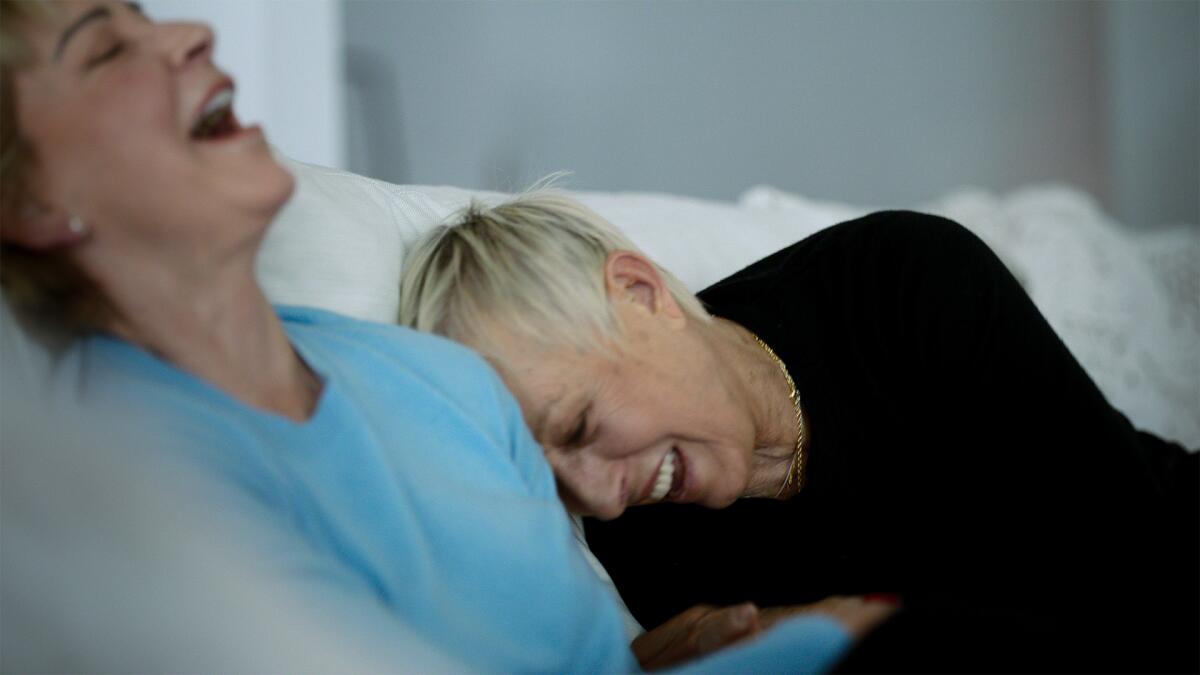
Chris Evert and Martina Navratilova were the most successful women’s tennis champions of their generation. Both were 18-time Grand Slam tournament winners — and each other’s greatest rivals.
Evert, a Florida native, became a tennis star in her teens. Navratilova was born in communist Czechoslovakia, and emerged as a player after Evert was established. They first faced off during a match in Akron, Ohio, in 1973, when Evert was 18, and Navratilova was 16. Evert won, but Navratilova left an impression.
“I remember thinking to myself, holy cow, when this young girl gets into better shape, she is going to be a force to be reckoned with,” Evert says. “She had so much talent. Her hands were quick, she had a big first serve, she had a big forehand, and she just was so powerful.”
Two years later, on the day she lost a semifinals match to Evert at the U.S. Open, Navratilova defected to the U.S. In the years that followed, her tennis game improved. Though she and Evert had initially been friendly, the friendship cooled as their rivalry heated up.
“Playing Chris was difficult because how can you not like Chris? What’s not to admire?” Navratilova says. “She was like the epitome of cool.”
“I can’t get away from her,” Evert jokes. “We had a 15-year career, and then we got cancer at the same time. It really is freaky, but I always say: If I want someone to be in the trenches with me, it’s Martina because she has been so supportive and so understanding.”
Navratilova agrees: “We have such a level of trust that we know whatever we say to each other, it stays there. We give each other the best advice we know how to. And there is no ulterior motive, no playing games.”
At the time that this interview was taped, Evert and Navratilova were both in remission from cancer. But late last week, Evert disclosed she’d recently been diagnosed with a recurrence of ovarian cancer.
Transcript:
TERRY GROSS, HOST:
This is FRESH AIR. I’m Terry Gross. My guests, Chris Evert and Martina Navratilova, were the greatest female tennis players of their generation. They were friends, and they were each other’s greatest rivals in the ’70s and ’80s. When Evert retired in 1989, they’d each won 18 Grand Slam victories, and they’d each been the top-ranked female player in the world seven times. Navratilova retired in 2006. Now they’re the subject of a new Netflix documentary called “Chris & Martina: The Final Set.” It tells the story of how they interacted as friends and as opponents and how their friendship went cold for an extended period when their rivalry became more fierce. When they were each retired, their friendship deepened as they both faced cancer and were able to support each other.
Evert was diagnosed with ovarian cancer in 2021. Navratilova was diagnosed with throat and breast cancer in 2022, the same year that Evert had a recurrence. When I spoke with them a couple of weeks ago, they were both in remission. But late last week, Evert disclosed she’d just been diagnosed with a recurrence of ovarian cancer. Here’s how the interview went a couple of weeks ago.
Chris Evert, Martina Navratilova, what a pleasure to have you on FRESH AIR. And really, like, the documentary is so good, both in terms of your friendship, your rivalry, but also the excerpts of matches between the two of you that are just spectacular to watch. So congratulations on that.
CHRIS EVERT: Thank you.
MARTINA NAVRATILOVA: Thank you.
GROSS: I mean, what are the odds you’d have cancer at the same time and be a short drive from each other in Florida? Really amazing.
EVERT: Yeah. This is Chris (laughter). Freaky. I can’t even – I can’t get away from her. You know, everything happens with us. We had a 15-year career, and then we got cancer, you know, at the same time. And it really is freaky. But, you know, I always say, if I want someone to be in the trenches with me, it’s Martina, ’cause she has been so supportive and so understanding and so – such a calming, you know, voice to talk to.
NAVRATILOVA: Yeah. We have such a level of trust that we know whatever we say to each other, it stays there. We know we give each other the best advice we know how to, and there is no ulterior motive or no – you know, no playing games. And that’s how we like it, because I think we both have had so many people say, oh, you’re great, this and that. They don’t – you know, they don’t give you the real story, but we’ve always been honest with each other on that front.
GROSS: So you both have, or had, athletes’ bodies, and, you know, Martina, one of the things you were known for at some point in your career was basically, building your body, you know, just, like, intense, like, four-hour-a-day training to make your body stronger. And then, Chris, you ended up doing a very similar thing to keep up with Martina. And when you had cancer, you were really weak. I mean, it was hard to just walk. What was it like for you as athletes to live in a body that wasn’t functioning, that was very weak?
NAVRATILOVA: Well, for me, I mean – so Chris’ diagnosis and treatment was much more life-threatening than mine, percentagewise. But my treatment was more difficult physically. I think – I was – I brought my yoga mat with me. I was in New York for seven weeks, and I literally sat on the yoga mat, maybe half an hour of the seven weeks and did some stretching. I couldn’t even do the down dog pose ’cause I would have fallen down. I had absolutely zero strength left. But the longest thing that took was the taste, which – I love to eat. So that was tough. But, you know, we’re athletes, so we want things to happen right away. It was almost a year before I had full taste buds coming back. But it all came back. But Chris was – well, you talk about…
EVERT: Yeah.
NAVRATILOVA: …What you went through.
EVERT: Well, I think the chemo, you know, kicked my butt. Let’s put it that way. And, you know, when you think about – you know, I don’t want to use the word poisons, but the toxins, you know, it’s killing the good cells as well as the bad cells, and it left me very weak, very, very weak. After chemo, I would have three or four days of intense nausea, and I just would feel tingling in my body, and it just wasn’t nice. And, you know, I didn’t have the energy. I mean, to walk six blocks was a big deal for me. And it was foreign. You know, it felt like it was in my body, for sure.
NAVRATILOVA: Yeah.
GROSS: What were you able to do to support each other through the cancer and its treatment?
EVERT: You know, there are a lot of phone calls between us, and Martina, who is the cook in the relationship…
NAVRATILOVA: (Laughter).
EVERT: I don’t cook, but Martina would bake bread for me, and her wife, Julia, would cook, make some chicken soup, so I…
NAVRATILOVA: I made you pesto.
EVERT: Got a lot of – pesto, yeah. I got a lot of food from Martina.
NAVRATILOVA: (Laughter).
EVERT: She got a necklace from me.
NAVRATILOVA: Yeah. I get jewelry from Chris. She gets food from me.
EVERT: But, you know, Martina’s and my relationship, because we’ve had one for 50 years, is not the type where we have to talk to each other every day to maintain the closeness. I always knew she was there. She always knew I was there if we needed to talk, and that was that.
GROSS: Martina, you knew that something was wrong when you felt a lump in your throat. But…
NAVRATILOVA: It was my lymph node.
GROSS: Oh, it was your lymph node.
NAVRATILOVA: Yeah. Yeah, yeah. The tumor was on my tongue, based on my tongue, but I did not feel that. I just felt a swollen lymph node, so if you can…
GROSS: Right, and that’s what got you…
NAVRATILOVA: (Inaudible) ask the question.
GROSS: …To be tested.
NAVRATILOVA: Yeah.
GROSS: But, Chris, you weren’t symptomatic, but your sister…
EVERT: No.
GROSS: Jeanne, had died of ovarian cancer, and she had a genetic mutation, and you wanted to see if you had the same thing. Did I get that right?
EVERT: Yeah. Yeah. I’ll tell you the story to that. My sister, Jeanne, was traveling with me to Singapore, and we were running to the gate. But I looked back, and Jeanne was huffing and puffing and not running. And I said, Jeanne, what’s the matter? She’s an athlete. And she said, I don’t know. I’ve just been out of breath the last few weeks, and I just don’t know. I think maybe I have a lung, you know, infection or something. And I said, well, did the doctor say that? And she goes, No, I haven’t been to a doctor.
So I said, Jeanne, you know what? We’re going to Singapore for four days. And when we come back, you are going to the hospital right away and get this tested ’cause something’s not right. So she said, OK. So she went, and first, she got genetic testing. And believe it or not, she did not – everything turned out fine. She didn’t have the BRCA Jeanne, but she had a variant that was of uncertain significance, which means it hasn’t been tested enough. You know, there’s not enough case studies. And so they said, you know, she doesn’t have BRCA, so you don’t need to be tested. So nobody else in the family was tested.
But unfortunately, Jeanne left it too long, and when she went in, it – she had Stage 4 ovarian cancer, and it spread everywhere in her body. And she ignored the symptoms because, like most women who are nurturers – they’re caring about their kids and their husband and their family – they forget about themselves. And that’s probably one of the messages I want to get out there. If you feel anything different at all, slightly, you know, go get it tested. So after my sister died, two years later, I get a call from the geneticist and they said, do you remember that variant that your sister had of uncertain significance? Well, that is – that has changed, and now that’s basically cancerous. And it’s BRCA. So maybe – we recommend that you and your family go get tested. Next day, I went, got tested. I had the BRCA gene in me, and that week, I got a hysterectomy, and they took it all out. But the results came back, and they said, unfortunately, you have a tumor in your ovaries, and you have tumors in your fallopian tube. And I was like, are you kidding me? And they said, but, you know, it’s Stage 1. You got lucky. You got it early. And by the way, I had had blood tests. I had had internal sonograms. I had, you know, everything that you can imagine, and nothing was detected as far as ovarian cancer. And I felt fine. I felt no symptoms. So that was my story. And it’s like, you know, so I had the BRCA gene, and I got – I had a hysterectomy, and then later on, I had a mastectomy because you have a 70% chance of getting breast cancer if you have the BRCA gene.
GROSS: Did you freak out, Martina, when you were diagnosed?
NAVRATILOVA: Yeah (laughter). Yes, I did. So I felt that my lymph node was swollen. So about two weeks later, it’s still there, swollen. So I called my doctor, and he says, we need to get a biopsy, and it was on a Tuesday. He says, by Thursday or Friday, we’ll know. So, Friday, I don’t hear anything. I call him. And he called back, like, 5 minutes later. He says, the lymph node is HPB, but the tumor could be anywhere. He literally said, it could be in your lungs or your kidneys or your liver. And I’m – oh, my God, you know, I could, like, not see next year. And so I totally freaked out over the weekend. This is Friday afternoon. And then I found out Monday, oncologist calls me, and he says, well, it’s HPB and it’s definitely just in your throat. It’s not anywhere else, and the cure rate is 95%. And I was so relieved. I had, like, the worst weekend of my life from what the original doctor said. And then the oncologist said, it’s going to be nasty. It’s not nice. We need to find out where the tumor is, but it’s somewhere in your throat. So good news, bad news.
And then when – and then – so we scheduled a CT scan, and – so then they inject you to see where the tumor is, and they said, OK, so we found the tumor, it’s at the base of your tongue on the left side, size of about maybe 2 centimeters, almost an inch. I didn’t feel it. And also, your right breast lit up. So I know it’s cancer (laughter). Unrelated to that, so now – so then I have biopsy on the breast, and it’s completely different cancer, tumor, about a centimeter. Same thing. Nothing showed. I did not feel anything. The mammogram, the day of the surgery, still didn’t show the tumor. So even with the mammograms that we have – they are amazing – they still didn’t find it. Only ultrasound found it.
So then I had to figure out, OK, what do we do now? You know, then you get into the solution. What’s the sequence of cure? Because I had two different cancers that went unrelated. I did the gene testing. I have nothing. I was just – this is my third cancer – second and third cancer that I’ve had unrelated to each other. So…
GROSS: You had breast cancer in 2010.
NAVRATILOVA: In 2010, yes.
GROSS: Well, let me reintroduce you both.
If you’re just joining us, my guests are Chris Evert and Martina Navratilova. They’re the subject of a new Netflix documentary called “Chris & Martina: The Final Set.” We’ll be right back. This is FRESH AIR.
(SOUNDBITE OF RUDY ROYSTON’S “BED BOBBIN’”)
GROSS: This is FRESH AIR. Let’s get back to my interview with tennis champions Chris Evert and Martina Navratilova. They were friends, they were rivals and they were the top players of their generation and two of the top female players ever. They’re the subject of a new Netflix documentary called “Chris & Martina: The Final Set.” It’s about their friendship, their rivalry and then years after they both retired, having cancer at the same time.
In the documentary, we see you in the present, and you’ve – you’re still, like, recovering, but you’re done with the treatment. And you’re in – I’m not sure what room you’re in (laughter), whether it’s one of your living rooms or someplace else, but you’re watching playback – like video playback – of some of your matches together, you know, of – excerpts of some of your matches together. The playing is spectacular. And what was it like? What were you seeing, and what was going through your mind as you are at this point, like, close to 70 – I think that’s about how old you were – looking back at when you were in your prime and were rivals battling it out on the tennis court?
NAVRATILOVA: For me, it was fun watching with Chris ’cause we were – had different reactions to what happened on the court. But what impressed me is how well we played with those wooden rackets because, you know what? Those rackets are not easy to play with. But you try to put yourself in there physically what it was like, mentally what it was like. And it’s like, oh, I should have gone down the line, or I can’t believe I’ll missed that shot, or Chris, you had such a great pass. It was amazing. So it was impressive. And the bodies, yeah, I’m like, I wish I could still have that six pack, but anyhow.
(LAUGHTER)
EVERT: Yeah. I think – I mean, I had to emotionally get myself back into that time, you know, that time of my life. You know, I think when I watched – you watched two different matches. One Martina one on the grass. And I noticed that I was winning quite handily. I had control of the match, and then I had a sitter, and I hit it down the middle, and Martina kind of ran into it because I didn’t mean to hit her in the head, even though some people may think I did. But Martina kind of was trying to cover that shot.
NAVRATILOVA: Yeah.
EVERT: So she ran, and I hit her in the head. And it was like a comic relief a little bit, you know, ’cause we were both so stressed out, comic relief. But unfortunately, for me, she came to life after that point. And then she just played, you know, great grass court tennis and beat me. And I remember feeling genuinely happy for her. I remember it was her first Wimbledon. That’s always been her dream since she defected. Her family couldn’t be there to watch her. She was all alone. And I just was happy for her. And I knew that this was going to be one of many for her to win. In my match, the French Open, I remember that that was in ’85, and that was the happiest I’ve ever been winning a major because I had had a 2 1/2 year drought against Martina and hadn’t beaten Everybody counted me out and never thought I’d win another major, and I did. And I went back to the gym and worked out and came into the net, had some new strategies to play. So we both kind of redefined ourselves and our games because the other one was No. 1 at the time, and we made each other better…
NAVRATILOVA: Yeah.
EVERT: …At the end of the day.
GROSS: So I’d like you to each evaluate each other’s strengths and vulnerabilities from your point of view as the opponent.
NAVRATILOVA: Well, for me, Chris was the epitome of mental toughness and poker face. She controlled her emotions on the outside 100%. You never knew if she was winning or losing. She was just so controlled, and I so wasn’t. So I always admired that and couldn’t believe that she could keep it together like that. And her concentration levels – she never gave anything away, as far as points. You had to earn it. So I knew every time before we played each other and whether winning or losing, I knew it was going to be a long, long physical match.
EVERT: Nothing physical in my game was any good?
NAVRATILOVA: Well, yeah, you never missed.
EVERT: (Laughter).
NAVRATILOVA: And you – she ran everything down. And then later, when she got older, she shortened the points and took the net away from me. But, yeah, it was emotional.
EVERT: OK, I think with Martina, she was, like, an unbelievable athlete. So basically, her movement, her power from her shots – you know, she had a great forehand and a really tricky serve to return. Her backhand was her weaker side, and, you know, I tried to extend rallies and keep her at the baseline because I felt like, you know, she would – I could wear her down, and eventually, she’d miss. And she would get emotional sometimes in matches, and I felt like that was sort of a feather in my cap. But later on, at the end of her career, obviously, she really improved in that area.
GROSS: You each started really young. Chris, you were 5. You were trained by your father, who was a tennis pro. And he used to come with, like, a cart of tennis balls and throw them your way so you can hit them back. Martina, you started training in Czechoslovakia at age 4. You started…
NAVRATILOVA: Five. Five.
GROSS: Oh, you were 5, too.
NAVRATILOVA: Yep.
GROSS: And it was your father or stepfather who trained you?
NAVRATILOVA: My stepfather. Yeah.
GROSS: And so you both…
NAVRATILOVA: But he was my father.
GROSS: You both trained hard. At the time when you were training, which obviously really paid off, did you want to go out and play with friends instead of constantly training? Did you think, at the time, I’m missing my childhood? Or did you think that in retrospect?
EVERT: My mother used to pick me up from kindergarten, and I used to go to Kara Bennett’s house, my girlfriend down the street, and go swimming in her pool, which was a novelty, and have barbecues at night. And I really had a great afternoon. All of a sudden, my mom started picking me up at kindergarten and bringing me to Holiday Park so that my dad could throw tennis balls.
GROSS: That’s where your dad was from.
EVERT: My dad, who was my tennis pro and tennis coach, used to throw balls, and I would, you know, repeatedly – you know, hit the tennis ball. So he was teaching me how to play tennis. I remember a 5 years old feeling very resentful and very bitter and very upset. And – but there was nothing I could do about it because my dad was my dad, and he was the – you know, he was a disciplinarian, and he was the head of the family. So I had no say. But it wasn’t my choice to go over and play.
But as time went by, interesting enough, more and more kids came to Holiday Park, and I met new girlfriends, and I played with the girls. I played tennis with the boys. And it really became a great little spot to have friendships and also to play tennis and to get better. So, I mean, that feeling went away quickly, and as soon as I started winning 10-and-under tournaments and 12-and-under tournaments, you know, I had the fever, and I knew that I really loved it, and I love to win.
NAVRATILOVA: Yeah, for me, it was different in that I did not play every day at all growing up. First two years since I was 5, I was just on the – hitting against the wall. And when I was 7, when I could hit the – I was my using grandmother’s racket. So when I could finally hold the racket with one hand, ’cause I was just hitting 200 backhands against the wall. Then I got on the real court, and then when I was 9, I got a coach who taught my father how to teach tennis. And in the winter, we didn’t play at all from, like, October – this was on clay in Europe. And so, from October to April, I did not play tennis at all until I was maybe 10 years old. Then I would go once a week for an hour in the winter. That was it.
And during the summer and in the winter, I was doing cross-training ’cause I was playing hockey. I was – you know, I was skiing, climbing trees. In the summer, I would swim in the river, ride my bicycle everywhere. But I didn’t really play tennis on a daily basis until I was, like, 15, 16 years old. So it was just completely different for me.
GROSS: My guests are Chris Evert and Martina Navratilova. The new Netflix documentary about their friendship, their tennis rivalry and having cancer at the same time in the 2020s is called “Chris & Martina: The Final Set.” They were in remission when we recorded our interview a couple of weeks ago, but last week, Evert disclosed she’d just been diagnosed with a recurrence of ovarian cancer. We’ll hear more of the interview after a break. I’m Terry Gross, and this is FRESH AIR.
(SOUNDBITE OF MUSIC)
GROSS: This is FRESH AIR. I’m Terry Gross. Let’s get back to my interview with Chris Evert and Martina Navratilova, who were tennis champions in the ’70s and ’80s. They spent much of their careers as friends and as their greatest rivals. A new Netflix documentary called “Chris & Martina: The Final Set” is about the challenges of that dual relationship and about how they supported each other when they were each diagnosed with cancer at about the same time in the 2020s. When I recorded this interview with them a couple of weeks ago, they were in remission. But late last week, Evert revealed she had just been diagnosed with a recurrence of ovarian cancer.
Chris, in 1970, when you were 15, you defeated the No. 1 ranked women’s professional player around the world, Margaret Court, and you became famous for being so good at age 15. How did that affect your sense of who you were and what your life would be like?
NAVRATILOVA: Good question. I want to know.
EVERT: (Laughter) You know, fame at a young age and success is not a good recipe for emotional and mental development and growth. It really isn’t, because I did beat Margaret Court and then all of a sudden, I was getting a lot of attention, and people were coming up and patting me on the back and telling me how great I was, and people were allowing me to get away with things, and it went to my parents allowing me to get away with things as well. You know, I just think before you develop a personality and you develop principles and boundaries, you know, when you’re a kid and everyone’s telling you that you’re the greatest ever, I just think that it just is very, very confusing and very detrimental to, you know, your health.
And in those days, we didn’t have psychiatrists and therapists, and, you know, we didn’t have the resources that today’s game has. You know, Martina and I had to do this all ourselves, figure it out all by ourselves. And my parents weren’t that much of a help because they had never been in my position. So it was like – it was very strange, and I think it affected me, you know, later on in my life when it came to relationships.
GROSS: Well, Chris, you had to go to school, I think, the day after the Margaret Court match.
EVERT: I did. I did.
GROSS: What a clash of worlds that must be.
(LAUGHTER)
EVERT: Yeah, I mean, I did. And, you know, I was – people – the kids were looking at me different. Like, I was very – honestly, I was very shy, and I wasn’t outgoing, and I wasn’t confident in myself. I was a bit insecure. I wasn’t the popular girl. And people were looking at me and kids were looking at me. You know, so I felt like an outsider, actually. And then, you know, as years went by and I started playing tournaments, and the press dubbed me – you know, they labeled me, gave me an image – Little Miss Ice Maiden, you know, Cinderella in Sneakers, Little Miss Icicle. And because I was very cool and calm on the court and composed, they thought I was cold, and how could this be a schoolgirl being this cold? And so they gave me an image. And honestly, when you’re young, you start living within your image. It’s just easier.
GROSS: Martina, when you played your first match in the U.S., I think it was the first time you’d been to the U.S. from Czechoslovakia, and travel was so restricted after the Russians invaded. What was that first tournament like for you? Like, you weren’t really speaking the language. You were basically alone. I think Chris had already, like, you know, befriended you and was helping kind of acclimate you. But tell me what that first match was like. And was that against Chris?
NAVRATILOVA: No, no, no, no. So the first tournament I had to play qualifying to get into the draw. It was 16 draw. Chris ended up winning it, of course. But I won my first round match. I got qualified, and I won the first round match, and then I lost in the quarters. But I was thrilled to be in the States. I always loved American cars. And when you ordered a ham sandwich, you got, you know, like 2 inches of ham and two slices of bread, whereas growing up, you had thick bread and one slice of ham. So I thought I was in heaven. And it was $2.50 for that sandwich. I still remember it. I couldn’t believe how much ham I was getting. So I fell in love with American culture because it was so – there were oranges on the streets. I could pick an orange.
GROSS: Is this Florida or California?
NAVRATILOVA: Florida. This is Fort Lauderdale. So I’m picking up an orange, you know, as I’m driving down the road. And in Czechoslovakia, we only had oranges once a year. For Christmas, we would get bananas and oranges. It was a treat. Normally, you just get apples and pears and maybe peaches. So it was, like, you know, “Alice In Wonderland” for me, coming to the States.
GROSS: Chris, you befriended Martina. You helped her, you know, culturally. But also, did you help her with her game? And did you think, she’s going to become my fiercest rival soon?
EVERT: No, I did not help her with her game.
NAVRATILOVA: She wasn’t going to do that even if she could.
EVERT: What the heck. Yeah. I was not a coach. I was a player trying to protect my No. 1 ranking.
NAVRATILOVA: And you were 18.
EVERT: But I saw a very talented young Czechoslovakian player, and I played her in Akron, Ohio. And you were 16 then?
NAVRATILOVA: Yeah, 16.
EVERT: Sixteen and I was 18.
NAVRATILOVA: (Inaudible) on the tour, yeah.
EVERT: Which is in the same month that I met her. And I won 7-6, 6-3. But I remember thinking to myself, holy cow. When this young girl, you know, gets into better shape, she is going to be a force to be reckoned with and very dangerous because she had so much talent. Her hands were quick. You know, she had a big first serve. She had a big forehand. And she just was so powerful.
GROSS: So you maintained your friendship until that kind of went cold. And the way the story is told in the documentary is that, Martina, you had become close to Nancy Lieberman, who, I think it’s fair to say was, like, the most famous basketball…
NAVRATILOVA: Yeah, she was at the time.
GROSS: …Female backetball player…
NAVRATILOVA: Yes.
GROSS: …Of her era. And I think you became romantically involved, too, but she told you that you had to, like, train harder, eat better and, you know, trim down. And she had you training, like, for hours a day. And your body transformed.
EVERT: Unbelievably.
GROSS: But she also told you that it was time to stop being friends with Chris because it’s hard for an opponent to be a friend. You have to just, like, not think about her feelings or anything and just see her as your rival. And I want to know from each of you how that felt. How – let’s start with you, Martina. How did it feel like, I can’t be friends with Chris anymore?
NAVRATILOVA: Well this happened – so Nancy and I met in April, and then Nancy came with me to the French Open, Eastbourne, Wimbledon, and I lost in the semis in all those tournaments. And after Wimbledon, she says, what are you doing? What do you mean? I mean, you could be in so much better shape, and you’re too nice to Chris. I’m like, what are you talking about? Oh, you need to be tough, and you need to start training harder. And you need to hate your opponents, and you need to hate Chris. I’m like, oh, OK. And I was very, you know, naive. And again, I didn’t have the skills to say, no, that’s – I don’t have to hate her. I just need to want to beat her. I was almost too friendly. But the getting in shape thing was news to me. I thought I was in good shape. Then she took me on the basketball court, had me run some suicide drills. And that’s when I realized, OK, I’m not in as good a shape as I thought.
So that summer, I started training hard. Then during the US Open, Renee Richards started helping me, became my coach after the US Open. And that’s when everything kind of changed for me, the fitness and then the coaching. Because for six years after I defected, I didn’t have a coach. My father was my coach. But we could talk maybe once a month. So he couldn’t coach me and I was on my own. And that’s when Renee started helping me. That’s when everything changed for me.
GROSS: And, Chris, what was it like for you after Martina, following the advice of Nancy Lieberman, distanced herself from you?
EVERT: Hurtful. It was very hurtful. And I don’t think that was really Martina. I think she was just, you know, following Nancy’s orders. And Martina, you know, was really sort of afraid to speak up to her at the same time. But in saying that, Nancy Lieberman did a heck of a lot for Martina Navratilova when it came to her tennis and her fitness.
NAVRATILOVA: Yeah, 100%.
EVERT: Because it was a 180-degree turn from the athlete that she was then until after she had worked out with Nancy. And she was just – she became unbeatable, and then for the next 2 1/2 years, you know, lost six matches. So she did her a lot of good, let’s put it that way, but not in a nice way.
GROSS: You lost six matches?
NAVRATILOVA: Well, I had a stretch where I lost six matches in three years. That’s how amazingly I played then. I mean, when I look at the numbers now, I’m like, wow.
GROSS: Dominant.
NAVRATILOVA: But when you’re doing it, you don’t think about it. But, yeah, that was a pretty good stretch.
GROSS: My guests are tennis champions Chris Evert and Martina Navratilova. They spent most of their careers as friends and rivals and are now the subject of a new Netflix documentary called “Chris & Martina: The Final Set.” We’ll be right back after a short break. This is FRESH AIR.
(SOUNDBITE OF MICHELLE LORDI SONG, “WAYWARD WIND”)
GROSS: This is FRESH AIR. Let’s get back to my interview with tennis champions who spent most of their careers as friends and rivals, Chris Evert and Martina Navratilova. They’re the subject of a new Netflix documentary called “Chris & Martina: The Final Set.” Chris Evert had been ranked the No. 1 female player for seven years. But in 1978, Navratilova defeated Evert in her first Grand Slam singles title at Wimbledon and supplanted Evert as the top-ranked female player. Navratilova went on to hold that position for almost seven years.
Chris, what did it do to your identity? Because your identity was built, ever since you were like 15, on, like, being amazing, being unbeatable, being No. 1. And when you stopped being No. 1, when you were losing to Martina, who you had known before she was nearly that good, what did it do to your sense of self?
EVERT: You know, I mean, whether it’s ego or pride or whatever it is, I wasn’t happy about it. I hadn’t played anybody like that before. Nobody had come along with that versatility and the strength, the power that Martina had. And it was tough to swallow, to tell you the truth. But after a while, I kind of came to terms with it and realized, she’s just too good. And you can continue to work hard, go in the gym like she does and train like she does and, you know, just try to become a better athlete and change your game a little bit.
GROSS: That’s what you did. You started training and…
EVERT: Yeah. Yeah. Changed my strategy, yeah.
GROSS: Yeah. You took a break for a while from tennis.
EVERT: I think I was the first one to take – it was a mental break at that time, because the way I described it was like I’d wake up in the morning, and I didn’t want to get out of bed. And the thought of competing, you know, made me – I just didn’t – I didn’t have the burning desire. I didn’t have the killer instinct.
GROSS: Were you burned out? And were you also discouraged because you weren’t winning as much?
EVERT: No. No, no, no, no. I was burned out. I mean, you know that – they call that the seven-year itch in marriage. Well, there’s, to me, there’s a seven-year itch as being an athlete. And I just was mentally drained. And I needed – I wanted just to live life like a normal 24-year-old.
NAVRATILOVA: Yeah, it was ’78. I played 21 tournaments, and Chris played 10 tournaments.
GROSS: Martina, did you go through that seven-year period?
NAVRATILOVA: I was burned out at the end of ’86, and I did not know it either. It should’ve been red flags flying everywhere because I asked my then coach Mike Estep, how few tournaments can I play and still stay No. 1? (Laughter) Hello.
GROSS: (Laughter).
NAVRATILOVA: But I didn’t know to take a break. I did not take any vacations. And I played for three years burned out, and I still kept trying, and the results weren’t there. Then Steffi Graf comes along and starts beating both of us. And so I ended up talking to Billie Jean. I said, Billie, I don’t know what’s going on. This is not ’89 in the spring. I said, I don’t know what’s going on. You know, I’m trying hard, but the results aren’t there and this and that.
So she advised me to take a week off, just do nothing except what I want to do and see if I still feel, like, the love of the game that I had when I was a little girl hitting against the wall. So I did that. I took a week off, did nothing. And I’m like, yeah, I still want to play. I love the game, and I still feel I can get better or improve in some ways, and I want to play. And so – and I played six more years after that. So all it took was one week of self-reflection. But I didn’t know to take the break.
GROSS: I wonder if this contributed to feeling burned out. You talk about – in the documentary, you talk about how Chris was, like, considered, like, the girl next door. Everybody loved her in the stands. But for you, people saw you like, well, she’s the communist and she’s a bully, and then at some point after you were outed, and she’s a lesbian.
NAVRATILOVA: Yeah.
GROSS: And you would get some boos. You wouldn’t get as many cheers as…
NAVRATILOVA: Yeah.
GROSS: …As Chris did. That sounds a little demoralizing. Did that contribute to your feeling of burnout, do you think?
NAVRATILOVA: I’m sure that didn’t help because I always felt like I was the visiting team. No matter where I played, you know, they were cheering for the other guy to win or for me to lose. Either way, you take it personally, and it was tricky. And playing Chris was difficult because how can you not like Chris? What was not to admire? You know, she was, like, the epitome of cool, and I was not.
But then coming from a communist country, coming from a Slavic country, then, of course, being gay didn’t help either so – and then, you know, I had visible muscles and, you know, I was physically stronger, imposing and all of this. And unapologetic – I never apologized for who I was. And, you know, as a woman, you’re supposed to be more demure, and I certainly never was that. So it was just a whole bunch of stuff. And when you really think back, I was still kind of alone because I was not getting the help emotionally or mentally that I could have used back then. And the pressure never goes away, really.
GROSS: And then there was also the pressure of not being able to come out because it wasn’t done. You know, you…
NAVRATILOVA: No, no, no, no, I couldn’t come out because it would have been a disqualifying – could be disqualifying for getting my citizenship. So I couldn’t come out until after I got my…
GROSS: Oh, I didn’t realize that.
NAVRATILOVA: …Citizenship in ’81. Yes, it was on there. It’s up to the final officer, which were I think always men who did the final interview to approve you for citizenship. They can ask you whatever they want. And if they ask you, are you gay – and you can’t lie, right? Because then that could be a disqualifier. You have to tell the truth. You’re under oath. And if you say, yes, and if that officer deems that a disqualifying answer, then you will not get your citizenship, and you’re done. And so I couldn’t come out for that reason. And then once I got my citizenship, I didn’t want to come out because it would have hurt the tour. So it was always something. I was never ashamed of who I was, but I was kind of in the closet because of these circumstances.
GROSS: That’s a lot to keep in when you’re in the public. eye.
NAVRATILOVA: Yup, it is. It is, yeah.
GROSS: Especially when you’re being booed, you know what I mean?
(LAUGHTER)
GROSS: You were just up against so much and had so much you had to keep inside yourself. So…
EVERT: Yeah.
GROSS: You were outed in the New York Daily News.
NAVRATILOVA: Yup.
GROSS: Do you know how that happened?
NAVRATILOVA: Yeah. So I got my citizenship. I think it was July 20. I go next – two days later, I got my passport. The next day, I fly to France to play in an exhibition in Monaco. And that reporter who had been asking me, are you gay or are there any lesbians? I can’t talk about it until I get my citizenship. I get my citizenship. He calls me. He finds me. And are you ready to talk now? I said, no, because I gave him the reason about the women’s tennis tour because Billie Jean King was outed about her lesbian relationship, and she was trying to save herself and – you know, from losing all the sponsors, sponsorship. She lost them anyway.
And then the people in charge of WTA said, you know, we cannot have another scandal. Because they knew I wanted to come out once I got my citizenship. So you can’t come out because the sponsors said they will leave the women’s tour if there is another scandal. So I explained this to him. I said, I can’t come out because. And then I said, you’re not going to print this story, right? And he said, not if you don’t want me to. I said, well, of course I didn’t want you to. Bam, the next day or two days later, it’s in the Daily News. Martina comes out as bisexual. So there we are.
GROSS: If you’re just joining us, my guests are tennis champions Chris Evert and Martina Navratilova. They’re the subject of a new Netflix documentary called “Chris & Martina: The Final Set.” We’ll be right back after a short break. This is FRESH AIR.
(SOUNDBITE OF GILAD HEKSELMAN TRIO’S “DO RE MI FA SOL”)
GROSS: This is FRESH AIR. and if you’re just joining us, my guests are tennis champions who spent most of their careers as friends and rivals – Chris Evert and Martina Navratilova. They’re the subject of a new Netflix documentary called “Chris & Martina: The Final Set.” It’s about their friendship, their rivalry And then, years after they both retired, having cancer at the same time.
So I want to ask you briefly about retirement. Chris, you retired in 1989. How old were you?
EVERT: Thirty-four years old.
GROSS: Yeah. How did you know it was time, and how did it affect your identity when you were no longer the tennis star? I mean, you were still a celebrity, but you weren’t playing anymore.
EVERT: The reason I retired was because the mental side of the game was my strength, and the focus and the determination and the hunger to win was my strength. I used it in my advantage. And I didn’t have it anymore. I just wanted to relax. I didn’t want to have pressure, and I wanted to start a family. So the nice thing was I had something to go to, and I think that made it, you know, not only bearable, but attractive to me to retire.
So after I retired, I was married to a great guy, Andy Mill, and we had a great life. And a couple years later, we started a family. And I remember every morning waking up after retirement felt like a vacation because I had the freedom to do whatever I darn wanted to do. ‘Cause since I was 6 years old, I had a plan, and I had a routine, and I was on the court every day. So that was that.
GROSS: And you had three children in five years. You could not have done…
EVERT: Yes.
GROSS: …That if you were playing.
EVERT: No. I really threw myself into motherhood and nurturing. And it was so nice not to think about myself. It was so nice to care for somebody else besides myself. It was just the time for me to start to be a little unselfish and not be selfish.
GROSS: Martina, you played for, like, nine – eight or nine years after that, right?
NAVRATILOVA: I retired in ’94, then I didn’t play for five years, and then I played doubles for six years because I really enjoyed it. But yeah, ’94 was my last year. And so I played my last match in the garden in New York in November. It was a Tuesday, and my parents were with me. And on Friday, my mom said I look 10 years younger because all that stress was finally gone.
GROSS: So I think it’s fair to say that you both contributed a lot to the state of women’s tennis, the popularity of women’s tennis because the rivalry between the two of you, these two amazing tennis players playing against each other, that really attracted a lot of crowds. And it was a thing, like, your friendship and your rivalry together, it was a thing. It was a story in the press. People wanted to see it. And I’d like you each to talk a little bit about how you saw the state of women’s tennis changing and what you think you contributed to that.
EVERT: Well, for me, I could sense that tennis was becoming more global. After the Billie Jean King generation – Billie Jean, we have to give full credit to her and the original nine for really working hard to create a tour and provide – that provide a good living for women tennis players and, you know, equal prize money. And she was the pioneer. But we were the next generation, and they needed us, also, to carry the torch. So when Martina and I came along, I think our rivalry brought it to another level – a whole new level because Martina and I brought our own set of fans…
NAVRATILOVA: Right.
EVERT: …To the plate. And Martina – we were so different. She came from a communist country. I came from America. I was a baseliner. She was a serve and volleyer (ph). She was emotional. I was cool and calm. So we both had our own set of fans, and I think we brought more eyeballs to the TV, and we brought more bodies into stadiums. And that, you know, it enhanced the game of women’s tennis.
GROSS: What about younger players now? Do you watch a lot of tennis, and do you think that they’re bringing something new to the table and helping to expand women’s tennis?
NAVRATILOVA: Yeah. So both Chris and I do commentary for – of – for different channels. So we work at all the majors. So we’re still, you know, have the finger on the pulse of the game. And yeah, because of TV, tennis has become much more international. And then when you have a player from that country, then they – that excels, then they – you know, they bring it to the new generation in their country and expand the map again. When Li Na won the Australian Open – or the French Open was the first major she won, first Chinese player or first player from Asia to win a major, oh, my God, tennis exploded in China, and now you have a lot more players playing as Chinese players because of Li Na paving the way for them. So every time you get a player from a different country, it kind of expands the map in that way.
EVERT: And when the Williams sisters came along, we have now more women of color…
NAVRATILOVA: Yeah.
EVERT: …Playing, and they were a great influence to women all over the world. I think the players nowadays have more of a social conscience, also. So they’re good – they’re very outspoken about what’s going on in the world, and they’re really good at, you know, bringing these issues to their platform and talking about whether it’s the mental health or whatever. You know…
NAVRATILOVA: Naomi Osaka…
EVERT: Naomi Osaka.
NAVRATILOVA: …Iga Swiatek, Coco Gauff.
EVERT: Exactly.
NAVRATILOVA: Very switched on.
EVERT: Inclusion, you know, all this. They tackle these subjects with class. And so I think that they’re very bright that way. And, you know, I think it’s in a good state right now.
GROSS: Thank you both so much…
NAVRATILOVA: OK.
GROSS: …For being on our show, and thank you for participating in that documentary ’cause it’s really good.
NAVRATILOVA: Thank you.
GROSS: Thank you.
EVERT: Thank you, Terry.
GROSS: Chris Evert and Martina Navratilova are the subjects of the new Netflix documentary “Chris & Martina: The Final Set.” We recorded our interview a couple of weeks ago. Late last week, Evert disclosed she’d been diagnosed with a recurrence of ovarian cancer. We send her our best wishes.
Tomorrow on FRESH AIR, we’ll talk about the conflicts between politics and the arts. Our guest will be Isaac Butler, author of the new book, “The Perfect Moment: God, Sex, Art, And The Birth Of America’s Culture Wars.” Butler said the conflict had a transformative effect on him because at the same time the culture wars hurdled toward their climax, art saved his life. I hope you’ll join us.
To keep up with what’s on the show and get highlights of our interviews, follow us on Instagram – @nprfreshair.
(SOUNDBITE OF MUSIC)
GROSS: FRESH AIR’s executive producer is Sam Briger. Our technical director and engineer is Audrey Bentham. Our engineer today is Adam Staniszewski. Our interviews and reviews are produced and edited by Phyllis Myers, Ann Marie Baldonado, Lauren Krenzel, Therese Madden, Monique Nazareth, Thea Chaloner, Susan Nyakundi, Anna Bauman and Nico Gonzalez-Wisler. Our digital media producer is Molly Seavy-Nesper. Roberta Shorrock directs the show. Our co-host is Tonya Mosley. I’m Terry Gross.
(SOUNDBITE OF MUSIC)