Blog
-

Count Binface: The intergalactic warrior who could upend Britain’s strangest election
When Nigel Farage triggered a special election this week amid scrutiny over his finances, Britain’s populist right-wing leader declared it a “people versus the establishment” election.
A longtime ally of President Donald Trump, Farage has built a political profile that extends well beyond Britain’s borders. He was one of the leading figures behind the campaign to leave the European Union, known as Brexit,
and has spent years presenting himself as an outsider in British politics.Now, the man who once helped reshape British politics is facing one of his strangest opponents yet: a candidate dressed as a giant trash can.
Hours after the Reform UK leader resigned his seat in Parliament, triggering a by-election -or special election – in his Clacton-on-Sea constituency in southern England, the country’s three main political parties said they would stay out of the contest.
Labour, the Conservatives and the Liberal Democrats all said they would not field candidates in the election, variously describing his resignation as a “stunt” and a distraction from the issue of Farage’s finances.
Instead, the contest has taken a bizarre turn, with Farage’s battle against the establishment now sharing the spotlight with Count Binface — a satirical candidate dressed as a garbage can.

Reform UK leader Nigel Farage stops outside a bucket and spade shop for a photograph while speaking to members of the public on the High Street on July 8, 2026, in Frinton-on-Sea, England. (Dan Kitwood | Getty Images Europe) Farage gambles on a new election
This latest twist in British politics comes after weeks of mounting questions over how Farage — whose right-wing populist Reform UK party has been leading in a number of national polls for months — gets his political funding.
Earlier this year, it emerged that Farage had received an undisclosed gift worth more than $6 million from cryptocurrency investor Christopher Harborne. The billionaire has lived in Thailand for two decades, where he is known by the name “Chakrit Sakunkrit”.
Harborne has donated millions to Farage’s Reform UK party, making him the single biggest living donor to a British political party in history. That gift is now being investigated by Parliament’s standards watchdog.
The scrutiny intensified earlier this month when it emerged that Farage had also failed to declare financial benefits — including private security, staff support and accommodation — provided by his longtime aide, George Cottrell, who has been found guilty of fraud in the United States. Now, Farage could face a second parliamentary investigation over the matter.
Both Farage and his Reform UK party have denied that he has breached any House of Commons rules in either case. But he has become increasingly frustrated by questions from the media over his finances.
On Tuesday, Farage hit back at the scrutiny, telling reporters he had “had enough” of questions about his finances and insisting he had “done nothing wrong.”
Farage then announced he would resign as a member of Parliament, forcing a special election where he will ask voters in Clacton to “be the judge of my actions.”

Labour’s Andy Burnham stands with Count Binface and a Protect British Wildlife candidate after winning the Makerfield by-election, boosting his bid to become the UK’s next prime minister, June 19, 2026. (Jon Super | AP) Enter Count Binface
Outgoing prime minister and leader of the Labour party Sir Keir Starmer described Farage’s resignation as a “desperate stunt.” The leader of the opposition Conservative party, Kemi Badenoch, described the contest as “fake” and accused Farage of throwing a “hissy fit.”
With Britain’s main parties staying out of the race, the spotlight has turned to a far less conventional challenger.
Enter Count Binface — real name Jon Harvey — one of the most eye-catching candidates now standing against Farage in Clacton.
Harvey is a comedian and satirist who, as Count Binface, has run against three prime ministers in the past decade. Most recently, Binface went up against Andy Burnham, the politician poised to become Britain’s next prime minister, in June’s Makerfield by-election, where he won 95 votes.
Clad in a silver cape suit, Binface describes himself as an “intergalactic space warrior from planet Sigma IX” and has become a familiar figure in British election campaigns.
In recent days, Count Binface has been interviewed on Britain’s main news channels about his policy proposals, which include nationalizing the singer Adele and a long-running campaign to move a badly positioned hand dryer in the gents’ toilets at the Crown & Treaty pub in Uxbridge.
Count Binface says his campaign is about celebrating the democratic process. Speaking to BBC News, he said: “My job is to demonstrate that British democracy is wonderful and unique in the entire Cosmos.”
Asked by BBC Radio 4’s Today program what his appeal to voters in Clacton would be, his answer was simple: “That I’m not Nigel Farage.”
From Screaming Lord Sutch to the Monster Raving Loony Party
Count Binface comes from a long tradition of joke candidates in British politics, who run in elections to poke fun at politicians.
Britain’s Monster Raving Loony party, led for decades by the late Screaming Lord Sutch, also often stands candidates in seats of prime ministers and cabinet members.

Screaming Lord Sutch, a former pop star who started his own political party but lost his deposit at each election. (Express Newspapers | Hulton Archive/Getty Images) These novelty candidates rarely expect to win, but they offer an alternative for protest voters and provide some of the most memorable moments on election nights, when major politicians are often flanked by quirky candidates.
This time around, Count Binface’s campaign may be more than just a photo op. Binface has launched a campaign donation page, which has received thousands of donations so far.
Count Binface is not the only outsider hoping to challenge Farage. The contest has also attracted unconventional candidates, including wildlife campaigner Rob Pownall, who is joining the race dressed in a fox costume to campaign against Farage’s record on animal welfare, wildlife and hunting.
The race also includes Lawrence Fox, a former actor turned political campaigner whose Reclaim Party has drawn controversy over his views on immigration, Islam and British identity.
Writing on X, Binface appealed to supporters, referencing his opponent’s financial scandals, “Who needs mysterious Thai-based crypto-billionaires or convicted criminals called Posh George?”
Britain’s finance minister, Rachel Reeves, also had a message for Farage this week.
Reeves wrote on X, “If he wants to spend the summer arguing with a bin, I won’t stop him.”
For Farage, the by-election was meant to be a chance to put his political future directly in voters’ hands.
Instead, the contest has become a snapshot of a fractured British political landscape — one where a former Brexit campaigner, a comedian in a bin costume and a collection of fringe candidates are all competing for attention in one of Britain’s strangest recent elections.
-
One U.S. visa program is growing rapidly. No one is happy with it.
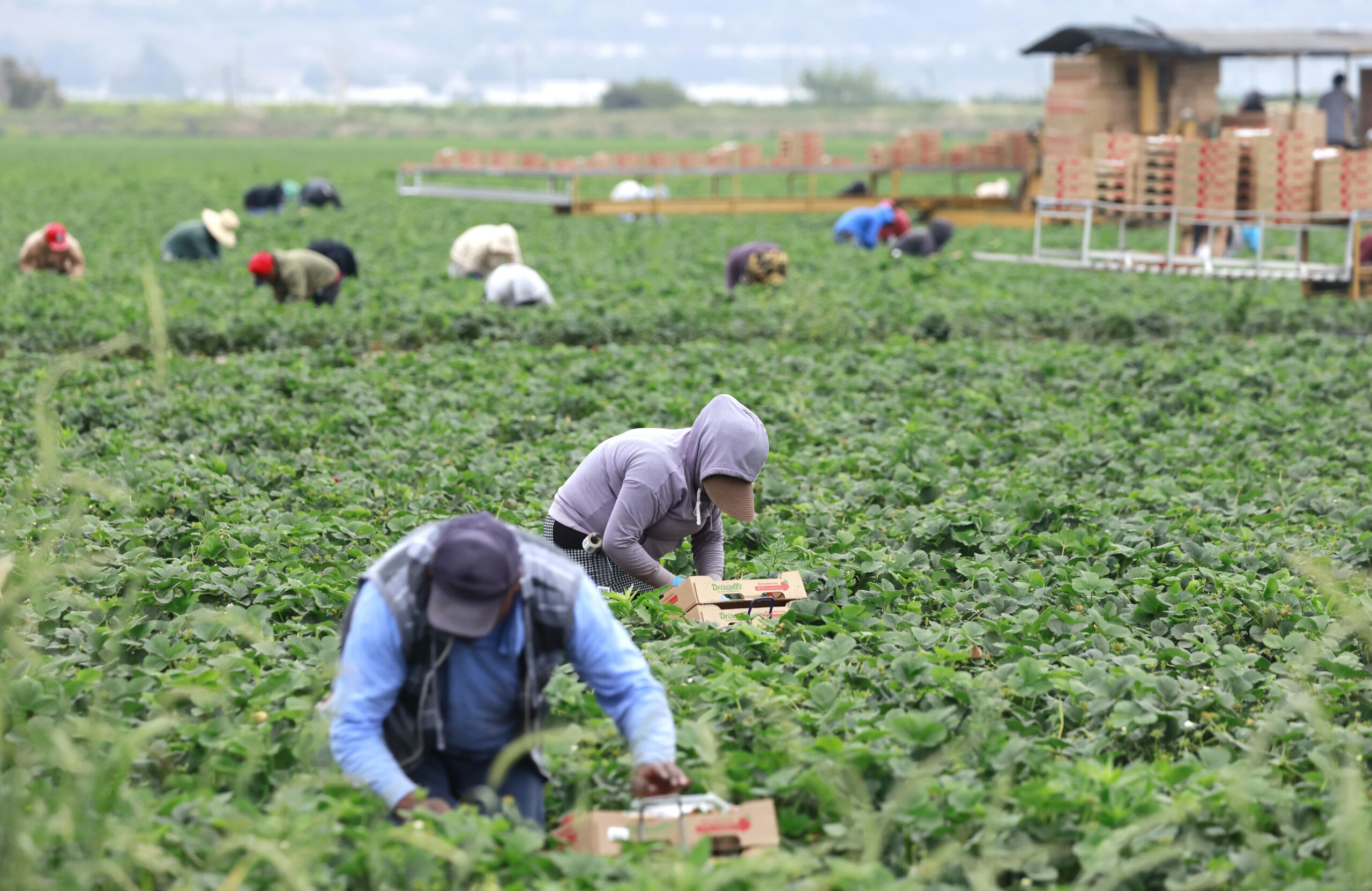
The Trump administration is focused on an immigration crackdown. But agriculture employers and some moderate Republicans want to start negotiating at least one aspect of legal immigration: expanding a visa program that brings foreign workers to America’s farms.
Dozens of farmers — including dairymen and blueberry, apple and peach growers — and lobbying powerhouses like the American Farm Bureau Federation took to Washington this month to advocate for their labor needs. At the center of discussions is a bill introduced by House Agriculture Committee Chairman Glenn “GT” Thompson that would expand access to the H-2A visa for seasonal agricultural labor.
“While this may not be in our jurisdiction, it is certainly in the interest of the farmers and ranchers, and foresters that we represent,” Thompson, R-Pa., told reporters and gathered farmers. He nodded to the fact that the House Judiciary Committee, not his, must approve any bill related to immigration and visas.
The H-2A visa program provides workers, primarily from Mexico, for farms that need someone to pick, fertilize and prune crops on a seasonal and temporary basis. Historically, farms with year-round needs such as dairies have been excluded from the program. But use of H-2A visas has jumped more than 500% since 2012 — from 62,743 to nearly 400,000 in 2025, in part because other programs have strict caps and other limits.
Despite its growing popularity and farmers’ reliance on the program, employers, labor advocates and both political parties agree that it is far from perfect. But there are strong ideological and practical differences on what needs to be changed.
Labor organizations and conservatives are skeptical of any program that expands the use of foreign labor. Labor groups have long criticized the H-2A program for the potential of workplace abuses; and conservatives take issue with any program that could grandfather in workers currently working in the U.S. illegally.
Farmers and other businesses warn of immediate consequences to their labor supply without expanding the program, given the administration’s deportations and continued record-low crossings at the southern border.
“Now that the administration has secured the border, it’s time to address the rest of our immigration system,” said Martin Durban, senior vice president of the U.S. Chamber of Commerce, citing a Congressional Budget Office report that predicts a drop in the working-age population. “You can’t grow the economy with a shrinking workforce.”
Farmers argue that if the administration continues to push for mass deportations, they need a legal pathway to get workers. An estimated half of all crop farmworkers are working without authorization, according to the latest estimates from the Agriculture Department.
The administration acknowledges challenges between strict immigration enforcement and farm labor supply. The Labor Department last year warned that increasing resources for immigration enforcement risks supply chain disruptions and food supply problems.
“Unless the Department acts immediately to provide a source of stable and lawful labor, this threat will grow as the tools Congress provided… to enhance enforcement of the nation’s immigration laws are deployed,” it wrote in a related Federal Register notice.
H-2A program grows as farmers ask for changes
First established in the 1980’s, the H-2A program allows agricultural employers to request foreign farmworkers on a temporary and seasonal basis, provided they cannot find enough workers in the U.S., among other requirements.
Florida is the top state for use of H-2A visas, followed by Georgia, California, Washington and North Carolina. Those states make up just over half of all H-2A visa certifications.
“We estimate using about 55,000 guest workers this past year, not because the program works well, but because growers have no other choice,” said Mike Joyner, president of the Florida Fruit and Vegetable Association.
Loading…
But growers are unhappy with the program’s provisions, such as wages that regularly increase and other costs, including responsibilities to pay for housing, transportation and medical care for each worker.
The Labor Department last fall issued a rule that would take housing costs out of workers’ paychecks and change the way wages are calculated – effectively lowering guest workers’ pay and making the program cheaper for farmers.
But farmers say more changes are needed — which is impossible without action from Congress.
Dairy, cattle and pork producers want access to the visa program. And some said they would like their current workers, who may be working illegally, to be able to access the visa.
For those who don’t have access to visas, like in the dairy industry, more than half of workers are undocumented, according to some estimates. State-level estimates in places like Idaho and Wisconsin are even higher.
Last month, U.S. Citizenship and Immigration Services issued a memo clarifying that some dairies could access H-2A visas if they proved “seasonal” labor needs. This caught the attention of the dairy industry, which is among the groups advocating for an expansion of the visas.
“A lot of us are still trying to figure out exactly what that meant,” said Cricket Jacquier, a dairy farmer in Connecticut and National Milk Board of Directors member, about the memo. “For me, it really raised dairy to the top and recognizes that there’s a serious problem in the dairy industry and they want to do something about that.”
Jacquier and other farmers said they want any changes or clarifications codified into law. Others, like Sydney Allison, who runs Wild Goose Farms in Florida, want workers for longer and more predictability in wage costs.
“We couldn’t get the labor and so we were pushed to use this program,” she said. Labor accounts for up to half of the production cost for blueberries she sells across the eastern seaboard.
She credits the H-2A program as the reason her farm exists, but warns it’s not enough.
“We can’t continue to expand. We honestly will probably shrink,” she said.
The bill introduced by Thompson would remove the seasonal requirements of the visa while keeping it temporary, at a maximum 350 days a year. It would ensure other sectors like forestry, aquaculture and livestock would get access to the program. And it would provide a process for existing unauthorized workers to access the H-2A program. The bill does not provide any pathway to legalization.
Opposition to H-2A expansion comes from all sides
From the other side, labor groups representing farmworkers and supporters of the president’s hardline immigration agenda oppose any H-2A expansion.
Teresa Romero, president of the United Farm Workers (UFW) union, said her group would not support a measure without a pathway to legalization for those already in the U.S.
“We have workers who are legal residents. We have workers who are citizens, and we have workers who are undocumented workers. And many of these workers who are citizens are being harmed by these changes,” Romero said. “[Employers] preferred to bring these workers, pay them less, have more control over them, and displace the workforce that is here right now.”
UFW has many members in some of the states that have seen highest use of H-2A visas, such as California and Washington. Romero and other labor groups also worry the H-2A program doesn’t do enough to protect workers. Workers who come on these visas are tied to a specific employer, making them particularly vulnerable to exploitation.
The AFL-CIO, the largest labor organization, also opposes any expansion.
“We have long-standing positions in support of reform rather than expansion of our work visa programs,” said Shannon Lederer, immigration policy director at the national AFL-CIO. “Systems that create an underclass of workers who can’t exercise their rights are bad for all workers.”
Simon Hankinson, senior research fellow at the conservative Heritage Foundation, agrees with agriculture employers that the current system is too complicated.
“It kind of is the worst of both worlds for employers who are trying to do the right thing, and I suppose for employees who are trying to do the right thing as well,” Hankinson said. But he also opposes expanding access.
“Because the visa is essentially uncapped, that’s going to create competition against American workers and drive wages down in a huge variety of sectors that I don’t think would be popular on the left as well as on the right,” he said.
But Hankison and others on the right diverge from labor groups on offering workers a path to some form of legal status.
“It wasn’t just ‘close the border,’ but we also have to deport the people who were ordered deported,” Hankinson said, in reference to President Trump’s promises.
Path forward in Washington is complicated
Thompson and other Republican members of Congress hope to start a new conversation around changes to popular visa programs that serve businesses, after 18 months of an administration that has prioritized border security.
“Since the president has closed the border, I think we can get this done,” said Rep. Mike Simpson, R-Idaho, during a press conference unveiling Thompson’s bill.
Several times last year, Trump vowed to support a visa solution for farms to get enough workers. While farms themselves have not been a primary target of immigration enforcement, few policy proposals to secure the workforce have come to fruition.
When asked about efforts in Congress to expand access, White House spokesperson Anna Kelly said: “We do not get ahead of the president on pending legislation.”
Thompson’s legislation faces a thorny path through Congress.
Reps. Jim Jordan, R-Ohio, and Jamie Raskin, D-Md., the leaders of the House Judiciary Committee, did not respond to questions about whether their committee would hold a hearing or a vote on the bill.
And senators haven’t acted on a companion measure, waiting to see the political reaction to the House version.
Thompson hopes to bring others on board with the measure, which currently has 50 cosponsors, including four Democrats. Proponents of the bill argue, though, that farm state Republicans could broker a negotiation if Republicans move forward with other border security and enforcement bills.
Conservatives in the House want to see a vote on a bill known as H.R. 2, which would increase border and immigration enforcement. But that measure is likely to see little movement unless moderates and conservatives in agriculture and Latino-heavy districts see efforts to include their demands, such as improving visa programs they say are vital to all Americans’ food supply.
“92% of all planted acres are represented by Republicans,” Thompson said. “Now, I will say 100% of all constituents eat.”
Transcript:
SCOTT DETROW, HOST:
The Trump administration wants to limit nearly all of the ways that someone can enter the U.S. legally, and that includes worker visas. There’s one type of visa even some Republicans want to expand. Demand for the H-2A visa for seasonal agriculture labor is skyrocketing. Farmers say it’s long overdue for an update. NPR’s Ximena Bustillo has the story.
XIMENA BUSTILLO, BYLINE: Dozens of farmers and groups representing food products like apples, peaches and dairy gathered in a room in Washington, D.C. They all came for one reason.
CRICKET JACQUIER: So you ask any dairy farmer in Connecticut or really anywhere across the country, their No. 1 concern at the farm is the access to labor.
BUSTILLO: That’s Cricket Jacquier. He’s a dairy farmer and like others in the industry wants to use H-2A visas to hire workers.
JACQUIER: We have no access to using H-2A on our dairies because of the seasonal component that was always in H-2A. Our dairy farms must run seven days a week. They must operate 365 days a year. We need access to workers year-round.
BUSTILLO: He is hoping that a new bill in the House can be the solution. Last week, House Agriculture Committee chairman, GT Thompson, introduced a measure that would give dairies access to H-2A. It would also increase the time frame farmers could keep the workers, and it would provide a way for those working illegally to be brought into the visa program. Thompson said now is the time for these kinds of reforms.
(SOUNDBITE OF ARCHIVED RECORDING)
GT THOMPSON: I traveled across the entire country asking producers what they needed from Congress so that they could do the important work of feeding and clothing the world. The issue of agriculture labor kept being brought up.
BUSTILLO: Over half of farmworkers are without legal status, according to the Agriculture Department. The H-2A program is a way for farmers to get legal workers, and since 2012, use of the visas has increased by more than 500%. Thompson hopes his fellow Republican colleagues are ready to come to the table.
(SOUNDBITE OF ARCHIVED RECORDING)
THOMPSON: You know, I think part of it is the border is under control. Part of it is the fact that food security clearly is national security, and workforce is a main factor.
BUSTILLO: The measure has received support from nearly every corner of the farming industry, but expanding H-2A visas has been met with opposition from labor and groups further on the right. Teresa Romero is the president of the United Farm Workers Union.
TERESA ROMERO: We have workers who are residents, legal residents. We have workers who are citizens, and we have workers who are undocumented workers. And many of these workers, like I said, that are citizens are being harmed by these changes.
BUSTILLO: She wants workers to get a more direct path to legal status under any deal. Visa worker status is tied to a specific employer, so they’re more vulnerable to workplace abuses, she says.
ROMERO: Why do we want to bring a workforce that is more vulnerable instead of having a workforce that is experienced that we can legalize, that we can compensate for the sacrifices that they have made?
BUSTILLO: Other critics of the H-2A program include Simon Hankinson from the Conservative Heritage Foundation. He agrees the visa program is complicated for both farmers and workers.
SIMON HANKINSON: It kind of is the worst of both worlds for employers who are trying to do the right thing and I suppose for employees who are trying to do the right thing as well.
BUSTILLO: But he does not want anything that resembles a legal pathway for those who are undocumented now.
HANKINSON: It wasn’t just close the border, but we also have to deport the people who were ordered deported.
BUSTILLO: Still, demand for the program among those who use it is only growing. Sydney Allison runs Wild Goose Farms in Florida, growing blueberries and other crops. She credits the H-2A program for her business surviving but worries about the future.
SYDNEY ALLISON: We would not have a farm without this H-2A program. We can’t grow without some of these things in the bill. We can’t continue to expand. Like, we honestly will probably shrink.
BUSTILLO: Farmers say the program is here to stay, but if it’s not changed, their own farms may not be here for long. Ximena Bustillo, NPR News, Washington.
(SOUNDBITE OF JAY Z SONG, “COMING OF AGE”)
-

No internet, no screen time? FCC weighs cutting subsidy that lowers school internet bills
Catch up on what you missed with our Education newsletter, sent weekly.
A program that helps connect schools and libraries to the internet at discounted rates is under review by the Federal Communications Commission. Educators and advocates are bracing for the funding to shrink or be eliminated.
The so-called E-Rate program, created in the 90s, has considerable bipartisan support. The agency’s recent focus on the program has left educators including David Thurston on edge.
Thurston oversees technology for the 33 school districts nested inside California’s San Bernardino County. The area covers more than 20,000 square miles of southern California: “We have mountain regions, far-flung desert regions, and then our urban and suburban areas. We’re a really diverse county,” Thurston says.
The county already built the infrastructure to get internet access from the edge of Los Angeles all the way to the state’s eastern border, but the spending doesn’t end once the fiber optic cables are installed. Internet access bills come monthly.
“There’s no doing without,” he says. School districts “are gonna have to pick up the costs.”
For San Bernardino districts, that’s tens of thousands of dollars every month.
“Those are ongoing, essentially, utility costs,” he says. “That’s what E-Rate pays for.”
A “healthy” program
E-Rate has had a notable impact since its founding. It was created by Congress in 1996, when only 14% of schools and libraries could access the internet. That number is now near 100%. The FCC has overseen the program through both Democratic and Republican administrations, so when the agency announced a full review of the program in late June, some were confused.
“By its own data and its own measurement, the program is healthy,” Thurston says. “The program is doing what it needs to and is important.”
Others saw this coming. The Project 2025 blueprint singled out federal broadband policy as a target for cutting agency spending.
Current FCC Chairman Brendan Carr helped write that chapter of the document, compiled by the conservative Heritage Foundation, which was meant to guide the second Trump administration.
Less predictable was the chairman’s reasoning for reviewing the program: kids getting too much screen time. In the now approved notice of proposed rulemaking, the FCC calls for a review “to better protect children when using E-Rate-funded networks, including to limit screen time.”
His prepared statement at the commission’s June hearing focused heavily on the dangers of screen time for kids and the growing body of research around it.
Since January, states including Alabama, Tennessee, Utah and Virginia have passed some form of legislation that calls for reevaluating technology’s role in teaching and testing, and more than 10 other states are considering similar restrictions. The Los Angeles Unified School District, the second-largest in the country, recently approved a policy to limit screen time for its students.
Some advocates for limiting screen time at school say gutting E-Rate funding isn’t the way to reduce how much time kids are spending on devices.
“We believe there are ways of strengthening school policies to promote more limited and privacy-protecting use of EdTech without taking away critical E-Rate funding,” said Josh Grolin, executive director at Fairplay, a nonprofit focused on digital safety for kids, in a statement to NPR.
Although states and districts are searching for ways to limit screen time, few — if any — are looking to operate without the internet altogether. Many schools rely on internet-based systems to track attendance, monitor school bus routes and give tests required by their state. According to the National Center for Education Statistics, 48 states now have some kind of online component with exams.
Bob Bocher, a senior fellow with the American Library Association (ALA), says that because the program is written into the Telecommunications Act of 1996, the FCC likely cannot fully eliminate it. And last year, the Supreme Court ruled that the Universal Service Fund, which collects the money that schools and libraries in turn use to lower internet costs, is constitutional.
But the FCC could change the way the E-Rate program is run to make it more complicated, so the ALA is still worried.
Bocher, who helped work on the original law back in the ’90s, worries the program could become so onerous it drives schools and libraries away by design.
“It’s like death by a thousand cuts,” he says, “death by a thousand rules and regulations.”
Keeping up with the rest of the world
While internet access has expanded significantly since 1996, internet pricing and options haven’t changed the way Bocher or his contemporaries expected.
“A common assumption that a lot of people had [was] … competition will evolve,” he says. “And then drive down the price.”
In cities, this may be true, but for many rural and remote areas, competition for internet service providers or ISPs is nonexistent.
“In rural Alaska, we don’t have numerous options,” says Patrick Mayer, superintendent for the remote Alaska Gateway School District. “We have one provider.”
His district, where some students rely on planes to get to school in the winter months, has just under 400 students. Still, the district spends more than half a million dollars per year to ensure it has internet access at its six schools. The price tag is high, but the connection is what allows them to keep up with the rest of the world.
“It means the difference between having a school in the 21st century,” Mayer says, “or a school in the 20th century.”
The expansion of connectivity in his district allows students to take dual enrollment courses online with a local college and access virtual speech and occupational therapy.
“To backfill that funding,” he says, “would be very, very difficult.”
He imagines there would be no way around cutting down on staff and student services to find money to pay the district’s entire internet bill. For now, he’s focused on making some noise.
Once the FCC officially publishes notice of its planned review, the public can comment for 60 days. After that, there will be a reply comment period of 30 days, followed by a full review of all of that input by the agency. The process can take a long time, but Mayer and other advocates are already working to draw attention to the issue.
He spent a few days this month in Washington, D.C., to meet with legislators about the importance of keeping Alaska’s students connected.
Edited by: Nirvi Shah
Visual design and development by: LA Johnson -

Waymo called the cops on teen riders, raising privacy concerns
Police in San Mateo, Calif., posted Monday on social media that they had apprehended a pair of teenagers from a Waymo driverless robotaxi after the company alerted authorities to suspected criminal activity. It’s the latest incident involving video surveillance of passengers and others by autonomous vehicles — raising questions about the limits of privacy in such vehicles.
The Facebook post by the San Mateo County Police said: “Parents do you know where your teens are? @waymo does!”
The 15-year-olds were allegedly drinking alcohol and shooting toy guns from the car, according to the police. They said Waymo’s systems detected behavior that then triggered a safety response, after which the company disabled the vehicle and contacted police.
Waymo’s cars, equipped with an array of cameras, microphones and other sensors to monitor passengers and other nearby vehicles, are becoming more common in cities across the United States. Experts say the detention of the two teens in San Mateo highlights a potential — but not inevitable — trade-off between privacy and convenience. It also questions the extent to which companies similar to Waymo are required to hand over private data, including audio and video of passengers, in situations where a crime is suspected.
NPR reached out to Waymo, which is owned by Alphabet, the parent company of Google, for comment on the details of the San Mateo incident and how the company responded, but did not hear back. But on its website, the company says that as many as 29 cameras in its autonomous cars provide an all-around view and “are designed with high dynamic range and thermal stability, to see in both daylight and low-light conditions, and tackle more complex environments.”
“There already exist laws that govern duty to report or even duty to protect” for carriers such as Waymo, according to Alessandro Acquisti, a professor of information technology at the MIT Sloan School of Management. “The privacy problems arise when and if driverless carrier companies used such laws or ethical obligations as a pretext for blanket, indiscriminate accumulation of identifiable data for unspecified future purposes.”
That includes not just monitoring people inside the cars, but outside too. Take, for example, a hit-and-run investigation last year in Los Angeles. Media reported that the police inquiry was aided by video captured by a Waymo taxi that had a clear view of the crime. Critics suggested at the time that authorities were using the company’s vehicles as a mobile surveillance platform. And during 2025 protests in Los Angeles against Immigration and Customs Enforcement crackdowns, demonstrators vandalized Waymos, apparently angry that video recorded by the vehicles could be used by police, although there is no evidence that happened.
In a transparency report, Google says it received nearly 290,000 requests from governments worldwide in the first six months of 2025 for disclosure of user information across all its platforms, including Waymo. The company says that in more than 80% of the requests in those six months, some information was disclosed. “Google carefully reviews each request to make sure it satisfies applicable laws. If a request asks for too much information, we try to narrow it, and in some cases we object to producing any information at all,” the company says.
In an email to NPR, San Mateo Police Department spokesperson Jeanine Luna said that detaining the teens in the Waymo on Monday was “wholly appropriate” under the circumstances. “We received the call of a ‘firearm’ being shot from a moving vehicle,” she said. “Furthermore, the occupants were described as being possibly ‘intoxicated.’” she said.
“Being that the vehicle was disabled (the occupants had every right to exit the vehicle before police arrival, but they did not), a high-risk traffic stop was conducted to ensure the safety of all involved,” Luna added. “They were not arrested and were released to their parents, however, potential charges are still pending dependent on what the video from inside the vehicle shows.”
Autonomous taxis represent an ethical gray area
Robotaxis began to roll out across the U.S. in December 2018, when Waymo launched in Phoenix. These services have been used for less than a decade — so the norms surrounding them aren’t settled, experts agree.
The Facebook post may make Waymo passengers wonder what triggers a police intervention, says Irina Raicu, director of the Internet Ethics program at Santa Clara University. She has used Waymo’s driverless taxis and says ethically, the privacy issues surrounding them sit in a gray area. “There’s something about being in a car without another person that makes you think it’s private.”
“With all these recording devices, we don’t see them, [and] they’re not these obvious things being stuck in our faces,” Raicu adds.
That brings up a key issue: informed consent, Acquisti says.
“It is not clear the extent to which passengers … are reminded that when they step into the car, that they are being monitored, and most likely they are not told in its entirety how the data will be used,” he says.
Bruce Schneier, a cybersecurity and privacy expert and professor at the Munk School at the University of Toronto, believes that Waymo does have a compelling interest in protecting its vehicles. He compares monitoring a robotaxi via cameras to a human taxi driver keeping an eye on passengers in the rearview mirror.
“Maybe the driverless car comes back … and it has all of its cushions slashed, and it’s like, ‘Who the hell did that? Let’s go and look at the tape,’” Schneier suggests. “You can’t have sex in the back of a taxi, right? Someone would say, ‘Stop it.’”
He concludes that some supervision makes sense. In an Uber rideshare, he notes, “most of the time there’s a camera recording the back seat.” (Uber says on its website that it allows drivers to install such cameras for the purpose of “fulfilling transportation services.”)
Waymo robotaxis, while a fairly common sight in the San Francisco Bay Area, are still a novelty in much of the country. And many people are hesitant to ride in one, according to a Pew Research Center poll published this month. The survey found that only 5% of Americans had ever ridden in a driverless car. Meanwhile, 71% of those polled said they would feel uncomfortable in one, with only 7% saying they would be “extremely or very comfortable” riding in one.
For that reason, experts who spoke with NPR said they were optimistic that it’s not too late to shift gears on privacy norms and policies surrounding these vehicles.
Acquisti doesn’t see why privacy measures can’t be built into driverless vehicles.
“I would immediately challenge the notion that people have to be monitored,” he says, noting that privacy-preserving technologies exist and can be installed.
“Driverless cars are coming, but they don’t have to come in this particular incarnation,” Raicu says. “They’re still being designed and redesigned. It’s early days.”
-

Baby Rose’s voice is always searching. ‘YEARNALISM’ gives it a home
“My heart can confide in itself / No, I don’t need no one else / To show me the way,” the incandescent singer Baby Rose once disclosed, consoling herself on the funky song “Fight Club” from her 2023 album Through and Through. Part of a spirited self-pep talk, the line is a useful way to think about her music. The act of confiding in oneself is the central conceit for many of her songs — a means to make a path forward, treating external voices as brush to be cleared. But the songs really work because of a crucial contradiction in that logic: A heart that can only confide in itself is always second-guessing. (“I wanna mean what I say,” she adds a few bars later, showing her hand.) Being forlorn and in her own head complicates this artist’s narratives, her inner monologue gaining depth and subtlety thanks to an indelible, even more interior voice that is constantly seeking someone else to believe in. Ever since her breakthrough single found her sitting all to herself at 3 a.m. thinking about her dearly departed heart, she’s been reaching out for something.
Rose’s new album, YEARNALISM, takes that search a step further, offering passionate songs that struggle with desire and the myriad ways gratification can hover out of reach. Joining Baduizm, SongVersation and “hateration” in the long and wonderful index of R&B neologisms, the title functions as a succinct summation of the feeling she chases across the record. If Moses Sumney’s Aromanticism was a bid to, as he put it, “interrogate the idea that romance is normative and necessary,” then YEARNALISM sees it in everything, casting romance as elusive and yet eternally worth pursuing. More than anything, the album reckons with the reality that yearning is about the promise of a thing, divorced from the actual result. In circling that epiphany, it fully realizes the promise of its central star.
Baby Rose has frequently been shuffled under the neo-soul banner, mostly for lack of a more comfortable slot. Since her debut album, To Myself, in 2019, her songs have been a cocktail of genres far more retro than neo — anchored by a classic voice that is oaky, smoky and sweet, like a Fireball old fashioned — but with a distinct chicness. YEARNALISM stops fighting destiny and embraces a more vintage sheen, deftly avoiding straight pastiche through its careful interrogation of personal desire. It eases from Motown sound to Philly soul to Stax deep cuts to Big Mama Thornton blues and beyond, scouring the songbook for answers. Still, the singer is not after a universal tonic for what ails her; on the contrary, she knows no such thing exists. Instead, Rose longs to legitimize her longing as a feeling with its own indulgences, one that needs no further payoff.
Yearning takes many forms here. Opener “When I’m Gone” tries to shake loose someone who has crawled under her skin (“I tell myself I’ll be fine without you / Then I keep holding on”), while “The Reason” relishes being head over heels. Some songs find excitement in toying with risk and opportunity; others slip into the quicksand of pining after a love clearly lost. The door opens for something casual to become something more (“Is This Love”), or the itch for liberation haunts a relationship that has become a prison (“Let Me Go“).
“Sunday” is about yearning more broadly, emphasizing the power of imagination to envision a future beyond the most likely one: “Gonna start a new beginning / Maybe find my way,” Rose croaks. Its porch soul briefly explodes into blues rock before inching into “Believe Me,” a fantasy where an answered phone call becomes an open line to possibility. Finding a way is always feasible, but these songs do not attempt to close loops. They linger in moments, settling in the transitional spaces between relationships, where the story of each romance is not yet written — a limbo quality that lets Rose’s singing tug at the ambiguity.
YEARNALISM is as consumed by regret as by desire, treating them as sides of the same coin. Yearning is defined by space, but where some songwriters prioritize the distance of a lover who can’t be accessed, or nostalgia for a time that can never be relived, Rose knows proximity to be just as impactful. “I don’t hate you, I’m just over it / Oh, and I need a world of space / No, I’m not afraid to love and lose / I guess that’s more than I can say for you,” she sings on “But, Nvm,” pulling on “space” as if literally trying to extend it.
This kind of interplay is epitomized by the dynamic, intoxicating “Friends Again,” a simmering duet with Leon Thomas that grapples with a one-night stand as a potential point of no return for a friendship. Regret and desire are equally represented, and the thrill is in not knowing which wins out. The way she boils down the words “ever” and “same” in the chorus draws a clear separation between what was and what will now be, a powerful tension that suffuses the important turns in each of these songs, emphasizing just how tenuous it all really is.
The greatest revelation to come of this record, though, is that Baby Rose’s voice is the ultimate vessel for a consideration of yearning that has long been pursued across the rhythm & blues continuum, and yet lately seems to have atomized. It’s no secret that the singer possesses one of the most unique and exquisite instruments in music, but YEARNALISM is the first album to activate that voice to its full potential. Rose recently explained that she tracked her vocals on an ancient microphone not intended for singing, and that when she tried again with better equipment, something was lost. “We tried it and everyone in the room agreed that the new version sounded technically better, but it didn’t have the emotional depth of the original take,” she recounted. “That’s when I realized the first few takes are sacred. There’s uncertainty there. You don’t fully know what you’re doing yet.”
Uncertainty is the freedom that allows for nuance and fluidity, and in these songs, her execution borders on rhapsodic. Her singing is so rich and full of character, so consumed by the exploration of urges. The songs mirror that precariousness, every open-ended question leaving room for suggestion. Listening, there is a sense that a heart confiding in itself can show the way — not to any sort of enlightened resolution, but to a wishful state of being as its own reward.
-

Shelling at night, gunfire by day in Israel’s expanding zone of control in Gaza
GAZA CITY, Gaza, and DUBAI, United Arab Emirates — On a small rickety table, under a tent made of worn-out tarps, four friends meet for a game of cards.
One of the older men gripes to the others: “Life is so boring.” Like most in Gaza, the group of men are unemployed with no hope on the horizon as President Trump’s peace plan, which calls for Israeli withdrawal, new governance in Gaza and Hamas’ disarmament, stalls nine months after the ceasefire was brokered.

Members of the al-Hattab family take turns filling water jugs at their ruined house where they shelter in al-Shujaiya, Gaza Strip. The al-Hattabs are among the few Palestinians still living inside Israel’s expanding zone of control. (Anas Baba | NPR) Still, the men meet almost every afternoon, about 400 yards from their homes in the neighborhood of al-Shujaiya in eastern Gaza City. But each day, as the sun begins to set, the men have nowhere else to seek shelter and no choice but to return to their bombed-out homes where they hunker down for the night.

Subhi Shurabasi, a 60-year-old grandfather, shelters with his sons, their wives and his grandchildren inside the ruins of their destroyed home in al-Shujaiya, on May 31. (Anas Baba | NPR) “After sunset we put our hand on our heart and just pray,” Abu Ahmed Humeid says. “No one dares go outside.”
That’s because Israeli forces have been pushing deeper into Gaza in recent months. At the start of the ceasefire in October, the military controlled around half of the territory, along what is called the “yellow line.”
Israel’s military now controls nearly 70% of Gaza, including the area of al-Shujaiya. That’s according to comments by Israeli leaders as well as maps indicating areas of restricted access for aid groups that have been analyzed by NPR.
Israeli tanks maneuver around new military posts marked by towering Israeli flags within eyesight of Palestinians in al-Shujaiya.
An expanding militarized “orange zone”

A yellow concrete block sits on a dirt berm marking an encroaching military boundary across Salah al-Din Street, Gaza’s main road, as Israeli forces continue to advance their positions deeper into the territory.
(Anas Baba | NPR)In mid-March, as the world’s attention was focused on the U.S.-Israeli war on Iran, Israeli troops took control of 10% more of Gaza by designating what they call a new “orange zone” that runs north to south. Israel’s military indicated this zone of control in maps distributed to aid groups, which were shared with NPR. Aid groups say the military now requires prior notification to enter these areas. With more than 400 aid workers killed in Gaza throughout the war, aid groups have suspended operations in northern Gaza’s orange
zone until the situation is fully clarified.Israel’s military did not respond to multiple requests for comment.
Loading…
Loading…
Residents of al-Shujaiya told NPR that aid operations have been halted in their neighborhood since March, and ambulances need Israeli permission to enter.
People living in the so-called orange zone of control say Israeli tank shelling and gunfire intensifies in the evening. Random bursts of tank fire are heard throughout the day.
“Homes here get hit by Israeli fire because they’re trying to push us out of here, or at least these eastern parts,” Humeid said. “But we can’t leave this area. This is where we grew up, where our parents and grandparents lived.”
Israel’s plans to control more territory

Tents stand amid the rubble of destroyed homes in al-Shujaiya, Gaza Strip, where displaced families endure harsh living conditions inside a new orange zone with nowhere else to go, on May 31. (Anas Baba | NPR) Israeli Prime Minister Benjamin Netanyahu said the military’s expanding footprint in Gaza is part of a step-by-step plan to surround Hamas from all sides, despite the U.S.-brokered ceasefire.
He told an audience in May that when the ceasefire began, Israel controlled half of Gaza, and then expanded that control to 60% of the territory. A man in the audience yelled out that the next step should be 100% control.
“First, 70%. Let’s go for that,” Netanyahu responded. “We’re hitting them from every direction,” he said.
On the ground, there are no markers indicating where the orange zone begins and ends. The original yellow line of control — which last year marked the border between Israeli-controlled Gaza and areas run by Hamas — is also moving deeper into Gaza, and is only partially marked in places.
The United Nations humanitarian office says around 200 Palestinians have been killed by Israeli forces since the start of the ceasefire in areas of Gaza close to the military’s shifting lines of control along its yellow and orange lines. They are among the more than 1,000 who have been killed across the devastated territory in that same period, according to Gaza’s health ministry.

A large Israeli flag waves in the distance over a landscape of destruction and debris in Gaza near the border with Israel. (Anas Baba | NPR) Israel’s military has commented on some of these attacks, saying its forces shot in self-defense at people it says posed an immediate threat to troops. The U.N. says a third of those killed have been women and children.
In a joint statement, U.N. agencies and aid groups criticized Israel’s moving lines of control, saying this is restricting access to aid for thousands of families and leading to lethal Israeli killings of people moving through areas lacking clear demarcation on the ground.
A ghost town of shelling and gunfire

A man fills a jug from from a rigged waterline in al-Shujaiya, but the nearest source of potable drinking water is 30 minutes away. (Anas Baba | NPR) At the start of the ceasefire, 500 families lived in al-Shujaiya. Today, fewer than 50 families remain. The neighborhood is a moonscape of rubble and debris, but it was once a thriving neighborhood of more than 100,000 people before the war.
Now, the closest source of drinking water is a half-hour walk away. There are no clinics, bakeries or shops in the area.
“You get scared to catch a bullet just walking or a missile and be blown apart,” said local resident Saeed al-Hattab. “It’s terrifying. It’s very dangerous to go outside after sunset,” he added.
NPR witnessed a ghost town with few people on the streets, even during the day.

Piles of uncollected garbage and debris line a deserted street in al-Shuja’iyya, a neighborhood, lacking basic services and aid due to israel restrictions as expanding the orange zone.
(Anas Baba | NPR)“People are scared to live in al-Shujaiya, and we’re scared, but we have no choice but to live here,” al-Hattab said.
He and his wife, Niveen al-Hattab, live with their younger son in a ground-floor shop, under their destroyed apartment building.
The couple’s 27-year-old daughter was killed when the family fled al-Shujaiya to another part of Gaza City during the war. She’s among more than 73,000 people Gaza’s health ministry says were killed in Israeli attacks.
“Where are we supposed to go? I’ve been displaced a lot already,” the mother said, adding their one tent was destroyed in an Israeli airstrike during the war and they cannot find another.
“We don’t know how to live, and we’re sitting in danger because there’s nowhere to go,” she said.

Three sisters sit looking out over a sea of debris as the sun sets in northern Gaza’s militarized orange zone of Beit Lahia, on May 31. (Anas Baba | NPR) Itay Stern contributed to this report from Tel Aviv, Israel.
-

Trump leans on ‘communist’ messaging as economic angst drives Democrats
President Trump made sure to repeat what has become one of his main attacks on Democrats ahead of the fall midterms before leaving a global summit in Turkey dominated by the Iran ceasefire.
“I want to get the word out because what’s forming is communism,” Trump said following the NATO summit in Ankara, Turkey.
Presidential speeches delivered abroad often carry as much weight with audiences back home as they do with foreign leaders.
Trump made that clear when he used his news conference to call communism the biggest threat that America has faced since its founding.
“Communism is easy to sell,” Trump added. “I would be the greatest communist in history. I’d be right up there with [former Soviet leader Vladimir] Lenin.”
It’s not a new tactic for this president.
During the last election, when struggling to find a memorable attack line against Kamala Harris, Trump eventually landed on “Comrade Kamala.”
He even shared a fake photo of the then-vice president speaking to a giant crowd bathed in red light and waving communist flags.
At the time, when pressed about the personal attacks, Trump defended the strategy – saying he had to run his campaign his own way.
“I think we’re hitting a nerve,” Trump said. “It’s a different kind of race. All we have to do is define our opponent as being a communist or a socialist or somebody who is going to destroy our country.”
Politicians have used the term communist as a way to attack political opponents for decades going all the way back to the 1950s.
It was during that period when Trump — who just turned 80 years old – grew up.
“This is in his bones,” said Tevi Troy, a presidential historian and former White House aide to George W. Bush.
Troy said anti-communism was not only a bipartisan issue, it was also the dominant view in America.
“And then you add on top of that that his mentor was Roy Cohn. And Roy Cohn was that lawyer, fixer who helped hunt communists under [former Senator Joe] McCarthy,” Troy said. “He worked on the McCarthy staff.”
McCarthy’s harsh tactics, though, caused political blowback.
Now, Trump has ramped up the anti-communism rhetoric after primary wins by democratic socialist candidates in New York and Colorado.
He has also painted it as a threat to religion.
“They will close your churches in this country if they go communist, and they’re trying to,” Trump said at the Faith & Freedom Coalition conference last month. “They will kill your people and that’s what they’re about. They want to end religion.”
Jennifer Stromer-Galley, who studies political messaging at Syracuse University, says Trump is conflating democratic socialists with communism in order to energize his base.
Democratic socialists believe capitalism can stay, but they want the government to do more to help everyday people by providing free healthcare, reducing income inequality and expanding social programs. Communists want to end capitalism and replace it with a system where private property is no longer owned by individuals.
Polls show a drop off of Trump support on key issues – such as immigration – that have motivated voters in the past.
“Part of what Trump is doing is creating a new boogeyman,” she said.
None of this is happening in a vacuum.
Economic concerns, in part caused by the war in Iran, have helped drive support for some candidates who identify as democratic socialists or back a larger government social safety net.
And Trump has sought to recast that debate in ideological and emotional terms.
One question is how much resonance the attack line still has with today’s voters.
Raymond Robertson of Texas A&M University’s Bush School of Government & Public Service, says while the anti-communist label still carries weight with older voters, it’s not so much in the mindset of younger Americans.
“I think the younger generations don’t have that context because, mainly, they only really remember the first Trump administration and maybe the Obama administration,” he said. “And they don’t remember the end of the cold war. That is ancient history.”
And Robertson says Trump’s criticism of communist influence on Democrats conflicts with his own administration’s investments in major U.S. industries, such as acquiring a stake in Intel and a quote “golden share” in U.S. Steel.
The White House dismisses those claims calling such comparisons “idiotic” and says Trump’s agenda is focused on quote “revitalizing American industry and reshoring manufacturing here at home.”
-

One of Spain’s deadliest wildfires has killed at least 11 people
MADRID — A wildfire in southern Spain has killed at least 11 people, making it one of the country’s deadliest on record, as soaring temperatures grip much of the country, authorities said early Friday.
Several victims of the fire in Almeria were found inside burnt-out vehicles, local media reported. Six others have been injured in the blaze, which 150 firefighters and 220 soldiers from Spain’s military emergency unit were battling Friday.
Spanish authorities reported earlier that 12 people had died, but revised the death toll Friday morning.
The fire broke out in a hamlet in a semi-arid area near the Sierra de Los Filabres mountains. Authorities have not confirmed the cause of the fire, but said people who called to report it said that a fallen power line had sparked a blaze that spread rapidly into a nearby forest.
The fire also led to road closures, while 1,000 residents were evacuated, according to emergency services.
Spanish Prime Minister Pedro Sánchez expressed his condolences, writing on X of his “Immense sadness and desolation in the face of the terrible consequences of the fire affecting the province of Almeria.”
Spain has battled frequent and severe heatwaves in recent years, with temperatures often exceeding 40°C (104°F). Wind, high temperatures and little rainfall help small wildfire grow into unchecked blazes.
In June, Spain experienced several days of record-setting heat, with over 1,000 excess deaths attributed to heat.
Parts of Western Europe are facing their third heatwave in six weeks.
Europe is the world’s fastest-warming continent, with temperatures increasing twice as fast as the global average since the 1980s, according to the European Union’s Copernicus Climate Change Service. Globally, 2025 was the third-hottest year on record, bringing several intense heatwaves across Europe.
Scientists warn that climate change caused in part by the burning of fuels like gasoline, oil and coal is exacerbating the frequency and intensity of heat and dryness, making certain regions more vulnerable to wildfires.