Blog

  • Scientists volunteer their time to document biodiversity in the Smokey Mountains

    Transcript:

    JUANA SUMMERS, HOST:

    Scientists are tracking all kinds of living things in the Great Smoky Mountains National Park on the border of Tennessee and North Carolina. Many are volunteers, and their work has become important in documenting changes in its rich biodiversity. As part of our series Here to Help, Katie Myers with Grist and Blue Ridge Public Radio reports.

    (SOUNDBITE OF FOOTSTEPS)

    KATIE MYERS, BYLINE: A gentle rain is falling as four people in raincoats make their way deep into the Great Smoky Mountains National Park. They duck under the bright green underbrush, stepping away from the road towards a high mountain spruce forest. A hush takes over. Just a few steps in, they see something exciting.

    JASON HOLLINGER: So it’s all up and down the side of this one tree.

    MYERS: It looks like a regular mossy tree, but to this crew, it’s a whole world of life. Jason Hollinger (ph) and Laura Boggess, two of the volunteers, take out a small magnifying lens.

    LAURA BOGGESS: Yes, right here. See how they kind of, like…

    HOLLINGER: Oh, yeah.

    BOGGESS: …Give a little swoop.

    HOLLINGER: I see the swoop.

    MYERS: They see a spongy little lichen, a combination of fungus and algae that grows really slowly. This one is so rare, it hasn’t really been documented in the park.

    HOLLINGER: So we could, right here, right now, come up with a common name for it.

    MYERS: Hollinger and the others call themselves the Gang of Retirees in Search of Life’s Diversity or GRISLD. This group is held together by a listserv and their own keen interest in getting to the park’s hard-to-reach spots. They quietly contribute to a unique project, the all taxa biodiversity inventory, managed by the nonprofit Discover Life in America. That means they’re out documenting every single species they can find.

    HOLLINGER: We’ll hike into these places that other researchers don’t have the resources, the funding to do. And we’re all retired, so we can do that.

    MYERS: Hollinger didn’t start out peering through a magnifying glass.

    HOLLINGER: Ex computer scientist in the .com boom – I was able to retire early.

    MYERS: When he retired, he became, as he says, an amateur lichenologist. He just thought their diverse and colorful ecosystems were really cool. He started looking for them all over the country, from Nevada to the Smokies.

    HOLLINGER: So I was choosing places that nobody could get funding to collect because, yes, lichens are useless commercially.

    MYERS: They’re an important part of the food chain. From squirrels to insects, they’re part of their diet. Lichen are also very sensitive to pollution, so if they die, other species may be in trouble, too. Besides lichen, volunteers have documented thousands of species, including rare salamanders, flowers and bugs. As a volunteer, you can contribute to the body of scientific knowledge, says Laura Boggess, who is a climber and ecologist. All it takes is being observant.

    BOGGESS: The small ways, the paying attention, the naming a species, which isn’t a small thing, but it’s, like, an accumulation of small, like, cooperative creation.

    MYERS: Every square foot of the park contains so much life, it takes a volunteer crew about 2 hours to go half a mile. At the end, they find something else – a rare parasitic fungus.

    HOLLINGER: I thought it would take a little longer.

    BOGGESS: It was just right down here?

    HOLLINGER: Yeah, it was just on that second branch I looked at.

    UNIDENTIFIED PERSON: Wow.

    MYERS: The magnifying glass comes out, and everyone slowly leans in for a good look.

    For NPR News, I’m Katie Myers in the Great Smoky Mountains National Park.

    (SOUNDBITE OF SEAN ANGUS WATSON’S “THE WOODS”)
  • The technology that emerged from the 1893 Chicago World’s Fair

    The Ferris wheel is just one of the many inventions that debuted when the World’s Fair in Chicago opened on May 1, 1893.

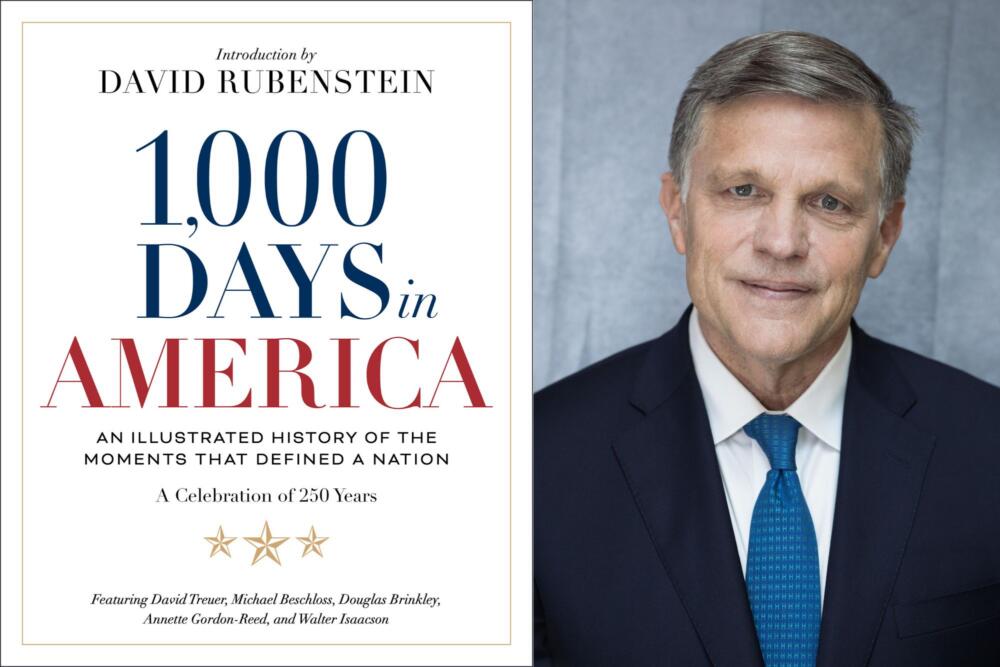
    Rice University history professor and CNN presidential historian Douglas Brinkley discusses that day in history with host Scott Tong. Brinkley is a contributor to the new National Geographic book “1,000 Days in America: An Illustrated History of the Moments That Defined a Nation.”

    The cover of '1,000 Days in America' and contributor Douglas Brinkley. (Courtesy of National Geographic and Moore Huffman)
    The cover of “1,000 Days in America” and contributor Douglas Brinkley. (Courtesy of National Geographic and Moore Huffman)

    On May 1, 1893, the Chicago World’s Fair opened with the Ferris wheel, which was invented for the event. Why is it on your list of important days in history?  

    “All these things got innovated there. Most famously, Nikola Tesla and George Westinghouse were able to show the public their alternating current, or AC, system, which was going to be the new system of electricity where Thomas Edison was promoting direct current, DC, and the fair made Tesla and Westinghouse sort of winners. And it was also the first all-electric affair ever. You had hundreds of thousands of lamps that lit up the whole city. It became known as the ‘White City.’

    “[The fair] brought the Midwest into America. It proved that Chicago was the other great city besides New York.

    “You mentioned the Ferris wheel. That’s invented by George Washington Ferris. He was an engineer, and there was a competition for what could be the Eiffel Tower. And he came up with that giant spinning wheel. The Ferris wheel becomes the amusement invention that symbolizes the United States. And then you can have things like Cracker Jacks, Aunt Jemima’s Pancake mix … the brownie was invented there in Chicago.

    “If you want to look at all of the things that took place there in Chicago… People like George Washington Carver with these beautiful botany plants and John Singer Sargent, [the] great portrait painter showing his wares and the Pledge of Allegiance that we know was first performed at the exposition by a school group there.

    “Frederick Jackson Turner, a historian, lectured about when he called his ‘frontier thesis,’ which is the story of America’s westward expansion. And when we hit the Pacific Ocean, we started becoming imperial, looking to take Hawaii and the Philippines and Guam and the Caribbean and Puerto Rico and Cuba. And later, people would say space was the new frontier, the idea that Americans have to keep moving, that that’s our central trait. And that [idea] was intellectually discussed there in Chicago.”

    In 1893, we’re about to enter the automobile age and it’s not too long after oil is discovered in western Pennsylvania. Are you saying there is to some degree kind of optimism about technology and ideas in America at the time?

    “Absolutely. And it was all about electricity. And in Chicago, the ‘White City’ there just lit up the electricity.  People’s jaws would drop. And we might think of the Ferris wheel as just an amusement, but for a lot of farmers coming in, they never were able to have an aerial view in their lives before. And now they’re looking at the beauty of Lake Michigan and looking at Chicago.

    “And remember, the whole city of Chicago had burned in 1871, almost every building. They rebuilt bigger and better than before. It was a turning point, the pivot from the candle-lit 19th century to the electrification of America in the 20th century and all that it brought. So it’s important we don’t forget Chicago 1893.”

    This interview was edited for clarity.

    ____

    Julia Corcoran produced and edited this interview for broadcast with Todd Mundt and Emiko Tamagawa. Tamagawa also produced it for the web.

    This article was originally published on WBUR.org.

  • Hike down ‘Astronaut Trail’ into 50,000-year-old Meteor Crater

    Ages ago, before humans lived in North America, a space rock pierced the atmosphere and screamed in a blaze of light toward the surface of the Earth.

    Oh, the catastrophe it must have been when the meteor hit the ground near modern-day Winslow, Ariz. The hole it left behind was a mile wide.

    Fifty thousand years later, I walked right into it.

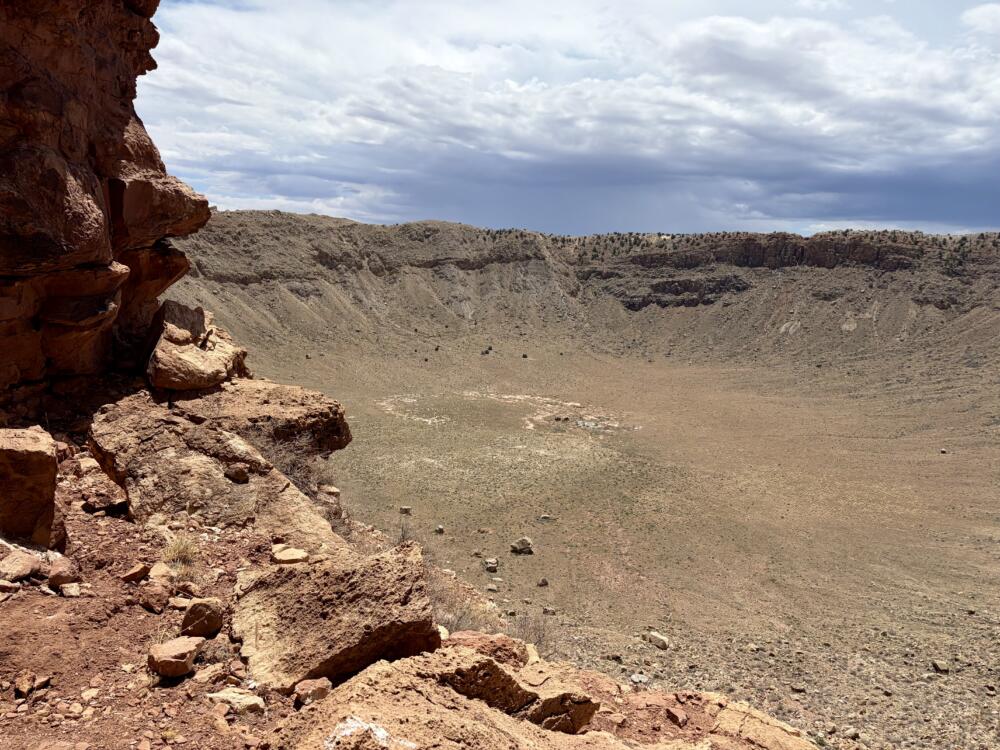
    A view from the trail that leads to the bottom of the crater in Northern Arizona. The meteorite that struck here was about 150-feet in diameter. (Peter O’Dowd/Here & Now)
    A view from the trail that leads to the bottom of the crater in Northern Arizona. The meteorite that struck here was about 150-feet in diameter. (Peter O’Dowd/Here & Now)

    “We believe there was a 150-foot meteorite that came in at about 26,000 miles per hour,” said Tyler Johnson, my tour guide on a hike to the bottom on a recent June morning. “We had essentially a nuclear explosion here.”

    Meteor Crater is one of the best-preserved impact craters on the planet. For years, visitors have wanted access to the bottom. Now for the first time ever, the narrow trail that leads to the bottom of Meteor Crater is open for guided tours.

    This part of Northern Arizona, between Flagstaff and Winslow, just off Interstate 40, is windswept and mostly barren. But 50,000 years ago, it looked very different. Mammoths and giant ground sloths roamed the juniper-pinon forest. The shockwave from the impact would have wiped out anything living for miles in all directions.

    But Johnson said the meteorite that made this hole is a “baby in comparison” to the one that wiped out the dinosaurs millions of years earlier. That one was “miles in diameter, versus 150 feet.”

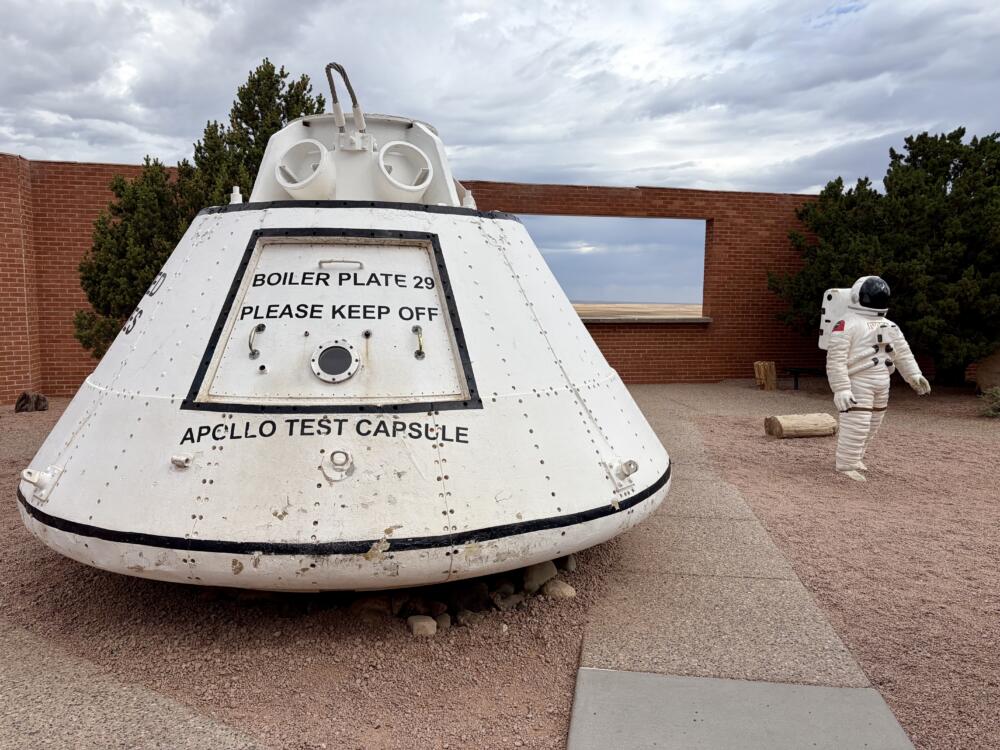
    Today Meteor Crater is 570 feet deep and the trail to the bottom is steep. It’s known as the Astronaut Trail because during the Apollo mission, NASA astronauts traveled this path.

    Buzz Aldrin, Michael Collins and Neil Armstrong came here to prepare for their trip to the moon.

    A museum at the top of the crater details the history of NASA using the site as a training opportunity before Apollo astronauts went to the moon. (Peter O’Dowd/Here & Now)
    A museum at the top of the crater details the history of NASA using the site as a training opportunity before Apollo astronauts went to the moon. (Peter O’Dowd/Here & Now)

    “Imagine doing this in full head-to-toe astronaut gear,” Johnson told a small group of hikers as we trudged deeper into the crater. “They used this as a training spot for the astronauts because it was the most realistic to a crater on the moon.”

    The training was worth it. Johnson said, at one point, an astronaut tore their space suit, and improvements were made before launching to the moon.

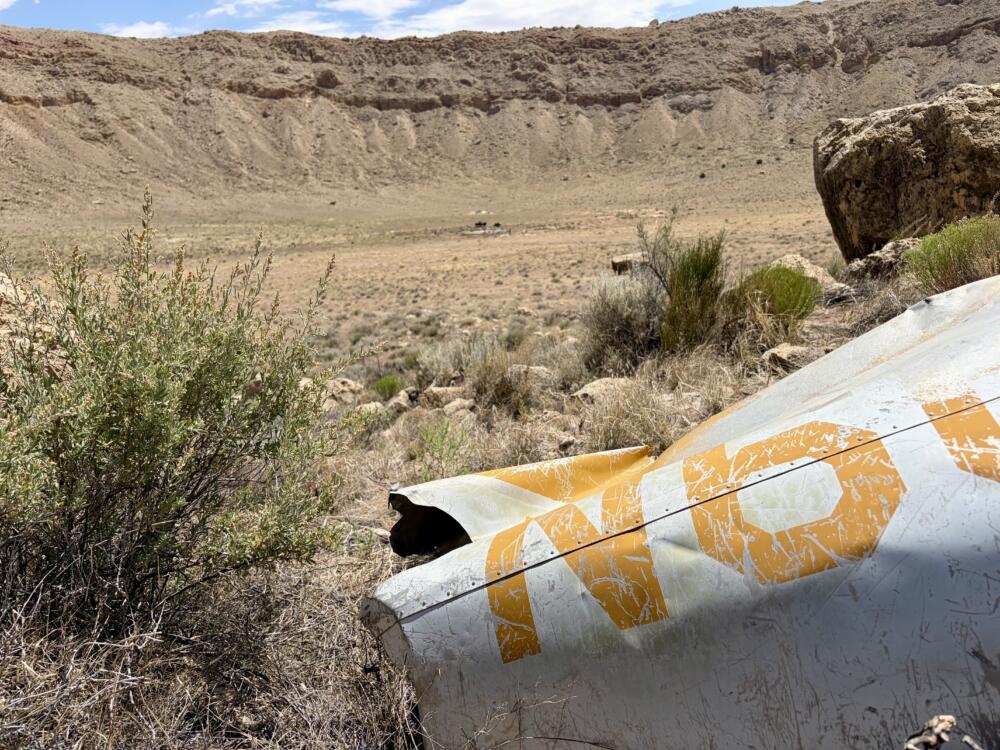
    In the 1960s, a small plane crashed when it tried to fly over the crater. Some of the wreckage is still visible today. (Peter O'Dowd/Here & Now)
    In the 1960s, a small plane crashed when it tried to fly over the crater. Some of the wreckage is still visible today. (Peter O’Dowd/Here & Now)

    Farther down the trail, more historical artifacts appear. Wreckage from a 1960s plane crash is still visible near the crater wall, the tail number fading after decades in the sun. So is a tangle of old pipes that once carried water to miners on the crater floor. Rusted out tanks and mine shafts are also clearly visible on the bottom.

    In the early 1900s, an engineer named Daniel Barringer believed he could make a fortune mining the heavy metals from a meteorite that was made mostly of iron and nickel. Barringer was convinced it was still buried below the impact crater. His plans didn’t work out.

    What Barringer didn’t realize is that when the rock struck the ground, “it hit like an atomic bomb, and over 80% was vaporized or recondensed into other materials,” Johnson said.

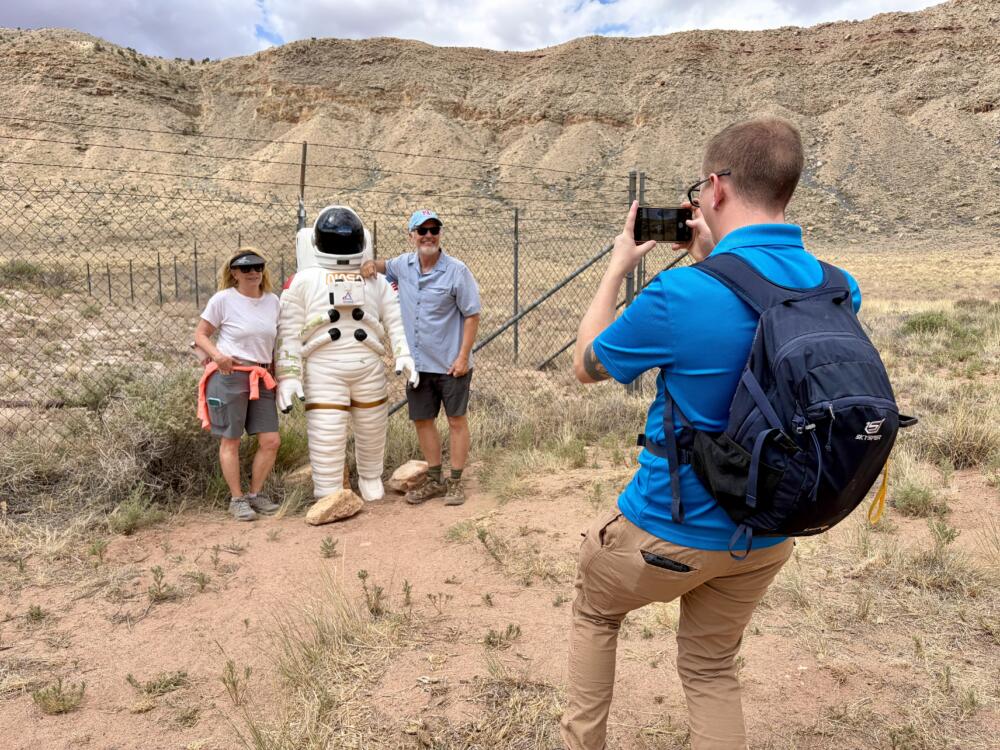
    Hikers Gena and David Stoll stop for a picture with a life-size statue of a NASA astronaut at the bottom of the crater. (Peter O’Dowd/Here & Now)
    Hikers Gena and David Stoll stop for a picture with a life-size statue of a NASA astronaut at the bottom of the crater. (Peter O’Dowd/Here & Now)

    But the family still owns the land where the meteorite struck and has encouraged scientific research at the site for decades. There’s also a museum at the crater’s rim that is a popular destination for tourists.

    Hiker Jonathan Misurda made the trip from Tucson. He said walking to the bottom reminds him of the cratered landscape he can see on the moon through a telescope.

    “It’s the closest I’ll ever get to that,” Misurda said, with the walls of Meteor Crater rising up around him. “It’s a great experience, and very awing.”

    This article was originally published on WBUR.org.

  • Baseball player Bobby Bonilla retired in 2001. Why is he still getting more than $1M per year from the Mets?

    Every July 1, former Major League Baseball star Bobby Bonilla collects a $1.19-million check from his former team, the New York Mets. It’s more money than some of baseball’s current stars will make in a year, and Bonilla will continue getting the annual payments until 2035.

    Kenny Malone, co-host of NPR’s Planet Money podcast, joins host Indira Lakshmanan to discuss one of the strangest contracts in baseball history.

    This article was originally published on WBUR.org.

  • One family is running together to celebrate America’s 250th birthday

    A civics-minded family in Atlanta celebrates America’s big birthday by running together.

    Georgia Public Broadcasting’s Sofi Gratas reports.

    This article was originally published on WBUR.org.

  • Trump wants 3 new nuclear reactors built by July 4. Can U.S. companies do it?

    An ambitious program to start up new nuclear reactors is bearing fruit. But some are worried about safety shortcuts.

    NPR’s Geoff Brumfiel reports.

    This article was originally published on WBUR.org.

  • The object that illuminated Washington’s Farewell Address

    To mark the 250th anniversary of the United States, we’re cataloging 25 objects that define the country’s history.

    George Washington could have stayed in office for a third term. Many thought he would, yet he wrote that he would “decline being considered” in his now famous Farewell Address.

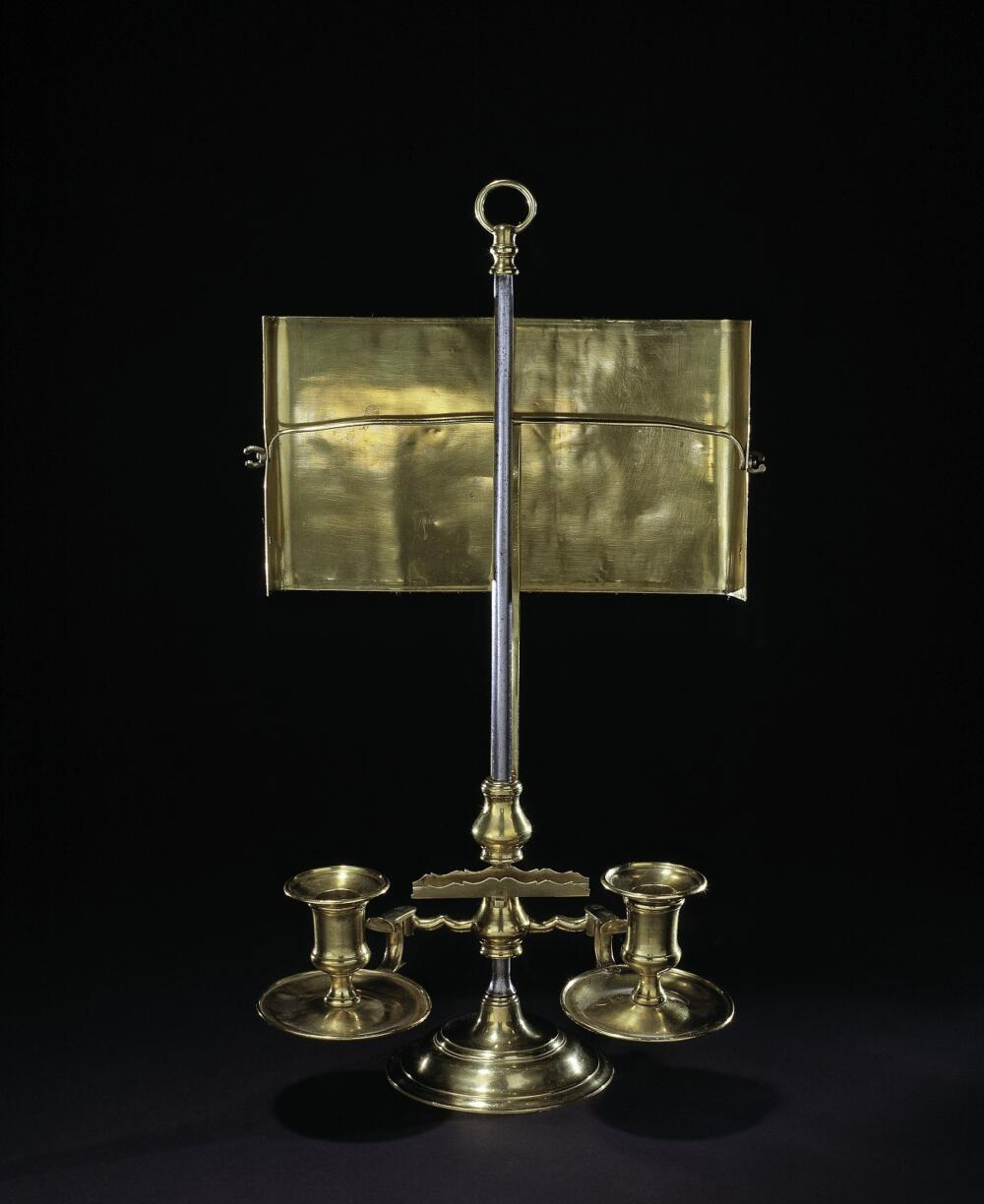
    Washington wrote those words by candlelight in 1796 beside a simple brass stand that is now part of the Smithsonian Institution’s collection.

    National Museum of American History curator Lisa Kathleen Graddy said the candle stand remains significant in America’s nearly 250-year-long history.

    George Washington's candle stand, (Courtesy of the Smithsonian's National Museum of American History)
    George Washington’s candle stand, (Courtesy of the Smithsonian’s National Museum of American History)

    Can you describe the stand? 

    “It raises and lowers. It has two holders for candles. They can move in and out depending on where you want to position them. And it has a brass reflector.

    “Of course, this was the only light available, so the brass reflector would magnify the light of the candles as Washington sat and wrote.”

    Why preserve this as a defining object in American history? 

    “Museums are filled with the things you write with and write on and, in this case, write by. And it’s a marvelous piece. It’s the physical object that helps us remember the Farewell Address and George Washington’s thoughts and commitment to his new country as he was leaving the presidency.”

    How do we know that this is the one George Washington used?

    “This is according to his family. And that’s another thing I think that is wonderful about it. After the centennial in 1876, America became much more interested in history again. It always happens around the time of these anniversaries.

    “Shortly after the centennial celebration, the family of his favorite granddaughter contacted the federal government. And they said that they were worried that, as years go on, pieces that they have that belonged to George and Martha Washington could scatter in bequests amongst the family. And they were afraid that they’d scatter to the winds. And so they wonder if the government would be interested in it.

    “Congress sends Ellis Spear, who’s the chief commissioner of the patent office, to look at the collection and make an assessment. Spear goes and he looks at it, and he comes back and says, ‘Yeah, we want it.’”

    George Washington labored with this Farewell Address for years. He got drafting help from James Madison and later Alexander Hamilton. What does that labored writing process reveal about George Washington? 

    “I think it shows how concerned he was that the country stayed together. It’s such a new country in 1796 still, and he hadn’t stepped down after his first term when he wanted to because everyone was afraid that without him, without the indispensable man, the country wouldn’t stay together. And so he stays another term.

    “With the Farewell Address — in true father-of-his-country fashion — George Washington is able to say, ‘You’re grown up. I think you’re on the right path. You can do this. But here are my words of advice to you to keep on the course that you’ve set.’”

    When you look at this candle stand, what does it tell you about the country? 

    “I think about George Washington sitting with this, editing drafts and writing down his ideas, and about how seriously people took this. How committed he and others are to the idea of this democracy that they fought for and they want to survive, and I think that’s part of the reason the family saves it. It’s not just a relic of Washington. It’s a talisman of faith in the United States and its survival.”

    This interview was edited for clarity.

    ____

    Will Walkey produced and edited this interview for broadcast with Catherine Welch. Walkey also produced it for the web.

    This article was originally published on WBUR.org.

  • People are learning to coexist with black bears as their population grows and habitat shrinks

    More people are having encounters with black bears as their habitat shrinks and they have more offspring. Now people are adjusting to coexistence with bears.

    Caroline Eggers from WPLN and the Appalachian Midsouth Newsroom reports.

    This article was originally published on WBUR.org.

  • For this family, attending a World Cup match is a generational dream

    Attending a FIFA World Cup game is a once-in-a-lifetime experience. It’s even more significant when you can do it with your family and fulfill a generations-long dream to cheer in the stands for your national team.

    KCUR’s Noah Taborda describes his experience.

    This article was originally published on WBUR.org.

  • Team USA faces off against Bosnia and Herzegovina in World Cup match

    Here & Now‘s Scott Tong talks with soccer commentator Sean Wheelock ahead of Wednesday night’s U.S. Men’s National Team match against Bosnia and Herzegovina.

    A win gets Team USA to the Round of 16. A loss means their tournament is over.

    This article was originally published on WBUR.org.