The Trump administration is proposing changes to what it calls “unnecessary and unworkable” Biden-era environmental rules designed to cut pollution from heavy-duty vehicles, including buses and large trucks.
The proposal — part of a series of deregulatory actions by the Trump administration that have rolled back emissions standards for new vehicles — includes changes that are welcomed by trucking organizations and denounced by environmental groups.
Specifically, the proposal from the Environmental Protection Agency would scale back and postpone two provisions designed to make sure emissions-reducing technology keeps working while a vehicle is in use; one related to warranties, and another related to the useful life of emissions technology.
Additionally, the current set of rules requires truck engines to automatically operate at reduced power if their emissions reduction systems aren’t working, which truckers and other heavy-duty vehicle operators have called disruptive. The EPA proposes getting rid of that requirement altogether and replacing it with an alert to drivers.
According to the EPA’s analysis, the changes would save the trucking industry between $4,130 and $6,152 per diesel engine affected. Compared to the current emissions rules, the change would increase ozone-forming nitrogen oxide pollution from heavy duty trucks by 4.2% in 2030 and by 11.6% by 2055.
The EPA did not model the resulting effect on air quality or human health, but noted that the modifications would likely reduce the benefits of prior rules changes in 2023.
“If finalized, these changes will help manufacturers keep improving their vehicles without being forced to rush products to market before they’re ready,” EPA administrator Lee Zeldin said in a statement, adding that the rules changes “will ease real burdens for operators.”
Kelly Loeffler, who heads the U.S. Small Business Administration, wrote that the rules change would alleviate “burdensome diesel regulations on behalf of farmers, truckers, and small business owners who were crushed by unworkable environmental activist demands that became costly mandates.”
The American Trucking Association had called for changes to the rules, writing in February that the Biden-era policies would require “a premature rollout of commercial motor vehicles with unproven engine technologies onto our highways.” The group specifically asked the agency to allow truck manufacturers to pay penalties instead of comply with the rules, as long as they were working on developing compliant engines, an option the EPA included in the proposal.
Environmental groups criticized the proposed changes, citing concerns about the health hazards of emissions. “Clean truck standards save lives,” Katherine García, director of the Sierra Club’s Clean Transportation for All campaign, wrote in a statement emailed to NPR. “Weakening them would mean more toxic pollution in the air and more families paying the price with their health.
The Environmental Defense Fund noted that while heavy trucks make up only 5% of vehicles on U.S. roads, they are the largest source of “pollutants that cause asthma attacks, bronchitis, heart attacks, strokes and preventable deaths,” and argued that truck manufacturers are already capable of meeting the Biden-era rules.
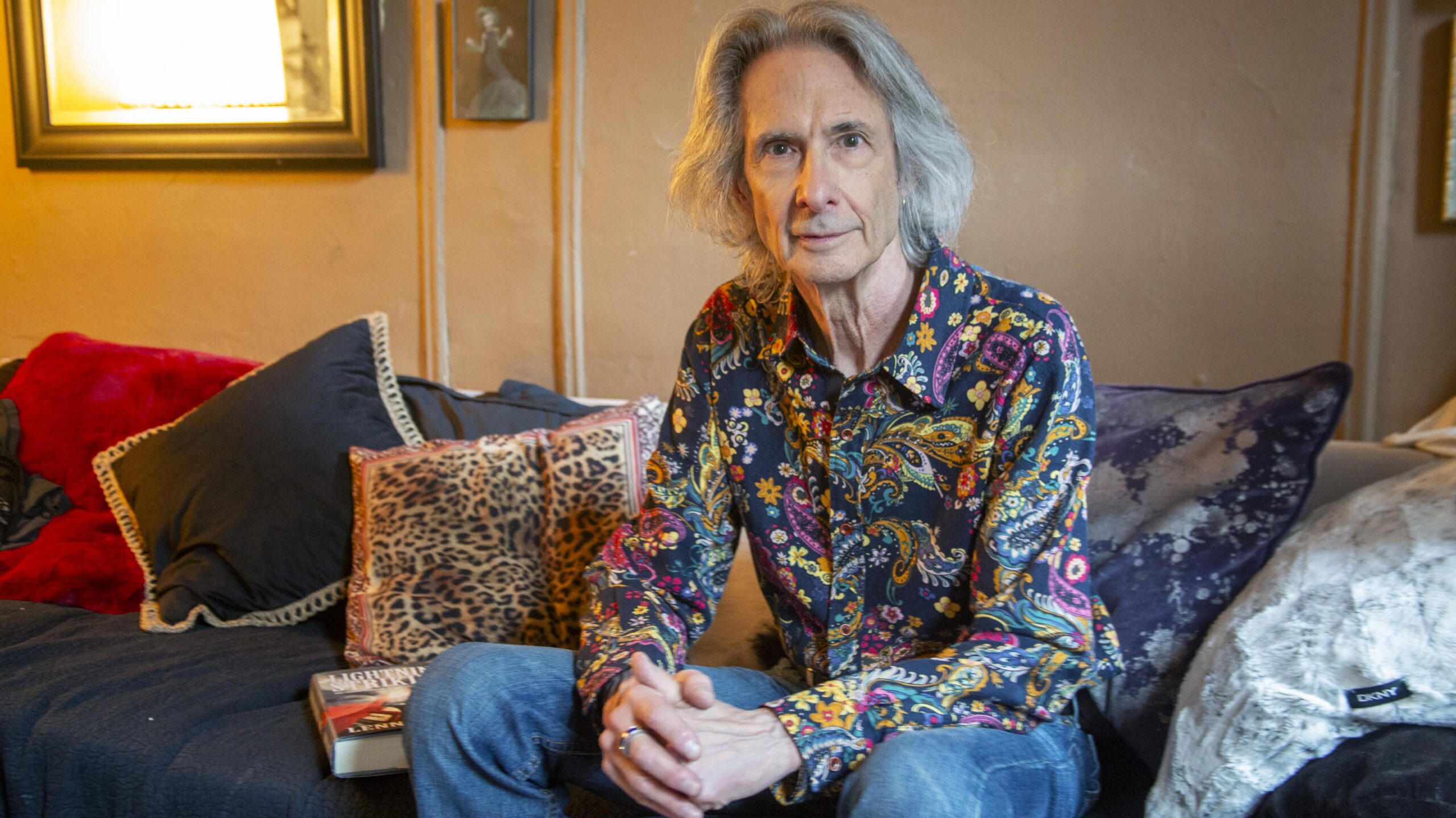
Lenny Kaye has been Patti Smith‘s guitarist since the early days, when he was a rock critic, and she was doing poetry readings. It all started in 1971, he says: “I went over to the loft where she was living with Robert Mapplethorpe and she read me her poems and I just kind of put some rhythmic energy behind the poems. … It was not meant to be anything.”
Kaye remembers New York City at that time as a hotbed of artistic creativity. “Theater, film, you name it. In that little 10-block circuit of the East Village, so much was happening,” he says. “We didn’t have a band for another three years. We developed organically, and that to me is what made us so special. We sounded like ourselves by the time we had all the pieces of a real band.”
Kaye’s collaboration with Smith continues to this day. He credits Smith with teaching him to trust his musical sensibilities — and to always keep evolving. “You have to keep moving forward, you have to be true to your art. You can’t be blinded by fame or money,” he says.
Now 79, Kaye is releasing his first solo album on July 17. He says the songs on Goin’ Local offer a snapshot of his musical consciousness: “I do a lot of things, and a lot of times I kind of duck into somebody else’s soundscape. But I thought it was time for me to really understand who I am as an artist.”
As for the album’s title, that reflects Kaye’s love of local music: “Music happens in the local and then sometimes the world discovers it. And I love that pattern and evolution of how music happens totally at the grassroots, one-on-one, and then perhaps gets figured out.”
Patti Smith and Lenny Kaye perform at an event at the Brooklyn Public Library in New York, May 21, 2022. (Andrea Renault | AFP)
Interview highlights
On his close collaboration with Patti Smith
I always collaborate with Patti. When she’s writing a book, she’ll often send me works in progress and we’ll talk about directions or the correct word. … And she encourages me too, as a writer and as a performer. We are astral twins. I’m so happy about that. That I get to be on her stage left for all these years. I always like to say, I’ve never seen her sing a false note ever. She always, during the course of a show, tries to make that night special for the audience. And she is my guiding light, my locus of energy.
On what Smith brings out in him
She helped me understand who I am as a musician and how it helped her understand herself as a singer, because Patti learned how to sing on the stage with the band. She also sensed a positive energy in me that I could go anywhere. I’m not hidebound by genre or how things should be done. And Patti, of course, is a creative force that continues to move ever forward. She’s not one to rest on her laurels. She wants to see what happens next. And she encourages that in me.
Whatever I’ve done in the past, great, but what I’m really interested in is getting up and seeing who I am today and as it moves into tomorrow.
Lenny Kaye
I’m a worker. That’s really what she encouraged in me. She’s a worker, too. No matter what we did yesterday, or five years ago, or 10 years ago or at this point, 55 years ago, it’s all about the future. She has an expression, “Progress isn’t the future, it’s keeping up with the present.” And so I try to incorporate that in my life. Whatever I’ve done in the past, great, but what I’m really interested in is getting up and seeing who I am today and as it moves into tomorrow.
On writing “The Things You Leave Behind,” a new song about what gets left when we die
I call my accumulation the Museum of Me, because I look at all the books, some of which I’ll never read, but I like seeing their spines on the shelf. Of course, the accumulation of records, which is a curation of a sort, and any time I get rid of a record, I want to hear it a week later. I’m in the book and making-records world too, so I’m adding to it. … The song was birthed when someone I knew passed on, and I was given the honorable job of moving their stuff out, and I thought, man, this is a great responsibility to make sure that somebody’s sense of curation is honored.
I have a lot of stuff. I mean in my house in Pennsylvania, I have the basement, I have two floors and an attic. And I filled it up. I can’t even believe it. I brought everything in there one at a time. There’s guitars. There’s my body of work, you know, the albums I’ve created over the years. I don’t know. And to be honest, when the time comes and it gets dispersed, I won’t know anything about it. I’ll be up there with the great file cabinet in the sky, thinking, oh man, I want to hear this record.
On how he believes that despite different genres, music is the same
Music releases us, music elevates us and music illuminates us. And no matter the different styles, this is what I’ve really found, given all my kind of accessorizing because the basic reasons for a song stay the same: “I want love, I don’t have love, I’m sad, I’ve lost love. Who am I? I’m peeved at the world.” All of these things are universal and no matter the decoration or the genre or how it’s presented, these are the elements of why we sing. And I’m, of course, quite blessed to be part of those who sing and see it come back to them in the response of the audience.
On changing musically throughout his career
I think it’s less age and more experience. I’ve been through so many musical genres in my time. I’ve sung to you some of the great crooners. I love country music. I’m a passable pedal steel guitar player. I love heavy music. I have a band called The Drift, my side project, which is kind of a power trio that accesses the darker side of my personality. But I thought that, in a sense, these songs show a personal thing. When I played them for Patti, she said something to me, which I thought was good, she said, “I’ve never heard you sound like this.” And it’s kind of something that I’ve kept private, but I’m also drawing on the experience of playing music for, at this point, nearly 60 years. All the influences that I brought within myself, the romantic side, the kind of social commentary side, all of these things revolve around who I am. I’m all about the future, Terry. I have to say, I have a long list of things I’ve done in the past, but to me, that’s the past. I really like the fact that I’ve given myself a new persona that I can pursue and understand who I am at this point in my life.
On why he enjoys generation gaps with music
I always hope that there is a generation gap. I don’t believe that music was, quote, “better then.” Music belongs to the moment. I would not want people to venerate the music that I grew up with, or even that I make now. I believe that music exists as the soundtrack of our present time. And often when I’m in the car, I listen to hit radio. I might not make music like that. I might not even understand how to make music, but I can certainly appreciate the cleverness and the skill that goes into making the hits of the day. And so I would hope that when [my daughter’s] kids grow up, they’re not gonna be listening to what she did, they are gonna be listening to the music of their generation.
Lauren Krenzel and Susan Nyakundi produced and edited this interview for broadcast. Bridget Bentz, Molly Seavy-Nesper and Jacob Ganz adapted it for the web.
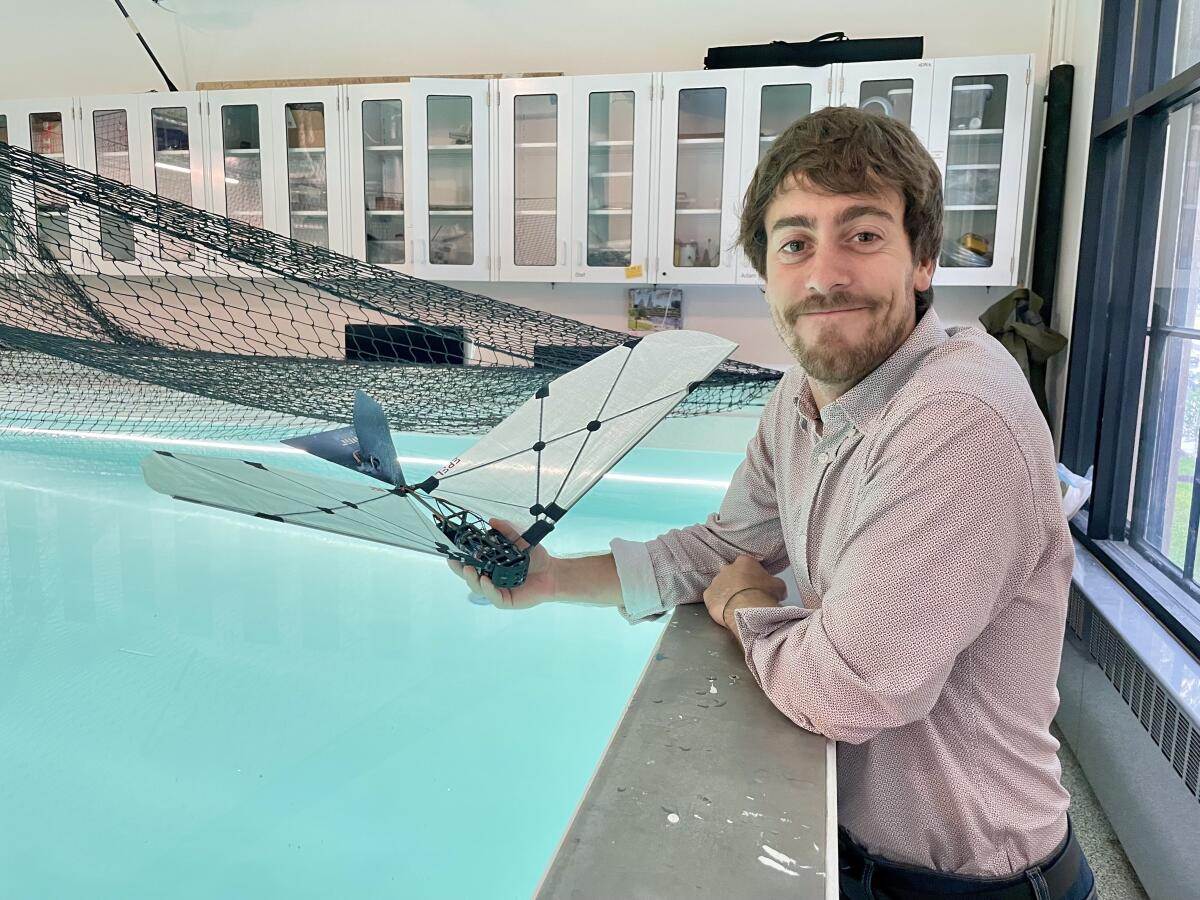
Mechanical engineer Raphael Zufferey’s lab at MIT contains a giant tank filled with bright turquoise water, an array of fans that can whip up a powerful wind, and small flying robots perched everywhere you look.
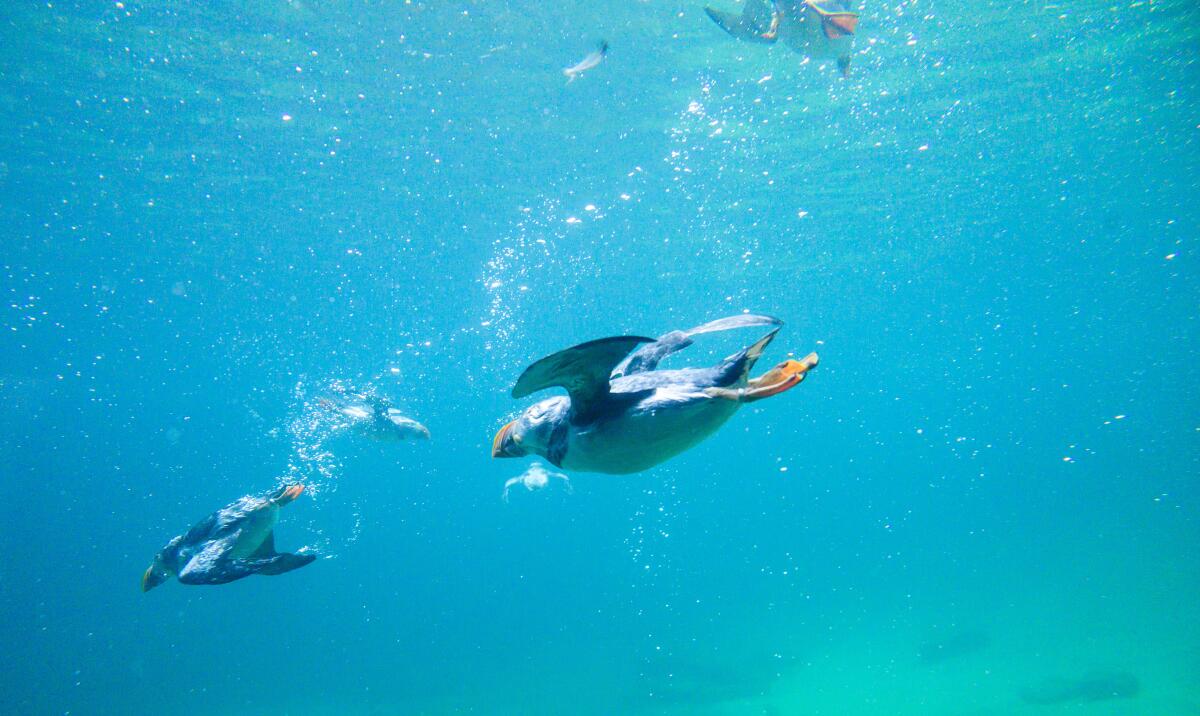
It’s the robots that are the stars of the show here and they’re inspired by diving seabirds like the Atlantic puffin, which uses its wings to both fly and swim.
“These puffins solve this really challenging task of moving in air, in water despite the huge difference in density,” says Zufferey.
He and his colleagues wanted to see if they could build a bird-sized robot that could also move through both mediums and transition between them. It’s something no one had ever done before.
Raphael Zufferey, a mechanical engineer at MIT, is one of the leaders of the project to create the new robot. (Ari Daniel/NPR)
In a paper published Thursday in the journal Science, they describe the engineering of just such an aerial-aquatic robot. It weighs about half a pound and its wingspan measures not quite three feet, tip to tip.
“This is a beautiful robot,” says Glenna Clifton, an animal movement biologist at the University of Portland in Oregon who collaborates with roboticists but wasn’t involved in this research project. She says the robot offers insights into what makes the flight biology of diving birds unique.
It also has many potential applications including observing the coastal ocean and monitoring something like a remote coral reef. The robot could fly to the reef — or something else like a pod of whales or an algal bloom — and then sample the water and collect data.
Such bio-inspired robots are fertile ground to learn about both nature and engineering. “The biology inspires the robotics,” says Clifton, “but then also the robotics are used to understand the biology.”
The engineers studied the way puffins dive, swim and fly, and move between air and water. (Raphael Zufferey)
Designing a novel robot
Creating this robot took two years. “Thinking of a wing that could operate in both [air and water] somewhat efficiently seems implausible,” Zufferey recalls thinking.
But he and his colleagues were undeterred. They based the robot’s overall body plan on a diving bird, but made a couple of key departures.
First, they decided not to include any legs because in robotics, legs are tricky to build, control, and achieve the desired movement in the robot. “Instead, we thought, ‘can we go from the water straight to the air simply with the wings themselves?’” says Zufferey.
Second, the research team decided against making those wings foldable as they are in many diving birds. That would have been too complex, Zufferey says. “You need to add joints, you need to add motors. So instead we rely on wing flexibility.”
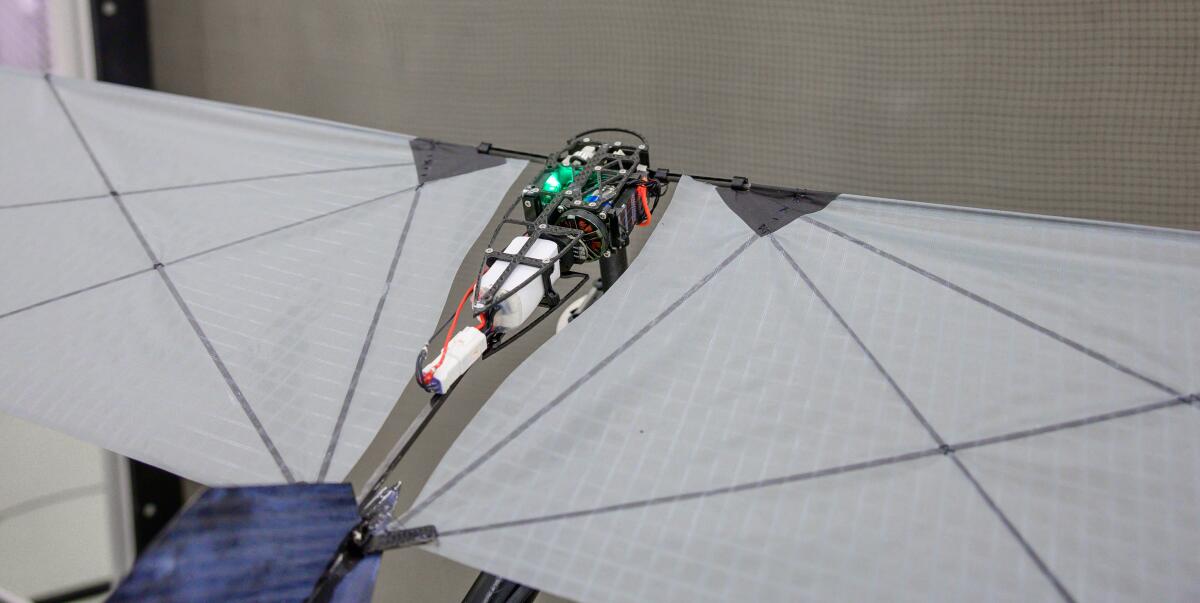
He holds up the final robot. It’s elegant. The central body, which houses the motor and battery is completely open, meaning its electronic guts are visible.
“So water floods the whole system here,” explains Zufferey. “You have to waterproof, individually, every single component.” Such an approach allows the robot to be both light enough to fly easily through the air and also neutrally buoyant, meaning it won’t float to the surface or sink to the bottom. It just stays put in the water.
The robot’s open body design keeps it neutrally buoyant in water, meaning it won’t float to the surface or sink to the bottom. It just stays put in the water. (Raphael Zufferey)
The robot has a tail to help it fly. The wings are made from a translucent nylon fabric reinforced with carbon fiber struts. Zufferey holds the body of the robot while its wings flap up and down crisply and quickly. “You can really feel the forces,” he says.
The robot flaps five to six times a second to maintain flight. To leave the water and propel itself into the air, however, it must move its wings ten times a second to generate sufficient speed and thrust.
Most diving birds can’t generate that kind of power with their wings alone, which is why they take off by using their legs to run along the water’s surface. (The kingfisher is an exception but it is an especially light bird, says Zufferey.)
“A monumental step”
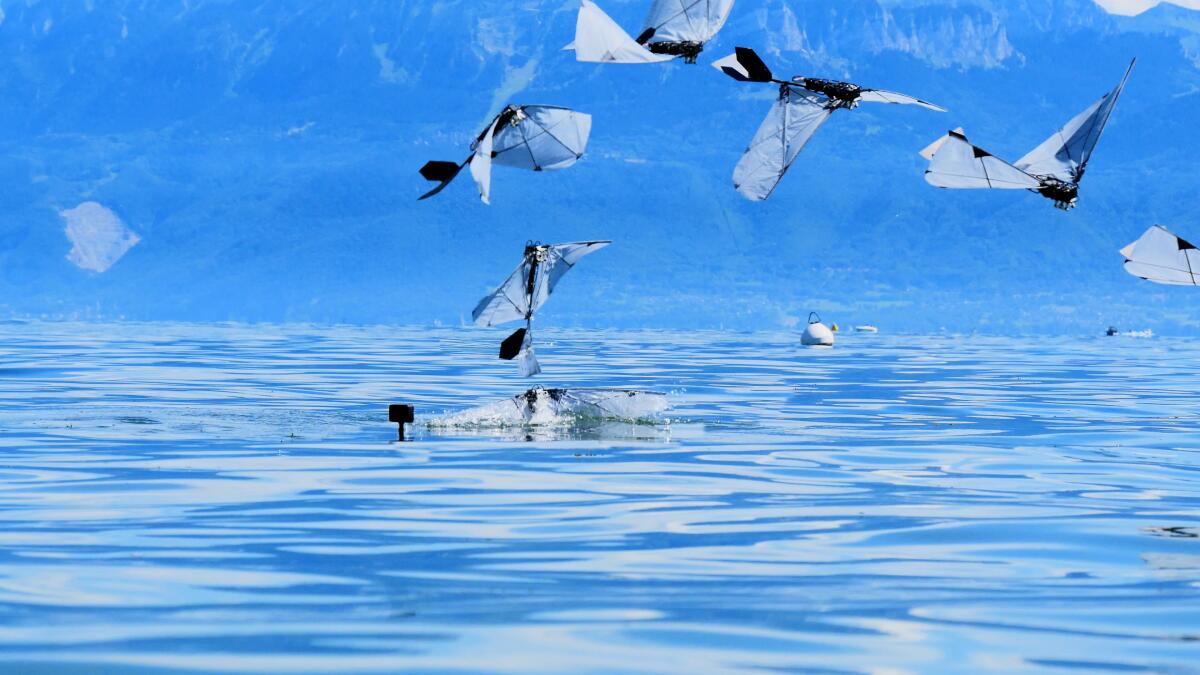
Zufferey calls up a video that he and his colleagues filmed at Lake Geneva in Switzerland. The Alps rise up in the distance and the water’s surface is placid.
There’s the slightest of ripples before the robot bursts out of the water and into the air — all in less than a second. It actually sounds like a bird taking flight.
The researchers computed the optimal launch angles and wing size. And they estimate that on a single charge, the robot could fly for not quite four miles or swim for a bit more than a mile, “which is longer than the running and swimming portion of a sprint triathlon,” observes Clifton.
A photo-illustration shows the flight arc of the robot, as it leaves the water and soars into the air. (Raphael Zufferey)
She was impressed by the robot overall. “It is light and powerful and a monumental step in the performance at both swimming, flying, and transitioning between the two,” she says.
Down the road, Zufferey is excited about using this kind of robot for a range of applications, including monitoring harmful algal blooms, fish stocks, and coastal erosion. He plans to equip the device with a handful of onboard sensors to enable such data gathering.
In addition, Zufferey and his team are continuing to refine and improve their aerial-aquatic robots — honed by experimentation but still inspired by the natural world. “You see that it has already been done in biology,” he says.
“So that gives you hope as a robotics researcher. It tells you that it should be possible.”
Mountain bike enthusiasts have been working for years on an ambitious 485-mile, multi-use trail called The Velomont that will span the length of the state.
When finished, the collaborative project will knit together existing trail networks, connect 27 communities and include huts and hostels for overnight stays.
New trail construction is finally ramping up after years spent on permits, plans and public input. And organizers say they want to make it as user-friendly as possible.
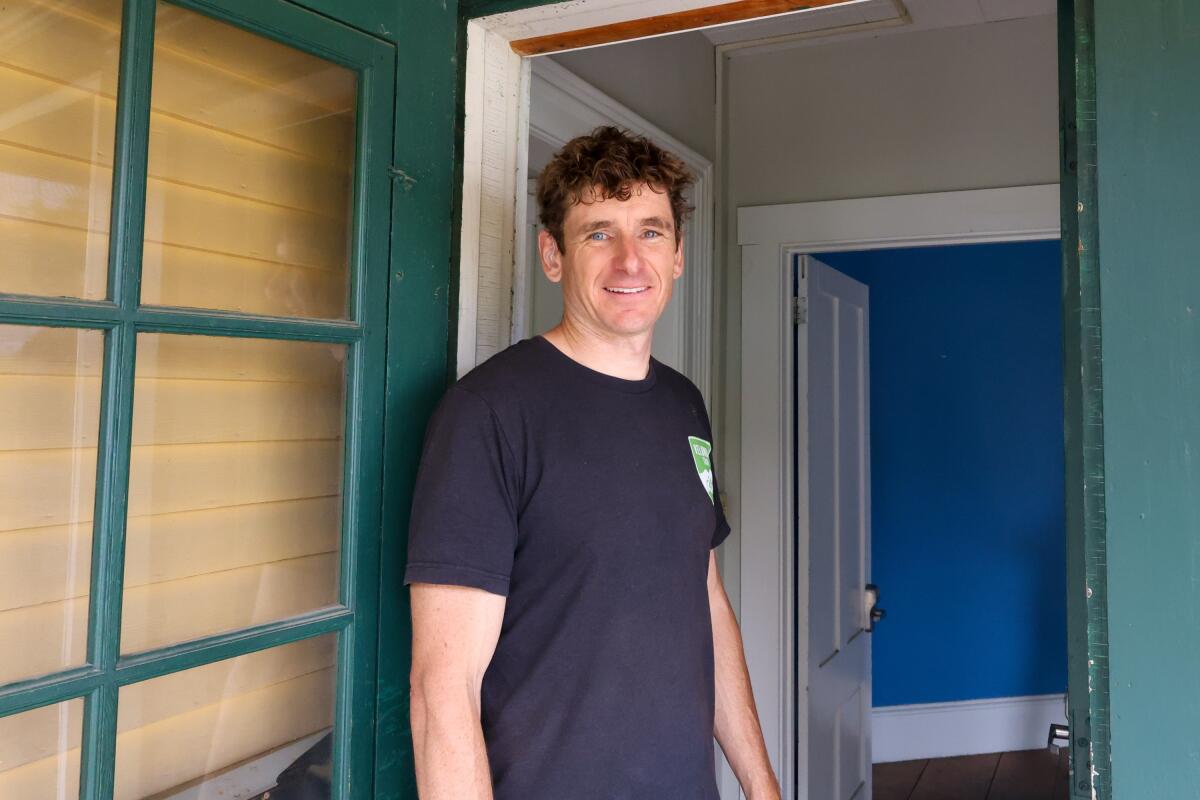
“For us, it’s not a huge lift to just be mindful when we’re trying to build trail or improve trail to think about the adaptive rider,” said Angus McCusker, the Velomont trail director with the nonprofit Vermont Huts and Trails.
McCusker is referring to the growing number of disabled athletes who mountain bike with specially designed equipment.
“The challenge,” said McCusker, “is we’re connecting to existing trail networks that were never intended for adaptive bikes. So, where we can, we’re trying to do adaptive assessments.”
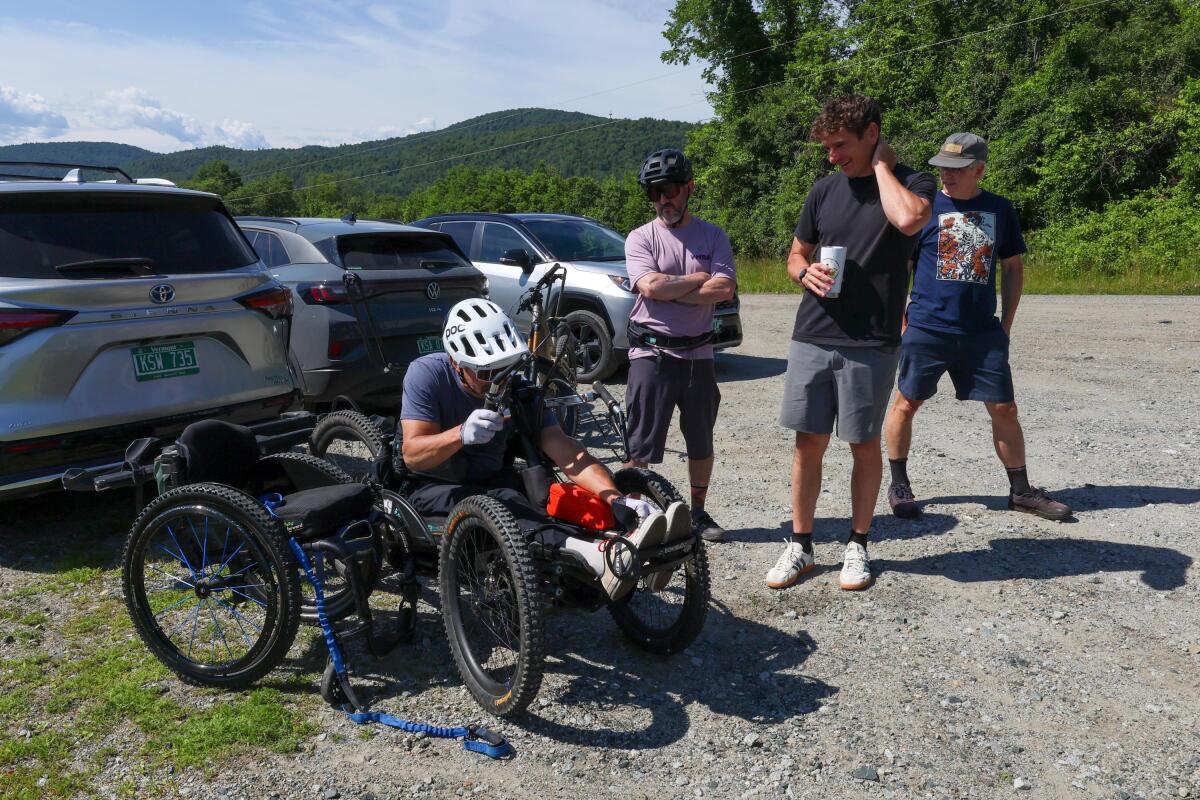
Louis Arevalo, left, straps into his adaptive mountain bike and chats with Jeff Dickson of the Vermont Mountain Bike Association, Angus McCusker with Vermont Huts and Trails, and volunteer Thatcher Hinman (all from left) ahead of a trail accessibility assessment in Randolph, Vermont, on Thursday, June 25, 2026. (Zoe McDonald | Vermont Public)
Louis Arevalo of Essex Junction is one of several adaptive athletes helping with that, most recently on some slightly overgrown single track trails in Randolph, a central Vermont town nestled along the eastern edge of the Green Mountains.
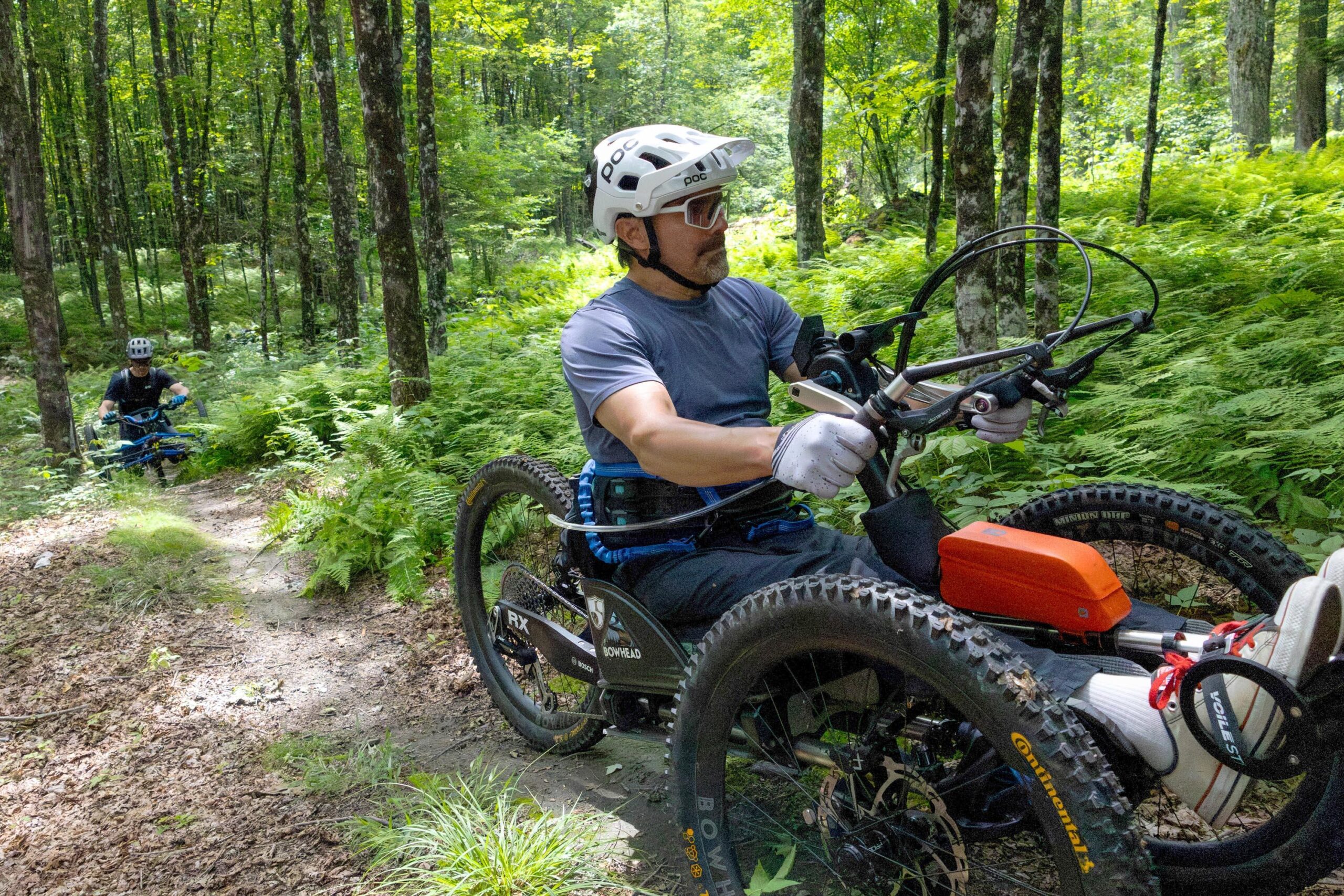
Arevalo pedals with his hands. He rides an electric powered recumbent-style three-wheeler that sits low to the ground. His service dog Azul chases along nearby.
“Once you realize what these bikes are capable (of) or this equipment actually opens up, it kind of blows your mind,” he said.
Arevalo was paralyzed in a skiing accident six years ago. Being able to get back on the trails has been a game changer, he said smiling.
“There’s a reason we live in the Green Mountain state. It’s because we like to get outside…you know, seeing the squirrels and chipmunks and birds… I mean, it’s life.”
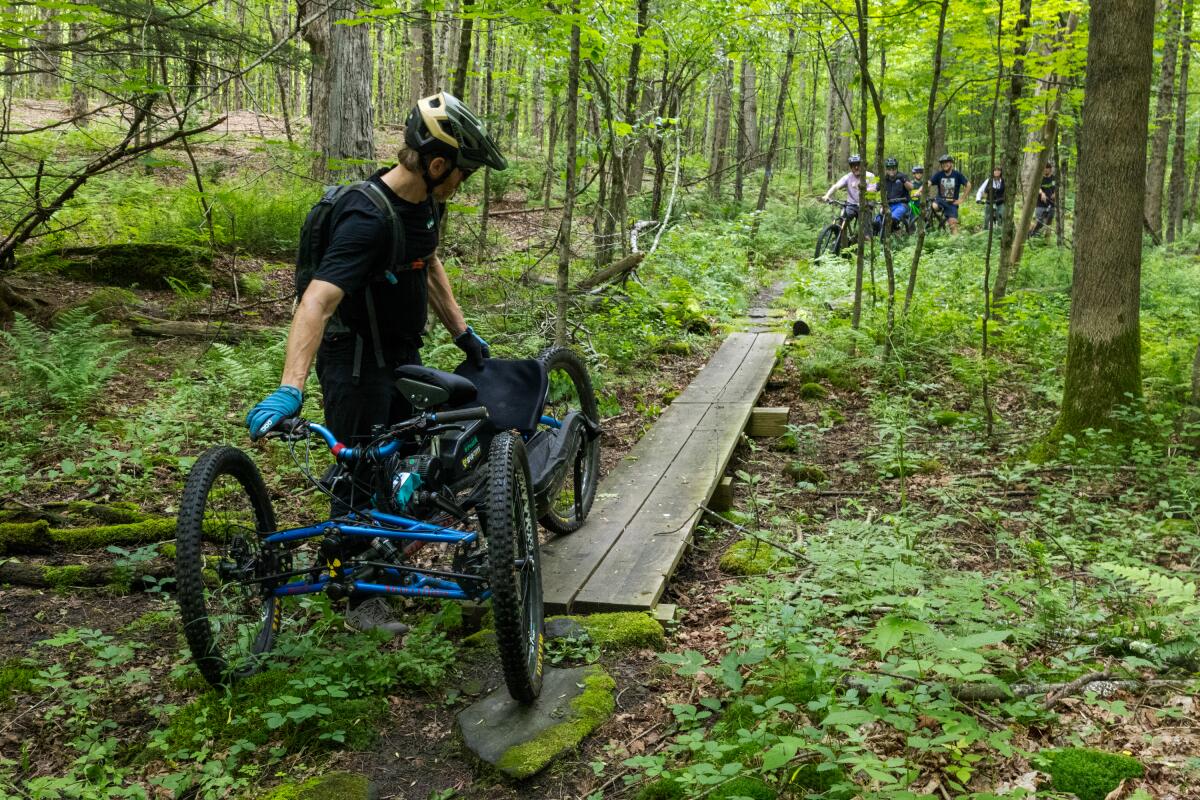
Nick Bennette, of the Vermont Mountain Biking Association, guides an adaptive bike over a narrow bridge, pointing out that other adaptive riders may have trouble getting across. (Zoe McDonald | Vermont Public)
But adaptive rigs like Arevalo’s are wider and heavier than regular mountain bikes, and not all trails are user-friendly.
Nick Bennette, who was testing a different type of adaptive bike, got hung up on several tight turns.
“It’s helpful to have different kinds of adaptive bikes on these tests because they all handle a little differently,” he said.
Bennette is executive director of the Vermont Mountain Bike Association, another nonprofit spearheading efforts around the Velomont. He and others involved in the assessment are taking detailed photos and notes on ways to make the trails more accessible.
“Just scalloping out a bit of material on the outside of that corner,” said Bennette, pointing to the area the bike got caught. “That will allow adaptive bikes to make that corner without really changing the way the trail rides.”
Angus McCusker with Vermont Huts and Trails is working to create accessible accommodations along the Velomont Trail, including a multi-group space in Randolph and a hut in Chittenden that has been outfitted with accessibility in mind. (Zoe McDonald | Vermont Public)
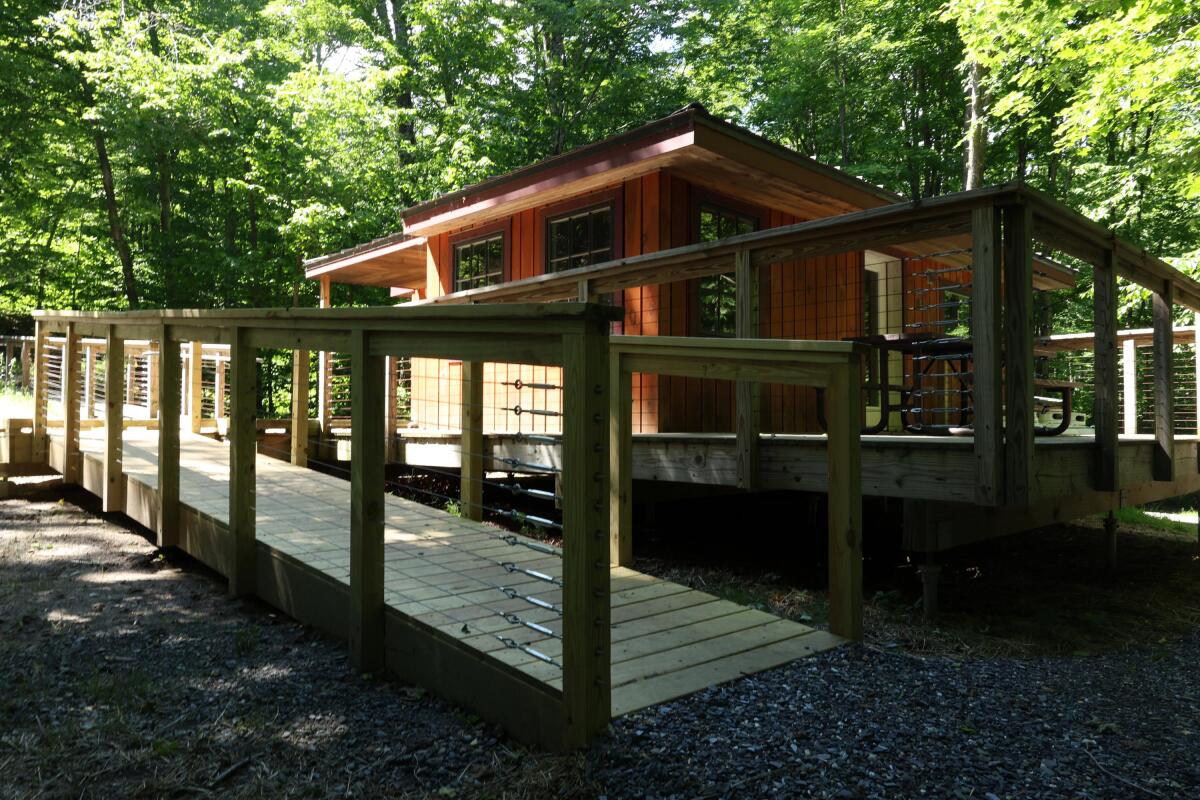
Contractors are also trying to reduce barriers at the trail’s overnight accommodations. This summer, contractors are building a new ADA accessible hostel in downtown Randolph.
And two remote huts along the trail will have locked sheds with off-road wheelchairs so bikers don’t have to haul their own.
At the Chittenden Brook Hut, McCusker highlighted a new ramp and wider driveway.
“So if you’re an adaptive rider, you can imagine rolling right up here and you can transfer to your chair that’s available here, and then roll down the ramp and go down to the fireplace, to the privy, to make your meal,” he said.
Louis Arevalo stayed at the hut last summer with other adaptive riders — his first camping trip since his accident.
“There was a babbling brook right there…and it was really refreshing to have easy access to a beautifully built hut that was easy to navigate, and then have these world-class trails right out the door,” he said. “And with these Velomont trails, I can actually plan a hut-to-hut trip with other people.”
The Chittenden Brook Hut includes accessible ramps, storage for adaptive bikes and specialized off-road wheelchairs for visitors. (Zoe McDonald | Vermont Public)
Jeff Alexander is counting on it. He’s director of strategic partnerships with Vermont Adaptive Ski and Sports, a nonprofit that helps people with disabilities access outdoor recreation.
An economic impact analysis the group commissioned estimates their programming generated more than $10 million last year.
“So the adaptive community has money, they travel, they want to travel and they want to play with everybody,” Alexander said. “We just need to level the playing field so that everyone can play together.”
New plaintiffs in a class action lawsuit against Elon Musk’s AI company, SpaceXAI, allege that the company’s image-generation models were used to create child sexual abuse material and that the company failed to adequately share information about an alleged perpetrator with authorities.
Two plaintiffs, one in Wyoming and the other in Wisconsin, joined the lawsuit filed by three Tennessee teenagers earlier this year, according to an amended complaint filed on Tuesday. All the plaintiffs are referred to as Jane Does. The suit was also expanded to include Stability AI, the company behind the Stable Diffusion image generator, as a defendant.
The suit alleges that the perpetrators, including a plaintiff’s male friend and another plaintiff’s stepfather, used the companies’ AI models to alter photos taken when the plaintiffs were underage to make child sexual abuse material (CSAM). The five plaintiffs accuse the companies of producing CSAM, benefiting from sex trafficking ventures, negligence, defective product design and creating a public nuisance.
“Public nuisance means that this is not just something that is problematic for our clients … this is something that is a scourge on society,” said Annika Martin, an attorney for all five plaintiffs. “We want to put these guardrails in place so that we do not cause this harm across an entire generation of children.”
The plaintiffs are asking the AI companies toinstall more effective guardrails to prevent the creation of exploitative and abusive imagery as well as seeking monetary compensation.
The case of Jane Doe 4
While SpaceXAI, like other internet companies, is required by law to report suspected child sexual exploitation, including CSAM, to the nonprofit National Center for Missing and Exploited Children (NCMEC), the lawsuit alleges that the company failed to adequately do so.
SpaceXAI was previously known as xAI. The company rebranded this month following its merger with Musk’s SpaceX earlier this year.
According to the complaint, the stepfather of Jane Doe 4, a woman in her 20s in Wyoming, used SpaceXAI’s chatbot, Grok, to generate about 7,000 sexually explicit images and videos from a single photograph taken when Jane Doe 4 was about 11. The AI-generated images included depictions of her nude, performing sexual acts on men, including her stepfather. Some images also included explicit captions.
SpaceXAI only sent one tip regarding Jane Doe 4 to NCMEC in February, when the stepfather asked the model to generate an image depicting the girl being raped by multiple men, according to the complaint. The company did not include any of the abusive images with its report, and also failed to share the alleged perpetrator’s IP address with NCMEC and law enforcement, even after officials requested it multiple times, according to the complaint.
Many electronic service providers submit a large volume of reports of suspicious activity to NCMEC, but do not include “sufficient or actionable information” because the law did not require it, the center wrote in a report in March.
When law enforcement eventually tracked down and investigated the stepfather, they found that he, like the other perpetrators mentioned in the lawsuit, traded the sexually explicit images with others online, according to the complaint. Two days after law enforcement searched his digital devices and charged him with child exploitation offenses, he died by suicide.
“Jane Doe 4 entered a period of extreme personal crisis,” the complaint said. “She had to grapple with the trauma of her own sexual exploitation while at the same time assisting her mother in navigating the loss of her stepfather … Her family was torn apart, and her life became a nightmare.”
Law enforcement told Jane Doe 4 that her stepfather had used Grok because it was more responsive to his prompts than other AI models, according to Martin, the lawyer representing the plaintiffs in the class action lawsuit.
NCMEC declined to comment on the case and referred NPR to law enforcement. The Wyoming Division of Criminal Investigation, whose task force on internet crimes against children was identified as one of the law enforcement agencies involved in Jane Doe 4’s case in the complaint, did not respond to a request for comment. SpaceXAI did not respond to a request for comment.
Apps that can alter photographs to make intimate images and pornography have existed for years in the shadows of the internet. But the creation of nonconsensual intimate images became much more mainstream in 2025 when major AI companies including Google, OpenAI and xAI updated their image generation tools in a way that allowed users to strip people down to bikinis.
From late 2025 into early this year, people used xAI’s tools to make a large number of altered photos showing women and children stripped down to bikinis or even less. As a result, countries including Indonesia, Malaysia and the UK launched investigations and imposed temporary bans on xAI. Currently, according to NPR’s testing, chatbots created by Google and OpenAI refuse to respond to the prompt “put her in a bikini.” A free version of Grok showed an error in loading images after receiving the same prompt.
The Stability AI logo is being displayed on a smartphone in this photo illustration on June 10, 2024. A class action lawsuit filed against SpaceXAI and Stability AI alleges the companies’ AI tools were used to make sexually explicit images of children. (Jonathan Raa/NurPhoto via Getty Images)
Stability AI is a new defendant
Stability AI, which makes the image generation tool Stable Diffusion, was added as a new defendant in connection with the claims filed by the three initial teenage plaintiffs in Tennessee. The complaint was updated to add that “The application on the perpetrator’s phone used to create the AI CSAM of Plaintiffs relied on Stability AI’s image-producing tools.”
Unlike proprietary models such as those made by SpaceXAI, OpenAI and Anthropic, Stability AI’s models are open-weight, which means it’s much easier for users to remove restrictions that model makers have put in place. What’s more, the model maker generally doesn’t have insight into user queries. Nonetheless, the lawsuit alleges Stability AI could have restrictedits models’ ability to generate CSAM but chose not to in its more recent releases.
The Verge reported in November 2022 that Stability AI said it filtered out not-safe-for-work (NSFW) content from its training data to restrict the Stable Diffusion Version 2 model’s ability to generate CSAM. This decision drew backlash from users, including one who decried the update as “censorship,” The Verge reported.
A more recent version of Stability AI’s model was frequently used to generate NSFW content and generated a higher proportion of such content compared with outputs from Stable Diffusion Version 2, according to a research paper by scholars from the University of Wisconsin-Madison, the Massachusetts Institute of Technology and other institutions, which has not yet been peer-reviewed. Stable Diffusion Version 2 was also much less popular than the Stability AI models that came before and after it, the researchers found.
“When they realized that nobody wanted to use their model when they put those guardrails in place, they rolled those guardrails right back so that everybody would want to use their model again,” Martin said. “They knew exactly how to rein this behavior in and they chose not to for profit.”
Stability AI did not respond to a request for comment.