Transcript:
JUANA SUMMERS, HOST:
It’s CONSIDER THIS, where every day we go deep on one big news story. Today, remembering a titan among Federal Reserve chairs.
(SOUNDBITE OF ARCHIVED RECORDING)
RONALD REAGAN: It’s my pleasure to welcome Alan Greenspan back to official service to his country.
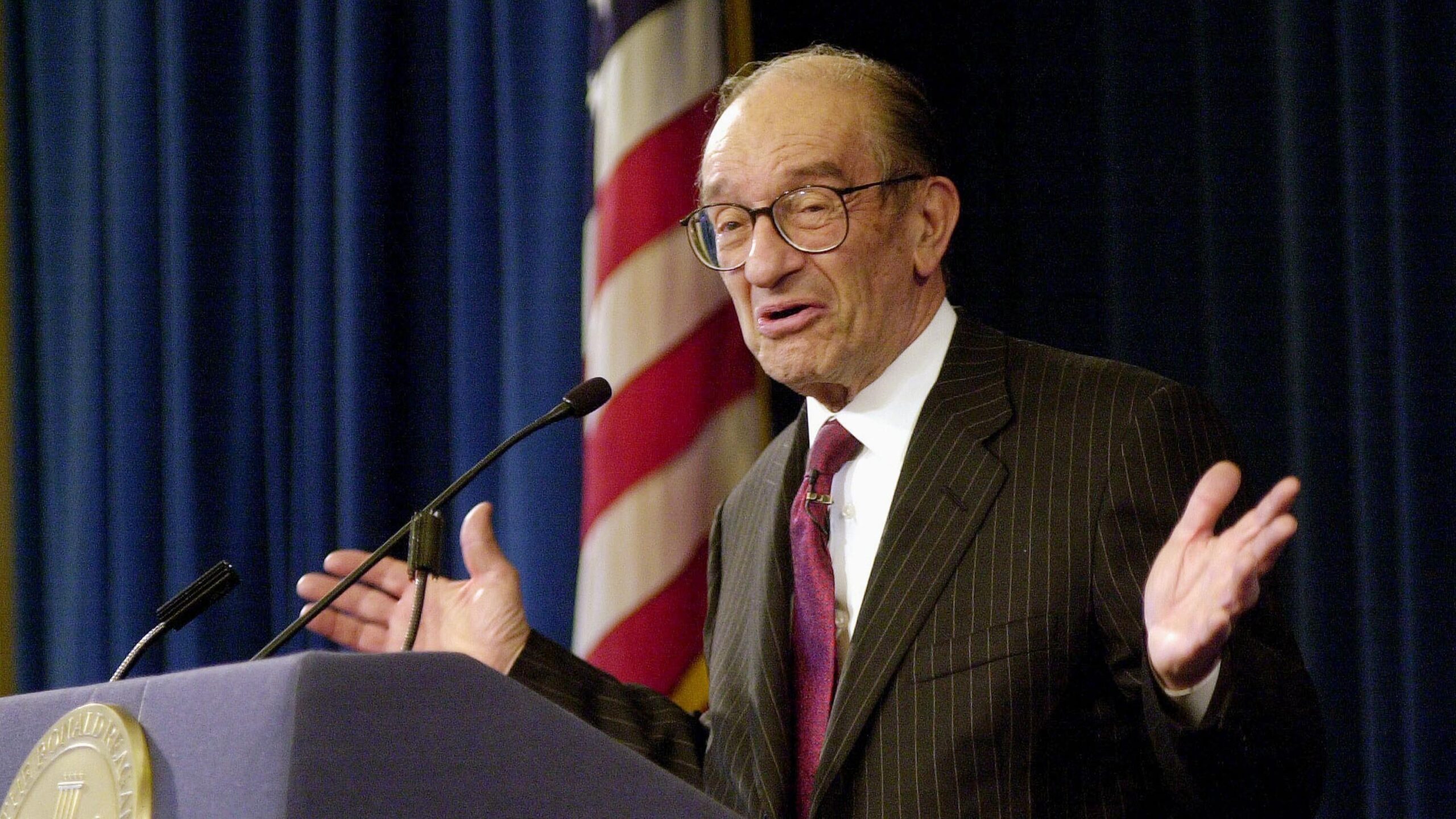
SUMMERS: Alan Greenspan, the longtime Federal Reserve chairman, being sworn into office by President Ronald Reagan in 1987. Greenspan led the central bank for nearly 20 years. Much of his tenure was marked by falling unemployment and an economic boom. But two years after he retired came the 2008 financial crisis. Critics argue that it was his hands-off approach to regulation that set the stage for the crash. Greenspan admitted that his approach wasn’t perfect. Here he is speaking to the House Oversight Committee in October 2008.
(SOUNDBITE OF ARCHIVED RECORDING)
ALAN GREENSPAN: I made a mistake in presuming that the self-interest of organizations, specifically banks and others, were such as that they were best capable of protecting their own shareholders and their equity in the firms.
SUMMERS: Greenspan died Monday at the age of 100.
CONSIDER THIS – Alan Greenspan ran the Federal Reserve for nearly two decades and was a celebrity among central bankers. What legacy does he leave behind?
(SOUNDBITE OF MUSIC)
SUMMERS: From NPR, I’m Juana Summers.
(SOUNDBITE OF MUSIC)
SUMMERS: It’s CONSIDER THIS FROM NPR. Here to talk more about Alan Greenspan’s legacy is NPR’s Scott Horsley. Hi there.
SCOTT HORSLEY, BYLINE: Hi. Good to be with you.
SUMMERS: Good to talk with you. So, Scott, Greenspan led the Federal Reserve under four different presidents – Ronald Reagan, Bill Clinton, both George Bushes. How did the economy fare while he was in charge?
HORSLEY: You know, the highs greatly outnumbered the lows, and that’s partly a credit to Greenspan. He’d only been on the job for a couple of months when the stock market crashed in 1987, tumbling more than 20% on what became known as Black Monday. And Greenspan moved quickly to make sure banks had plenty of money to keep lending so the gears of the economy did not seize up. And as a result, that crash of ’87’s barely a blip now in financial history. Donald Kohn, who worked with Greenspan at the Fed, says future chairs used similar tactics when they were faced with shocks like 9/11 or the coronavirus pandemic.
DONALD KOHN: In a sense, what he did set a pattern for Fed reactions to these crises.
HORSLEY: Greenspan was a larger-than-life figure whose celebrity was not confined to the business pages of the newspaper. Like his predecessor, Paul Volcker, he raised interest rates at times to keep prices under control. But Greenspan is perhaps best remembered for a decision not to raise interest rates, even though a lot of people thought he’d have to.
SUMMERS: What was going on that people thought would require a rate hike?
HORSLEY: In the mid-to-late 1990s, we had what seemed at the time like very low unemployment rates, and when that happens, central bankers often raise interest rates to keep the economy from overheating and causing inflation. But, you know, Greenspan was skeptical of that kind of formulaic policymaking. He was a very talented jazz musician. He studied clarinet at Juilliard. And he was not afraid to improvise. Kohn says Greenspan’s read of the economic data was that productivity was rising, so the economy was not in danger of overheating and inflation would stay in check.
KOHN: He had to resist what the conventional wisdom wanted him to do, which was to raise rates to prevent a pickup in inflation. But it wasn’t just an idea he had. It was all backed by data and reasoning.
HORSLEY: And you hear echoes of that argument today from people who want lower interest rates. Kevin Warsh, who just took over as Fed chairman, says he hopes to follow where Greenspan led.
(SOUNDBITE OF ARCHIVED RECORDING)
KEVIN WARSH: Chairman Greenspan was the first to tell me and show me what this role demands.
HORSLEY: At his own swearing-in last month, Warsh praised Greenspan for his energy and his sense of purpose.
SUMMERS: Now, Greenspan was widely quoted, but, Scott, I have to ask – did people really understand what he was saying?
HORSLEY: (Laughter) You know, Greenspan was fluent in the obscure language known as Fed speak, and he sometimes deliberately obfuscated to avoid saying anything that might move financial markets.
(SOUNDBITE OF ARCHIVED RECORDING)
GREENSPAN: Looking at the overall gross domestic price index from a macro point of view confirms the essential order of magnitude of the bias implied.
HORSLEY: Did you get that, Juana?
(LAUGHTER)
HORSLEY: One memorable exception was when Greenspan’s words did rattle markets. It came in 1996 at a time when the stock market was booming, and he fueled fears that it might be a bubble.
(SOUNDBITE OF ARCHIVED RECORDING)
GREENSPAN: How do we know when irrational exuberance has unduly escalated asset values?
HORSLEY: NBC’s Andrea Mitchell alluded to that notorious comment in her statement today, saying Greenspan was irrationally exuberant for baseball, Washington’s pro football team, tennis, golf and music.
SUMMERS: Greenspan retired as Fed chairman back in 2006. Two years later, of course, we had the financial crisis. How did that affect his legacy?
HORSLEY: It definitely tarnished it. You know, Greenspan was a libertarian. He was a follower of the philosopher and novelist Ayn Rand, and he believed that bankers didn’t need a lot of regulation because he thought their own self-interest would prevent them from taking undue risks. Now, that turned out to be a very costly misjudgment. Greenspan’s hands-off approach to regulation set the stage for the financial crisis in which close to 10 million people lost their homes, millions more lost jobs and savings. Here’s Donald Kohn again.
KOHN: Could he have raised the alarm more? Could he have tried to get the rest of the government to pay more attention? Yeah, I think he could have.
HORSLEY: Kohn says he’ll remember Greenspan as someone who is really good at setting interest rates, maybe not so good at regulation. And Greenspan himself acknowledged those missteps when he later testified before a congressional committee that investigated the financial crisis.
SUMMERS: NPR’s Scott Horsley, thank you.
HORSLEY: You’re welcome.
(SOUNDBITE OF MUSIC)
SUMMERS: This episode was produced by Mia Venkat and Karen Zamora. It was edited by Pallavi Gogoi, Christopher Intagliata and Tinbete Ermyas. Our interim executive producer is Courtney Dorning.
(SOUNDBITE OF MUSIC)
SUMMERS: It’s CONSIDER THIS FROM NPR. I’m Juana Summers.