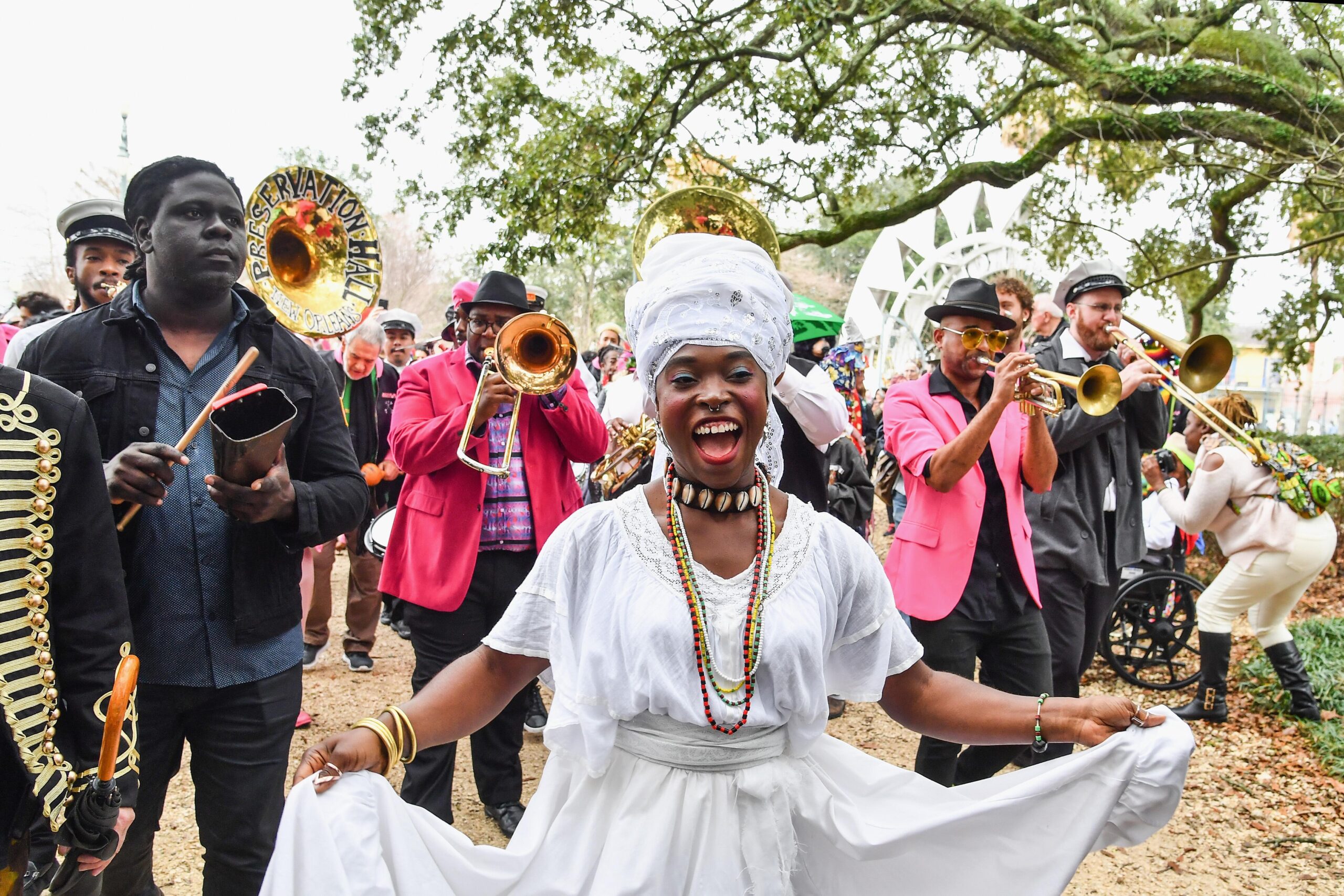
Congo Square is still a rich place to hear music. Every year, Mardi Gras Indians stage friendly musical battles underneath its live oak trees.
“Congo Square is ground zero of what I would consider the big bang of American music culture,” said musician and eight-time Grammy Award winner Jon Batiste, who — along with his many accomplishments as a marquee artist — is part of a multi-generational family of more than two dozen New Orleans musicians.
Batiste said that Congo Square gave the U.S. its foundational artistic elements: ritual, rhythm, song and dance that “exist in the very fabric of this country, interwoven into everything that we do. They are ubiquitous in a way that is like the air that we breathe.”
Congo Square is inside of Louis Armstrong Park, just within the Treme neighborhood of New Orleans. This May, the temperature is already blistering. Despite the heat, the park is dotted with tourists and tour guides chatting amidst the clangor of nearby renovation on the city’s Municipal Auditorium – which was devastated more than 20 years ago during Hurricane Katrina and has languished, empty, ever since.
Scholar Freddi Williams Evans has written two books on Congo Square. “Congo Square is on the other side of Rampart Street,” she observed, “meaning the end of the official town. So it evolved as a place for unofficial events like cockfights, ball games and political rallies. Eventually, it became known as the place where enslaved Africans were able to gather on Sunday afternoons. It’s not the only place they gathered, and not consistently, but it’s the place for which we have the best documentation. There was never a law saying that they had the right to gather, so they just really seized the opportunity.”
Evans said that in cities colonized by Protestant Europeans, including the Dutch and the British, Sundays were quiet days for pious religious behavior. But because New Orleans was originally under French rule, the vibe in the city on Sundays was different. “After the hours of mass, Sunday afternoons were for recreation and fun,” she said. “By law, Sundays were to be work-free for all inhabitants of the French colonies, and by default that included the enslaved people.”
She said that such gatherings were allowed, off and on, but not consistently — and in 1817, a city code restricted gatherings of enslaved Black people to one place: Congo Square. There, they gathered for religious rituals, and for singing, dancing and drumming (which in various African traditions, often includes these elements).
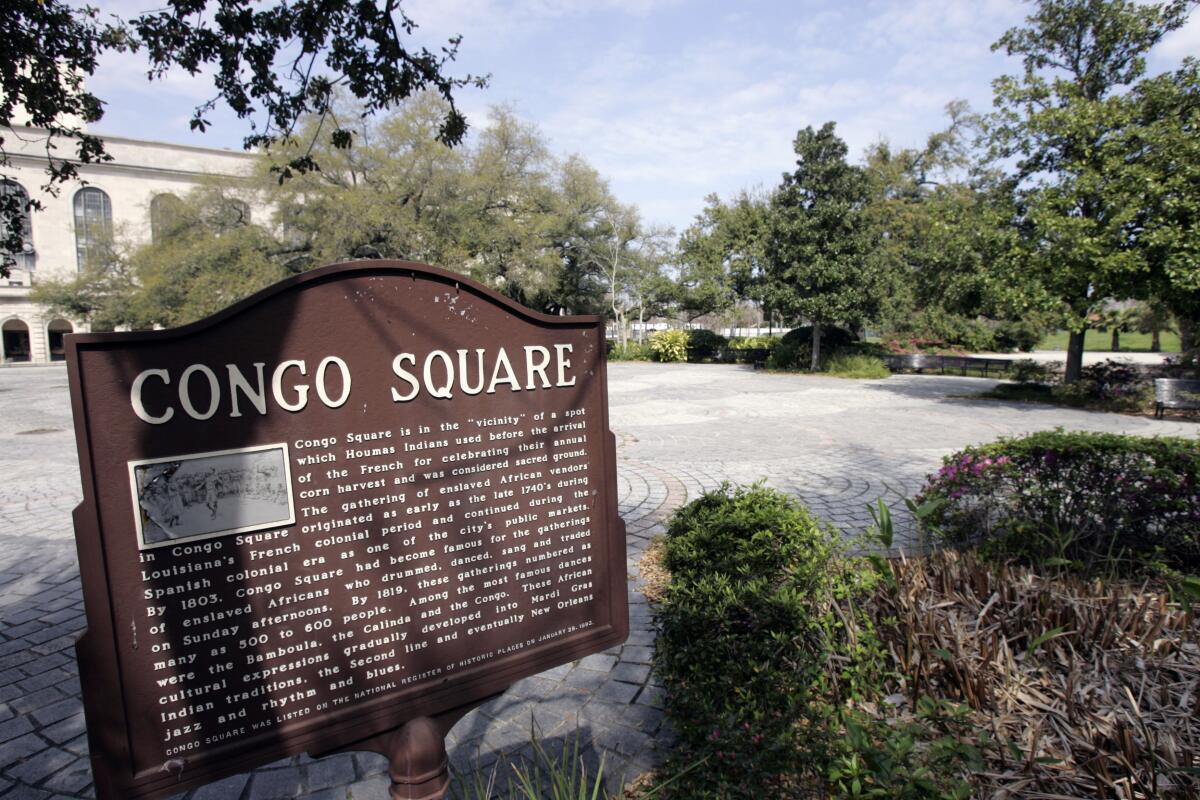
One of the drums they used, the bamboula, and a rhythm closely associated with it — counted as 3 + 3 + 2 — became part of a shared vocabulary between Africa, the Caribbean and the port city of New Orleans.
“In Cuba,” Evans said, “the rhythm received the name tresillo. In Haiti, it may be called something else. There are so many names for it, and that is the basis of Mardi Gras Indian music — the second line beat, the parade beat, the bamboula beat.”
It’s endured over many generations — and, like all rhythms, is not necessarily played on a drum: New Orleans native, the pianist and composer Jelly Roll Morton, is playing it with his left hand in a 1923 recording of his “New Orleans Joys” (also known as “New Orleans Blues”). You can also hear that rhythm propelling this contemporary song, “Do Watcha Wanna” by the New Orleans group Rebirth Brass Band, in which it’s played by low brass.
That bamboula rhythm, deep at the bass, is the signature sound of a New Orleans second line, passed from generation to generation. But it’s a way of life as well, Jon Batiste said.
“New Orleans is particularly unique in that we have this lineage of musicians whose families still exist and are carrying the traditions forward,” Batiste said.
Not only that: everyone within New Orleans musical families have a specific role to play in the hierarchy — just like in West African griot families, whose members are musicians, storytellers, poets, and the oral historians of their communities.
“The way it’s passed down is the same as it is in African cultural traditions, West Africa, in the Congo and Benin, with the Yoruba people, the Igbo people,” Batiste said. “It’s griot, it’s an oral tradition. It’s a way of identifying very early on, who is the drummer? Who’s the elder going to mentor to fill this position within our tribe?”
“A lot of times,” Batiste continued, “someone is identified very early in their life in the family. ‘Oh, that’s the new leader,’ or ‘That’s the one who’s going to be our arranger. That’s the one who’s going to be our orchestrator. That’s the one who’s going to continue to build the business and the infrastructure around it.’ Because villages all have this sort of hierarchy of authority, and different aspects of it need to be led by different people. And you start to understand that in musical families in New Orleans that there’s a real tribal understanding that is rooted in the way that we live and pass on the traditions. And as one of those culture bearers, I find that it’s an incredible joy and a great responsibility, and a great pressure.”
Tonya Boyd-Cannon is a New Orleans-based singer. She says she feels that weight too, as a creative descendent of those people who gathered in Congo Square.
“I am responsible for picking up what my ancestors put down,” Boyd-Cannon said. “So if they laid the foundation, I need to pick it up and be bold with it. On Sundays, they still gathered at Congo Square, where freedom was only on one day, and only until sundown, it would be remiss to not share that with those kids who are coming up and already speaking the languages.
Boyd-Cannon is a member of the current cohort of the recently established Jazz Generations Initiative, co-founded by the noted composer and pianist Courtney Bryan. Among its wide array of activities in New Orleans and New York, the program brings together cross-generational musicians and audiences to nurture and sustain this American-born style.
“One of the things I was really excited about was to have a gathering of musicians who are doing really creative work in and outside of the city, but very rooted in New Orleans,” Bryan said. The initiative, she said, is creating revolving cohorts of artists where “everybody comes together to share ideas creatively and business-wise, to produce events that are intergenerational and interdisciplinary as well.”
That’s an essential part of the Congo Square legacy: to hold onto elders’ stories and traditions, to be creative today no matter what, and to pass that heritage forward.
Transcript:
SCOTT SIMON, HOST:
Congo Square in New Orleans was one of the only places where enslaved Africans in the 18th and 19th centuries could gather – just for a few hours, just on Sundays and just until sundown. They joined together there for religious ceremonies to sing, dance and to drum. To mark the 250th anniversary of America, NPR is bringing you stories that illustrate American life, liberty and the pursuit of happiness for our series called America In Pursuit. So NPR cultural correspondent Anastasia Tsioulcas takes us now to New Orleans.
ANASTASIA TSIOULCAS, BYLINE: Congo Square is still a rich place to hear music. Every Mardi Gras, groups stage friendly musical battles underneath the live oak trees.
(SOUNDBITE OF MUSIC)
UNIDENTIFIED MUSICAL ARTIST: (Singing, inaudible).
JON BATISTE: Congo Square is ground zero of what I would consider the big bang of American music culture.
TSIOULCAS: That’s musician and eight-time Grammy Award winner, Jon Batiste. He knows New Orleans. He’s part of a family of more than two dozen NOLA musicians. He says Congo Square gave this country its foundational elements – rhythm, song, dance and ritual that are…
BATISTE: Ubiquitous in a way that is like the air that we breathe.
TSIOULCAS: The square’s inside Louis Armstrong Park in the Treme neighborhood, and it’s where I meet historian Freddi Williams Evans.
FREDDI WILLIAMS EVANS: It evolved as a place – one of the locations for unofficial events like cock fights, ball games, political rallies. And it eventually became known as the place where enslaved Africans were able to gather on Sunday afternoons.
TSIOULCAS: Evan says in cities colonized by the Protestant Europeans, like the Dutch and the British, Sundays were quiet days for pious religious behavior. But because New Orleans was under French rule, the vibe in the city on Sundays was different.
EVANS: After the hours of mass on Sunday afternoons was a place for recreation and reverie and fun. And so that location became Congo Square.
TSIOULCAS: So enslaved people gathered for religious rituals, for singing, for dancing and for drumming. And one of those drum rhythms from Africa became part of a shared vocabulary between Africa, the Caribbean and this port city of New Orleans.
EVANS: In Cuba, the rhythms receive the name tresillo, cinquillo. In Haiti, it may be called something else, but we know that.
(SOUNDBITE OF RHYTHMIC CLAPPING)
EVANS: (Singing) Hey pocky-a-way (ph). Hey pocky-a-way.
There are so many names for that, and that is the basis of Mardi Gras – Indian music, the second line beat – we call it that. We call it the parade beat, the bamboula beat.
TSIOULCAS: You hear it in the left hand in this 1923 recording by New Orleans native Jelly Roll Morton of his “New Orleans Joys.”
(SOUNDBITE OF JELLY ROLL MORTON’S “NEW ORLEANS JOYS”)
TSIOULCAS: And it continues to live in New Orleans’ quintessential parade music, like in this song, “Do Whatcha Wanna,” by the New Orleans group Rebirth Brass Band.
(SOUNDBITE OF SONG, “DO WHATCHA WANNA”)
REBIRTH BRASS BAND: (Singing) Everybody. Everybody. It’s a party. It’s a party. Everybody. Everybody.
TSIOULCAS: There’s that bamboula rhythm deep at the bottom. That is the signature sound of a New Orleans’ second line passed generation to generation. But it’s a way of life as well.
BATISTE: New Orleans is particularly unique in that we have this lineage of musicians whose families still exist and are carrying the traditions forward.
TSIOULCAS: Jon Batiste says everyone in New Orleans’ musical families has a role, like in West African griot families whose members are musicians, storytellers, poets and the oral historians of their communities. It’s a responsibility.
BATISTE: The way it’s passed down is the same as it is in African cultural traditions, West Africa and the Congo and Benin, the Yoruba people, the Igbo people. It’s a griot. It’s a oral tradition. It’s a way of identifying very early on who is the drummer, who’s the elder going to mentor to fill this position within our tribe. And you start to understand that in musical families in New Orleans, that there’s a real tribal understanding that is rooted in the way that we live and pass on the traditions. And as one of those culture bearers, I find that it’s an incredible joy and a great responsibility. It’s a great pressure.
(SOUNDBITE OF SONG, “IN NEW ORLEANS”)
TONYA BOYD-CANNON: (Singing) So I was walking into Washington Park.
TSIOULCAS: Tonya Boyd-Cannon is a New Orleans-based singer. She says she feels that way, too, as a creative descendant of those people who gathered in Congo Square.
BOYD-CANNON: I am responsible for picking up what my ancestors put down. So if they laid the foundation, I need to pick it up and be bold with it. On Sundays, they still gather at Congo Square where freedom was only on one day. It would be remiss to not share that with those kids who are coming up and already speaking the languages.
(SOUNDBITE OF SONG, “IN NEW ORLEANS”)
BOYD-CANNON: (Singing) New Orleans. Oh.
TSIOULCAS: She’s part of the Jazz Generations Initiative, cofounded by composer Courtney Bryan.
(SOUNDBITE OF COUNRTNEY BRYAN’S “CARNIVAL FOR UNITY: I. UNITY AMONGST YOUTH OF THE DIASPORA”)
TSIOULCAS: The program brings together cross-generational musicians.
COURTNEY BRYAN: One of the things I was really excited about was to have a gathering of musicians who were doing really creative work in and outside of the city, but very rooted in New Orleans.
TSIOULCAS: And that’s the story of Congo Square – to hold on to elders’ stories, to be creative today, no matter what, and to pass that legacy on. Anastasia Tsioulcas, NPR News.
(SOUNDBITE OF SONG, “FREEDOM”)
BATISTE: (Singing) When I move my body just like this, I don’t know why, but I feel like freedom.