Transcript:
ADRIAN FLORIDO, HOST:
It’s CONSIDER THIS, where every day we go deep on one big news story. We’re just a few weeks away from celebrating the nation’s 250th birthday. So I went to the city called the birthplace of America – Philadelphia.
(SOUNDBITE OF BELLS TOLLING)
FLORIDO: It was right here at Independence Hall that the Founding Fathers signed the Declaration of Independence in 1776. Philadelphia became the nation’s first capital, George Washington its first president. He lived a block away. For decades and decades, people have come to these few old city blocks, all cobblestone and red brick, to steep themselves in this history of American freedom. Our producer, Henry Larson, and I came because of a battle playing out right now over that history. Specifically, over whether the National Park Service, which runs these historic sites, should have to tell the stories of the Black people who are part of it.
We’re standing here looking at this beautiful rear facade of Independence Hall, and then you turn around, and just a few steps away is the house where George Washington, when he was president during those early years, lived, and not only where he lived, but where he enslaved nine people.
MICHAEL COARD: Austin, Paris, Hercules, Christopher Sheels, Richmond, Giles, Oney Judge, Moll.
FLORIDO: Michael Coard is reading their names etched onto a wall at the site of Washington’s house. Coard’s a lawyer and an activist, and like many Philadelphians, he was stunned in the early 2000s when a local historian unearthed records that George and Martha Washington had brought nine slaves to work for them here.
COARD: Many of us knew that he enslaved, but not many knew that nine were held right here in Philadelphia. So I was enraged. I put together a group of local activists. We formed it…
FLORIDO: He called it the Avenging the Ancestors Coalition. It began pressing the Park Service to create an exhibit. It took years, but in 2010, it was finished. The house, long gone except for its foundations, was partially rebuilt. Panels and video screens along the walls told the stories of George Washington’s nine enslaved workers.
COARD: It was the grand opening of the first slave memorial of its kind on federal property in the history of the United States of America. We thought it would last forever, but 15 years later, the destruction came.
FLORIDO: Last year, President Trump signed an executive order titled Restoring Truth and Sanity to American History. It ordered national parks and historic sites to remove any exhibit or display that, quote, “inappropriately disparages Americans past or living.” A few months later, federal workers showed up at the slavery exhibit here at the president’s house with crowbars.
COARD: There were 34 interpretive panels to tell this old story. They pulled all 34 down. I felt like a part of my soul was being ripped out with each interpretive panel being ripped out because this is my story.
FLORIDO: At national parks and historic sites across the U.S., the Trump administration has for months been removing displays about slavery and other ugly chapters in U.S. history. Trump’s order said that telling history this way deepens societal divides and fosters a sense of national shame. This week, a federal judge temporarily blocked the president’s order, but it’s not clear what that will mean for the slavery exhibit here in Philly, which has already been partially restored because of a separate lawsuit brought by the city.
(SOUNDBITE OF ARCHIVED RECORDING)
UNIDENTIFIED PERSON: One, three, four, eight, city of Philadelphia against the Secretary U.S. Department of Interior.
FLORIDO: CONSIDER THIS – just days before thousands of people are expected to stream into Philadelphia to celebrate the nation’s 250th birthday, some of the exhibit at the president’s house has been restored, but a lot is still missing.
(SOUNDBITE OF MUSIC)
FLORIDO: From NPR, I’m Adrian Florido.
(SOUNDBITE OF MUSIC)
FLORIDO: It’s CONSIDER THIS FROM NPR. In Philadelphia, a historic site meant to tell the stories of Black people enslaved by George Washington is at the center of a battle over history.
(SOUNDBITE OF BELL RINGING)
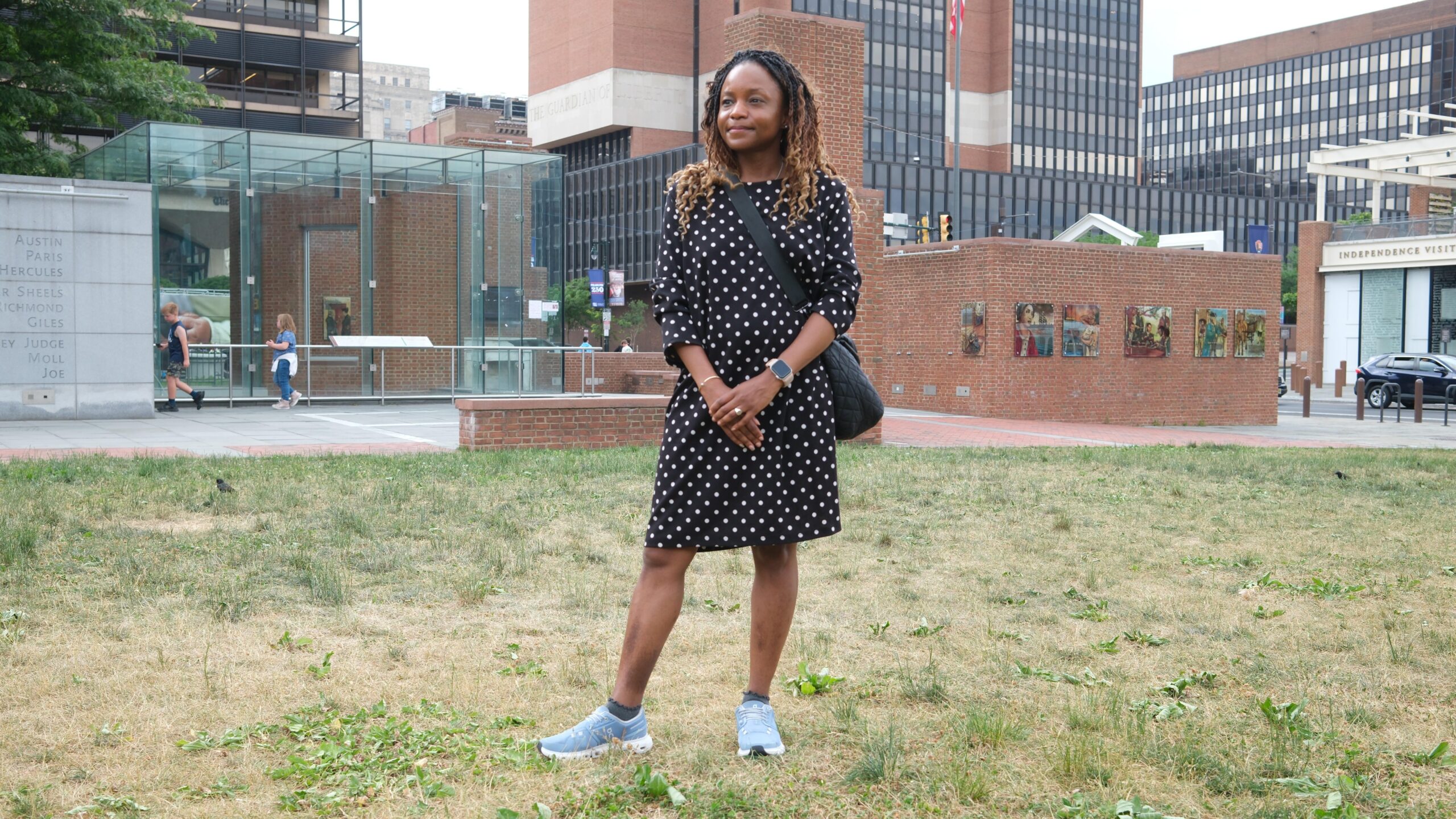
FLORIDO: Five months ago, the Trump administration took down an exhibit at the site. To get a sense of what the slavery exhibit’s removal has meant, we met tour guide Raina Yancey at the house. Her shock hasn’t gone away.
RAINA YANCEY: I wasn’t prepared for the full range of emotions that overcame me. I don’t know. I’m still upset. I’m still angry.
FLORIDO: Seven years ago, Yancey started a company called The Black Journey. She gives walking tours about Philadelphia’s Black history. Here at President Washington’s house, she always tells the story of Ona Judge, who ran away – escaped to freedom. Yancey gave me a bit of the tour.
YANCEY: So you have about 50% of the walls as it would’ve had. We’re walking to a wall that once held a panel information about the dirty business of slavery. There are metal brackets where the panels used to be secured to the wall.
FLORIDO: We’re looking at an empty wall now.
YANCEY: We’re looking at an empty wall. It doesn’t make sense without the context. There are footprints that are supposed to represent Ona Judge’s triumphant escape in the ground. They’re bronzed. They’re beautiful. But it doesn’t make sense without the story – what the significance of the names etched in granite, the footprints. It doesn’t make sense.
FLORIDO: When you’re bringing people through this house, what is the story you’re trying to tell them while you’re standing right here, where we’re standing right now?
YANCEY: I want them to understand that history of slavery in the United States is from the very beginning, from the very top. And I also want to tell the story of triumph, that people stood up for themselves, in particular, Ona Judge. She emancipated herself. She was a young woman. She had no idea where she was going. She knew she would never see her family again.
FLORIDO: Yancey tells me that after she learned of the story of Judge’s escape and the stories of the other eight enslaved workers, she felt an urge to tell as many people as possible.
Did you ever consider, after those panels came down, not doing the tours?
YANCEY: No. I see the Black journey as stewards of this history, and we saw how easily the history was previously lost for over a century, and I want to make sure that that doesn’t happen again.
FLORIDO: How do you grapple with this paradox of slavery in the shadow of Independence Hall?
YANCEY: I call it hypocrisy. On the tour, we share a picture of the founders. There’s a famous oil painting, and it’s supposed to depict the signing of the Declaration of Independence. And there are red dots on the faces of most of the founders, and I always ask the visitors, well, what do you think those red dots represent? And of course, it represents those that owned human beings.
FLORIDO: When people are making that realization as you’re telling them that story, what do you notice come across their faces?
YANCEY: Some people thought about it, but for some people, it’s, like, the first time that that’s clicked. And they realized, oh, my, like, there are, like, so many levels of freedom right in this square block. And so we want to make sure that the panels tell the full story of slavery and how people did self-emancipate. It was so intolerable to so many people, and people resisted in so many ways.
FLORIDO: In his executive order, President Trump directed the Parks Department to remove exhibits that did not emphasize American greatness. What does that say to you?
YANCEY: I think Ona Judge’s story is a prime example of American greatness, of self-emancipating herself to create her own life, her own story, and people need to understand it so that we don’t go back. Just by taking the panels down, you can’t make it disappear. You can’t make that history go away.
FLORIDO: We asked the Trump administration for an interview. The Interior Department sent us a statement saying the administration, quote, “is committed to celebrating and acknowledging the full breadth of our nation’s history.” It also sent us a link to new exhibit panels it wants to replace the ones it removed. These new panels would tell some of the story of the people Washington enslaved at his Philadelphia house, but they also downplay their possible suffering, suggesting they had better lives than slaves at Washington’s plantation in Virginia.
As we walked through the house with Raina Yancey, we noticed something – all the little acts of public rebellion. On some of the walls, people had taped up handwritten explanations of why the exhibit was missing.
YANCEY: So the signs are removed by the Department of the Interior every day – these protest signs. There’s facsimiles of what used to be there printed on, you know, 8 by 10 paper. But every day, they’re taken down in the evening, and every day, people exercise their First Amendment rights and replace them.
FLORIDO: In front of another wall, a woman named Nikia Stevenson (ph) was reading aloud from a white binder.
NIKIA STEVENSON: 1793, the Fugitive Slave Act passed by Congress…
FLORIDO: She told me it was the text from the missing panels.
STEVENSON: I’m very passionate about history, and I am obviously African American. So this is my history that they’re trying to erase.
FLORIDO: Michael Coard, the activist who fought to have this exhibit created, says it’s urgent to get it back up before July 4, when thousands of people will stream into Philadelphia.
COARD: So either the federal government is going to tell the story, or damn it, we’ll tell the story.
FLORIDO: He’s planning a number of events here to tell the story of Black people’s fight for freedom in the birthplace of American freedom.
(SOUNDBITE OF MUSIC)
FLORIDO: This episode was produced by Henry Larson. It was edited by Sarah Robbins. Our executive producer is Courtney Dorning.
(SOUNDBITE OF MUSIC)
FLORIDO: IT’S CONSIDER THIS FROM NPR. I’m Adrian Florido.