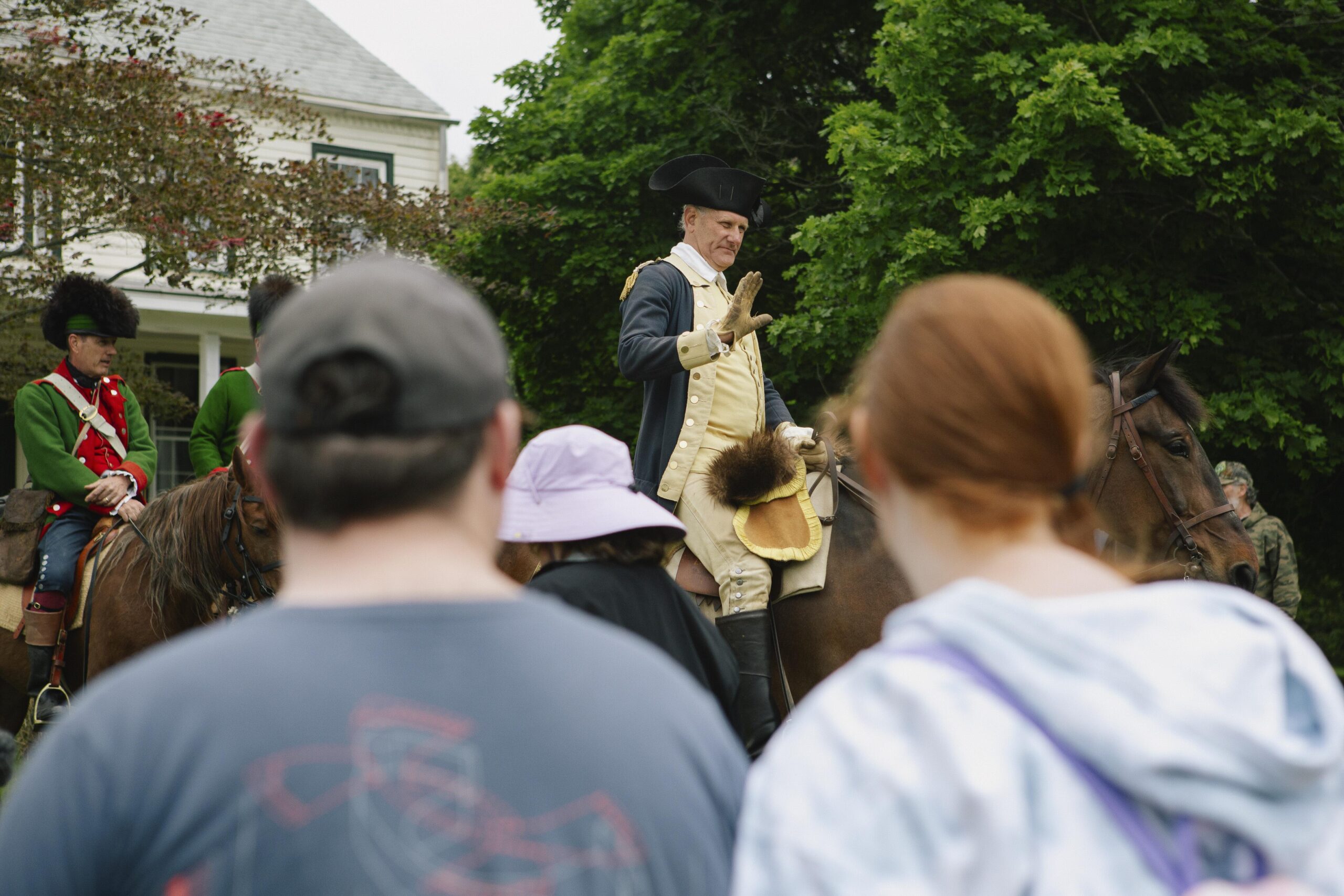
MILLSTONE TOWNSHIP, N.J. — One recent day in central New Jersey, the grass field around a historic farmhouse was transformed into a Gen. George Washington Revolutionary War encampment, with tents, people in costume and families taking photos.
Suddenly, an unmistakable figure appeared on horseback, wearing a long navy wool coat and a black tricorn hat.
“March!” yelled a man, as a drum and fife (piccolo, actually) struck up a Revolutionary battle tune. Three people dressed as soldiers lined up for review by Washington, then fired shots from long muskets.
Scenes like these have played out across the country as America celebrates its 250th birthday and more people look for ways to take part.
“Anything that pops up, I try to go to,” said Robin Fox, who’s lived nearby for 21 years but never been to this site.
The semiquincentennial has meant a banner year for historical reenactors and interpreters, especially those who portray the ever-popular Founding Father. Some have driven hundreds of miles a week to meet the demand. And whether it’s a hobby or a career, they believe George Washington’s life holds important lessons for today, especially at a time of such divided politics.
“Exactly what Washington predicted”
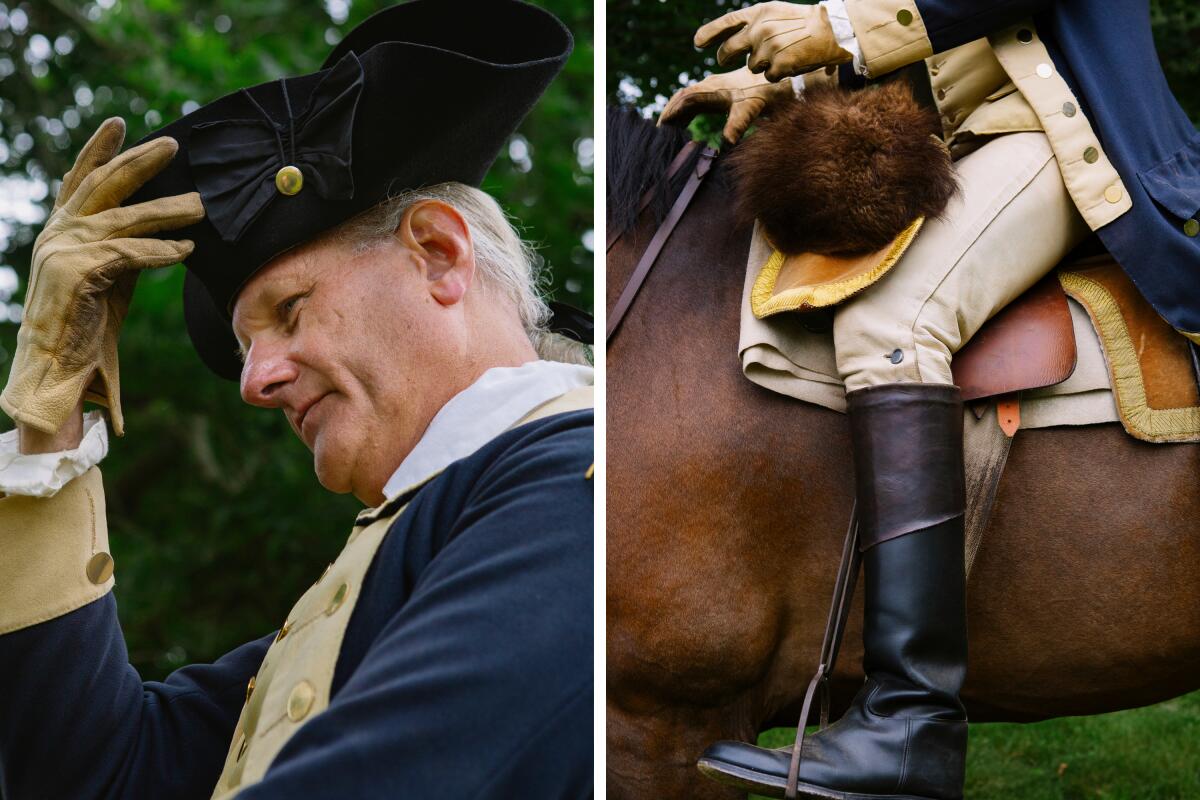
John Koopman III looks straight out of a history book. It’s not just his angular face and hair tied back with a ribbon, but his entire tall frame, as he learned from the tailor who made his military costume.
“Where my sleeves fall and my wrist, the size of my chest, where my breaches fall, is all identical to Washington,” he explained. “That made my day.”
We met under a shade tree as he stood next to his beloved horse, Bear. Koopman started this hobby nearly three decades ago, when his Connecticut town put on a reenactment to mark the 300th anniversary of its founding.
“Of course, now my wife regrets it, but she said, ‘You know, John, you should join one of these units,’” he said. “And now she’s sitting there, ‘What was I thinking?’”
He liked the Revolutionary War time period and its sense of chivalry, so he stuck with it. The hobby inspired him to learn how to ride a horse. In 2006, a friend said he should try playing Washington because he looked so much like him.
Koopman used a small inheritance to pay for an appropriate saddle and the costume, which cost several thousand dollars each. For an authentic version of Washington’s uniform, he commissioned a friend who’d been a tailor for the first president’s historic home at Mount Vernon.

Since then, Koopman has performed in a film shown at Mount Vernon and multiple other documentaries. He even branched out to write a historical novel on the Revolutionary War.
He retired a year ago from his “regular job” at an alternative energy company and is reenacting full time these days, while the heightened interest lasts. He and his horse recently set a personal best with three separate events in one weekend.
“We had to get in the trailer and go to a different place,” he said, adding that Bear “did very well.”
Koopman concedes Washington was hardly perfect. He and his wife owned hundreds of slaves, freeing those he owned personally in his will. Still, he finds Washington’s call for national unity more relevant than ever. Especially his warning that political parties would put their own needs before those of the people.
“And then you get the situation you have today,” he said, where lawmakers oppose good legislation simply because it’s proposed by the other party. “That’s exactly what Washington predicted would happen.”
Koopman’s manager, Brad Fay, has had a lifelong fascination with Washington because a distant ancestor was an officer for him during the Revolutionary War. The family inherited a famous painting of the first president, “and it was literally over my shoulder, you know, for my entire teenage years,” he said.
Fay believes the significance of America’s birth, with its ideals of freedom and equality, has the power to unite.
“It’s the one story we all subscribe to,” he said, “and so I think it’s more important than ever for us to feel a connection to our founding.”
A surging hunger for that has kept him and his small team of reenactors busy: He booked 31 events from May through July 4. Beyond the battlefield, a popular experience is an evening dinner with Washington, which often includes the traditional 13 toasts for 13 colonies.
“They would usually be given to Washington, and then Washington would give a return toast,” he said.
Comfort looking back in time
The central New Jersey encampment included a hospital tent, farm animals and a table where a woman demonstrated how laundry was done. Visitors also packed inside the farmhouse where Leslie Bramlett portrayed the enslaved cook Hannah Till, who traveled with Washington.
“She ends up being freed, and she still stays with George Washington, for seven years of the war,” she explained to one family.
Bramlett is part of a broader push to tell the stories of those who made Washington’s success possible but were long ignored.

“There were 850 women and children encamped with George Washington at Valley Forge, the beginning of the war, and then that number grows,” she said. “So every time you see soldiers, you should remember that there are women and children following them.”
Outside the farmhouse, Anthony Privetera said he brought his 7-year-old son to the day’s event “because you always learn about history, because if not history repeats itself.”
Down the hill, Lee Ann Folk said she became more focused on history in the past few years. Looking back in time helps her feel less worried about today’s political divides.
“We’ve been through hard times,” she said. “So it helps to calm the soul, to know that we’ve been there and we’ll get through this.”
Sharing Washington’s ideals with a new generation
A few hours south, at historic Mount Vernon, more fife and drum music heralded a recent ribbon-cutting for an updated exhibit. And another person portraying General Washington was on hand to work the crowd.
“Would you have changed anything in your life?” asked a middle school student on a class trip from Bettendorf, Iowa.
“I would not have stood for a second term,” replied Doug Thomas, in full military uniform.
Thomas stayed in character as the students asked about his horses and his religion, and he explained how he made a point of attending different houses of worship to show that “bigotry had no place in America.”
He also poked gentle fun at the shorts all the students wore, when he said at one point, “The thought is as absent as the rest of your trousers!”
And there was laughter when several middle schoolers from California tried to explain a “selfie” as they gathered around the Founding Father and mugged for the camera.

This is a career for Thomas, who is not a reenactor but a first-person interpreter. He’s played more than 20 people in theater and at historic sites in Philadelphia and “aged into” Washington about seven years ago.
The 250th anniversary amped up his workload. In the past week, he’d driven hundreds of miles to various gigs, including one at a financial group in New York City. There, he talked about lessons from Washington the businessman, such as the importance of branding.
“Branding is literally because he used a branding iron to brand the barrels of flour that he sold at his mill,” he explained. “They said ‘G. Washington,’ so you knew you were getting the finest quality flour that was out there.”
Thomas said the nation has not always lived up to the ideals of Washington and its founding documents. But he sees his work as helping to pass them on to new generations, so they can keep building on what’s come before.
“The fact that we have a government by the people, for the people, is really absolutely astounding,” he said. “And we just need to make sure that we inform the populace that they are, in fact, in charge.”

Also on hand for the ribbon cutting was Mount Vernon CEO Doug Bradburn, a scholar of early American history. He pointed out that Washington’s government, too, had political division.
“Even in his own Cabinet, he had people that hated each other,” Bradburn said, “and he constantly had to remind them, until we are governed by angels, we have to allow for differences of opinion.”
Transcript:
SCOTT SIMON, HOST:
It’s a banner year for people who portray George Washington. America’s 250th birthday has brought more events, new crowds for Revolutionary reenactors and interpreters. NPR’s Jennifer Ludden caught up with a couple to see what they hope comes of all the attention.
JENNIFER LUDDEN, BYLINE: On a recent day in central New Jersey, a grass field is transformed into one of General George Washington’s Revolutionary War encampments. There are tents, people in costume. Families mill about and snap photos.
UNIDENTIFIED PERSON #1: One…
UNIDENTIFIED PERSON #2: Let’s do three.
(SOUNDBITE OF CAMERA SHUTTER CLICKING)
UNIDENTIFIED PERSON #1: …Two, three.
UNIDENTIFIED PERSON #2: Thank you.
JOHN KOOPMAN III: You’re welcome.
LUDDEN: Then an unmistakable figure appears on horseback.
UNIDENTIFIED PERSON #3: March.
(SOUNDBITE OF DRUM AND FIFE MUSIC)
LUDDEN: Washington in long navy coat, tricorne hat, makes his way over to review the troops. Well, three soldiers who form a short line. Dotted across the field, there are also farm animals, a hospital tent. One woman demonstrates how laundry was done. Another is set up inside a historic farmhouse to portray the enslaved cook who traveled with Washington. Locals who’ve come to soak it all in say they wanted to mark the nation’s Semiquincentennial.
ROBIN FOX: We’ve lived here for 21 years and never came to this house.
ANTHONY PRIVETERA: Because you always learn about history. Because if not, history repeats itself.
LEE ANN FOLK: All of a sudden, in the last maybe four years, I’m a history person (laughter). My mother did bring us up that way anyway, but even more so these days.
LUDDEN: That’s Robin Fox, Anthony Privetera and Lee Ann Folk. She says looking back in time makes her feel less worried about today’s political divides.
FOLK: We’ve been through hard times, so it helps to calm the soul to know that we’ve been there, and we’ll get through this.
LUDDEN: Behind the farmhouse, I meet the man of the moment. And it is uncanny talking to someone who looks straight out of a history book. John Koopman III, dressed as George, stands under a tree next to his beloved horse, Bear.
KOOPMAN: So this is the big guy.
LUDDEN: He’s gorgeous.
KOOPMAN: Oh, thank you.
LUDDEN: Koopman retired a year ago from his regular job at an alternative energy company. He’s full-time reenacting these days, while the heightened interest lasts. One recent weekend, he and Bear set a personal best for busy.
KOOPMAN: Three different events altogether. You know, we had to get in the trailer and go to a different place.
LUDDEN: Koopman started this hobby nearly three decades ago, when his Connecticut town marked its 300th anniversary.
KOOPMAN: And so they had a reenactment in town. And then, of course, now my wife regrets it. But she said, you know, John, you should join one of these units. And now she said, what was I thinking?
LUDDEN: He likes the Revolutionary time period and its sense of chivalry. So he stuck with it, and that’s what led him to learn horseback riding. Then, in 2006, a friend said he should try playing Washington because he looks like him. Koopman used a small inheritance to pay for the costume and a saddle, several thousand dollars each. And he commissioned a friend who’d been a tailor for Washington’s historic home at Mount Vernon. It turns out…
KOOPMAN: Where my sleeves fall at my wrist, the size of my chest, where my breeches fall is all identical to Washington. So when I learned that, it made my day (laughter).
LUDDEN: Koopman has since appeared in a film at Mount Vernon and other documentaries. He admits Washington was hardly perfect. He and his wife enslaved hundreds of people, freeing those he owned personally in his will. Still, Koopman thinks his message as president holds lessons for today, like his warning that political parties would put their own needs before those of the people.
KOOPMAN: And then you get the situation you have today. Let’s say a legislator has good legislation. Well, the opposing party will say, even though it’s good legislation, I’m going to oppose it. So that’s exactly what Washington predicted would happen.
(SOUNDBITE OF DRUM AND FIFE MUSIC)
LUDDEN: A few hours south, I stopped by a ribbon cutting for an updated exhibit at historic Mount Vernon.
DOUG THOMAS: Three cheers for George Washington and a revolutionary life. Hip, hip.
UNIDENTIFIED CROWD: Hurrah.
THOMAS: Hip, hip.
UNIDENTIFIED CROWD: Hurrah.
THOMAS: Hip, hip.
UNIDENTIFIED CROWD: Hurrah.
LUDDEN: Another George Washington is on hand to work the crowd.
UNIDENTIFIED STUDENT #1: Did you know that you were, like, about to die, when you died?
THOMAS: (As George Washington) I am quite healthy and hale, Miss.
UNIDENTIFIED STUDENT #1: OK. Well, I…
THOMAS: (As George Washington) My secretary of state?
UNIDENTIFIED STUDENT #2: Aaron Burr.
THOMAS: (As George Washington) No. No. Thomas Jefferson.
UNIDENTIFIED STUDENT #2: I knew that.
UNIDENTIFIED STUDENTS: Oh. I knew that.
THOMAS: (As George Washington) You did not.
UNIDENTIFIED STUDENT #2: OK.
THOMAS: (As George Washington) You did not.
(LAUGHTER)
UNIDENTIFIED STUDENT #2: Yeah. Yeah.
THOMAS: (As George Washington) The thought was as absent as the rest of your trousers.
(LAUGHTER)
LUDDEN: This is a career for Thomas, who’s not a reenactor but a first-person interpreter. He’s played more than 20 people in theater and at historic sites in Philadelphia and says he aged into Washington about seven years ago. Just this past week, he drove hundreds of miles to various gigs, including at a financial group in New York City, where he talked about lessons from Washington the businessman, like the importance of branding.
THOMAS: Branding is literally because he used a branding iron to brand the barrels of flour that he sold at his mill. So they said, G. Washington, so you knew you were getting the finest quality flour that was out there.
LUDDEN: Thomas says the nation has not always lived up to the ideals of Washington or its founding documents, but he sees his work as helping to pass them on to new generations so they can keep building on what’s come before.
THOMAS: The fact that we have a government by the people for the people is really absolutely astounding, and we just need to make sure that we inform the populace that they are, in fact, in charge.
LUDDEN: Back at the exhibit, an older couple complains to Thomas about corrupt politicians. He tells them that’s nothing new. Then more schoolgirls want a selfie.
UNIDENTIFIED STUDENT #3: But what he said in the hall…
THOMAS: (As George Washington) A self-portrait…
UNIDENTIFIED STUDENT #4: That is an awkward angle.
THOMAS: (As George Washington) Because it is poor artistry.
LUDDEN: They crowd around the Founding Father and mug for the camera.
Jennifer Ludden, NPR News, Mount Vernon, Virginia.
(SOUNDBITE OF MUSIC)