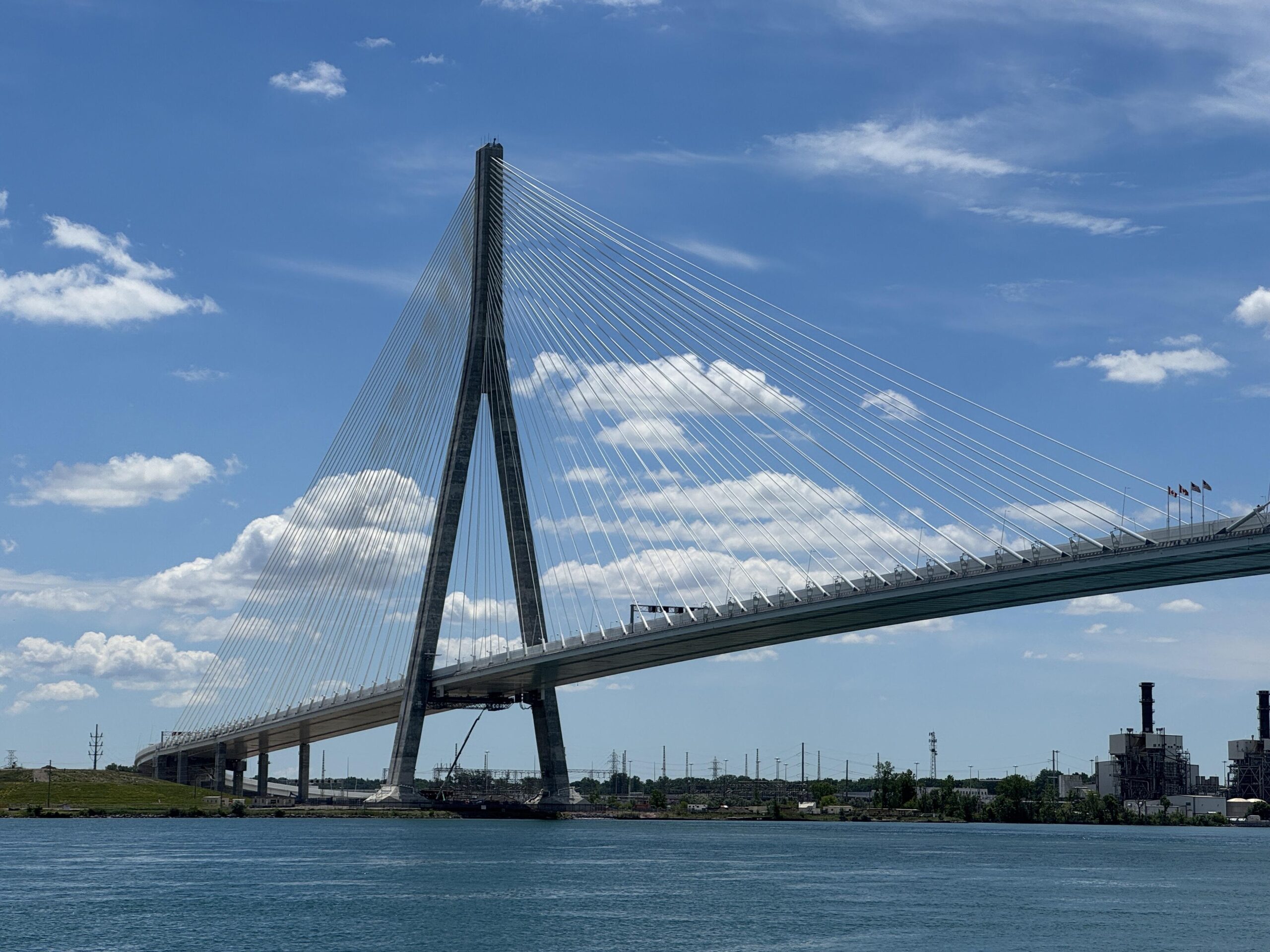
Millions of trucks carrying billions of dollars worth of car parts, machinery and a long list of other commodities pass checkpoints along one small stretch of the U.S.-Canada border each year.
It’s known as North America’s busiest land crossing, and it sits between Detroit and Windsor, Ontario.
NPR’s Don Gonyea recently visited this crossing to take a look at a brand new bridge that sits completed and unopened.
Construction on the Gordie Howe International Bridge, named for the Hall of Fame Canadian-born hockey legend who played for the Detroit Red Wings, began in 2018. It was set to open early this year. That was before President Trump intervened in a social media post.
Trump demanded that Canada share ownership with the United States before he would allow the bridge to open. Months passed. In June, the bridge authority actually scheduled a grand opening. But at the last minute, it was canceled.
Stephen Laskowski is president of the Canadian Trucking Alliance and head of the Ontario Trucking Association. He was about to make his way to the grand opening when he got the news.
“I was heading out. My wife said, ‘Your phone’s ringing’ … it said, don’t bother going,” Laskowski told NPR.
The Canadian government and Michigan jointly own the bridge. Canada agreed to front the cost of construction and to split the toll fees with the state once the cost has been recouped.
But the president has said that isn’t good enough. Some Canadian politicians have suggested the owners of a rival bridge linking Detroit and Windsor are responsible for Trump’s interest in delaying the opening. The Moroun family, which owns the Ambassador Bridge, has given millions to Republicans in recent years, including a $1 million donation to a Trump-aligned super PAC.
Gonyea spoke with WDET reporter Alex McLenon, Canadian residents and others to understand how the bridge’s closure is rippling across the continent.
Listen to the full story by clicking on the blue play button above.
Transcript:
DON GONYEA, HOST:
American businesses, especially those in the northern half of the United States, depend on trade with our closest neighbor, Canada. Millions of trucks carrying billions of dollars’ worth of car parts, machinery and a long list of other commodities pass across checkpoints along one small stretch of the border each year. It’s known as North America’s busiest land crossing, and it sits between Detroit, Michigan, and Windsor, Ontario.
I’m standing here on the Detroit side of the Detroit River. Windsor is just a short distance across the way. That, of course, is Canada. And more significantly, I’m essentially underneath or close to it – the brand-new Gordie Howe Bridge. Construction on the Gordie Howe, named for the Hall of Fame Canadian-born hockey legend who played for the Detroit Red Wings, began in 2018. The Canadian government and the state of Michigan share 50/50 ownership of the bridge. Canada agreed to front the cost of construction and to split the toll fees with the state of Michigan once that cost has been recouped.
Today, there’s a problem. The bridge is ready to open, but it’s still closed. Across the river in the Canadian city, Windsor, residents are angry about the delays.
MISTY SERGE: I think it’s absolutely ridiculous. I mean, this took eight years to build, $6 billion. Canada paid for everything and to get this held up just is out of our control, obviously, out of Canada’s control.
GONYEA: Sixty-five-year-old Misty Serge (ph) says she’s refrained from traveling to the U.S. or buying American as tensions have increased between the two countries.
SERGE: The American businesses, you know, are waiting for the opening ’cause Canadians will spend their money. And it’s not their fault this is going on.
GONYEA: In February, President Trump posted on Truth Social, demanding that Canada share ownership with the U.S. federal government before he would allow it to open. Months passed after the threat. In June, the bridge authority actually scheduled a grand opening, but at the last minute, it was canceled. WDET reporter Alex McLenon has been covering the bridge since the construction began eight years ago.
ALEX MCLENON, BYLINE: It was on track to happen, and then at the last minute, the government seemingly stepped in and said no.
GONYEA: I met up with McLenon on the American side of the Detroit River to understand why the Gordie Howe Bridge has yet to open.
So there is another bridge, just to the east of us here, that is the current route for trucks carrying goods back and forth between the two countries. It’s the Ambassador Bridge. How does that bridge’s situation affect what we’re looking at with the new Gordie Howe Bridge?
MCLENON: Well, pretty closely. The Moroun family has owned the Ambassador Bridge for generations. They’re big supporters of the Trump administration. They’ve donated millions to the Republican Party. And when you talk to politicians over on the other side of the border in Windsor, they say that that relationship with the Trump administration is one of the reasons that this bridge hasn’t opened yet. Essentially, they’re currying favor with the Trump administration. They’ve given them a lot of money, and they would like assurances that they’re not going to be losing money once the new span opens. Mayor Drew Dilkens over in Windsor says that’s a major reason why the bridge hasn’t opened yet. And that seems to be a sticking point.
GONYEA: So the mayor of Windsor, Dilkens, has been outspoken and very frustrated.
MCLENON: Yeah. He’s frequently critical of both the Trump administration and the Moroun family. And this isn’t the first time that they’ve butted heads.
GONYEA: So the bridge was built and paid for by the Canadian government.
MCLENON: Correct.
GONYEA: People are no doubt wondering what the role of the White House is then. How can the White House stop the opening?
MCLENON: Well, they have – the staffing for the bridge has to come from the federal government.
GONYEA: Are we hearing Michigan and Detroit politicians be as critical as what we’re hearing from across the river in Windsor, Mayor Dilkens?
MCLENON: No, really not – the rhetoric seems to be fairly different. And you get the sense that a lot of the politicians on the American side would like it to kind of go under the radar and be as quiet as possible, while the ones on the Canadian side have been very critical because the relationship isn’t just about the bridge. It’s a microcosm of the ongoing political climate between the two countries. And there’s a lot of tension there. The Canadians are very willing to call that out. It seems like when it comes to especially city politicians in Detroit, they don’t want to draw the eye of the president too much, and they are keeping as low of a profile as possible when it comes to talking about big issues like the bridge.
GONYEA: In the meantime, we wait.
MCLENON: Everyone will just be twiddling their thumbs until the bridge opens.
GONYEA: Alex, thanks for bringing us up to speed on all of this.
MCLENON: Any time, Don.
GONYEA: One of those thumb twiddlers is Stephen Laskowski. He’s the head of the Ontario Trucking Association and president of the Canadian Trucking Alliance. Based in Toronto, Laskowski was about to make the drive to the Detroit-Windsor border for the Gordie Howe’s ribbon-cutting ceremony when he got the news.
STEPHEN LASKOWSKI: I was heading out. My wife said, your phone’s ringing. And I said, oh, God. And the oh, God was answered and said, don’t bother going.
GONYEA: I wanted to talk to Laskowski to better understand just how important the bridge is for the people who drive 4 million trucks across this corridor every year.
Can you kind of put me in the driver’s seat of a truck being piloted by one of your members approaching the Ambassador Bridge? What are the kind of things that go through their mind today?
LASKOWSKI: I think No. 1 is, how many lights am I going to hit? There’s 10 of them. And then, when you get to the other side, when you finally get there, and if you’re moving agricultural product, am I going to be sent to secondary that’s kilometers off the bridge?
GONYEA: Secondary, meaning just, like, a secondary checkpoint…
LASKOWSKI: Correct.
GONYEA: …To go more closely through the cargo?
LASKOWSKI: Yeah. Exactly it. So what’s going through their head – why am I going through these inefficiencies when there’s a brand-new, efficient connection that I can use?
GONYEA: Describe for me how that will change with the Gordie Howe Bridge when that’s an option.
LASKOWSKI: So you don’t just have a logistical improvement with the Gordie Howe Bridge. You have an efficiency improvement with regards to toll collections. But more importantly, for everyone, security – X-ray machines, new plazas where trucks can be efficiently inspected but ensuring security from all around.
GONYEA: U.S. President Donald Trump has held up the bridge’s opening, and he has said it’s because America isn’t getting a good deal. How do you react to that?
LASKOWSKI: So I’m not going to react necessarily to what individuals are saying in Ottawa or in Washington, but I’ll explain what the deal is, and then people can make their own judgments of what is happening. The bridge was conceived in controversy, and its birth is in controversy. The U.S. and Canada couldn’t agree on how it would be funded. And ultimately, Canada took the leadership and said this – we will build it. We will pay for it. When the debt is paid by the tolls, we will share that toll revenue with the state of Michigan and Washington, however that was to play out. And so to me, ultimately, as a businessperson, I don’t think you can get a fairer deal.
GONYEA: Obviously, you represent your organizations, but are you just finding this maddening? Are you angry about it on any level?
LASKOWSKI: Unfortunately, I have to keep my robe of president on. I think there’s a lot of frustration – a lot of frustration. This makes way too much business sense for that bridge to open. And there’s a credible frustration within my own offices, within my members’ offices at this situation. There is anger by some in our membership – anger at the fact that waste is happening, just unnecessary waste. And our economies and society have become great by eliminating waste. We could be better together. Why aren’t we? That’s frustrating and now verging on anger. We can be better, and we’re being held back unnecessarily.
GONYEA: Stephen Laskowski is CEO of the Ontario Trucking Association. Stephen, thank you.
LASKOWSKI: Thank you very much.
GONYEA: And we reached out to the Ambassador Bridge, owned by the Trump-friendly Moroun family, and to the White House about accusations that the family has asked the administration to delay the opening of its rival bridge. Neither has responded yet. Meanwhile, Misty Serge, the Windsor resident who swore off visiting America, she says if and when the bridge opens, she’ll end her personal boycott.
SERGE: I will probably walk over, maybe drive over. You know, but I can’t wait to see that bridge open. Like, we’ve been waiting eight years for this (laughter).
GONYEA: After all, she says, it is a Canadian bridge, and she wants to support her country.