In the annals of movies about bickersome couples spending an ill-advised evening together, Olivia Wilde’s The Invite falls somewhere between two poles. No, it isn’t as good as Who’s Afraid of Virginia Woolf?, Mike Nichols‘ scalding 1966 adaptation of Edward Albee‘s classic play. But it’s significantly better than Carnage, Roman Polanski‘s annoying 2011 film of the Yasmina Reza play God of Carnage.
All these movies have a tricky needle to thread: how do you open up a story for the screen when the story is claustrophobic by design? How do you get an audience to feel the tension and heat of marital rage without driving them toward the exit?
In the case of The Invite, Wilde and her screenwriters, Will McCormack and Rashida Jones, are working from proven material. This is a remake of a Spanish stage-to-screen adaptation, The People Upstairs, which was released in 2020. It’s already inspired remakes set in Italy, Switzerland, France and South Korea.
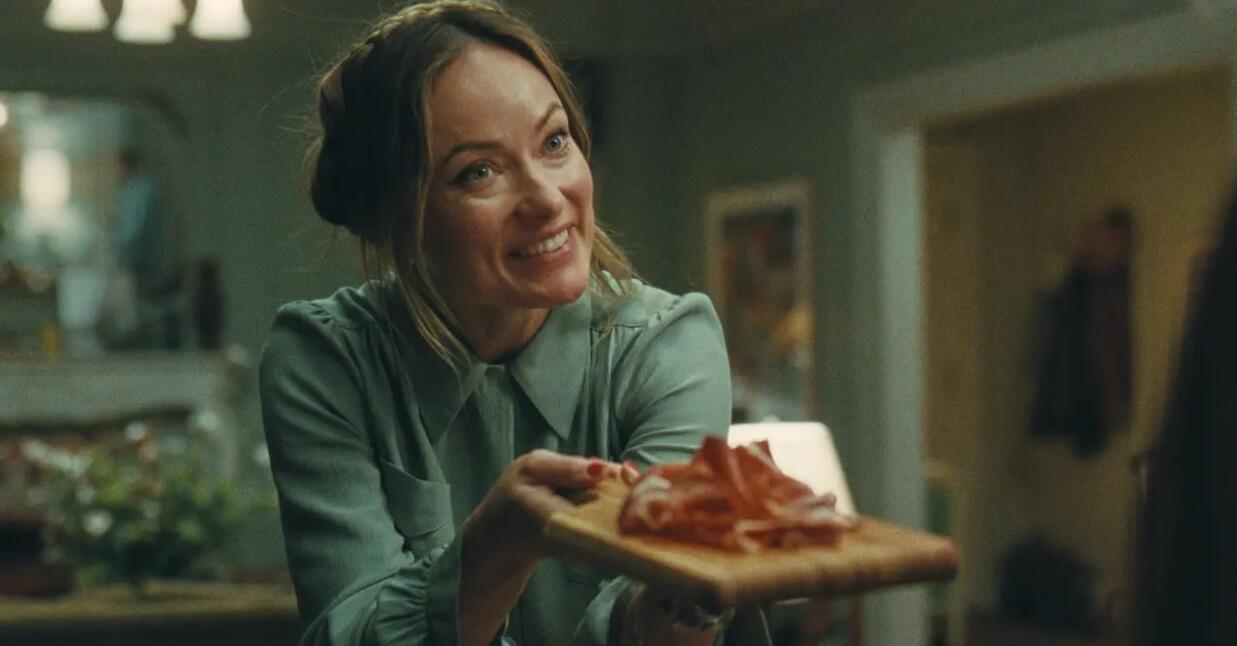
In this new version, Wilde plays Angela, who lives in a San Francisco apartment with her husband, Joe, played by Seth Rogen. The film unfolds over a single evening. Their 12-year-old daughter is away at a sleepover, and Angela has invited their upstairs neighbors — Piña and her boyfriend, Hawk — over for wine and charcuterie.
The knives come out even before the guests show up. Angela is a ball of nerves, anxious to make a good impression. Joe, by contrast, couldn’t care less what they think, and he means to confront them about their very noisy sex life, which has woken Joe and Angela up at odd hours of the night.
Wilde is a terrific director of actors, herself included, and she and Rogen are all too persuasive as a long-married couple who know just how to push each other’s buttons. Rogen is especially strong; the boisterous good vibes that once powered many a Judd Apatow comedy have hardened into a shell of middle-aged discontent.
Piña and Hawk, played by Penélope Cruz and Edward Norton, eventually arrive. As the couples get to know each other, we get to know them, too, and we come to understand the roots of Joe and Angela’s unhappiness. Joe was a once-promising indie-rock artist whose career flamed out after one big hit; he now teaches music at a Bay Area conservatory, and his sense of failure is eating him alive. And Angela hasn’t made much use of her art-school degree, apart from renovating and redecorating the apartment — her sole creative outlet these days.
Piña and Hawk are a model couple by comparison, which makes them irritating and amusing in equal measure. Hawk lays on the flattery and the New Age sensitivity awfully thick, and Norton, not for the first time, expertly blurs the lines between charm and smarm.
Piña is a psychotherapist and sexologist, and at first, she might seem to veer toward a hot-blooded Euro-seductress caricature. But Cruz is too vivid to be reduced to a stereotype. Piña is ultimately the one character the movie refuses to mock; she’s too comfortable in her own skin, and too ruthlessly accurate in her assessments of Joe and Angela’s troubled marriage.
Wilde previously directed the enjoyable teen comedy Booksmart and, less successfully, the domestic-dystopian satire Don’t Worry Darling — an ambitious movie that ultimately proved less interesting than its much-publicized behind-the-scenes shenanigans.
It was smart of Wilde to scale back with an intimate chamber piece like The Invite, though here, as in Don’t Worry Darling, her stylistic tics sometimes get the better of her. Early on, Joe and Angela’s arguments are almost drowned out by the score’s frenzied cello strings. And Wilde is a bit too fond of using the apartment’s many, many mirrors to isolate the characters visually, as if we needed reminding of how fragmented their relationship has become.
Piña and Hawk have their own ideas about how to help, and it’s worth seeing the movie yourself to discover what they are; suffice to say that the title The Invite has more than one meaning. It’s disappointing, though not surprising, that the film pulls back from those ideas. After dangling a more audacious outcome, The Invite retreats to a zone of emotional safety — one that’s poignant in its own way, though it also feels like a missed opportunity. The movie could have been — dare I say it — a little Wilder.
Transcript:
DAVE DAVIES, HOST:
This is FRESH AIR. In the new comedy “The Invite,” Seth Rogen and Olivia Wilde play a San Francisco couple who spend an evening getting to know their upstairs neighbors, played by Penelope Cruz and Edward Norton. It’s Wilde’s third directorial effort after her earlier films, “Booksmart,” and “Don’t Worry Darling.” “The Invite” opens in theaters this week. Our film critic Justin Chang has this review.
JUSTIN CHANG, BYLINE: In the annals of movies about bickersome couples spending an ill-advised evening together, Olivia Wilde’s “The Invite” falls somewhere between two poles. No, it isn’t as good as “Who’s Afraid of Virginia Woolf?” Mike Nichols’ scalding 1966 adaptation of Edward Albee’s classic play. But it’s significantly better than “Carnage,” Roman Polanski’s annoying 2010 film of the Yasmina Reza play “God Of Carnage.” All these movies have a tricky needle to thread. How do you open up a story for the screen when the story is claustrophobic by design? How do you get an audience to feel the tension and heat of marital rage without driving them toward the exit?
In the case of “The Invite,” Wilde and her screenwriters, Will McCormack and Rashida Jones, are working from proven material. This is a remake of a Spanish stage-to-screen adaptation, “The People Upstairs,” which was released in 2020. It’s already inspired remakes set in Italy, Switzerland, France and South Korea. In this new version, Wilde plays Angela, who lives in a San Francisco apartment with her husband, Joe, played by Seth Rogen.
The film unfolds over a single evening. Their 12-year-old daughter is away at a sleepover, and Angela has invited their upstairs neighbors, Pina and her boyfriend, Hawk, over for wine and charcuterie. The knives come out even before the guests show up. Angela is a ball of nerves, anxious to make a good impression. Joe, by contrast, couldn’t care less what they think. And he means to confront them about their very noisy sex life, which has woken Joe and Angela up at odd hours of the night.
Wilde is a terrific director of actors, herself included, and she and Rogen are all too persuasive as a long-married couple who know just how to push each other’s buttons. Rogen is especially strong. The boisterous good vibes that once powered many a Judd Apatow comedy have hardened into a shell of middle-aged discontent. Pina and Hawk, played by Penelope Cruz and Edward Norton, eventually arrive. Not long afterward, Hawk, who’s nothing if not direct, tries to either diffuse or exacerbate the obvious tension in the room.
(SOUNDBITE OF FILM, “THE INVITE”)
EDWARD NORTON: (As Hawk) It took you a while to come to the door.
PENELOPE CRUZ: (As Pina, speaking Spanish).
NORTON: (As Hawk) And it sounded like you were arguing.
CRUZ: (As Pina) No filter.
NORTON: (As Hawk) No, I just want to be honest. We were at the door before we rang, and we could hear you were fighting.
OLIVIA WILDE: (As Angela) Oh, we were…
SETH ROGEN: (As Joe) We were fighting.
WILDE: (As Angela) We were fighting, yeah.
ROGEN: (As Joe) Bit of a contentious environment in here, so I understand if that’s repellent to you. No hard feelings. You know what I mean? Completely understand, you know?
NORTON: (As Hawk) We love a contentious environment. We love it.
WILDE: (As Angela) OK.
ROGEN: (As Joe) Well…
NORTON: (As Hawk) Really, it’s fine.
ROGEN: (As Joe) You hit the jackpot then, my friend.
(LAUGHTER)
CHANG: As the couples get to know each other, we get to know them, too. And we come to understand the roots of Joe and Angela’s unhappiness. Joe was a once-promising indie rock artist whose career flamed out after one big hit. He now teaches music at a Bay Area conservatory, and his sense of failure is eating him alive. And Angela hasn’t made much use of her art school degree, apart from renovating and redecorating the apartment, her sole creative outlet these days.
Pina and Hawk are a model couple by comparison, which makes them irritating and amusing in equal measure. Hawk lays on the flattery and the new-age sensitivity awfully thick. And Norton, not for the first time, expertly blurs the lines between charm and smarm. Pina is a psychotherapist and sexologist. And at first, she might seem to veer toward a hot-blooded Euro seductress caricature, but Cruz is too vivid to be reduced to a stereotype. Pina is ultimately the one character the movie refuses to mock. She’s too comfortable in her own skin and too ruthlessly accurate in her assessments of Joe and Angela’s troubled marriage.
Wilde previously directed the enjoyable teen comedy “Booksmart” and, less successfully, the domestic dystopian satire “Don’t Worry Darling,” an ambitious movie that ultimately proved less interesting than its much-publicized behind-the-scenes shenanigans. It was smart of Wilde to scale back with an intimate chamber piece like “The Invite,” though here, as in “Don’t Worry Darling,” her stylistic ticks sometimes get the better of her. Early on, Joe and Angela’s arguments are almost drowned out by the score’s frenzied cello strings, and Wilde is a bit too fond of using the apartment’s many, many mirrors to isolate the characters visually, as if we needed reminding of how fragmented their relationship has become.
Pina and Hawk have their own ideas about how to help, and it’s worth seeing the movie yourself to discover what they are. Suffice to say that the title, “The Invite,” has more than one meaning. It’s disappointing, though not surprising, that the film pulls back from those ideas. After dangling a more audacious outcome, “The Invite” retreats to a zone of emotional safety, one that’s poignant in its own way, though it also feels like a missed opportunity. The movie could have been, dare I say it, a little wilder.
DAVIES: Justin Chang is a film critic at The New Yorker. On Monday’s show, Chris Evert and Martina Navratilova. They were tennis champions, the two biggest stars of their generation. They were friends. They were rivals. And after retiring, they got cancer at the same time. Now they’re the subject of a new Netflix documentary. I hope you can join us.
(SOUNDBITE OF DAVE HOLLAND AND PEPE HABICHUELA’S “JOYRIDE”)
DAVIES: FRESH AIR’s executive producer is Sam Briger. Our senior producer today is Roberta Shorrock. Our technical director and engineer is Audrey Bentham, with additional engineering support from Julian Herzfeld, Diana Martinez and Charlie Kaier. Our interviews and reviews are produced and edited by Phyllis Myers, Ann Marie Baldonado, Lauren Krenzel, Therese Madden, Monique Nazareth, Thea Chaloner, Susan Nyakundi, Anna Bauman and Nico Gonzalez-Wisler. Our digital media producer is Molly Seavy-Nesper. For Terry Gross and Tonya Mosley, I’m Dave Davies.
(SOUNDBITE OF DAVE HOLLAND AND PEPE HABICHUELA’S “JOYRIDE”)