Transcript:
B A PARKER, HOST:
Hey, everyone. You’re listening to CODE SWITCH, the show about race and identity from NPR. I’m B.A. Parker. If you grew up with elders who served in the military, you might have had some version of this moment. It’s a family gathering, and an elder casually tells you about their time in World War II or the Korean War or the Vietnam War or Desert Storm. I’ve had this conversation about all of them. The most cherished came from my Grandpa Roy (ph).
He was a private in World War II, who drove trucks. And though he never really spoke about the war itself, he did regale me with stories about all the places he got to visit, from driving in Myanmar, which he called Burma, to running from insects in Australia, to crossing the equator in South America. It was a singular experience for a young Black man who never left his hometown before, crossing the ocean to fight for freedom abroad that he wasn’t even fully granted at home. All of that young lived experience is synthesized into his official Army portrait, hanging in our family’s living room. My grandpa’s smiling in his uniform, holding a cigarette, and that’s all we got. Clint Smith, the author, poet and staff writer at The Atlantic, has a similar story from his own family.
CLINT SMITH: My grandfather’s brother served in World War II. He was part of the Red Ball Express, which was a group of largely Black soldiers who were not allowed to participate in combat.
PARKER: Most Black servicemen weren’t allowed access to firearms, and so they largely played support roles.
SMITH: You’d have general after general on the record saying that if it weren’t for these soldiers and their sacrifice and their bravery and their courage, the supplies, the food, the ammunition wouldn’t have gotten to the front lines, and the war wouldn’t have been won.
(SOUNDBITE OF TV SHOW, “ROLL OUT”)
UNIDENTIFIED NARRATOR: (As narrator) France, 1944. With the French…
PARKER: During the Normandy invasion, the Allies had destroyed French railroads, and supplying the front line became a huge logistical problem that they solved by urgently sending trucks.
(SOUNDBITE OF TV SHOW, “ROLL OUT”)
UNIDENTIFIED NARRATOR: (As narrator) By the skillful and dedicated drivers of the legendary Red Ball Express.
UNIDENTIFIED ACTOR #1: (As character) Let’s go. Let’s go. Roll out. Roll out.
(SOUNDBITE OF WHISTLE)
PARKER: What you’re hearing there is from the first episode of “Roll Out.” It was a short-lived sitcom that CBS aired in the post-“M*A*S*H” 1970s. It’s fine.
(SOUNDBITE OF TV SHOW, “ROLL OUT”)
UNIDENTIFIED ACTOR #2: (As character) What happened to this truck?
(LAUGHTER)
UNIDENTIFIED ACTOR #3: (As character) World War II, sir. We never seen it coming.
(LAUGHTER)
PARKER: And that, in turn, was inspired by a 1952 movie called the “Red Ball Express.”
(SOUNDBITE OF FILM, “RED BALL EXPRESS”)
DAVIS ROBERTS: (As Private Dave McCord) We’re in the transportation corps, aren’t we? That means we’ll be driving trucks.
HUGH O’BRIAN: (As Private Wilson) Yeah. The kind of work they don’t care who does.
PARKER: And that’s about the extent of the cultural memory, a 1952 movie that’s actually mostly about two white men and a sitcom that didn’t last a season. So outside of families like Clint’s, this history is pretty buried. So what happens to stories like Clint’s uncle Lawrence (ph) or my Grandpa Roy’s now under Pete Hegseth’s Pentagon?
Black service members have been disproportionately impacted by efforts to dismantle diversity initiatives, alter grooming standards and even hijack the promotion tracks of high-ranking career officers, particularly women and leaders of color. Clint recently wrote about all of this in a piece for The Atlantic called “The Betrayal Of Black Patriots.” He interviewed two dozen current and former Black military members about how the Pentagon had changed under Hegseth and what those changes mean. So in today’s episode, I talked to Clint Smith about what it means when a country that’s never quite figured out how to honor its Black soldiers decides to stop trying.
As someone who has written a lot about Black history and how we remember it or don’t, why did you decide to write about Black service members in the military now?
SMITH: You know, I looked around and obviously recognized that we were in a different sort of political moment. And part of it is that I was a high school teacher before I was a writer and a journalist. And when I taught high school, I taught high school in Prince George’s County, Maryland. I remember the Army and the National Guard setting up tables in the lunchroom when my students came, and more than any college, more than any community college, the military was a consistent presence at our school attempting to enlist many of the young men and women and telling them that they would have the opportunity to get a college education, to see the world if they joined the military.
And it – I always had complicated feelings about that, right? I don’t think you can disentangle the sort of contemporary landscape of immigration across Central and South America and even beyond across the ocean from much of what America has done and much of what the American military has done over the course of generations. So you hold that on the one hand. At the same time, as I mentioned, like, the military has been a central and, in some ways, singular force for upward mobility for Black Americans in ways that it’s difficult to think about another space, maybe the federal government, that has afforded people the same level of opportunity.
I’ve seen it in my own family, you know, like, I have family members who didn’t have a lot of choices coming out of school. And then they went to the military and they served in the military for 20, 25, 30 years. And it provided, you know, financial stability. Like, it doesn’t only impact that person, but it impacts the entire extended family. They become the sort of central financial pillar of that family. And I take that seriously. And so when I think about the military showing up at tables with, you know, my students, these 15-, 16-, 17-year-olds, I was kind of caught in two minds about it. But more recently, I’ve been in conversation with some of those students.
One of my students in particular, who I was especially close to, is in the National Guard. And he was deployed to Washington, D.C., when Trump deployed the National Guard into the city, as he did for several cities across the country. And I was just thinking about, you know, how is he feeling about being deployed to an American city in the political context in which Trump is utilizing the military, while also recognizing that the National Guard has paid for his education, has paid for his schooling and given him and his family opportunities that maybe he otherwise wouldn’t have had.
And so I’m always interested in these stories of cognitive dissonance. And so I had some conversations with him and then got more interested in exploring, well, how are Black folks in the military writ large thinking about what it means to serve in this political moment?
PARKER: Was that former student able to answer that question for you?
SMITH: You know, paraphrasing his answer, you know, I think he was kind of like, as long as I’m not asked to do something harmful. You know, I think the way that he was justifying his position to himself, but also to me, was that it felt like he was being used as a political pawn, which he didn’t appreciate. But he also felt that he still had some level of agency with which to decide how to navigate the situation, right? So, you know, you can come in, and you can be a head-bashing, brazen extension of much of what this administration is doing, or you can come and try to take a more measured approach, a more thoughtful approach.
And I think that that’s something that would come across in many of the conversations that I had over the course of several months with folks who were in the National Guard, the Army, Navy, Air Force, etc., is that they, while these directives were coming down from the administration and from the Pentagon, there still was a level of autonomy and agency people believed they had to be intentional about what they did or didn’t do in the name of the U.S. military.
PARKER: I mean, so many of the people that you interviewed come from military families. What did they tell you about why they chose to serve?
SMITH: There’s a range of reasons. I mean, a huge one is the recognition that it can provide financial and social stability in ways that few other institutions can and that it has done so for many generations. You know, they watch their father or they watch their cousin or they watch their uncle or they watch their great-granddad benefit from being a part of the military, even when the military was not treating them with the respect that they deserve.
And, you know, what’s unique about the military in some ways is that once you get past 20 years, it triggers a pension that you get for the rest of your life. And the longer you stay in after those 20 years, you know, 25, 30, 35, the higher the pension you receive when you ultimately retire is. I have family members who retired after, say, 25 years and then got another job, and so are making the salary from their other job while also receiving the 25-year pension from the military. And that…
PARKER: Really?
SMITH: I mean, that’s transformative for people, right? Like, so that is a consequential part of it. But beneath that is really this feeling of demonstrating a patriotism and demonstrating a commitment to a country, even if that country hasn’t always demonstrated that same commitment to you. And I was struck by how many people I spoke to talked about this idea of, like, fighting for what this country can be. More than they were fighting for what this country is today. And that came up over and over again.
It was this idea that, you know, I don’t swear allegiance to a president. I don’t swear allegiance to Congress. What I do is I swear allegiance to a Constitution. And then there’s also this, you know, and in a generational sense, not only as an American, but specifically as a Black American. You know, one of the folks I talked to who’s still in the Army, who’s an officer in the Army, he said, I’m not going to leave the military. Like, I’m not going to let these people chase me out. We built this country. Right?
Like – and I think that sometimes people can use that in a sort of, like – people can say it and not take seriously, like, what it means for people. But, like, he literally was like, no, Clint. Like, my folks have been here longer than the vast majority of white people’s families. So there is this deep anchor, this feeling of being tethered to this country in a way that the folks who joined the military take very seriously, and they are not quick to abandon their role in that project.
PARKER: I mean, with that being said, like, Secretary Hegseth and the Trump administration have been targeting diversity initiatives, like, taking down portraits of Black Servicepeople, renaming military bases, honoring Confederate figures. How have you seen these cultural mandates impact Black servicepeople?
SMITH: It’s been really hard, and I think Black service members have been experiencing a sort of cognitive dissonance, and they have been experiencing this feeling of despair, a feeling of being subjected to disrespect, that the policies and the rhetoric coming from this administration and coming from the Pentagon are suggesting that they are not worthy of being there. Certainly, if they’re in a high-ranking officer position, that they don’t deserve to be in that position.
You know, Secretary Hegseth has made no secret of the fact that he thinks that functionally, as a Black person or a woman, if you are in a high-ranking position, it is because you are there at the expense of a white man who actually deserves to be there. He has no notion of Black people being in positions of power without attributing that to affirmative action or attributing that to DEI or attributing that to something other than the military record, the capabilities, the intelligence of the people, the Black people and the women who sit before him.
And he’s shown this, you know, over and over again, over the course of the last year and a half. He has blocked the appointments of people who have gone through the process of being promoted to various ranks – admiral, one-star, two-star, three-star, four-star general. And the thing that is consistent in that is that he is preventing those who have made statements in support of the importance of diversity and equity and inclusion. Those who themselves seem to embody his limited conception of, like, a woke military that he wants to eradicate. And as a result, you know, just recently, he blocked another group of Black officers and women officers from being promoted in ways that are, to this degree, kind of unprecedented in recent American military memory, you know? And I think the thing that’s important for people to understand is that these decisions aren’t made, like, on a whim, right?
Like, the decision to promote someone to admiral, the decision to promote someone to general is made by a military committee that takes into account your entire military record, all of your character references, all of your combat service, all of your public service. Like, all – it is – they – no one is brought up for promotion and promoted through this committee simply because of their gender or their race. It’s simply not true. And so it’s incredibly disconcerting.
And so there’s this feeling of despair that people are navigating, but also this feeling of, well, as hard as this is, our ancestors experienced worse, right? Like, there are people whose ancestors were formerly enslaved and fought for the Union Army, people who, you know, their ancestors were coming from towns where they were lynched and terrorized and then went and fought for this country in World War I and World War II, all the while fighting in segregated units. And people who were sprayed with hoses during the Civil Rights Movement, and then who went to fight for this country in Vietnam.
And so people at once experience a sense of frustration, despair and anger at how they’re being treated today, while also trying to keep it in perspective with the way that their ancestors have been treated and how, despite the fact that they feel like they’re going backwards rather than forwards, they are still in a better position than their ancestors were, and that they have a responsibility to continue to stay in the military because there is this sense of the Trump administration being a season in American history – right? – and this season will pass. And what a lot of folks I spoke to have said is that we have to make sure that enough of us are still here to keep the ship steady and to rebuild the ship after this administration is gone because we will be here much longer than they will.
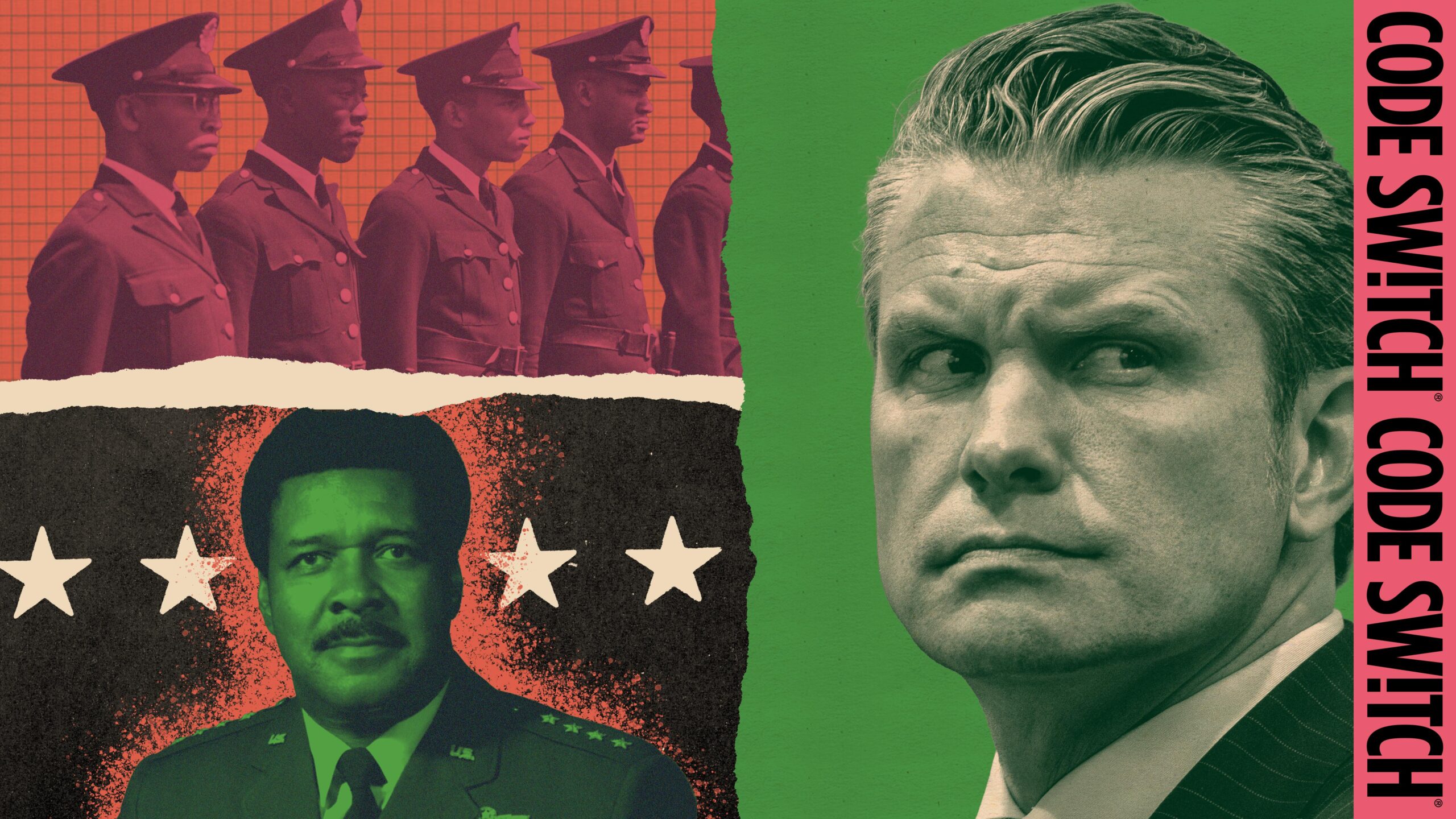
PARKER: I want to bring up an example of one of the slights that you mentioned in your article about a portrait of General Chappie James, who was the first Black four-star general who – I guess he sounds like a badass. Can you catch us up on his legacy and what happened with his portrait?
SMITH: Yeah. I mean, I think there are a lot of people who think that he was a badass, you know? I mean, he is someone who has an extensive military record. He served in World War II, served in Vietnam. He was a fighter pilot. There’s a remarkable story about him confronting who would then become the future leader of Libya, Muammar Gaddafi, when he was a young rebel taking over Libya in a coup. And there’s this moment where Gaddafi is driving a military vehicle onto this U.S. Air Force base, and Chappie James closes the gate before Muammar Gaddafi can get in. And then Muammar Gaddafi tries to pull out his gun. And Chappie James, almost in a John Wayne-esque style, pulls out his gun before and points to Gaddafi and is like, you better not move your hand or you’ll regret it. And Gaddafi slowly backs away and then drives off.
And it becomes this sort of military lore. You know, that’s – it sounds like a scene from a movie. And he would go on to become the first four-star general in the U.S. Air Force. And what’s interesting about General Chappie James is – so his portrait was taken down from the Pentagon. It was in the Air Force gallery, and it was removed from that space in the Pentagon. And many of the folks that I spoke to talked about how, when it was there, it was a source of pride, and Chappie James was in many ways a sort of aspirational figure, this feeling that this is a person who represents what is possible for Black people in the military. Like, if I do my service, if I (inaudible) someone who reaches the highest military standards, that I, too, can become a four-star general with my portrait on the wall and leave a legacy that will be remembered throughout American history.
And when it was removed, to many people, it felt as if the very possibility of ascending to the position that he occupied was also removed. And Chappie James is interesting also because he wasn’t this, like, radical liberal by any means. In many ways, he was kind of a Reagan Republican. He had very conservative political ideologies. Ronald Reagan himself really loved him and talked about what an excellent pilot he was, what a model military man he was. Even just a few years ago, Florida named a bridge after him in a bill that was signed by Ron DeSantis. And so his ideological positions, his political positions, were more closely aligned with that of the Republican Party and the current administration.
And in some ways, the fact that he was still taken down despite his political disposition was almost a sort of further slap in the face because it created this sentiment among many folks in the Pentagon and beyond that, like, man, if sharing the politics of these people, if having an exquisite military record, serving decades and decades for your country and being as Reagan said, you know, the sort of model pilot, model soldier isn’t enough, then none of us will ever be enough. And so it almost amplified that sense of despair that many people were feeling that under this administration, under this secretary, Black officers would never get the shot that they deserved.
PARKER: And noting here that we reached out to the Pentagon, and they said that two portraits of General Daniel Chappie James Jr. are currently on display at the Pentagon. They added that one of his portraits has been on loan since 2021 and has never been moved or taken down. Clint also reached out to the Pentagon for comment multiple times for his own reporting and got different answers each time. But he says that his sources sent him documentation showing that the portrait has, in fact, been removed and says he stands by his reporting.
(SOUNDBITE OF MUSIC)
PARKER: When we come back…
SMITH: Just like, man, what does it mean to go abroad and fight fascism when in many ways, you were experiencing a sort of version of fascism and domestic terrorism here in the United States?
PARKER: That’s coming up. Stay with us.
(SOUNDBITE OF MUSIC)
PARKER: Parker. Just Parker. CODE SWITCH. I’m talking to reporter Clint Smith of The Atlantic about how Black service members are faring under Pete Hegseth’s Pentagon. Clint walked us through portraits coming down, promotions being blocked, an institution telling its own people they don’t belong. So I had to ask Clint the question that kept nagging me after reading and hearing about his reporting.
All right. I think there are some people who would say this is an institution that, for decades, has displayed racism, misogyny, homophobia, transphobia. Why be a part of an institution that actively does not want them there?
SMITH: Yes, I think that is true. And what is true is that the people within the military in many ways represent the plurality and the heterogeneity of Black America, right? Like, there are people in there who themselves represent all sorts of different dispositions, positions, orientations, identities that exists within the Black identity. And I think that different folks make different decisions about what they want to be complicit in and what their theory of change is, right? Like, there are some people I spoke to who are like, I could make a decision to not be a part of this institution because of the history of imperialism, the history of militarism, the history of, as you said, sexism, racism, transphobia, homophobia. Or I could go into this institution and be a part of what helps to change it.
And their position is that if everyone who wants to make the military a better version of itself leaves, then the military will never change. And this is a thing that people have to wrestle with even beyond the context of the military, right? I mean, people have to think about this in the context of the schools they attend. People have to think about this in the context of the workplaces they operate in. People have to think about this in terms of the communities and neighborhoods they live in, the cities they’re part of.
And obviously, we’re in a moment where a lot of people feel like so much of the progress that has been made on these fronts is moving backwards. But there’s also a sense that, again, that this is a season, or as some say this is a storm or this is a fever, you know, to use these different metaphors. And this one person I spoke to said, this is a fever, and it’s going to break. But we just have to ensure that when the fever does break, we are still here to sort of put things back together.
PARKER: Is there a generational divide between how young Black service members are responding to the military’s cultural shift versus the older guard?
SMITH: You know, what’s interesting in there is, and yet it manifests itself in a particular sort of way because I think the older guard, so to speak, are people who themselves have experienced different levels and gradations of racism and discrimination throughout their time in the military. You know, I spoke to folks who joined the military in the ’60s, in the ’70s, when the military was rife with a sort of racism that was more forceful, more conspicuous, oftentimes more violent, and they remember that time.
And so what they’re experiencing and how they make sense of this moment today is informed by the decades of experience that they have had in the military and in America that has given them a sense of perspective, they might say, about what they are willing to tolerate and not. But because they often have already gotten past their 20 years, there is this feeling of, well, actually, you know, I’m going to get my check for the rest of my life because of the sacrifices I’ve made for this country.
And there’s a sort of, like, I’ve done my time, and I don’t have to subject myself to this anymore, while many of the younger folks have not necessarily experienced virulent racism in the way that one would have, maybe in the ’60s or ’70s or ’80s in the military, but they have not themselves gotten to the 20-year mark, which means you don’t get that forever check. You don’t get that pension that comes to you every month. And again, going back to the beginning of our conversation, we were talking about the practical reasons, the financial reasons, the social reasons that people often join the military. That is a huge part of it. And so for some of the younger people, they might have less tolerance, actually, than some of the older generation does.
But because of the reality of the professional position they’re in and how far into their tenure they are, sometimes – again, I can’t speak too broadly because everybody makes different decisions – sometimes, maybe oftentimes, they make a decision like, I’ma just put my head down and keep going because I just have to get through the next 2 1/2 years or however they’re thinking about it until we have a new secretary, until we have a new administration, until we are not operating in the same political context that we are today.
It’s a tricky moment for a lot of people, you know? Like, when I was having a lot of these conversations, there was a real fear that Trump was going to deploy U.S. soldiers, not even the National Guard, but, like, active military infantry to American cities – right? – to put down some of these protests that were happening. And for some people, they were like, if that happens, I’m out, right? Like, I can’t be a part of that.
And so, everybody, I think, is trying to figure out, like, what is their red line. But again, you’re weighing this against. Like, and I said this before, but I really need to emphasize, like, many of these folks who are in the military become the central financial means of stability for their entire family unit. And so your – if the calculus is not only, like, do I agree with the war in Iran or not, or do I think that I’m going to be deployed to Minneapolis or not. It’s, like, if I step away from this, am I letting down or sort of ceding my responsibility to my family who needs me and who I’m only able to support because of the professional position I’m in within the military? And so I just – again, I’m like the both/and guy, the complexity guy. But I do think…
PARKER: Yeah.
SMITH: …It’s important for people to, like, sit with the full picture.
PARKER: It really is a stress test. Whoa.
SMITH: So much of being a Black American is a stress test. Yeah.
PARKER: I’m thinking about – I don’t know if you’ve ever seen the Spike Lee film “Miracle At St. Anna.”
SMITH: I don’t think so.
PARKER: All right. Let me tell you – I mean, the movie’s got its problems, but there’s this really impactful scene where these Black soldiers are storming into battle. This is World War II, while on the other side is a voice that’s called Axis Sally on a bullhorn who is telling them you are dying for a country that does not respect you. And so it’s kind of like the opening of “Saving Private Ryan,” but they’re being told that they’re dying for naught. And I think about that in juxtaposition with, like, I think one of the people you interviewed said they’re concerned that everything they’ve done has been in vain. So those are the kind of – the dualities that I’m trying to navigate when I’m reading your article.
SMITH: Yeah. I think those are the dualities the people who are in the military are trying to navigate every day. I mean, it is true that Black Americans have, for many years, and, you know, many would argue today, fight for a country that refuses to fight for them. You know, I’ve been working on a book the last five years about World War II memory. And I’ve traveled across the world, and I’ve gone to Nagasaki and spent time with atomic bomb survivors. I’ve gone to Seoul, Korea, and spent time with women who were forced into sex slavery by the Japanese military. I’ve gone to Normandy – spent time with World War II veterans. I’ve gone to Bariloche, Argentina, to sort of chase the trail of Nazis who fled Europe after the war. I’ve been to Berlin – spent time with Holocaust survivors.
But I’ve also spent time here in the U.S. with people who were born into Japanese incarceration camps in California, with some of the surviving Navajo Code Talkers in Arizona and New Mexico on the Navajo Nation. And those two, in particular, are interesting ’cause they – I very much put them in conversation with the experience of my Uncle Lawrence, who, you know, grew up in Mississippi in a town where multiple people had been lynched during his childhood and as a 19-year-old enlisted to fight in the Army – U.S. Army during World War II.
And I – whenever I think about his story, just like, man, what does it mean to go abroad and fight fascism when, in many ways, you were experiencing a sort of version of fascism and domestic terrorism here in the United States, that you and your family and your community were subjected to, like, a constant barrage of not only disrespect, but violence, like, physical, psychological and emotional violence?
And I put that in conversation with the experience of, you know, Japanese Americans who went and fought for the United States during World War II, while their families were locked in open-air prison camps. I think about the Navajo Code Talkers who went and used their language as a secret code to transmit messages in the Pacific, when just a few years before they had been put in boarding schools to try to extract that language from that culture, and they were asked to use that very language to fight on behalf of this country. And so I say that because the experience of Black Americans in that regard is not necessarily unique.
Like many people who have experienced racism in this country, thinking particularly of those two groups, have conceived of a way to, like, fight for a country that not only doesn’t fight for them, but that actively subjugates and oppress them. And again, within those communities, there are differing positions. Some within the Navajo community are like, why would I ever go do that? Like, why would I ever go fight for this country when this country has for generations extracted my language, my culture and physically removed my family from our land? Japanese Americans were like, why would I go fight for a country that is keeping my family in a prison camp?
And then, at the same time, there are some who believe that, in fact, this is a way to demonstrate our commitment to America, and maybe, again, not America as it is today, but America as it can be. America as it aspires to be, you know, as Dr. King writes about the Constitution, talking about it as a promissory note – right? – that this promise of what America can be is the thing that we are moving toward, even when the country itself seems as if it is serving as the obstacle to us getting there. So, yeah, it’s hard and it’s complex, and people can be of two minds and often are, you know? But I think that complexity and that duality and that cognitive dissonance is worth sitting with because it reflects the really difficult nature of these questions.
PARKER: I don’t know. We’ve been aspiring for 250 years, Clint.
SMITH: I hear it.
PARKER: I’m ready for a result.
SMITH: I hear it.
(SOUNDBITE OF MUSIC)
PARKER: Clint Smith, thank you very much for talking with me.
SMITH: Thank you. It’s been a pleasure.
(SOUNDBITE OF MUSIC)
PARKER: And that’s our show. CODE SWITCH has a newsletter, and it’s pretty good, if I do say so myself. You should sign up for it at npr.org/codeswitchnewsletter.
This episode was produced by Jess Kung. It was edited by Courtney Stein. Our engineer was on Annlie Huang and a big shout-out to the rest of the CODE SWITCH massive – Cristina Cala, Xavier Lopez, Leah Donnella, Dalia Mortada, Maya Dangerfield, Barton Girdwood, Yolanda Sangweni and Gene Demby. And I’m B.A. Parker. Hydrate.
(SOUNDBITE OF MUSIC)