The last time Georgelyss Montes saw her best friend, Angelo Mejía Meléndez, was four years ago, at a goodbye party before he left for the U.S.
“We were like, ‘You are stupid for leaving us!” she joked.
Last week, she got word he was coming home, unexpectedly, as a deportee. Mejía Meléndez was one of 146 Venezuelan nationals who landed in Caracas after being deported from the U.S. on Wednesday.
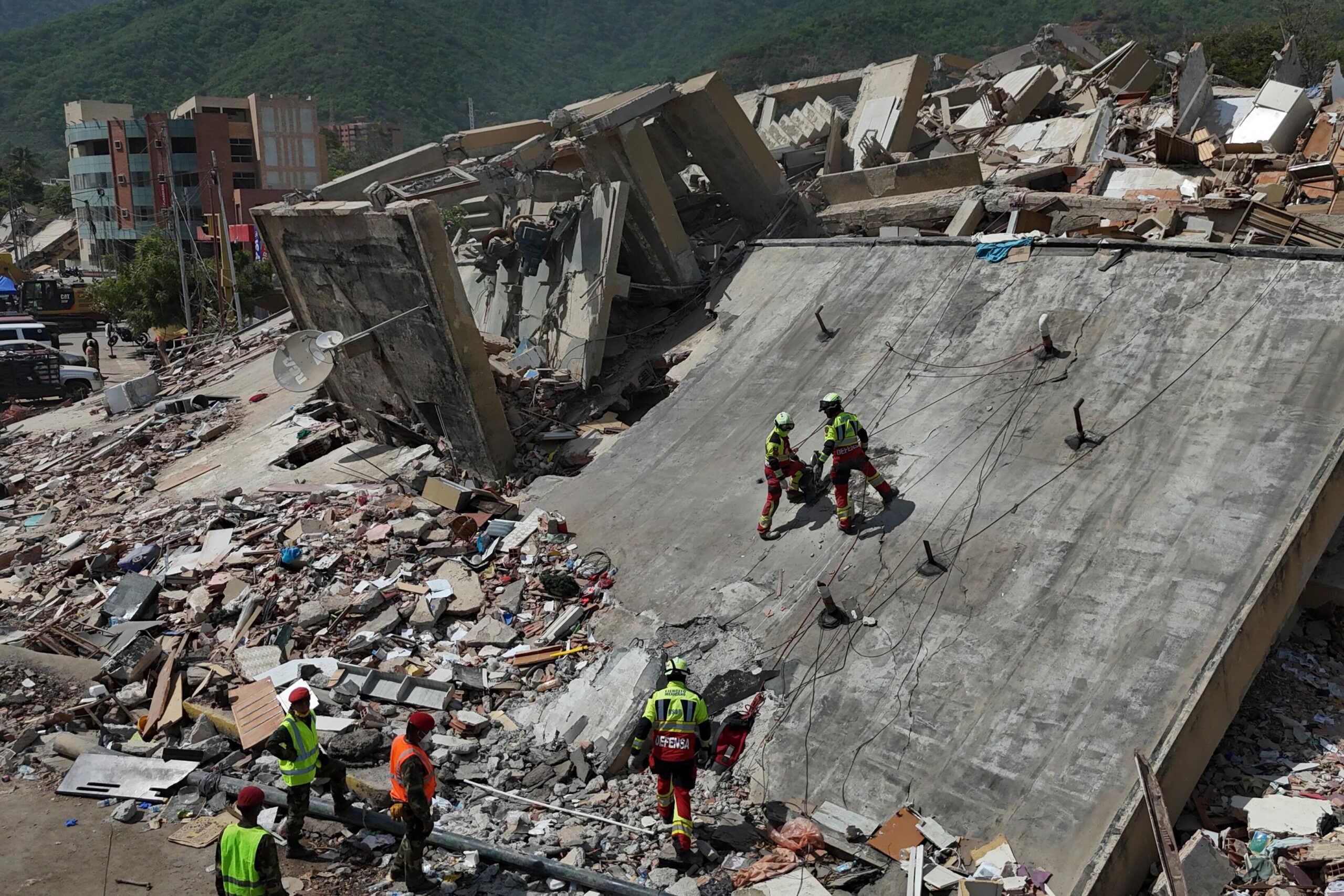
Passengers on that plane, which included women and children, were being processed in a guarded hotel in La Guaira when powerful twin earthquakes struck, according to family members. The building they were in pancaked.

The family of Mejía Meléndez had planned to celebrate with him once back home. Instead, they had to spend days searching hospitals and morgues. Ultimately, they identified his body by a distinctive pizza tattoo on his arm.
“We grew up together,” Montes said. “It’s so hard.”
Mejía Meléndez was building a life in Miami. He worked at a pier. He was happy to be in the city, near the ocean. In a recent voice note to his mom, Mejía Meléndez told her how much he loved her. He also shared that his bosses had bought a new Jet Ski, and that they named it after him.
“They told me I was doing a good job, that they loved me — things are going well!” he told his mother. “I love you so much — if I were to be born again, I would want you to be my mother.”
Hoping for a sign of life
Of the 146 deportees aboard that flight, there are conflicting accounts of how many survived the earthquakes.
The Venezuelan agency in charge of transporting the deportees declined to tell NPR how many have survived. In a message through WhatsApp to NPR, the agency said families have been informed of the status of their loved ones — a statement some family members dispute.

Alonso Guanipa Toyo told NPR his brother, 32-year-old Víctor, is among the missing deportees.
“The government is not doing anything,” Alonso Guanipa Toyo said. “My family is looking for him in the hospitals, in the shelters, in the morgues.”
He said his brother appeared to be in a hospital, according to a database he searched. But as of Monday, Víctor had yet to be found.
Alonso Guanipa Toyo said he believes there are deportees alive under the rubble.
“If there’s not a corpse, there’s no dead (person),” Alonso Guanipa Toyo said.
His brother Víctor lived in Pecos, Texas, where he worked in construction during the day and as a rideshare driver at night.
“My brother was very humble,” Alonso Guanipa Toyo said.
Víctor was detained by immigration authorities in Texas on June 12. He and his wife were at a nightclub when they were picked up.
Alonso Guanipa Toyo said his brother had no criminal record and was in the U.S. legally.
Alonso Guanipa Toyo said the first thing he did when he heard the news of the earthquakes was look up the building where the deportees were.
“I saw the building had collapsed,” he said.
Still, he said his family continues to search for Víctor.
The unexpected result of a deportation
It’s unclear whether the Trump administration will continue to deport Venezuelans post-earthquakes. The Department of Homeland Security did not respond to a request for comment from NPR.
That angers Oswadeliz Nuñez, whose son Daniel Núñez remains missing after being deported.

“Venezuelans are not animals,” she said. “They are humans, not criminals. My son paid taxes.”
For almost five years, Daniel had been living in Jacksonville, Fla., where he worked in construction. Oswadeliz Nuñez says her son’s only crimes were crossing the border illegally and a misdemeanor for driving without a license.
He was arrested by immigration authorities on his way to work in May.
“My biggest hope is that my son is alive,” she said.
She said she briefly talked to him on the phone before the earthquakes struck. Daniel told her he had landed in Venezuela and was being processed.
“In those four minutes he told me a lot of things — that we were going to live in Venezuela together, that we were going to keep going,” she said. “That happiness lasted 30 minutes.”
Nearly a week later, Oswadeliz Nuñez says, “I don’t have any more strength.”
“At this point, we need help getting their bodies from under the rubble,” she said. “We need their bodies.”
Transcript:
SCOTT DETROW, HOST:
Dozens of Venezuelans were deported from the U.S. to Caracas on June 24, the same day two devastating earthquakes struck. Many of the people deported were among the nearly 2,000 killed by the tremors and that death toll is expected to climb. NPR’s Sergio Martínez-Beltrán reports on the deportees’ fate.
SERGIO MARTÍNEZ-BELTRÁN, BYLINE: So the last time Georgelyss Montes saw her best friend, Angelo Mejia Melendez, was four years ago. Mejia Melendez was leaving for the U.S. and Montes and other friends were sending him off.
GEORGELYSS MONTES: (Speaking Spanish).
MARTÍNEZ-BELTRÁN: “I remember we got so drunk. I told him, you’re stupid for leaving us.”
Last week, Montes got word that Mejia Melendez was coming home unexpectedly as a deportee. Mejia Melendez was one of 146 Venezuelan nationals who landed in Caracas on the morning of June 24 after being deported from the U.S. Passengers on that plane included women and children. They were being processed that afternoon in a hotel in La Guaira when powerful twin earthquakes struck, according to family members. The building they were in pancaked.
MONTES: (Speaking Spanish).
MARTÍNEZ-BELTRÁN: “It’s impressive. There’s nothing left. It’s horrible,” Montes says. She and Mejia Melendez’s family had planned to celebrate with him once he was back home. Instead, they had to spend days searching hospitals and morgues. Ultimately, they identified his body by a distinctive pizza tattoo on his arm. Of the 146 deportees aboard that flight, there are conflicting accounts about how many survived the earthquakes. The Venezuelan agency in charge of transporting the deportees tells NPR through WhatsApp it has notified each family of the status of their loved ones, a statement some parents and friends dispute. Alonso Guanipa Toyo tells NPR his brother, 32-year-old Victor, is among the missing deportees.
ALONSO GUANIPA TOYO: (Speaking Spanish).
MARTÍNEZ-BELTRÁN: “The Venezuelan government is not doing anything,” he says.
TOYO: (Speaking Spanish).
MARTÍNEZ-BELTRÁN: “My family is the one looking for Victor in the hospitals, in the shelters, in the morgues.” Guanipa Toyo says his brother Victor appeared to be in a hospital according to a database he searched. But as of Monday, Victor had yet to be found. Guanipa Toyo says he believes there are deportees alive under the rubble.
TOYO: (Speaking Spanish).
MARTÍNEZ-BELTRÁN: “If there’s not a corpse, there’s no dead person,” Guanipa Toyo says. His brother Victor lived in Pecos, Texas, where he worked in construction during the day and as a rideshare driver at night. Victor was detained by immigration authorities in a Texas nightclub on June 12. Guanipa Toyo says his brother had no criminal record and was in the U.S. legally. He’s angry at the Venezuelan government and the U.S. government.
TOYO: (Speaking Spanish).
MARTÍNEZ-BELTRÁN: “ICE continues to arrest people and deport them knowing what’s happening there in Venezuela,” he says.
The Department of Homeland Security did not respond to questions from NPR on whether it will continue deporting Venezuelans after the earthquakes. That has angered family members who say Venezuelans are not criminals and that their death could have been prevented if they had not been deported on June 24. But there’s not much time left. It’s been nearly a week since the earthquakes. The families of the missing continue to race to recover the bodies of their loved ones. Others hope for a miracle. For those who had confirmation of the death of their loved ones, they are left with memories. Georgelyss Montes has been listening to a voice note her best friend, Angelo Mejia Melendez, sent to his mom recently.
(SOUNDBITE OF ARCHIVED RECORDING)
ANGELO MEJIA MELENDEZ: (Speaking Spanish).
MARTÍNEZ-BELTRÁN: “What’s up, Mom? How are you?”
(SOUNDBITE OF ARCHIVED RECORDING)
MELENDEZ: (Speaking Spanish).
MARTÍNEZ-BELTRÁN: “Today at work, I got a surprise. The bosses bought a jet ski, and they named it after me. They said I’m doing a good job, and they said they loved me.”
(SOUNDBITE OF ARCHIVED RECORDING)
MELENDEZ: (Speaking Spanish).
MARTÍNEZ-BELTRÁN: “Mom, I love you so much. If I were born again, I would want you to be my mother again. I love you. Thank you for what you have done for me.”
Sergio Martínez-Beltrán, NPR News.
(SOUNDBITE OF MUSIC)