Transcript:
JUANA SUMMERS, HOST:
It’s CONSIDER THIS, where every day we go deep on one big news story. Today, a public stake in the country’s largest AI companies. The U.S. economy’s future is being shaped right now by AI, and a handful of people are reaping the benefits with little oversight.
BERNIE SANDERS: The average American understands that AI is going to have a profound impact on his or her life, and yet as of today, there has not been one significant piece of legislation passed to regulate AI.
SUMMERS: That is independent U.S. Senator Bernie Sanders, and he wants to change that. His solution? A sovereign wealth fund financed by the AI industry – the top AI companies would be subject to a one-time 50% tax on their stocks. And that could send every American a $1,000 check, and…
SANDERS: The public would have 50% representation on every major AI company, and that means that these billionaires who now control the industry want to do something that will be harmful to the American people – the people representing the public will say, sorry, you can’t do that.
(SOUNDBITE OF MUSIC)
SUMMERS: CONSIDER THIS – only a handful of people are benefiting from the AI boom. Could a sovereign wealth fund level the playing field?
(SOUNDBITE OF MUSIC)
SUMMERS: From NPR, I’m Juana Summers.
(SOUNDBITE OF MUSIC)
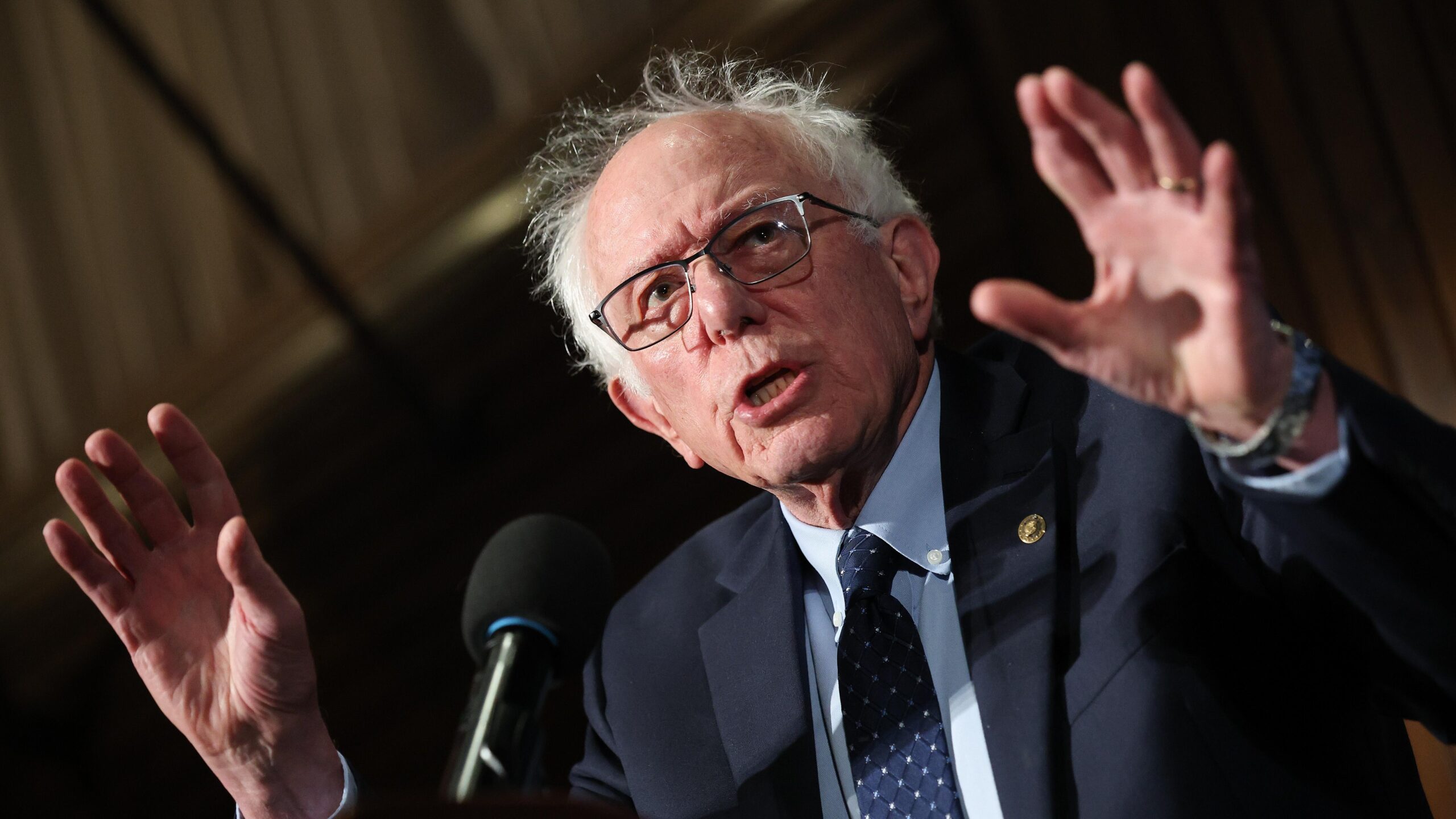
SUMMERS: It’s CONSIDER THIS FROM NPR. A small number of people have made billions from AI and control the future of this groundbreaking technology. While a large number of people have growing unease about AI’s impact on the American workforce, they have little say in that matter. Senator Bernie Sanders wants to change that. His proposed legislation would create what he is calling an AI sovereign wealth fund. Bernie Sanders, independent senator from Vermont, joins us now.
SANDERS: Thanks very much for having me.
SUMMERS: Thanks for being here. OK. I just want to start by asking you, what types of scenarios do you foresee that led you to write this legislation?
SANDERS: I’ll tell you why. I got involved in this whole issue of AI because it is clear to me that AI is going to be the most transformational technology in the history of humanity. It will dwarf what the Industrial Revolution did. It’s going to move very, very quickly. It will impact our economy and perhaps lead to the loss of tens of millions of jobs over the next decade. It’s going to have a huge impact in devastating privacy rights – your healthcare records, your banking records, etc., etc. It is going to have a deleterious impact on the mental health of our kids. It’s going to impact our democracy. Right now, you’re already seeing deepfakes. And by the way, there’s the existential threat that as AI becomes smarter than humans, become independent and lead to catastrophic impacts.
SUMMERS: Yeah. That’s a long list there. Now, your office has calculated that a 50% tax on the top AI companies’ stock means at today’s rates, a fund could send a $1,000 check to every American each year. Now, $1,000 is not anything to sneeze at, but if AI does permanently change our economy, how much would that help?
SANDERS: Well, the more important point is that the public would have 50% representation on every major AI company. That’s the more important point, actually. And that means that when Mr. Musk and Mr. Bezos and these billionaires who now control the industry want to do something that will be harmful to the American people, the people representing the public will say, sorry, you can’t do that. And we have got to work to make sure that AI and robotics work for all of us, not just to enrich people who are already incredibly wealthy and powerful.
SUMMERS: That kind of proposal sounds like something that might be a pretty hard sell for some of the leaders of the leading AI companies. What have you heard from them?
SANDERS: Well, I’m not talking to the leaders of the AI companies. We’re talking to the American people. And here is a very important aspect of this whole discussion, and that is – the foundations of AI is based on human knowledge and human labor. This discussion that we’re having will become part of AI. Every book that somebody has written, every work in mathematics, every poet becomes part of AI. And the people themselves who have built AI – if you like – through their knowledge and work, they deserve the benefits of that. So it’s not what the billionaire CEOs want. It’s what the American people want.
SUMMERS: I do want to ask you about one of those CEOs because according to The Associated Press, you did meet with the CEO of OpenAI, Sam Altman, for about an hour in private at your Senate office earlier this month. Did you talk to him about this idea, and what did he think of it?
SANDERS: He was not enthusiastic about this idea, to tell you the truth, but – not surprisingly, nor are any of the major CEO executives. They have enormous wealth now. They have enormous power, and they want more. And the idea that the American people will be able to say no to some of their harmful projects is not something they are sympathetic to. On the contrary, though, the American people, I think, think it’s a very good idea.
SUMMERS: Now, President Trump has talked about how he wants to start a sovereign wealth fund for the U.S., like ones in Saudi Arabia, China and Norway. Is President Trump a potential ally for you on this legislation?
SANDERS: I doubt it very much. I mean, Trump is actually a good politician. I mean, he’s a terrible president, but he’s a good politician. He knows where people are at. And I think what he’s seeing is what a lot of people are seeing. The American people are angry. They’re tired of getting ripped off. They don’t want to see all this wealth go to a handful of billionaires. And Trump is saying, hey, maybe we can get some of that. But what we are talking about is something very different. We are talking about giving the American people the ability to help control the future of AI so that it works for the public good, not just to benefit the very, very wealthy.
SUMMERS: Have you spoken to the president about this issue?
SANDERS: No. I have not.
SUMMERS: I know that there are a number of pieces of draft legislation floating around the Hill that seek to regulate AI. For example, there’s a bipartisan bill called the Great American AI Act. There are some tax ideas from Senator Elizabeth Warren as well as others. What makes your bill – what makes this bill the right approach?
SANDERS: Well, I think it’s more comprehensive than other bills. But I would say this – and here is really a remarkable reality – the average American understands that AI is going to have a profound impact on his or her life and the lives of kids. And yet as of today, there has not been one significant piece of legislation passed to regulate AI. And why is that? It speaks to the corrupt campaign finance system that we have and the fact that AI can spend as much money as they want. We’re talking about hundreds and hundreds of millions of dollars they’re going to spend right now in this coming election to make sure that we do not have members of Congress who are going to protect the American people regarding this industry. And that’s a sad state of affairs. So that’s a whole other issue in terms of reforming a corrupt campaign finance system that we’ve got to work on.
SUMMERS: Just thinking about the legislative road here, do you see a path that legislation like this can actually become law, can actually make its way through both chambers of Congress?
SANDERS: Yes, I do. But it will have to start at the grassroots level, and I think there are candidates all over this country who are in agreement with me. A number of months ago, as you may recall, we introduced a legislation calling for a moratorium on data centers. Initially, did not have much support. Now you’re seeing two states’ legislatures passing it, hundreds of communities moving forward. It’s not going to be done by members of Congress who are owned by the AI industry. It will be done when the American people start electing people who are going to stand up and represent the average person and not just the CEOs of large corporations.
SUMMERS: Senator, we began our conversation by talking about a number of the ills and anxieties and concerns that you and others have about AI. I want to ask you this – do you ever wish that AI had never been created?
SANDERS: I am very worried about it. I think AI has real benefits in terms of healthcare and other areas. It’s a very, very powerful tool. But I worry. I do worry very, very much. So the bottom line is not whether AI is going to exist or not exist, or it’s – whether it’s going to go forward or not. The question is how we can make sure that it works in a positive way. If we can lower the work week and increase people’s salaries, if we can improve people’s health, if we can figure out a way to use AI to address the crisis of climate change – that’s positive stuff. But that’s what we’ve got to do. We got to make sure that AI works for everybody and the common good, not just to make the richest people in the world even richer and more powerful.
SUMMERS: Senator Bernie Sanders, independent from Vermont. Thanks so much for your time.
SANDERS: Thank you very much. Take care.
(SOUNDBITE OF MUSIC)
SUMMERS: This episode was produced by Christopher Harland-Dunaway and Tyler Bartlam. It was edited by Sarah Handel and Tinbete Ermyas. Our interim executive producer is Courtney Dorning.
(SOUNDBITE OF MUSIC)
SUMMERS: It’s CONSIDER THIS FROM NPR. I’m Juana Summers.